TWD Forecast: Trends, 5 Drivers & Best Exchange Timing

New Taiwan Dollar Forecast: Complete Analysis of TWD Trends, Master the Five Reasons for Appreciation and the Timing of Currency Exchange
Recently, TWD exchange rates have fluctuated significantly. Whether you are a traveler preparing to go abroad, an investor with financial planning needs, or a business owner concerned about Taiwan’s economy, you are likely very interested in the future direction of the New Taiwan dollar. Will the TWD appreciate or depreciate? Is now a good time to exchange for US dollars? This article provides a comprehensive forecast of the New Taiwan dollar, from a full analysis of TWD trends to an in depth discussion of the underlying reasons for TWD appreciation, helping you make the most informed decisions in the unpredictable foreign exchange market.
Recent Review of New Taiwan Dollar Trends: Appreciation or Depreciation?
To predict the future, we must first review the past. The exchange rate of the New Taiwan dollar does not follow a simple linear path but reflects a dynamic balance influenced by multiple factors. Understanding recent price behavior forms the basis for further analysis.
Changes in the TWD Exchange Rate Over the Past Year and Interpretation
Looking back over the past year, the exchange rate of the New Taiwan dollar against the US dollar has generally fluctuated within the range of 31.5 to 32.8. At the beginning of the year, expectations of a global economic slowdown and the strength of the US dollar placed pressure on the TWD. However, as Taiwan’s exports, particularly the semiconductor industry, performed better than expected and foreign capital returned to the Taiwan stock market during certain periods, strong support was provided for the TWD. The chart (a chart should appear here) shows that whenever key support or resistance levels were reached, the market displayed clear buying or selling pressure, reflecting the psychological expectations of market participants at specific price levels.
Comparison of TWD Performance Among Major Asian Currencies
Across Asia, the TWD has performed relatively steadily. Compared with the highly volatile Japanese yen or Korean won, the New Taiwan dollar has demonstrated strong resilience. This is largely due to Taiwan’s solid economic fundamentals and substantial foreign exchange reserves. Nevertheless, the TWD cannot fully detach from regional currency movements. When the Chinese yuan weakens due to economic data from China, the New Taiwan dollar is often affected to a certain extent. Overall, the TWD can be considered a “strong performer” among Asian currencies, but developments in surrounding markets still require close attention.
Five Key Factors Influencing TWD Trends
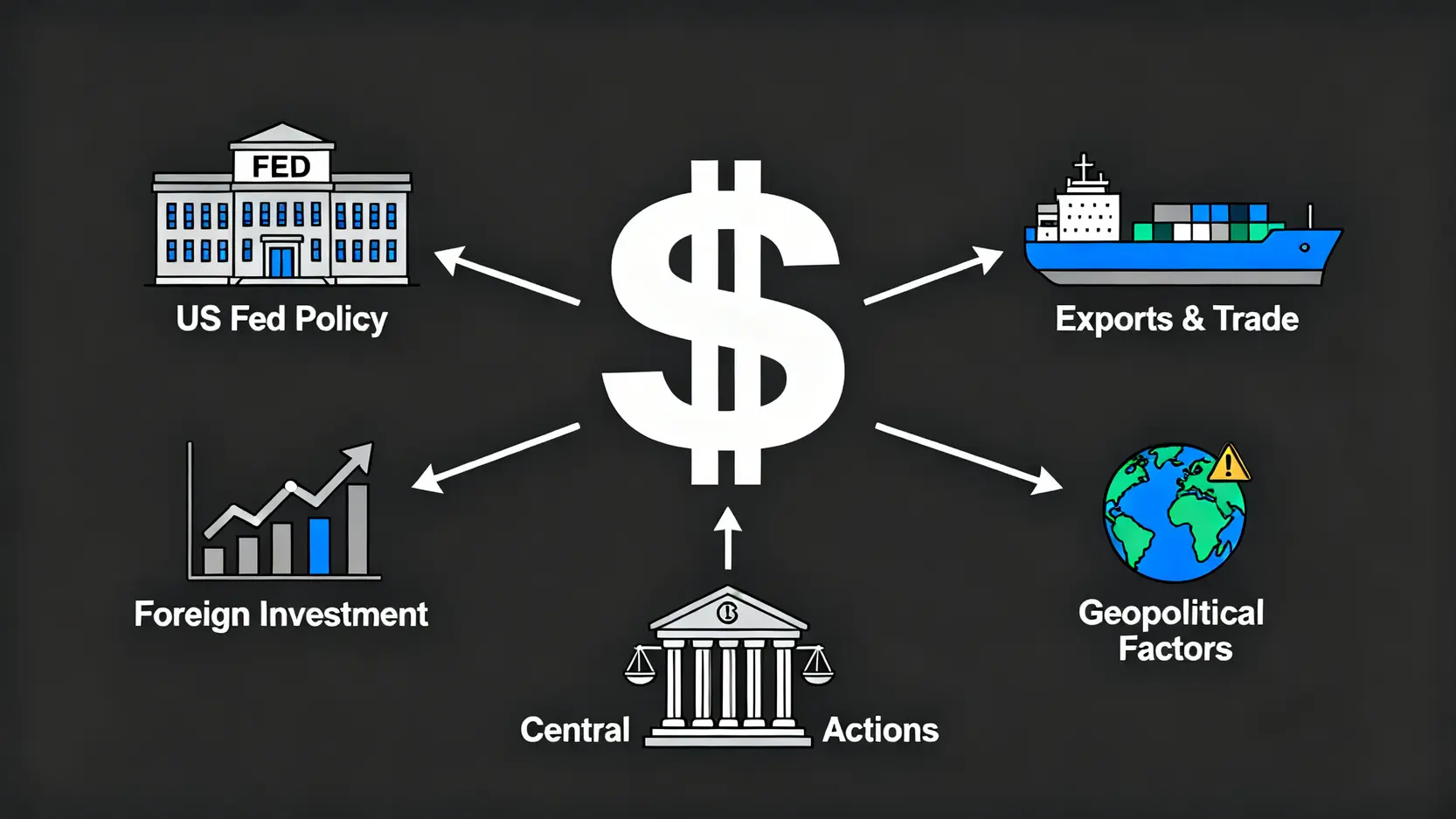
The exchange rate of the New Taiwan dollar is like a ship sailing across the ocean, with its direction determined by multiple forces. To conduct accurate TWD trend analysis, it is necessary to understand these core driving factors.

Reason One: US Federal Reserve Interest Rate Policy and the Strength of the US Dollar Index
The “dominant force” in global financial markets is undoubtedly the US dollar. Any signal from the US Federal Reserve directly affects the strength of the dollar and consequently impacts all non US currencies. When the Fed raises interest rates to combat inflation, capital flows into higher yielding US dollar assets, pushing up the US Dollar Index (DXY) and causing currencies such as the TWD to depreciate relatively. Conversely, if the Fed signals potential rate cuts and the dollar weakens, it supports appreciation of the TWD. Therefore, paying attention to Fed meeting minutes and official statements is the first step in assessing the direction of the TWD.
Reason Two: Taiwan’s Export Performance and Trade Surplus
Taiwan is a typical export driven economy, and its trade surplus (where exports exceed imports) forms the foundation supporting the TWD exchange rate. In particular, electronic components and information and communication technology products account for a large portion of exports. When these industries perform strongly, exporters earn substantial foreign currency, primarily US dollars, and convert them into New Taiwan dollars to pay salaries and operating expenses. This large scale conversion demand naturally pushes up the value of the TWD. Observing monthly export data and trade surplus figures is an important indicator of the strength of the TWD’s fundamentals.
Reason Three: Net Inflows of Foreign Capital and the Linkage With the Taiwan Stock Market
The movement of foreign capital is the most direct and powerful factor influencing short term TWD fluctuations. Whether international hot money favors the Taiwan stock market often determines short term exchange rate direction. When foreign investors are optimistic about Taiwan stocks, they bring large amounts of US dollars into Taiwan, convert them into TWD, and invest in equities. This process increases demand for the TWD and drives appreciation. This is why we often observe situations where “both stocks and the currency rise together or decline together”. Monitoring daily net buying or selling by foreign investors can effectively capture shifts in market sentiment.
Reason Four: Central Bank Interest Rate Decisions and Intervention Measures
As the “steering authority” of the exchange rate market, the position of Taiwan’s central bank is crucial. The central bank’s main objective is to maintain financial market stability rather than target a specific exchange rate level. When the TWD appreciates too quickly and threatens export competitiveness, the central bank may enter the market to buy US dollars and release TWD to moderate the appreciation. This is known as “countercyclical intervention”. In addition, the central bank’s own interest rate decisions affect the attractiveness of the TWD. If the central bank raises rates, it can attract capital inflows and support the currency. Understanding the central bank’s monetary policy provides a more comprehensive perspective when forecasting potential exchange rate ranges.
Further Reading (Highly Recommended)
Reason Five: Geopolitical Risks and the Global Economic Outlook
Geopolitical risks, particularly tensions across the Taiwan Strait, represent a major variable affecting foreign investor confidence. Any unexpected development may trigger risk aversion and capital outflows, placing depreciation pressure on the TWD. In addition, the overall health of the global economy indirectly affects Taiwan. If the global economy enters recession, demand for Taiwan manufactured products may decline, impacting export performance and ultimately influencing TWD trends.
2026 New Taiwan Dollar Forecast: How Do Major Institutions View the Outlook?
Considering the factors above, market views on the future of the New Taiwan dollar are mixed between bullish and bearish perspectives. The following summarizes the mainstream views of domestic and international financial institutions as well as potential positive and negative factors.
Summary of Views From Domestic and International Experts and Financial Institutions
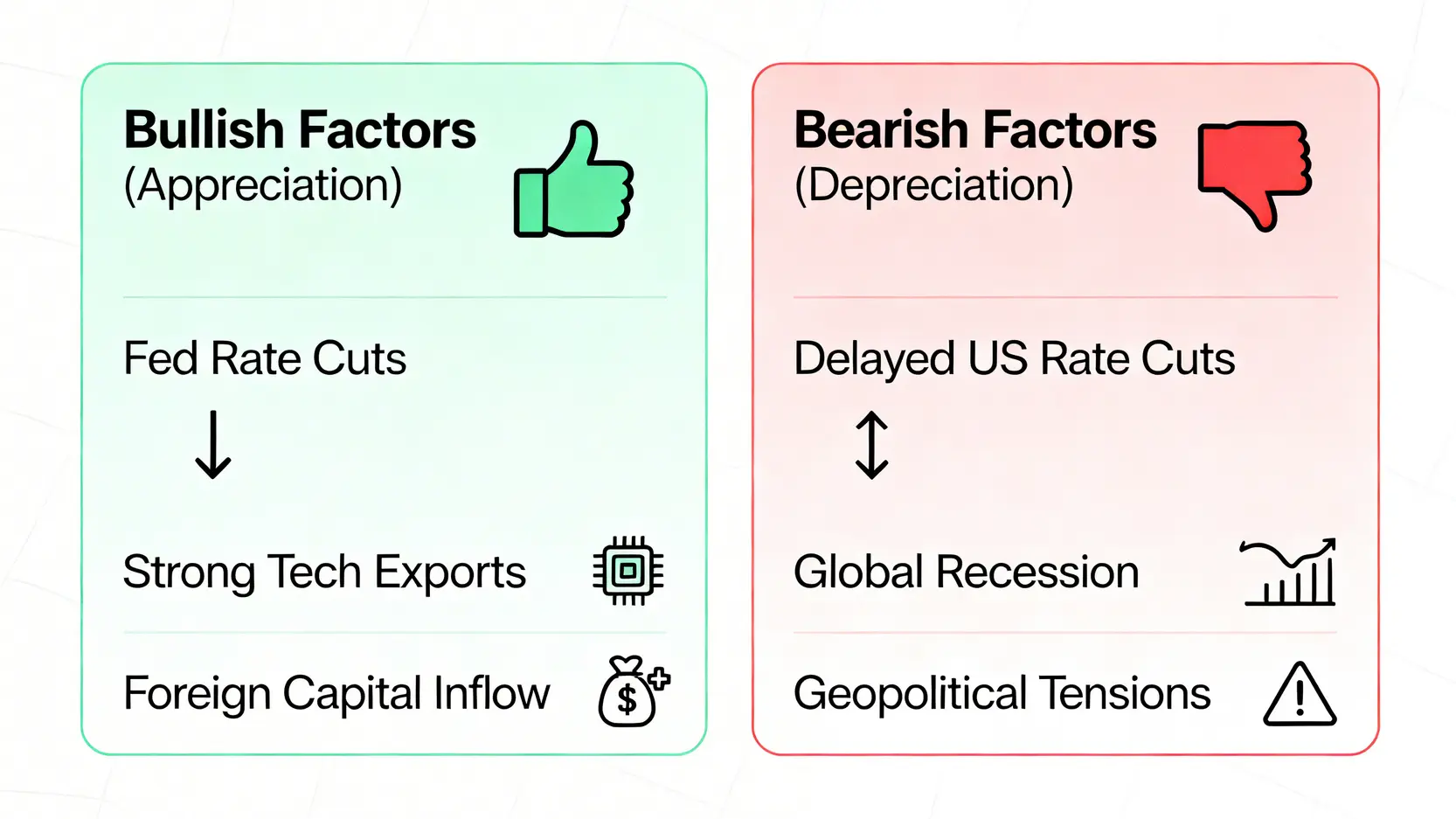
Most institutions believe that in 2026 the New Taiwan dollar will exhibit a pattern of range bound “fluctuations with a slight upward bias”. The main reason is the expectation that the US Federal Reserve may begin a rate cutting cycle in the second half of the year, which could cause the US Dollar Index to retreat from its highs. At the same time, with the rapid development of global AI technology applications, Taiwan’s semiconductor industry chain is expected to continue benefiting, and strong exports may provide solid support for the TWD. However, some experts caution that uncertainties such as weaker than expected global economic recovery and rising geopolitical risks may limit the appreciation potential of the TWD. Most forecasts place the exchange rate range between 30.5 and 32.5.
Analysis of Potential Positive and Negative Factors

How Should I Respond to Future TWD Trends?
After understanding the influencing factors and future forecasts, the more important step is converting this information into practical strategies. Whether you are a business owner or an individual investor, appropriate measures can be taken to manage exchange rate risk.
Hedging Suggestions for Exporters
For exporters, TWD appreciation means that the US dollar revenue they receive converts into fewer New Taiwan dollars, reducing profit margins. The following tools can be used for hedging:
- Forward foreign exchange contracts: agree with a bank to settle US dollars at a fixed exchange rate at a future date, thereby locking in profits in advance.
- Foreign exchange options: purchasing options gives you the “right” to buy or sell foreign currency at a specified price in the future, providing greater flexibility.
- Increase non US dollar quotations: where possible, increase pricing and settlement in other currencies such as euros or Japanese yen to diversify single currency risk.
For Investors: Is Now a Good Time to Buy US Dollars?
There is no single correct answer to this question, as it depends on your needs and objectives. The following perspectives may help guide your thinking.
- For those with actual needs (such as studying abroad or travel): if you have a clear demand for US dollars within the next three to six months, it is recommended to adopt a “phased buying strategy”. For example, set psychological levels such as 32.5, 32.2, and 32.0, and exchange a portion whenever the rate reaches those levels, averaging the cost and avoiding the risk of exchanging everything at the highest point.
- For asset allocation: allocating part of your funds to US dollar assets (such as USD time deposits, US stocks, or US Treasury bonds) is a good way to diversify risk. Compared with short term exchange rate fluctuations, greater attention should be given to the long term growth potential of the assets.
- For those seeking to profit from exchange rate differences: forecasting exchange rates is extremely difficult. It is not recommended that ordinary investors commit substantial capital to exchange rate speculation. If you are interested, it is advisable to participate with a small amount of capital and set clear stop loss levels.
Conclusion
In summary, to accurately forecast the future of the New Taiwan dollar, it is essential to comprehensively consider multiple factors, including international economic conditions (strength of the US dollar), domestic fundamentals (exports and foreign capital), and central bank policies. This is a dynamic and complex system, and no single indicator can provide an absolute answer. Through the TWD trend analysis and discussion of the reasons for TWD appreciation in this article, it is hoped that you can build a clear analytical framework, enabling you to make more confident and optimal decisions, whether in corporate hedging strategies or personal asset planning.
Common Questions About New Taiwan Dollar Trends (FAQ)
Q: How does TWD appreciation affect the daily life of the general public?
A: The benefits of TWD appreciation include cheaper imported goods (such as international brand apparel and automobiles) as well as lower costs for overseas travel or study. The drawbacks include potential negative impacts on export oriented industries, affecting the income of related workers, and disadvantages for individuals earning US dollars abroad.
Q: What is the central bank’s “Willow Theory”?
A: This is an exchange rate management philosophy proposed by former central bank governor Perng Fai-nan. It means that the central bank’s intervention behaves like a willow tree, swaying in the direction of market forces but moderating the extent of movement through intervention. The objective is to maintain market order and stability rather than reverse long term trends. Simply put, it aims to “stabilize the exchange rate without going against the trend”.
Q: Besides the US dollar, which other foreign currencies are worth paying attention to?
A: For individuals with travel needs or asset diversification goals, the following currencies may be worth considering: 1. Japanese yen (JPY): if it remains relatively weak due to Bank of Japan policies, it benefits those who favor Japanese culture. 2. Australian dollar (AUD) and New Zealand dollar (NZD): As commodity currencies, their movements are closely linked to global raw material prices and can serve as indicators of global economic conditions. 3. Euro (EUR): as the world’s second largest reserve currency, it often moves inversely to the US dollar.
Q: What is the most important single factor influencing TWD trends?
A: Although all factors are important, in the short term, “foreign capital flows” and the “US Dollar Index” have the most direct and significant impact. Large-scale capital inflows or outflows by foreign investors can change the market supply and demand balance in a short period, and as the global pricing currency, the strength or weakness of the US dollar is the “fundamental premise” for the movements of all non-US currencies.
Related Articles
-
Complete Guide to Virtual Asset Trading Platform (VASP) License Applications: A 2026 Hong Kong Web3 Compliance Practical Guide At the pivotal moment of 2026, as global financial digitization accelerates at an unprecedented pace, Hong Kong has firmly established itself as a leading Web3 compliance hub in Asia and around the...2026 年 6 月 3 日
-
2026 Offshore Renminbi Range-Bound Arbitrage Trading Guide: Mastering the CNH-CNY Spread and a Profit Guide to Hedging Through Two-Way Volatility Against the combined influence of global macroeconomic developments and international trade policies, the foreign exchange market in 2026 has become increasingly complex. The Renminbi exchange rate often exhibits a pattern...2026 年 6 月 3 日
-
Friday Taiwan Index Options Buyer Strategies: Precisely Capturing Explosive Market Moves From Non-Farm Payroll Data Many investors often complain that options buyers have low win rates, frequently predicting the direction correctly but ultimately losing to time decay. However, under the new dual-settlement system, short-term volatility and event-driven trading have created...2026 年 6 月 3 日