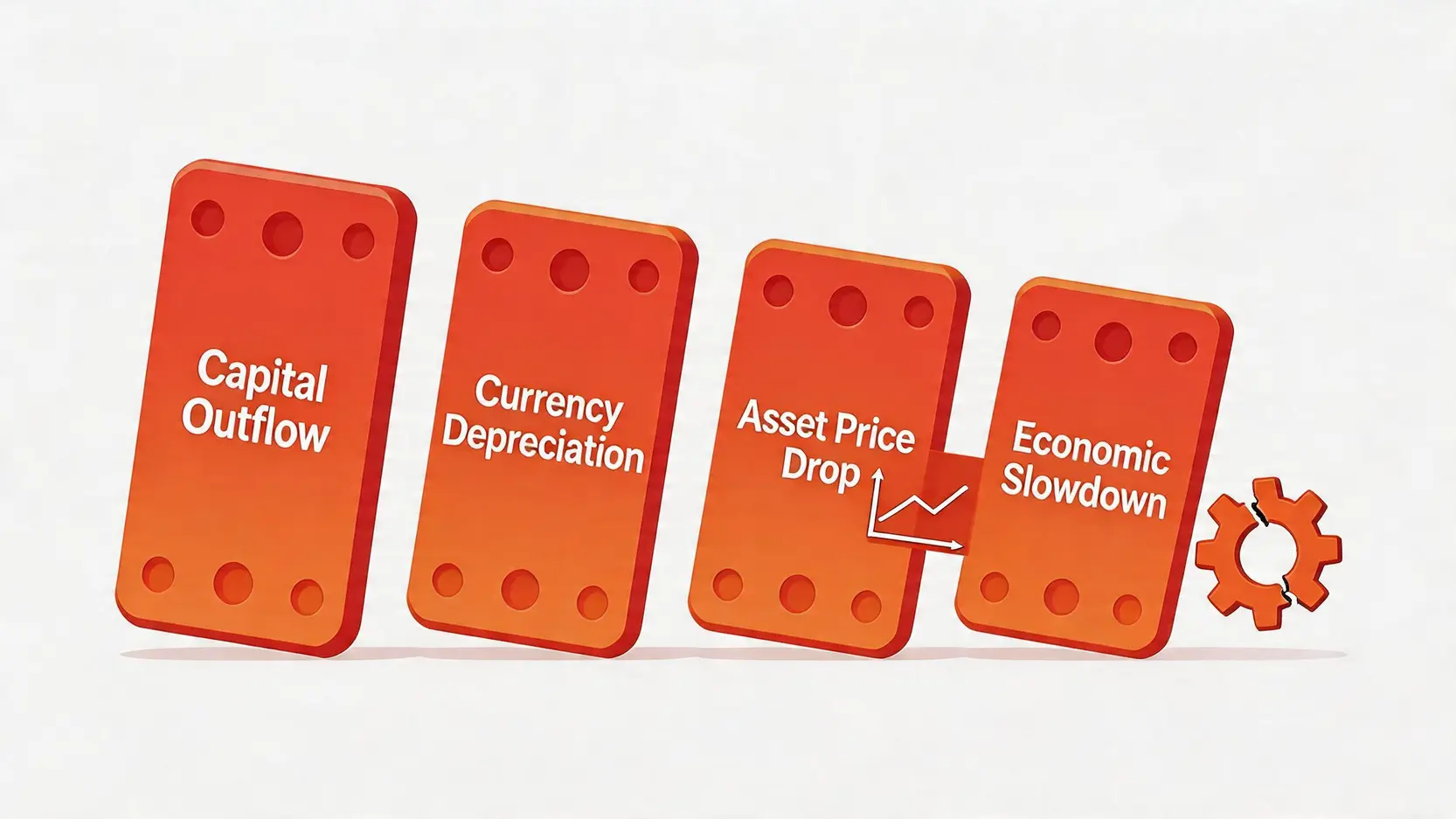
Chain Reactions Triggered by Capital Outflows
Sharp Currency Depreciation and Imported Inflation Pressure
The most immediate and severe impact is reflected in the foreign exchange market. When large amounts of foreign capital sell local currency and convert it into US dollars to exit, the local currency comes under significant depreciation pressure. Currency depreciation means that the prices of imported goods and services rise (because more local currency is required to purchase them), triggering “imported inflation”. This leads to a sharp increase in living costs and further undermines economic stability.
Declining Stock and Bond Markets, Significant Asset Value Erosion
Foreign capital is often a key participant in emerging market equity and bond markets. When it withdraws collectively, it creates massive selling pressure in the market, causing both stock and bond prices to fall. This not only significantly erodes the wealth of local investors but also wipes out corporate market capitalization, severely damaging overall confidence in the financial markets.
Rising Corporate Financing Costs and Risks of Real Economic Recession
To prevent continued capital outflows and stabilize exchange rates, emerging market central banks are often forced to follow US Federal Reserve interest rate hikes, and sometimes even raise rates more aggressively. This will lead to a significant increase in domestic corporate borrowing costs (that is, financing costs), thereby suppressing companies’ willingness to invest and expand. Combined with weak demand and financing difficulties, this can eventually push the real economy toward the edge of recession.
Crisis as Opportunity? 3 Investment Strategies During Capital Outflows
Faced with turbulent capital flight, investors should not respond with panic alone. Rational analysis and stable strategies are the compass for navigating through market storms. The following are three deployment strategies during capital outflow periods.
Defensive Positioning: Increase Allocation to US Dollar Assets and Gold as Safe-Haven Tools
In a strong US dollar cycle and risk-off environment, the most direct defensive strategy is to “go with the trend”. Increasing allocation to US dollar-denominated assets, such as USD deposits, US Treasuries, high-quality US dollar corporate bonds, or index funds (ETFs), allows investors to directly benefit from US dollar strength. In addition, gold, as a traditional safe-haven asset, often helps preserve value during market turbulence and rising geopolitical risks. For a deeper understanding of US dollar asset allocation, you can refer to “US Dollar Appreciation and Depreciation Guide”.
Selective Bottom-Fishing: Identify Quality Markets with Strong Fundamentals and Policy Support
Panic-driven selloffs are often indiscriminate, where even fundamentally strong markets and companies may be wrongly sold off. This creates “selective bottom-fishing” opportunities for long-term investors. Investors can focus on emerging markets that still have strong fundamentals, low external debt levels, sufficient foreign exchange reserves, and governments capable of implementing stabilizing policies. When market sentiment recovers, these undervalued quality assets often lead the rebound and deliver substantial returns.
Diversification: How Multi-Asset Allocation Helps Hedge Single-Market Risk
“Do not put all your eggs in one basket” is a fundamental investment principle, especially in the current environment. A well-structured diversified portfolio should include different countries (developed markets and selected high-quality emerging markets), different asset classes (stocks, bonds, commodities, cash), and different currencies (US dollar, euro, Japanese yen, etc.). Through professional asset allocation strategies, investors can effectively hedge against volatility in any single market or asset, reduce overall portfolio risk, and achieve more stable long-term growth.
Further Reading (Highly Recommended)
Allianz South African Rand Fund Ultimate Guide: 2026 High-Yield Investment and 5 Key Risk Management Strategies
Federal Reserve Rate Hike and Cut Overview: Key Timing and Impact of US Monetary Policy
Frequently Asked Questions About Emerging Market Capital Outflows
Q: How long will this emerging market capital flight last?
A: It depends on the evolution of several key factors, especially the direction of US Federal Reserve monetary policy. Generally, as long as the Fed maintains a high interest rate environment and global growth prospects do not show significant improvement, pressure from capital outflows is likely to persist. Investors should closely monitor US inflation data, employment reports, and public speeches by Fed officials, as these are key indicators for assessing policy direction.
Q: What impact does capital outflow have on the Hong Kong market?
A: As an open international financial center, Hong Kong plays an important role in global capital flows but is therefore also exposed to their impact. Capital outflows may put pressure on the Hong Kong dollar exchange rate (approaching the weak-side convertibility undertaking), tighten stock market liquidity, and reduce asset valuations. However, Hong Kong has substantial foreign exchange reserves and a robust Linked Exchange Rate System, which helps it withstand large-scale capital shocks effectively.
Q: Should retail investors exit the market or buy the dip?
A: There is no standard answer, as it depends entirely on an individual’s risk tolerance, investment objectives, and investment horizon. For investors with lower risk tolerance, reducing exposure to emerging market assets and shifting toward defensive positioning is a more prudent approach. For experienced investors with a long-term perspective, selectively accumulating undervalued quality assets in stages, under strict risk control and thorough research, may present potential opportunities. Emotional decision-making and blind chasing of trends should be avoided.
Q: Which emerging markets have stronger resilience against risk?
A: Emerging markets with the following characteristics generally have stronger resilience: 1) a current account surplus or manageable deficit, 2) low external debt as a percentage of GDP, 3) sufficient foreign exchange reserves, 4) relatively stable political environments, and 5) diversified industrial structures that do not overly rely on a single commodity export (such as oil or minerals). Conducting in-depth analysis of a country’s fundamentals is essential before investing.
Conclusion
In summary, capital outflows from emerging markets are the result of multiple overlapping factors, including global macroeconomic conditions, monetary policy shifts, and geopolitical risks. Their impact is both profound and complex. In the face of such market changes, investors should not react with panic or uncertainty. The key lies in understanding the underlying causes and transmission mechanisms of capital flight, and making informed capital allocation decisions based on one’s own risk tolerance and financial situation. In volatile markets, maintaining a calm mindset and adopting a strategy that balances defense with opportunity is the key to successfully navigating market cycles.