Web3 vs Web2 Guide: Blockchain Pros, Cons & Risks

Updated: 2026/03/06  |  CashbackIsland

Web3 vs Web2 終極指南:區塊鏈優缺點與5大投資風險全解析

Web3 vs Web2 Ultimate Guide: Comprehensive Analysis of Blockchain Advantages, Disadvantages, and the Five Major Investment Risks

Are you also feeling both excited and confused by popular terms such as Web3, blockchain, and NFTs? As the world moves from the familiar Web2 era toward a decentralized Web3 future, understanding the differences, opportunities, and pitfalls is crucial. This article provides a comprehensive Web3 vs Web2 comparison, explores in depth the advantages and disadvantages of its core technology, blockchain, and reveals the Web3 risks you must be aware of before getting involved, helping you navigate safely through the waves of the next generation internet. 


Web3 vs Web2: This Is Not Just a Technological Upgrade, but a Shift in Power

At its core, the evolution from Web2 to Web3 is not merely a technological iteration, but a revolution concerning data ownership and network control. The fundamental difference in this transformation lies in “centralization” and “decentralization”.


What Is Web2? A Centralized Network Dominated by Giants

The era we are currently living in is the Web2 era. Think about the Facebook, Google, and YouTube you use daily. These platforms provide tremendous convenience, but they share a common characteristic: they are centralized. This means:

  • Data monopoly: Your personal information, social connections, and created content are stored on these companies’ servers. They can use this data for advertising and may even share it with third parties without your explicit consent.
  • Platform as the rulemaker: Platforms hold absolute power. They can modify terms of service, censor content, or even delete your account at any time. Your digital assets do not truly belong entirely to you.
  • Unequal value distribution: Creators publish content on platforms, yet the majority of advertising revenue is taken by the platform, leaving creators with a relatively small share of profits.

Simply put, Web2 is like a large community controlled by a few “landlords” (tech giants). We are merely “tenants”, enjoying the services but lacking true ownership.


What Is Web3? A User Owned, Blockchain Driven Decentralized Network

Web3 attempts to break this model by building a “decentralized” network. Based on blockchain technology, it aims to return data ownership and control to users. Its core features include:

  • User owned data: Your data and digital assets (such as cryptocurrencies and NFTs) are stored on the blockchain and controlled through your personal wallet (private key). Without your permission, no one can access or use them.
  • Decentralized governance: Many Web3 applications (DApps) adopt a decentralized autonomous organization (DAO) model, where token holders collectively vote on the platform’s direction rather than being controlled by a single company.
  • Direct value distribution: Creators can generate revenue directly from supporters through NFTs or other token based economic models, bypassing intermediary platform commissions and achieving a fairer distribution of value.

In the Web3 world, you are no longer a “tenant”, but a “property owner” who owns your own land and assets.

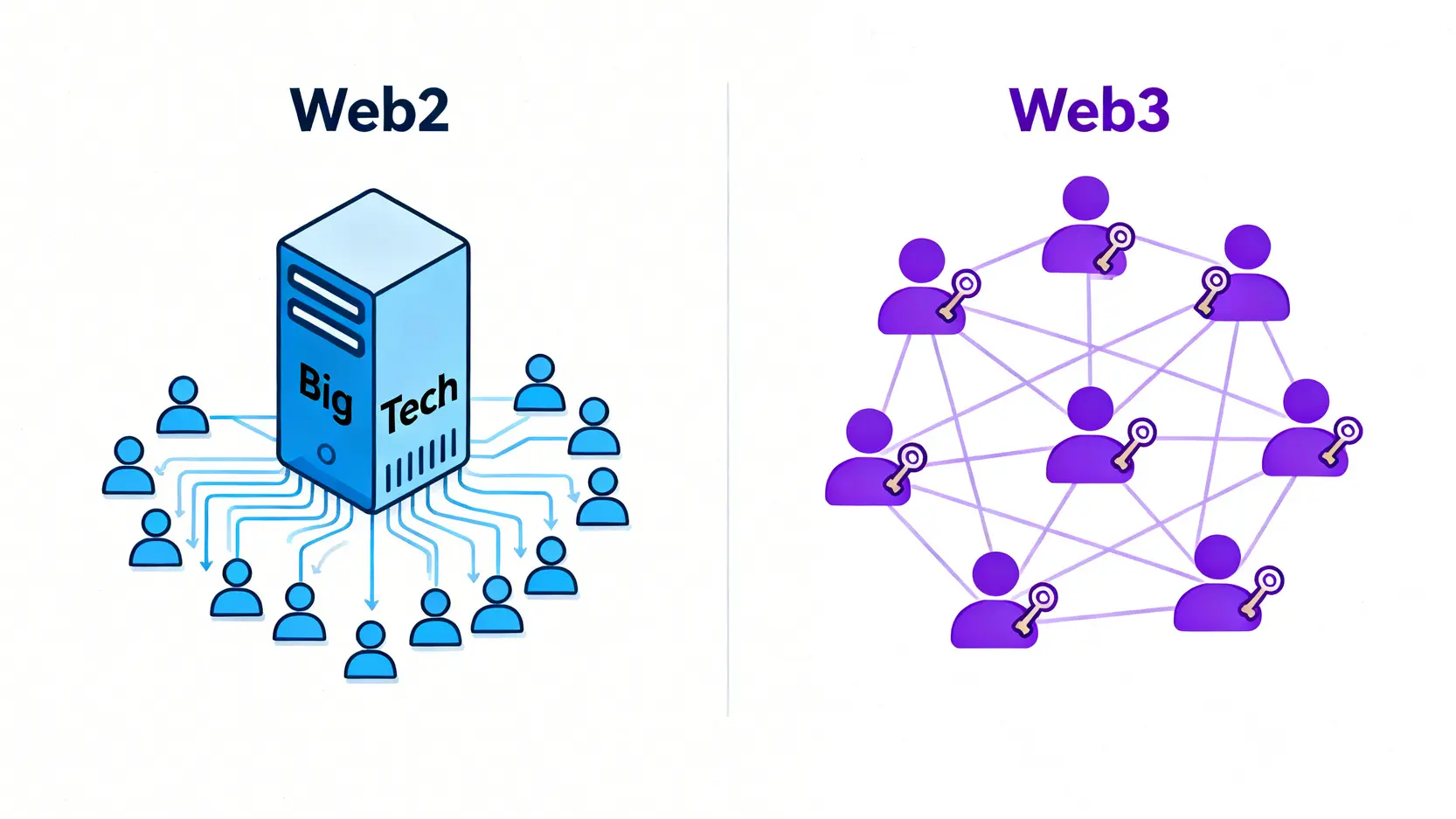
Web2 與 Web3 的架構對比圖,顯示了中心化伺服器與去中心化網絡的區別。

Power in Web2 is concentrated in platforms, whereas Web3 returns data ownership to users.


A Visual Overview of the Core Differences: Data Ownership, Architecture, and Value Distribution

To help you more clearly understand the Web3 vs Web2 comparison, the following is organized into a table for an at a glance view:

Features

Web2 (Current Internet)

Web3 (Next Generation Internet)
Core Architecture Centralized servers Decentralized blockchain network
Data Ownership Owned and controlled by platform companies Owned and controlled by individual users
Control

Tech giants (Google, Meta, Amazon)

User communities (DAO)
Value Distribution Platform commissions, creators receive less revenue Disintermediation, creators earn directly
Login Method Email / social accounts

Cryptocurrency wallets (such as MetaMask)

Representative Applications Facebook, Instagram, TikTok Uniswap, OpenSea, Axie Infinity


Further Reading (Highly Recommended)

Comprehensive Guide to Cryptocurrency Investment: Master Risks, Avoid Scams, and Ensure Asset Security and Regulatory Compliance

Complete Guide to Blockchain Applications in 2025: 10 Real World Virtual Currency and Ethereum Application Cases


The Foundation of Web3: An In Depth Analysis of the Advantages and Disadvantages of Blockchain

The grand vision of Web3 is built entirely upon blockchain technology. However, this technology is like a double edged sword, offering both disruptive advantages and significant drawbacks. Understanding the advantages and disadvantages of blockchain is key to evaluating the future of Web3.

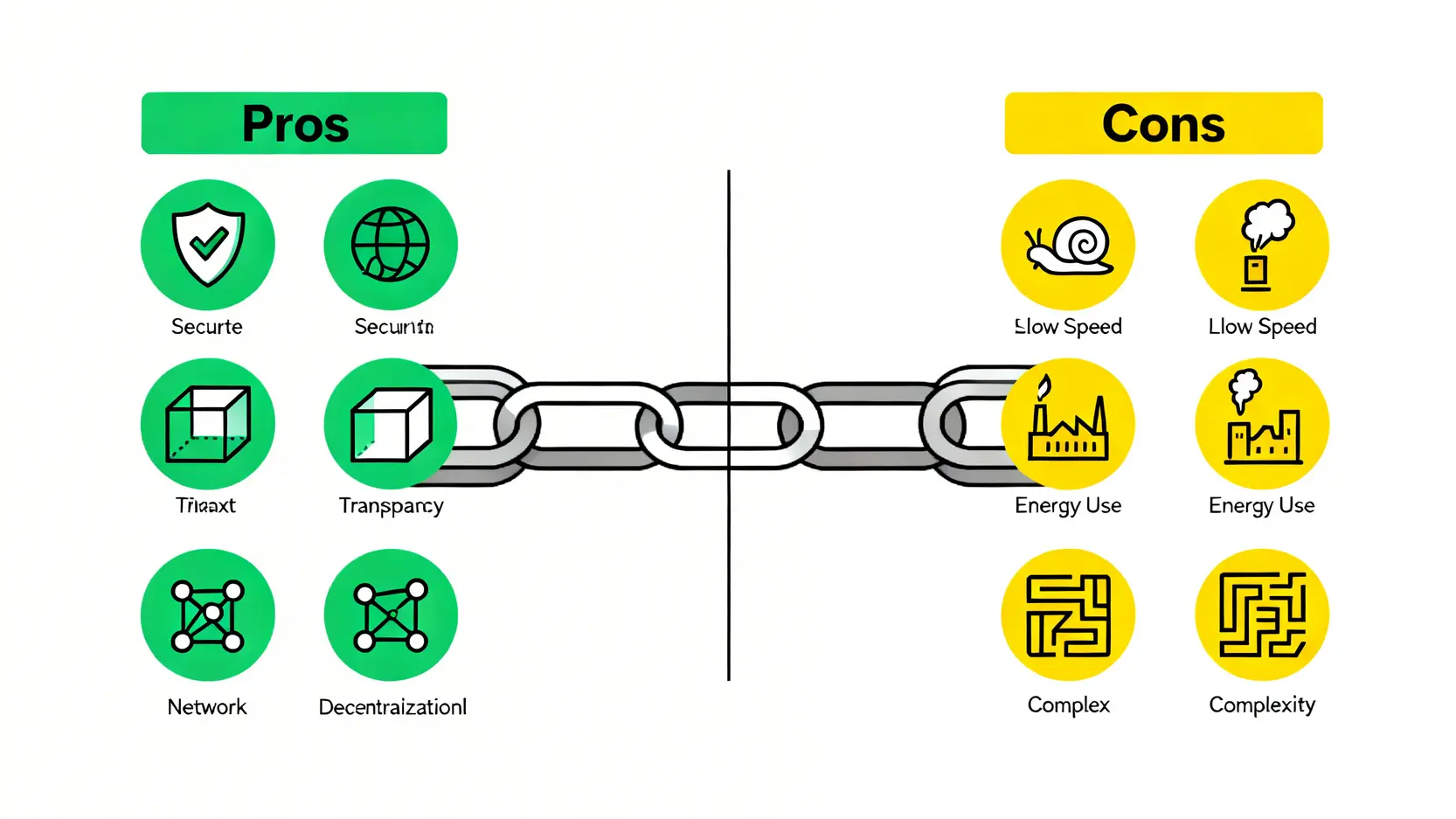
區塊鏈技術的優點與缺點示意圖,一面是安全與透明,另一面是速度慢與高能耗。

Blockchain technology is a double edged sword, combining disruptive strengths with real world challenges.


Advantages of Blockchain: Why Can It Disrupt the World?

  1. Decentralization: This is the most fundamental advantage. Data is no longer stored on a single server but distributed across thousands of nodes within the network. This means no single entity can control or shut down the network, making it highly resistant to censorship.
  2. Transparency & Immutability: All transactions on the blockchain are publicly verifiable (unless on a private chain). Once recorded, they are nearly impossible to alter or delete. This brings unprecedented trust to industries such as finance, supply chains, and voting systems.
  3. Enhanced Security: Each block is linked using cryptographic principles and validated collectively by a decentralized network. To attack or alter data, one would need to control more than 51% of the network’s computing power, which is extremely costly, making it highly secure.
  4. Permissionless: On public blockchains (such as Ethereum), anyone can participate in the network or build applications without approval from any central authority, greatly stimulating innovation.


Disadvantages of Blockchain: The Harsh Reality Behind the Ideal

  1. Scalability Issues: This is currently the biggest bottleneck. Networks such as Bitcoin and early Ethereum handle far fewer transactions per second (TPS) than traditional systems like Visa. As a result, during peak periods the network becomes congested and transaction fees (Gas Fee) surge.
  2. Slow Transaction Speed: Because consensus must be reached among multiple nodes, blockchain transaction confirmation times range from a few seconds to several minutes, resulting in a poor experience for scenarios requiring instant payments.
  3. Energy Consumption: Blockchains using the Proof-of-Work (PoW) consensus mechanism (such as Bitcoin) consume large amounts of electricity for “mining”, leading to serious environmental concerns. However, many newer blockchains have shifted to the more energy efficient Proof-of-Stake (PoS).
  4. Complex User Experience: For ordinary users, managing private keys, understanding Gas Fee, and interacting with DApps present high entry barriers, making them far less intuitive and user friendly than Web2 products.


Must Read Before Entering Web3: The Five Major Web3 Risks and Pitfalls You Must Know

Web3 is full of opportunities, but it is also a dark forest filled with hidden dangers. Before committing capital and time, you must clearly understand the following five major Web3 risks, which could cause your assets to drop to zero instantly.

Web3 世界中常見的五大風險,包括智能合約漏洞、釣魚詐騙、監管不確定性和市場波動。

Before entering Web3, you must remain vigilant about risks such as smart contracts, phishing, regulation, market volatility, and private key management.


Risk One: Smart Contract Vulnerabilities

Smart contracts are self-executing code agreements that form the foundation of applications such as DeFi and NFTs. However, “code is law” means that once deployed, contracts are difficult to modify. If undiscovered vulnerabilities exist in the code, hackers can exploit them to drain all funds locked in the contract. The infamous DAO incident remains a painful lesson in history.


Risk Two: Phishing and Hacking

This is one of the most common Web3 risks. Scam tactics constantly evolve, for example:

  • Impersonation websites: Creating websites identical to well known projects to trick you into connecting your wallet and authorizing malicious contracts.
  • Malicious airdrops: Sending seemingly free NFTs or tokens to your wallet. Once you attempt to interact with them, theft may be triggered.
  • Direct message scams: Impersonating project support on Discord or Telegram and claiming to “resolve issues” in order to obtain your private key or seed phrase.

Remember: Never disclose your private key or seed phrase, and remain highly cautious about any request for wallet authorization.


Risk Three: Regulatory Uncertainty

Governments around the world continue to adjust their stance toward cryptocurrencies and Web3. Some adopt a supportive approach, while others impose strict restrictions or even bans. Sudden regulatory policies in the future may significantly impact specific projects, token prices, or even the entire market. This is an important macro level disadvantage of blockchain.


Risk Four: High Market Volatility

The cryptocurrency market is known for extreme price fluctuations. A token’s price may rise 100% in one day or fall 90% within hours. Such volatility creates potential for high returns but also carries substantial loss risk. Without strong psychological resilience and effective risk management strategies, it is easy to be eliminated during sharp market swings.


Risk Five: The Challenge of Private Key Management

In Web3, you are the sole authority over your assets, and this freedom comes from controlling your wallet’s private key. However, this also means you bear full responsibility. If your private key is lost, damaged, or stolen, you will permanently lose access to all assets in your wallet, and there is no “customer service” to recover them. “Not your keys, not your coins. is the golden rule of the Web3 world.


Further Reading (Highly Recommended)

Comprehensive Guide to Cryptocurrency Investment: Master Risks, Avoid Scams, and Ensure Asset Security and Regulatory Compliance


Frequently Asked Questions (FAQ)

Q: What is the relationship between Web3, the Metaverse, and NFTs?

A: It can be understood this way: Web3 is the underlying infrastructure, like the operating system of the internet. The Metaverse and NFTs (non fungible tokens) are applications running on this operating system. NFTs provide unique ownership proof for virtual assets in the Metaverse (such as land, items, and avatars), and all of this relies on Web3’s decentralized architecture.

Q: How can ordinary individuals start engaging with Web3?

A: Getting started with Web3 is not complicated and can begin with the following steps:
1. Set up a crypto wallet: Download and install a non custodial wallet such as MetaMask or Trust Wallet, and securely store your seed phrase.
2. Acquire cryptocurrency: Purchase a small amount of mainstream cryptocurrencies such as ETH on a compliant exchange and transfer them to your personal wallet.
3. Explore DApps: Try using some mainstream decentralized applications, such as decentralized exchanges (Uniswap) or NFT marketplaces (OpenSea), and begin with small transactions to gain experience.
4.Continue learning: Stay curious, follow industry developments, and independently evaluate and research any investment advice (DYOR – Do Your Own Research).

Q: Is my data completely secure on Web3?

A: This question should be viewed from two perspectives. On one hand, as long as the blockchain itself is not subject to a 51% attack, the data recorded on the chain is extremely secure and cannot be altered or deleted. On the other hand, the weak point in security often lies with the user. If your private key is compromised due to phishing, malware, or improper storage, all your assets will be at risk of theft. Therefore, security in Web3 depends more on your personal security practices.

Q: Will Web3 truly replace Web2?

A: In the short term, Web3 is unlikely to completely replace Web2. It is more likely that both will coexist and gradually integrate. Web2 still holds significant advantages in user experience and processing efficiency. The future trend may see Web2 applications incorporating Web3 elements (such as logging in with crypto wallets or using NFT membership cards) while Web3 continues to improve its user experience and performance, ultimately forming a hybrid network ecosystem.


Conclusion

In summary, the evolution from Web2 to Web3 centers on returning data power to users through blockchain technology. The essence of the Web3 vs Web2 comparison is a redistribution of power and value. It brings unprecedented opportunities, but also presents challenges in technological maturity, security, and regulation. While embracing the potential of Web3, deeply understanding its operating principles, objectively evaluating the advantages and disadvantages of blockchain, and remaining highly vigilant about potential Web3 risks are the critical first steps for every participant to safeguard their assets. Start your learning journey today and prepare for the next generation of the internet.

If you liked this article, please share it!

Related Articles

  • Volatility Surface Guide: Skew Trading Strategies
    Practical Applications of Volatility Surfaces: From Options Modeling to Advanced Skew Trading Strategies In options markets, implied volatility is never a flat line. Instead, it forms complex "smile" or "skew" surfaces. For advanced traders, mastering the practical applications of volatility surfaces is equivalent to possessing a lens that reveals market...
    2026 年 6 月 3 日
  • Foreign Capital Flow Model: Track Institutional Money
    Building a Foreign Capital Flow Copy Trading Model: A Stock Market Indicator for Accurately Tracking Institutional Positioning In Asia-Pacific stock markets, foreign capital inflows and outflows often determine the direction of the index. However, simply looking at daily net buy and sell data is no longer enough. Only by building...
    2026 年 6 月 3 日
  • Options Buying Strategies for Extreme Market Risks
    Options Buyer Strategies During Extreme Market Conditions: Black Swan Hedging and Cross-Market Arbitrage During Volatility Surges The most terrifying aspect of financial markets is not a gradual decline, but overnight flash crashes and cross-market capital withdrawals accompanied by volatility surges. In the highly unpredictable global macroeconomic environment of 2026, geopolitical...
    2026 年 6 月 3 日
返回顶部