VIX ETF Hong Kong Guide 2026: How to Buy & Risks

Fear Index ETF Hong Kong Investment Guide: How to Buy the VIX Index? Popular ETFs, Account Opening Tutorial, and Risks
When the market shifts and stocks plunge, is your portfolio left with no way to respond? Known as the “fear index”, the VIX Index is a hedging indicator that draws significant attention in volatile markets. However, for Hong Kong investors, how do you buy the VIX Index? And what fear index ETF options are available in Hong Kong? This article provides the most comprehensive guide to VIX Index investment methods, from concept explanations and popular ETF introductions to specific account-opening and trading steps, as well as potential risks, helping you master this advanced market tool.
What Is the VIX Index (Fear Index)? Why Is It a Thermometer of Market Sentiment?
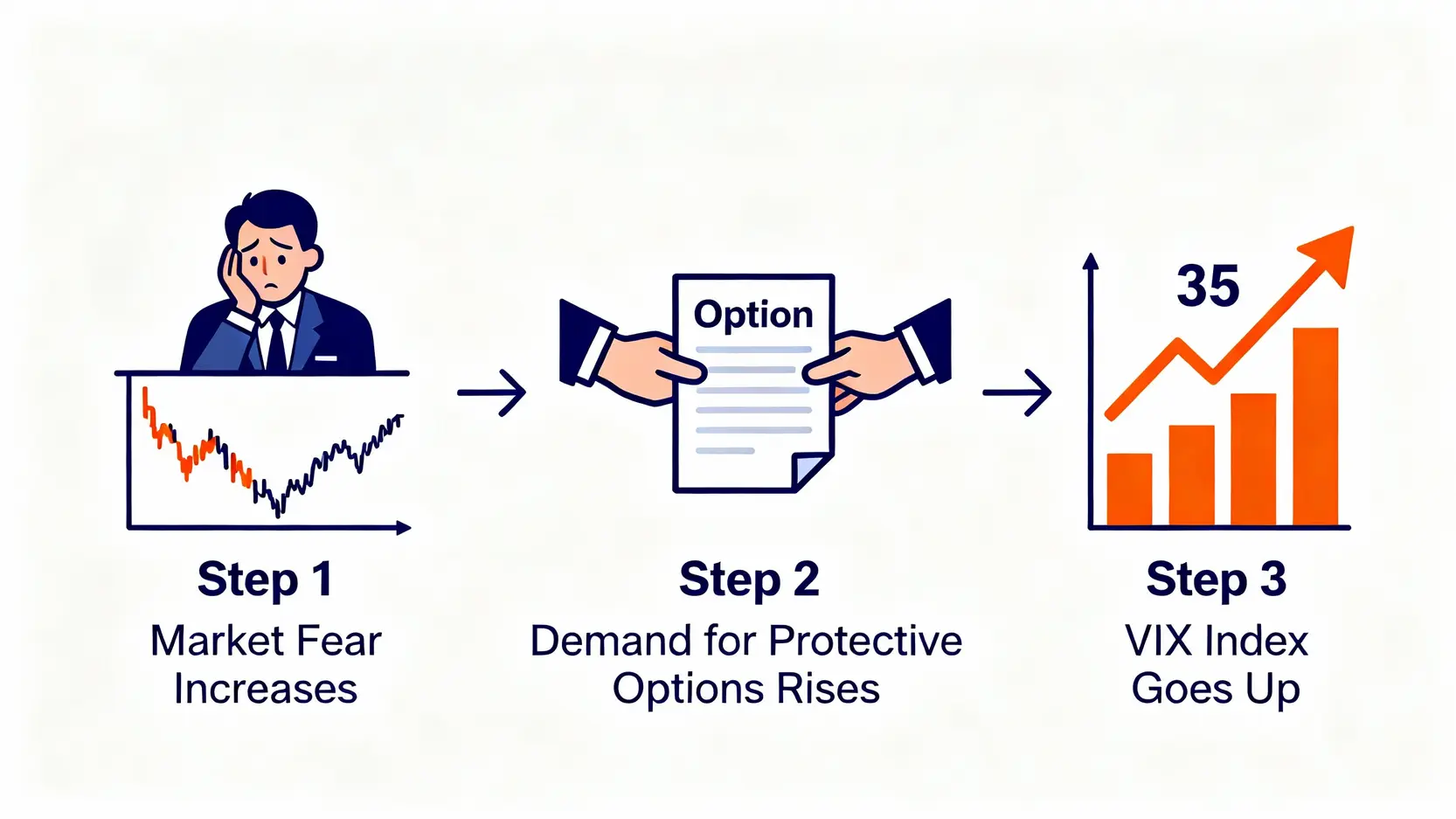
The VIX Index, formally known as the “Volatility Index”, was launched by the Chicago Board Options Exchange (CBOE) in 1993. It does not directly track the price of any stock. Instead, it reflects market expectations for the implied volatility of S&P 500 Index options over the next 30 days. Simply put, the VIX Index measures “how volatile the market is expected to be in the future”, not “how volatile it is right now”. When investors expect sharp market swings, (typically declines), they buy options to hedge, pushing option prices higher, and the VIX Index rises accordingly. As a result, it is widely regarded as a “thermometer” of market sentiment or a “panic indicator”.
The Definition of the VIX Index: It Does Not Directly Track Stock Prices, but Rather Expected Market Volatility
To accurately understand the VIX Index, you must move beyond the traditional mindset of stock price indexes. It is calculated based on S&P 500 Index option prices, and most buyers of these options do so to hedge downside risk in their equity holdings. When expected market risk increases:
- Large investors and fund managers buy put options to protect their investment portfolios.
- This increase in hedging demand drives option prices higher.
- The VIX Index calculation formula captures these changes in option prices, thereby reflecting the market’s collective expectations for future volatility.

Therefore, the VIX Index is a forward-looking indicator. It tells us the degree of stock market volatility that market participants “believe” will occur over the next month. For more official information on the VIX Index, you may refer to the historical data of the CBOE Volatility Index.
How to Interpret the VIX Index? What Do Different Levels (Such as 20 and 30) Signal About the Market?
Interpreting VIX Index readings is key to mastering how to apply it. Although there is no absolute standard, the market generally refers to the following ranges to assess current sentiment:
| VIX Index Level | Represented Market Sentiment | Potential Market Conditions |
| Below 20 | Market sentiment is stable and optimistic |
The stock market is usually in a steady uptrend or consolidation phase, with investors showing lower risk awareness. |
| Between 20 and 30 | Market concerns emerge and uncertainty increases | The market may be facing potential negative news or turning points, and volatility begins to increase. |
| Above 30 | Market is in panic, with heightened risk-averse sentiment | This is usually accompanied by sharp stock market declines or extreme events (such as financial crises or pandemic outbreaks), with intense market volatility. |
| Above 40–50 | Extreme panic, with the market nearing the brink of collapse | Historically, this has appeared only during a few major crises, such as the 2008 global financial crisis and the early stage of the 2020 COVID-19 pandemic. |
The VIX Index’s Negative Correlation With the S&P 500 Index and Its Applications
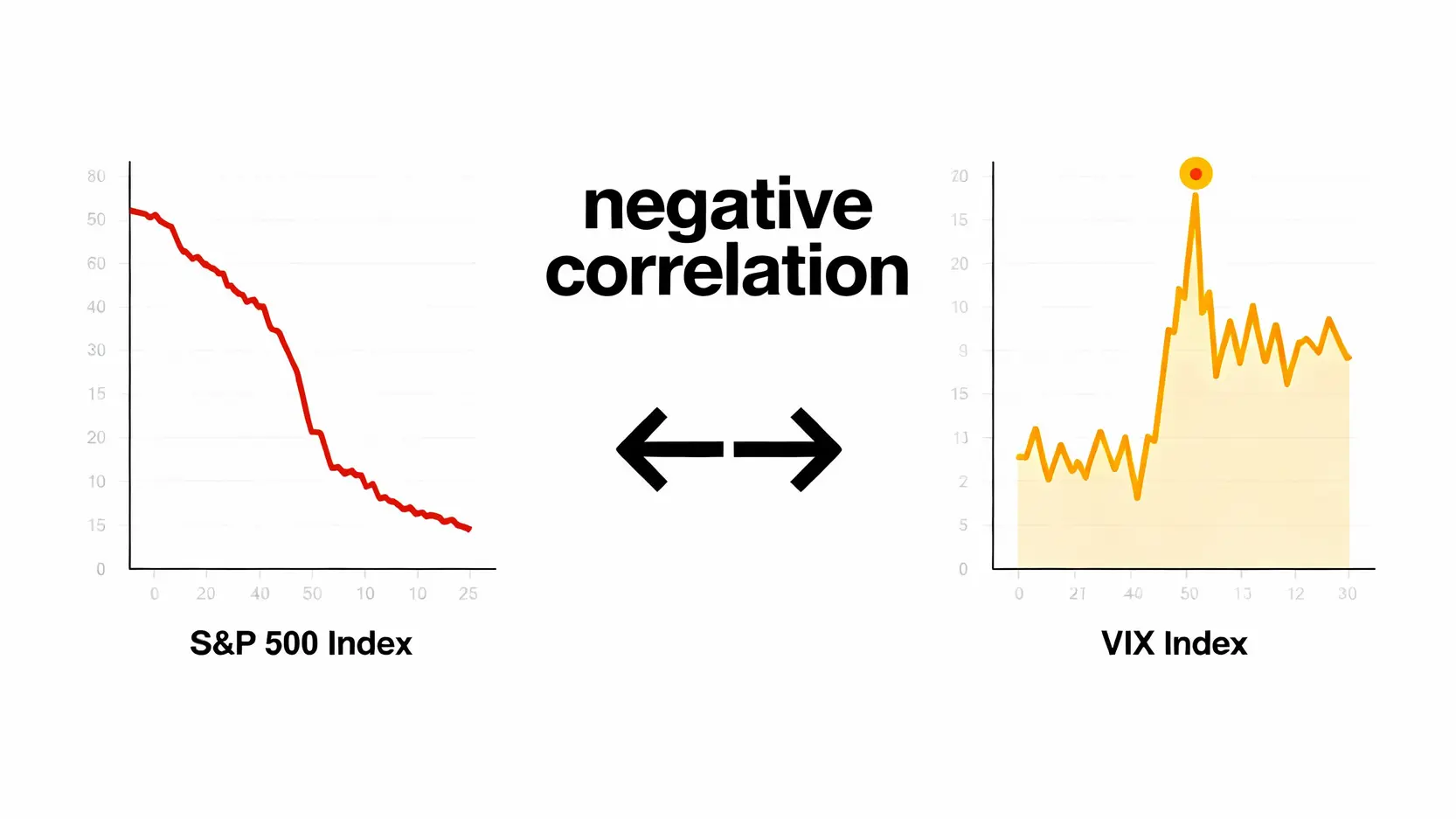
The most notable characteristic of the VIX Index is its strong “negative correlation” with the US Standard & Poor’s 500 Index (S&P 500). This means that when the S&P 500 Index falls, the VIX Index usually rises. Conversely, when the S&P 500 Index rises, the VIX Index tends to decline. The logic behind this relationship is that “fear of declines far outweighs greed for gains”. Panic triggered by a sharp stock market drop is far more intense than the optimism from a gradual rise, causing hedging demand to surge and pushing the VIX higher.

It is precisely because of this negative correlation that VIX-related financial products (such as ETFs) are regarded as potential hedging tools. When investors worry that their equity portfolios may suffer losses due to a market decline, they may buy VIX ETFs, hoping that profits from a rising VIX Index can offset part of their stock losses.
Further Reading (Highly Recommended)
What Is the S&P 500? A Beginner’s Investment Guide: Understanding Constituents, ETFs, and How to Buy
What Are ETF Risks? A Comprehensive Analysis of ETF Risk Levels and Investment Management Strategies
VIX Index Investment Methods: Three Major Strategies and Key Risk Analysis
Directly investing in the VIX Index itself is not feasible. Investors must use its derivative products, most commonly VIX futures ETFs. However, before discussing which fear index ETFs are available for Hong Kong investors, it is essential to first understand the investment strategies and the significant risks involved. This is by no means a “buy and hold” tool.
Strategy One: Use as a Short-Term Hedging Tool for Your Investment Portfolio
This is the most common VIX Index investment method. When you anticipate that the market may experience a short-term sharp pullback due to certain events (such as the release of important economic data or geopolitical conflicts), you may buy a small amount of VIX ETFs. If the market does decline, the profits generated by rising VIX ETF prices can be used to offset part of the losses in your equity portfolio. The key word is “short term”. Hedging deployments should be measured in days to weeks and should never exceed one month.
Strategy Two: Capture Short-Term Trading Opportunities During Extreme Market Panic
This strategy is more speculative and carries extremely high risk. When irrational extreme panic appears in the market and the VIX Index surges to historical highs within a short period (such as above 40), some traders take a contrarian approach by selling (shorting), VIX ETFs or buying inverse VIX ETFs. Their bet is that panic sentiment will eventually fade and the VIX Index will fall back from elevated levels. This strategy requires exceptionally precise market timing, and even a small misjudgment can result in substantial losses.
【Must-Read for Beginners】The Fatal Risks of Investing in VIX ETFs: Price Erosion and Roll Costs
Why are VIX ETFs not suitable for long-term holding? The answer lies in their structural flaws, which are mainly reflected in the following two aspects:
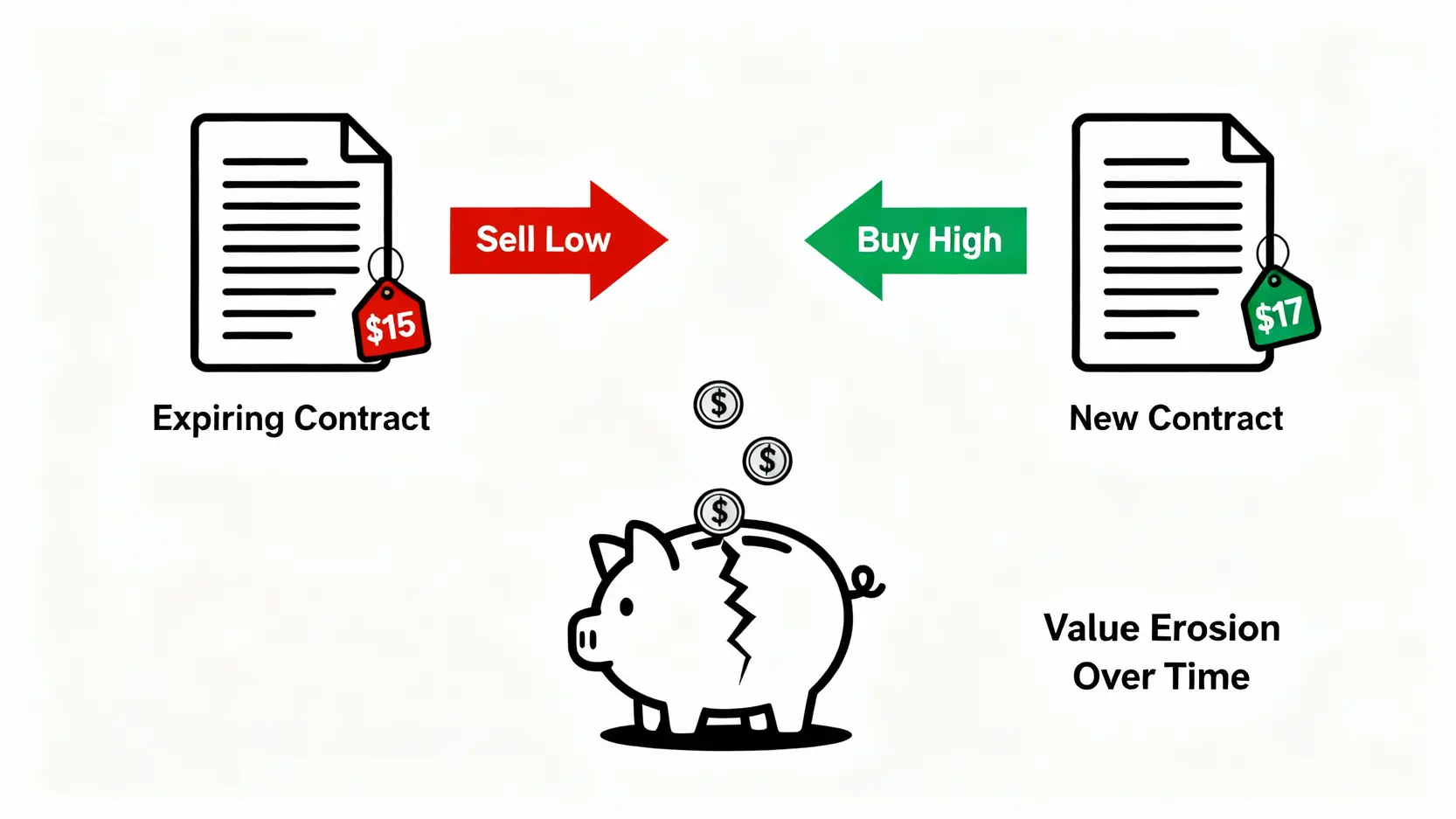
- Roll cost (Contango or roll cost): VIX ETFs do not directly hold the VIX Index, but instead hold VIX futures contracts. To maintain their positions, fund managers must continuously sell contracts that are nearing expiration and buy more expensive longer-dated contracts. During most stable market periods, longer-dated futures are priced higher than near-term futures (known as contango). This “sell low, buy high” process continuously erodes the ETF’s net asset value, causing its price to decline over the long term.
- Price erosion (Beta slippage): For leveraged VIX ETFs (such as UVXY, which provides 1.5x leverage), daily rebalancing of leverage results in value decay. This erosion is especially severe in volatile markets. Even if the VIX Index itself eventually returns to its original level after a period of time, the price of the leveraged ETF may have already fallen significantly.

These two factors cause almost all VIX ETFs to exhibit a long-term downward trend. If you hold a VIX ETF over the long term, even if the market experiences several major sell-offs, your final return is highly likely to be negative. This is a race against time, and time is usually not on the side of VIX ETF buyers.
Fear Index ETF Hong Kong Practical Guide: Comparison of Popular ETFs and Purchase Process
After understanding the strategies and risks, if you still decide to include VIX ETFs in your trading toolkit, the following is practical information that Hong Kong investors need to know. As there are no locally listed ETFs in Hong Kong that directly track the VIX Index, investors must operate through securities accounts that allow trading in US equities.
Introduction to Popular US-Listed VIX ETF Products (e.g., VIXY, UVXY)
There are many VIX-related ETFs on the market, differing in their underlying benchmarks, leverage ratios, and fees. The following are some representative products.
| ETF Ticker | Full Name | Leverage Ratio |
Key Features and Risks |
| VIXY | ProShares VIX Short-Term Futures ETF | No leverage | Tracks short-term VIX futures indexes and aims to deliver performance closely aligned with the intraday movements of the VIX Index. Although it has no leverage, it is still heavily affected by roll costs and is not suitable for long-term holding. |
| UVXY | ProShares Ultra VIX Short-Term Futures ETF | 1.5x leverage | Provides 1.5x daily returns of short-term VIX futures indexes. Volatility is extremely high, price decay is rapid, and it is only suitable for experienced intraday traders. The risk is extremely high. |
Purchase Process for Hong Kong Investors: How to Choose a Broker and Place Orders
For Hong Kong investors in fear index ETFs, the process for how to buy the VIX Index is relatively straightforward, provided that you have a securities account that supports US stock trading.
- Choose a suitable broker: First, you need to open a securities account that allows trading US stocks. There are many options in Hong Kong, including traditional banks, (such as HSBC and Bank of China (Hong Kong)), and emerging online brokers (such as Futu (Futubull), Tiger Brokers, and Interactive Brokers). When choosing, you should compare their trading commissions, platform usability, and customer service.
- Deposit funds: After opening the account, deposit HKD or USD into your securities account. Most brokers support fast deposits via eDDA or bank transfers.
- Search the ETF ticker: In the broker’s trading app or website, enter the ticker of the VIX ETF you want to trade, such as “VIXY” or “UVXY”.
- Place a buy order: After confirming the real-time quote of the ETF, enter the number of shares and the price you want to buy (choosing either a market order or a limit order), then submit the order.
- Monitor closely: VIX ETF prices can move very quickly. After completing the trade, you must stay on top of market developments and set take-profit or stop-loss levels in advance.
Does Hong Kong Have a VIX Index? Understanding the Hang Seng Volatility Index (VHSI)
Although Hong Kong investors mainly trade US VIX Index products, Hong Kong also has a similar local indicator, the Hang Seng Volatility Index (VHSI). The VHSI is compiled by Hong Kong Exchanges and Clearing. Its methodology is similar to the VIX, but it tracks the implied volatility of options on the Hang Seng Index (HSI), reflecting market expectations for Hang Seng volatility over the next 30 days. Therefore, the VHSI is regarded as the “fear index” for Hong Kong equities. Unfortunately, there are currently no ETF products that directly track the VHSI available for retail investors to buy or sell.
FAQ: Common Questions About VIX Index Investing
Q: Can VIX Index ETFs be held long term?
A: Absolutely not. Due to the “roll costs” and “price erosion” mentioned above, the net asset value of VIX ETFs will continue to decline over time. They are tools designed for short-term trading or hedging, and long-term holding is almost certain to result in losses. Treat them as an “insurance” that requires paying a time cost, rather than an “asset” that can appreciate.
Q: If the VIX Index spikes, does it mean the stock market will definitely plunge?
A: Not necessarily. The VIX Index measures “expected volatility”, not direction. While sharp spikes typically occur alongside stock market declines, it can also rise during periods of violent two-way swings. A high VIX indicates greater market uncertainty, but it does not guarantee a one-way decline in equities.
Q: Do I need to pay attention to tax issues when investing in VIX ETFs in Hong Kong?
A: Hong Kong residents do not pay capital gains tax when trading overseas assets, including US-listed ETFs. However, if an ETF pays dividends, it is subject to US dividend withholding tax, typically 30%. That said, most VIX ETFs do not pay dividends. Their returns come entirely from price movements, so dividend tax issues generally do not apply.
Q: Besides VIX ETFs, are there other hedging tools?
A: Yes. Other hedging tools investors may consider include inverse ETFs, such as SQQQ, which tracks inverse returns of the Nasdaq 100 Index, buying gold or gold ETFs, buying US Treasuries or related ETFs, or directly buying put options on individual stocks. Each tool has different risks and characteristics, and should be selected based on your personal investment risk management strategy.
Conclusion
In summary, VIX fear index ETFs are a double-edged sword. They can offer potential hedging benefits during market turbulence, yet their complex product structures come with extremely high risks, making them absolutely unsuitable for long-term holding or beginner investors. Before Hong Kong investors consider how to buy the VIX Index, they must thoroughly understand how these products work and their fatal flaws, such as roll costs. It is hoped that this VIX Index investment methods tutorial can help you use this tool more wisely and make more informed investment decisions.
Related Articles
-
How Do Federal Reserve Interest Rate Hikes Trigger Waves of Cryptocurrency Liquidations? Understanding the Logic Behind It in One Article Introduction Late at night, alarm bells ring across the market. The prices of Bitcoin and other cryptocurrencies suddenly plunge, causing hundreds of thousands of investors to be liquidated within moments....2026 年 6 月 12 日
-
The Interest Rate and Exchange Rate Seesaw: How Does the Central Bank Use the "Dual-Rate Policy" to Stabilize Taiwan's Economy? Interest rates and exchange rates are the two lifelines of a country's economy. Any movement in either one directly affects the stock market, property market, corporate profitability, and even the...2026 年 6 月 12 日
-
US-Japan Interest Rate Differential Out of Control? Uncovering the Root Causes of Yen Depreciation and the Bank of Japan's Policy Dilemma Recently, even though Japan's Ministry of Finance has repeatedly deployed large-scale intervention measures, the yen has only enjoyed brief periods of relief before returning to its depreciation trend. This...2026 年 6 月 9 日