USDT to Fiat Guide 2026: HKD & TWD Fee Comparison

How to Convert USDT Back to Fiat Currency? 2026 Comparison of Stablecoin Conversion Channels and Fees for Hong Kong Dollars and New Taiwan Dollars
In the crypto market, no matter how impressive the numbers on paper may appear, profits are only truly realized when funds are safely secured. How to convert USDT into fiat currency safely and at low cost is an essential lesson every investor must face. As global regulatory policies continue to tighten, choosing the wrong withdrawal channel may not only result in high fees, but could also expose investors to serious legal risks such as frozen bank accounts. This article provides an in-depth analysis of the safest and most reliable strategies for converting stablecoins into Hong Kong dollars and New Taiwan dollars, while comprehensively examining the current USDT withdrawal process. We will also explore the latest 2026 HKD stablecoin market trends to help you protect your assets steadily in an ever-changing financial environment.
Common Stablecoin-to-Fiat Conversion Channels and Analysis of the Pros and Cons of USDT Withdrawals
Before discussing the specific withdrawal procedures, it is essential to understand the mainstream cryptocurrency cash-out channels currently available in the market. Whether converting stablecoins into Hong Kong dollars or New Taiwan dollars, choosing the right channel based on your transaction size and speed requirements is critical. Below is a detailed comparison of the two most common conversion methods to help you evaluate the USDT withdrawal strategy that best suits your needs.
Fiat Withdrawals Through Compliant Exchanges
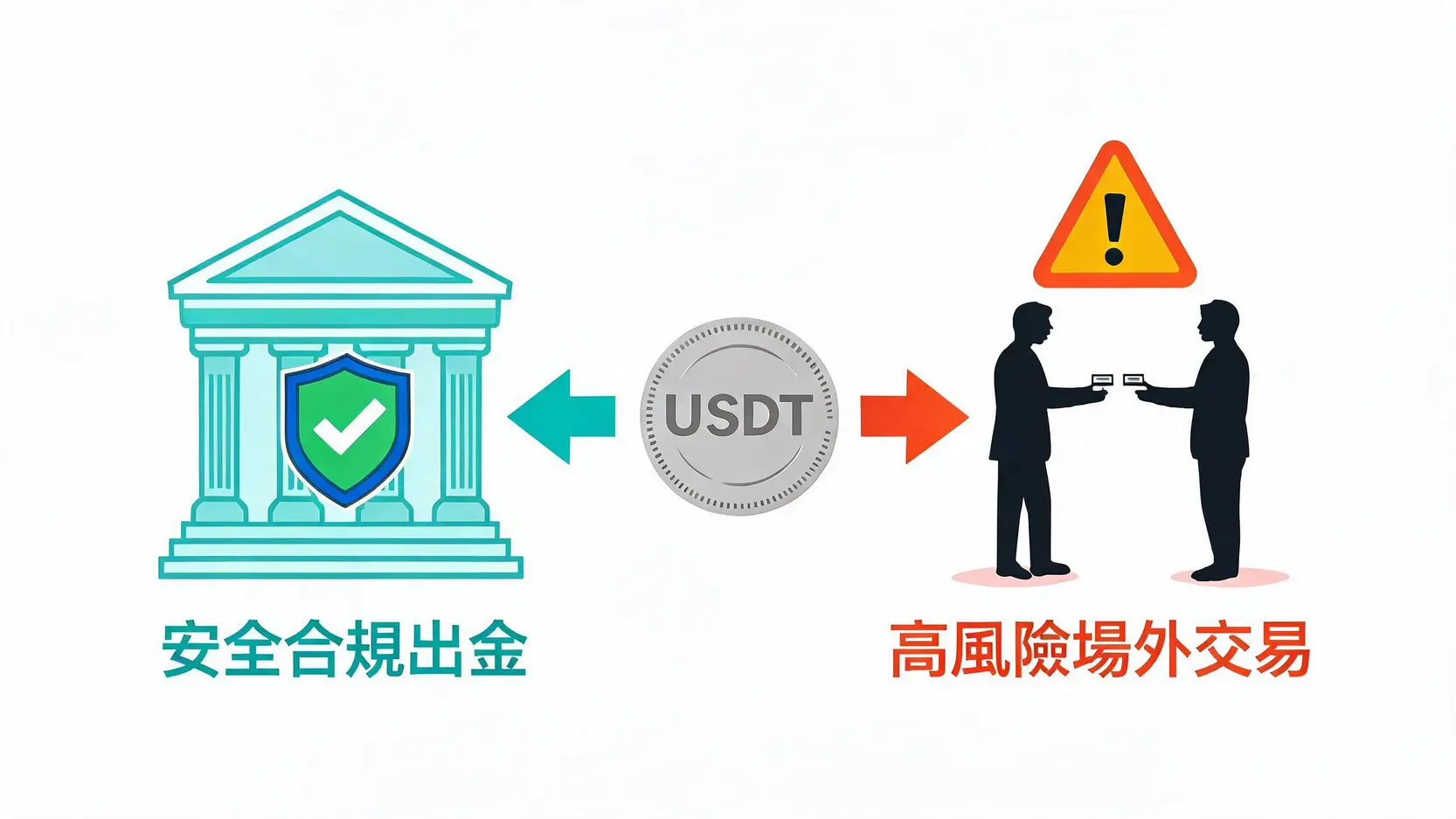
Withdrawing USDT through the fiat channels of compliant exchanges is currently the preferred choice for large capital holders and professional investors. This method requires users to complete strict KYC (Know Your Customer) and AML (Anti-Money Laundering) verification. During the review process, users are generally required to provide identity documents, recent proof of address, and declarations regarding the source of funds.
Under this model, the source of funds is transparent, and there is almost no risk of bank account freezes. For users who need to convert large amounts of stablecoins into New Taiwan dollars or Hong Kong dollars, compliant exchanges can provide official remittance records, which offer significant advantages when banks conduct reviews on large fund transfers. However, the downside is that the fees are relatively fixed, such as wire transfer fees and withdrawal fees, and cross-border remittances may require one to several business days for processing.
P2P and OTC Over-the-Counter Trading
P2P (peer-to-peer) or OTC (over-the-counter) trading is a commonly used USDT withdrawal method among retail investors. Buyers and sellers are matched through exchange platforms or third-party intermediaries, allowing direct settlement of fiat currency and cryptocurrency at an agreed exchange rate.
Although these channels often provide highly favorable exchange rates for converting stablecoins into Hong Kong dollars or New Taiwan dollars, and funds are usually received very quickly, the hidden risk of “dirty money” cannot be ignored. If the fiat currency paid by the buyer is connected to fraud or other illegal activities, there is a very high probability that the seller’s bank account receiving the funds will be frozen by law enforcement authorities. Experienced market participants usually conduct strict counterparty due diligence, such as requiring trading counterparts to provide verified identity information and rejecting any third-party payments. Even so, it is extremely difficult for ordinary retail investors to completely filter out contaminated funds. Therefore, while pursuing exchange rate advantages, investors must carefully weigh the potential legal risks involved.

Risk Comparison Between Compliant Exchanges and P2P Over-the-Counter Trading
| Channel Type | Exchange Rate Advantage | Processing Time |
Risk of Bank Account Freezing |
Suitable Users |
| Withdrawal Through Compliant Exchanges | Average (Based on Market Rates) | Several Hours to Several Days | Extremely Low | Large Fund Holders, Users Seeking Stability |
| P2P/OTC Trading | Better (Possible Premium Rates) | Instant Transfer | High | Small Test Transactions, Users Familiar With Risk Control |
Practical Tutorial: The Complete Process for Converting Stablecoins Into Hong Kong Dollars and New Taiwan Dollars
After understanding the risks and characteristics of each channel, the next step is to explain how to complete the withdrawal process smoothly while ensuring fund security. The following operational guide is suitable for the vast majority of virtual asset investors seeking stability.

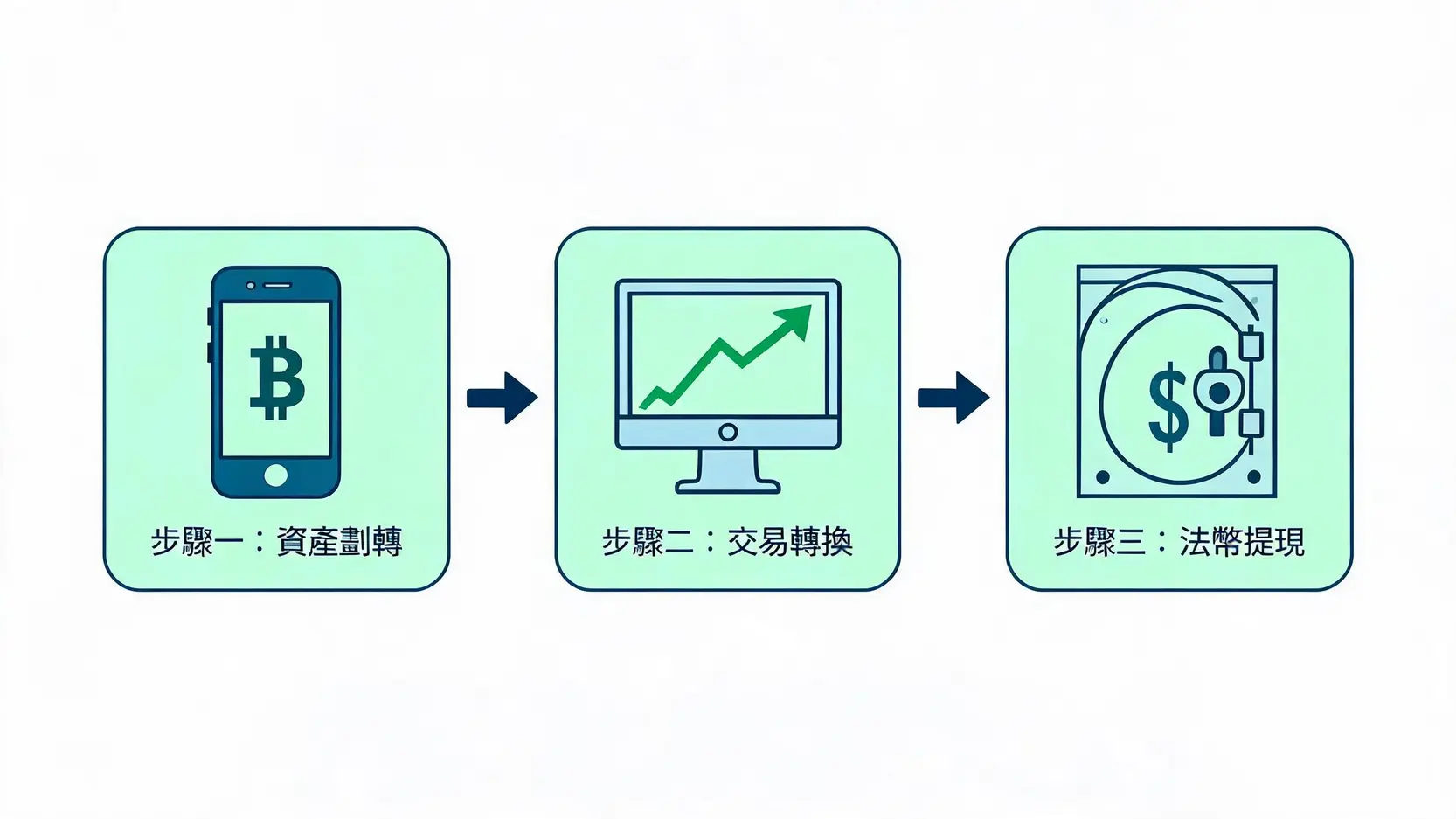
Three-Step Standard Process for Safely Converting Stablecoins Into Fiat Currency
Steps and Precautions for Converting Stablecoins Into Hong Kong Dollars
For investors in Hong Kong, the process of converting stablecoins into Hong Kong dollars has become relatively convenient with the development of local compliant exchanges. First, investors should choose trading platforms that hold relevant Hong Kong Securities and Futures Commission (SFC) licenses or are recognized under transitional arrangements.
- Step 1: Asset Transfer: Transfer assets from a cold wallet or other international exchanges into the funding account of a local compliant exchange. The exchange fund transfer operation process can help beginners avoid asset loss caused by selecting the wrong blockchain network.
- Step 2: Trading Conversion: Sell USDT or USDC on the exchange and convert them into HKD fiat currency.
- Step 3: Fiat Withdrawal: Link a local bank account registered under the same name as the platform account, then apply for withdrawal through FPS (Faster Payment System) or bank transfer. Under normal circumstances, funds will arrive within several hours to one business day.
If you still choose to use the P2P model, be sure to select verified merchants with a high number of historical trades, long registration periods, and high completion rates to reduce the risk of fraud. You may refer to this detailed “2026 Binance Withdrawal Hong Kong” tutorial covering four of the fastest withdrawal methods for more in-depth operational guidance.
Recommended Compliant Platforms and Procedures for Converting Stablecoins Into New Taiwan Dollars
For the Taiwan market, the best practice for converting stablecoins into New Taiwan dollars is through local exchanges that have obtained AML compliance declarations from the Financial Supervisory Commission, such as MAX and BitoPro. These platforms maintain deep trust partnerships with local banks, providing investors with extremely high levels of fund security.
- Step 1: Cross-Platform Transfer: Transfer USDT through low-fee crypto networks such as TRC20 from international platforms into the dedicated address provided by the Taiwanese local exchange.
- Step 2: Market Sell Order: Sell the cryptocurrency through TWD trading pairs on the local exchange to convert it into New Taiwan dollars.
- Step 3: Bank Withdrawal: Submit a withdrawal request, and the funds will be directly transferred into the linked bank account verified under your real-name registration.
Although this USDT withdrawal method requires a withdrawal fee of approximately NT$15 per transaction, it completely eliminates the bank account freezing risks associated with over-the-counter trading.
Latest 2026 Update: The Development Status and Future Conversion Advantages of HKD Stablecoins
As global Web3 competition intensifies, Hong Kong has made steady progress on the path toward virtual asset compliance. In particular, the rise of HKD stablecoins will bring revolutionary changes to future fiat deposit and withdrawal channels, which is a major positive development for both compliance-focused institutions and retail investors.

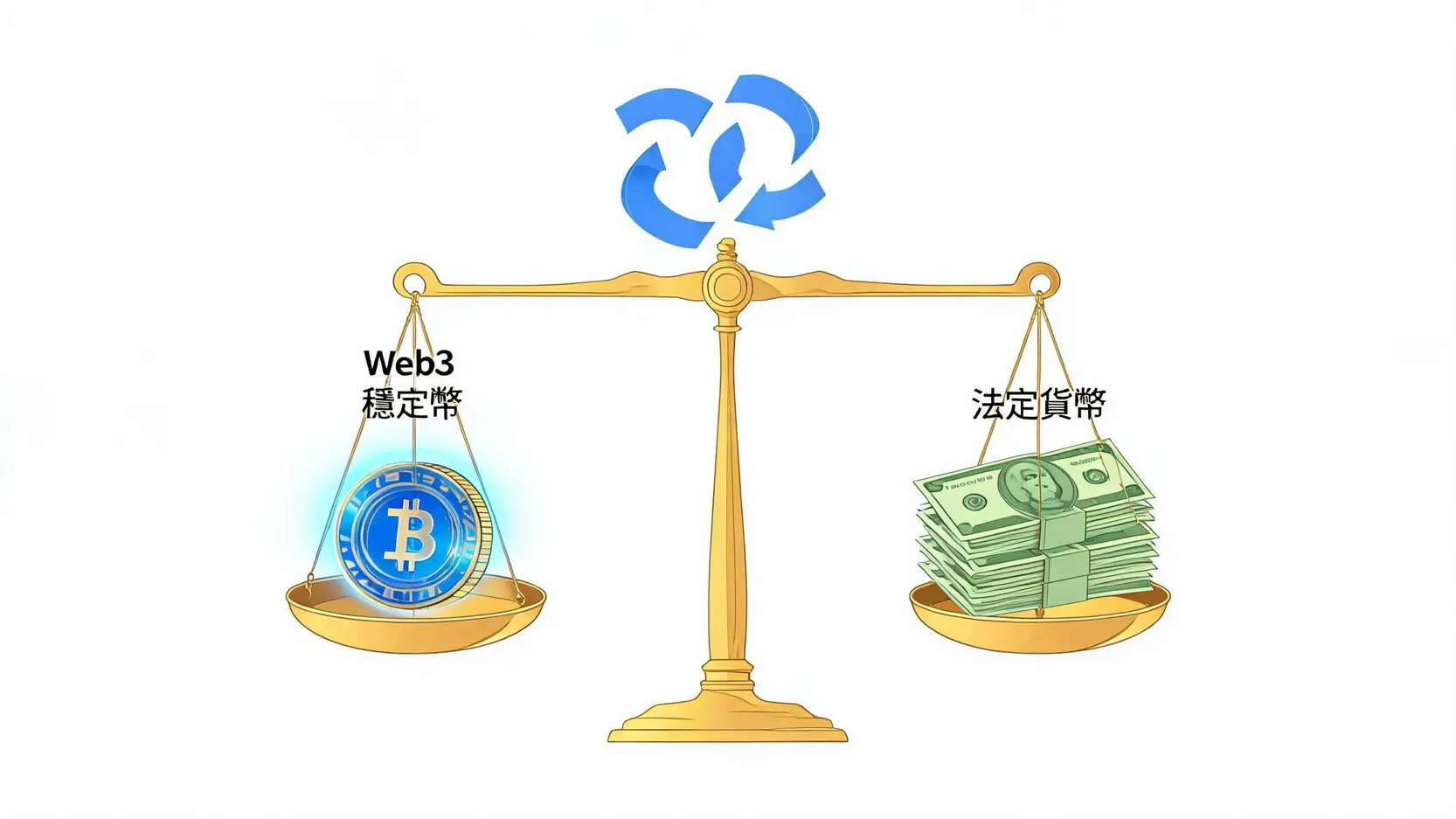
The Future Vision of Seamless Conversion Between Compliant Stablecoins and Traditional Fiat Currency
Progress of the HKMA’s Hong Kong Dollar Stablecoin Sandbox Program
The Hong Kong Monetary Authority (HKMA) has officially launched a regulatory framework for stablecoin issuers and actively approved several well-known institutions to participate in testing. According to the officially released information on the HKMA’s announced stablecoin issuer sandbox participants, these selected financial institutions will conduct strict testing of stablecoin issuance, reserve management, and redemption mechanisms within a controlled environment. Entering 2026, as the regulatory framework becomes fully implemented, HKD stablecoins backed by major financial institutions are expected to gradually become available to the general public, significantly enhancing the credibility of converting stablecoins into Hong Kong dollars and improving overall market depth.
How HKD Stablecoins Eliminate Exchange Friction and Cross-Border Payment Costs
In the past, Hong Kong investors buying or selling virtual assets usually needed to first exchange Hong Kong dollars into US dollar-pegged stablecoins such as USDT or USDC. This process not only involved exchange rate spreads charged by banks or trading platforms, but also required paying unnecessary transaction fees. Furthermore, under macroeconomic conditions, exchange rate markets often experience sharp volatility as central banks around the world alternate between monetary easing and tightening cycles. Once compliant HKD stablecoins become widespread, local investors will be able to convert funds directly at a 1:1 ratio, completely eliminating exchange friction between the US dollar and the Hong Kong dollar, significantly reducing hidden costs in cross-border trade payments and on-chain transactions, and providing an excellent safe haven for the local market.
Future Arbitrage Opportunities Through Seamless Conversion Between Hong Kong Dollars and Stablecoins
Under a complete regulatory framework and strict auditing systems, future HKD stablecoins will be supported by sufficient highly liquid fiat reserves to ensure strict 1:1 pegging with the physical Hong Kong dollar. This will not only solve common issues such as liquidity depletion and slippage frequently encountered in traditional USDT withdrawals, but will also create significant opportunities for institutional investors to conduct seamless arbitrage between traditional financial markets and DeFi (Decentralized Finance) protocols. Two-way conversion between real-world assets and blockchain-based digital assets will become as instant, transparent, and low-cost as modern bank electronic transfers.
Frequently Asked Questions: Stablecoin Conversion and USDT Withdrawal FAQ
Q: Will banks investigate large stablecoin withdrawals?
A: Absolutely. Anti-Money Laundering (AML) regulations are a core principle of the global traditional financial system. If a large amount of funds inconsistent with your normal salary or regular income suddenly flows into your bank account, the bank’s internal risk control system will automatically trigger an alert. At that point, you will be required to provide legitimate proof of the source of funds, such as complete transaction records from compliant exchanges and withdrawal transaction statements, to cooperate with the investigation.
Q: Which channel offers the lowest exchange rate loss and fees?
A: Purely in terms of quoted exchange rates, P2P/OTC over-the-counter trading usually offers rates closest to the market price, and may even provide premium rates while charging no platform fees. However, when the potential legal costs associated with the “risk of bank account freezing” are taken into account, converting stablecoins into New Taiwan dollars or Hong Kong dollars through local compliant exchanges, although requiring small fiat withdrawal fees and minor slippage, is unquestionably the wisest option with the lowest overall cost and the highest level of security.
Q: What is the “dirty money” risk in C2C trading?
A: “Dirty money” refers to illicit funds originating from online fraud, illegal money laundering, or other criminal activities. In C2C trading, if a buyer uses such illegal funds to purchase your USDT, once the victim files a police report, law enforcement agencies will trace and freeze all bank accounts through which the funds have passed. This may result in your account being frozen for an extended period, even if you were completely unaware of the illegal activity.
Q: What impact are HKD stablecoins expected to have on ordinary retail investors?
A: HKD stablecoins will make the process of participating in Web3 investments more intuitive and trustworthy for retail investors. In the future, investors may only need to use familiar banking apps or local electronic payment tools to seamlessly convert between fiat currency and blockchain-based stablecoins, eliminating the need to endure complicated cross-border transfer procedures and expensive intermediary bridge fees.
Conclusion: Moving Forward Steadily With a Safety-First Fiat Conversion Strategy
Experienced investors understand that the market never lacks profit opportunities. What is truly scarce is the risk management wisdom needed to safely bring paper profits back into the real world. Whether your current goal is converting stablecoins into Hong Kong dollars or New Taiwan dollars, the absolute top priority should always be the safety and legality of your funds. Although USDT withdrawal channels are becoming increasingly diverse, in 2026, as regulatory frameworks around the world continue to mature, using the official channels of compliant exchanges remains the best long-term strategy to ensure asset security.
Never expose the wealth you have worked so hard to accumulate to the enormous risks of account freezing and legal disputes merely for a small exchange rate advantage. At the same time, investors should continue paying attention to the progress of HKD stablecoins promoted by the Hong Kong Monetary Authority. This innovation, combining the foundations of traditional finance with blockchain technology, is expected to bring a more convenient, transparent, and lower-cost ultimate withdrawal experience to the entire virtual asset market in the near future.
Related Articles
-
Your Money Is Losing Value! Understanding How Inflation Affects the Purchasing Power of the Taiwan Dollar and Wealth Preservation in One Article Have you ever felt that NT$1,000 doesn't buy as much as it used to? A lunch box that once cost NT$80 now costs NT$120, and movie tickets have...2026 年 6 月 12 日
-
The Taiwan Dollar Surges Past 31.5! With Hot Money and Foreign Capital Inflows, Is This an Opportunity or a Risk? An In-Depth Analysis The Capital Frenzy: The Three Major Drivers Behind the Taiwan Dollar Breaking Above 31.5 The New Taiwan dollar has recently become the absolute focal point of the...2026 年 6 月 10 日
-
Taiwan Dollar Appreciation and Hot Money Inflows! An Investor's Action Guide: Should You Buy Stocks, Bonds, or Exchange for US Dollars at This Stage? One of the hottest topics in the market recently has been the capital-driven rally fueled by foreign investors' consecutive net buying of Taiwan stocks, pushing the...2026 年 6 月 10 日