HK Crypto Margin Financing & Perpetuals Guide

In-Depth Analysis of Crypto Collateralized Financing Mechanisms: A Complete Guide to SFC Virtual Asset Margin Financing and Perpetual Contracts in Hong Kong
In 2026, competition to become a global Web3 hub has intensified dramatically. To enhance market liquidity and compete with emerging markets such as Singapore and Dubai, the Hong Kong Securities and Futures Commission (SFC) officially fully implemented the regulatory framework for virtual asset margin financing and perpetual contract trading. This policy, regarded by the industry as a major positive development, means that under a compliant environment, investors will be able to utilize crypto collateralized financing mechanisms to obtain substantial liquidity by using their digital assets as collateral.
Whether institutional entities seeking greater asset allocation efficiency or high-net-worth individuals, the market is highly optimistic about the liquidity injection brought by this new Hong Kong SFC virtual asset policy. In particular, the legalization of compliant Bitcoin collateralized lending models completely resolves the long-standing issue of Asian investors previously relying on offshore exchanges while bearing significant platform collapse risks. How exactly will this transformation reshape the financial derivatives market landscape? What hidden liquidation risks are involved behind the scenes? This article provides an in-depth analysis.
The Core Policies Behind Hong Kong’s Crypto Collateralized Financing Mechanism and the Development of Hong Kong’s New SFC Virtual Asset Policy
Hong Kong has consistently maintained a prudent and steady approach toward virtual asset compliance. The latest policy guidelines released in early 2026 officially incorporated virtual asset margin financing into the scope of services permitted for licensed brokers, while simultaneously establishing high-level regulatory standards for perpetual contract trading. According to the SFC’s high-level framework for virtual asset perpetual contracts, the market opening strategy adopts a gradual and defensive approach in order to protect investor interests and prevent systemic risks.
Initially Limited to High-Liquidity Assets (BTC, ETH) as Collateral
During the initial implementation stage of the new regulations, regulators strictly limited the types of crypto assets eligible for margin collateral. Currently, only Bitcoin (BTC) and Ethereum (ETH), which possess extremely strong global consensus, large market capitalizations, and deep liquidity, are permitted as qualified collateral assets. This measure aims to prevent low-market-cap tokens from triggering cascading liquidation risks due to liquidity shortages or malicious market manipulation causing collateral values to collapse instantly. By focusing on highly liquid mainstream assets, the SFC has established the market’s first strong firewall.
The Background Behind Allowing Licensed Brokers to Provide Margin Financing Services
In the past, investors in Asian markets who wished to participate in high-leverage cryptocurrency margin trading often had no choice but to rely on unregulated offshore platforms, placing their capital security at significant risk. By allowing licensed brokers and Virtual Asset Trading Platforms (VATPs) with strong credit conditions and sufficient capital adequacy ratios to provide such services, the SFC not only aims to retain local capital, but also seeks to attract global institutional investors looking for a compliant safe haven. This special license grants traditional financial institutions legitimacy to enter the crypto financial derivatives market, further accelerating the integration between traditional capital and decentralized assets.
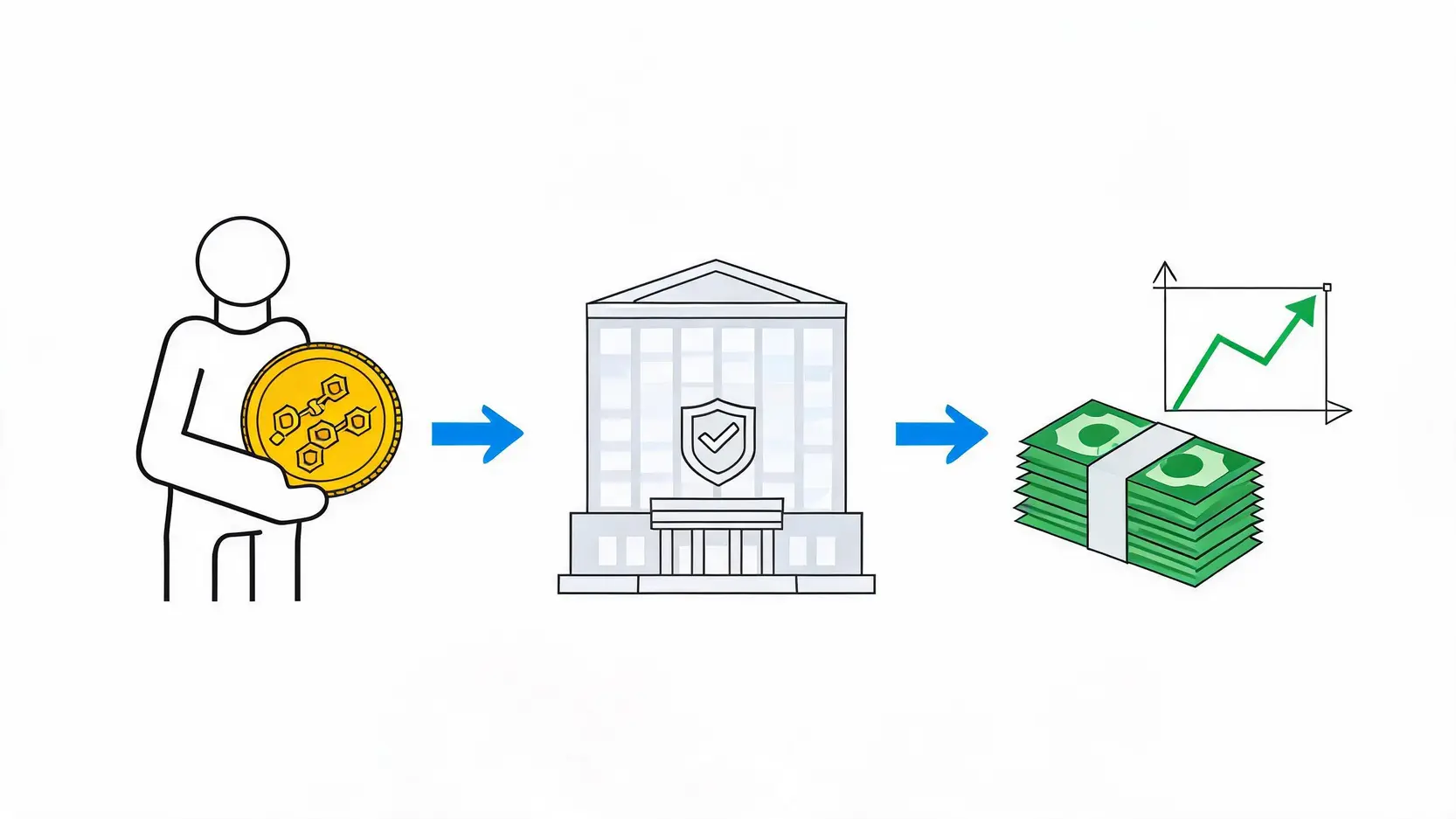
Illustration of the Hong Kong Compliant Virtual Asset Collateralized Financing Process
Further Reading (Highly Recommended)
Comprehensive Assessment of Tether Risks: An Essential USDT Safety Guide for Hong Kong Investors
A Comparative Analysis of Virtual Asset Margin Financing and Traditional Securities Financing
Although crypto asset collateralized lending and traditional stock-backed financing share similarities in operational logic, the fundamental differences in the underlying asset classes create completely different approaches to risk pricing and liquidity management. A deep understanding of these core differences is essential for investors participating in crypto financing through licensed brokers.
Valuation Haircut Requirements Caused by the High Volatility of Crypto Assets
In traditional finance, high-quality blue-chip stocks can often achieve loan-to-value (LTV) ratios of 60% or even higher. However, virtual assets experience extremely high intraday volatility. As a result, compliant platforms have introduced very strict valuation haircut mechanisms. Taking Bitcoin as an example, despite being the largest crypto asset by market capitalization, platforms generally apply haircut rates ranging from 20% to 30% when calculating its collateral value. Under extreme market volatility conditions, these haircut rates may even be dynamically adjusted downward by risk management algorithms. This means that BTC collateral worth US$100,000 may only support borrowing between US$50,000 and US$70,000 in fiat currency or stablecoins, ensuring that the platform maintains a sufficient safety buffer.
The Introduction of Market Maker Mechanisms and Liquidity Provision
Traditional stock markets operate within fixed opening and closing hours, making market maker risk exposure relatively easier to calculate and manage. However, maintaining deep liquidity in the 24/7 virtual asset market presents a significant challenge. One major highlight of the SFC’s latest policy is the permission granted for affiliated companies of licensed platforms to act as market makers. By introducing professional quantitative market-making institutions, platforms can effectively narrow bid-ask spreads and significantly reduce slippage losses for investors executing large contracts or facing liquidation events, thereby improving overall market pricing efficiency and system stability.
| Comparison Item |
Traditional Securities Margin Financing |
Compliant Virtual Asset Margin Financing |
| Trading Hours | Fixed Trading Hours (e.g. 09:30 – 16:00) | 24/7 Continuous Trading |
| Valuation Haircut | Lower (Usually 10% – 40%) | Higher and Dynamically Adjusted (Usually 20% – Above 50%) |
| Liquidation Mechanism | T+1 or T+2 Margin Call | Real-Time Monitoring With Automatic Forced Liquidation Upon Trigger Thresholds |
| Market Making and Liquidity | Traditional Market Makers, Opening and Closing Risks Are Controllable | Relies on Professional Crypto Market Makers to Handle Extreme Price Spike Volatility |
A Lifeline During Extreme Market Conditions: Forced Liquidation in Crypto Asset Margin Trading and Perpetual Contract Hedging Strategies
While enjoying improved capital efficiency, leverage is always a double-edged sword. For investors accustomed to traditional stock market rules, the brutality of the virtual asset market is often fully exposed during extreme market conditions. Mastering forced liquidation mechanisms and properly utilizing hedging tools are the only rules for survival in this zero-sum game.
Real-Time Margin Call Pressure in a 24/7 Market
Unlike traditional brokers, which usually issue margin calls on the following day and give investors time to arrange additional funds, crypto collateralized financing mechanisms operate through a “real-time monitoring and automatic liquidation” system. When Bitcoin experiences a flash crash at 3 a.m., causing your maintenance margin ratio to fall below the required threshold, the system will not wait until the next morning for you to transfer funds from your bank. Instead, it will immediately trigger forced liquidation without hesitation. This around-the-clock margin pressure requires investors to always maintain sufficient available funds or establish automated API alert mechanisms to guard against sudden market volatility.
How Compliant Platform Liquidation Engines Protect Clients From Negative Equity During Flash Crashes
“Negative equity” refers to a situation where investor losses exceed the account principal, exposing the platform to bad debt risk. To prevent such catastrophic outcomes, compliant VATPs must deploy highly advanced millisecond-level liquidation engines. When liquidation conditions are triggered, the system prioritizes partial liquidation instead of fully liquidating positions through a one-time market sell order, minimizing harmful impact on market prices as much as possible. At the same time, compliant platforms establish substantial insurance funds. In situations where extreme flash crash volatility causes liquidation prices to fall below bankruptcy prices and liquidation mechanisms fail, the insurance fund absorbs the bad debt difference, ensuring that the rights of profitable clients remain protected while preventing liquidated investors from bearing unlimited liability.
How Investors Can Use Perpetual Contracts to Hedge the Downside Risk of Spot Collateral
Now that the SFC has officially opened perpetual contract trading, smart capital can utilize it as an excellent hedging tool. Suppose you remain bullish on Bitcoin’s long-term macro value and therefore pledge your BTC as collateral to a platform in exchange for fiat currency to invest in other high-return opportunities. However, in the short term, you are concerned that US macroeconomic data may trigger a sharp correction in crypto prices. In this situation, you can use part of your remaining capital to open an equivalent Bitcoin perpetual contract short position on a compliant platform.
If Bitcoin prices fall as expected, although the value of your spot collateral declines and you face margin call risks, the unrealized profits from the perpetual contract short position will perfectly offset the spot losses, forming a professional “Delta-neutral” investment portfolio. With the implementation of the new regulatory framework, these institutional-grade spot-futures arbitrage and hedging strategies can finally operate fully within Hong Kong’s compliant market environment, adding an additional golden layer of protection for investor capital.

Using Perpetual Contracts for Delta-Neutral Risk Hedging Strategies
Frequently Asked Questions About Virtual Asset Margin Financing in Hong Kong
Q: What direct impact does this policy have on ordinary retail investors?
A: According to the SFC’s current high-level framework in 2026, perpetual contracts and high-leverage margin financing services remain primarily limited to professional investors (PIs) and institutional participants during the initial stage in order to strictly control market risks. Although ordinary retail investors may not yet have direct access to high-leverage derivative tools in the short term, they will still benefit from improved market depth and liquidity, resulting in better spot pricing and reduced trading slippage. As regulatory mechanisms mature and stress testing proves successful, participation requirements for retail investors may gradually and moderately loosen in the future.
Q: Can funds borrowed through crypto asset collateralization be withdrawn to purchase real-world assets?
A: This depends entirely on the internal compliance policies of the licensed institution providing the financing service. Under the current compliant framework, if you pledge Bitcoin to a broker and borrow fiat currency, as long as the source of funds is legitimate and fully complies with strict Anti-Money Laundering (AML) and Know Your Customer (KYC) regulations, investors may theoretically withdraw the borrowed fiat currency into their linked traditional bank accounts for purposes such as purchasing real estate, expanding business operations, or investing in other traditional financial products, thereby achieving seamless integration between digital assets and the real economy.
Q: What are the typical financing interest rates offered by compliant platforms?
A: Financing interest rates in compliant markets are not fixed and fluctuate dynamically based on overall market supply and demand for capital, traditional benchmark interest rates such as the US SOFR rate, and crypto market bull and bear cycles. Under the current 2026 market environment, annualized collateralized lending rates for mainstream assets such as BTC and ETH generally range between 6% and 12%. Compared with unsecured decentralized finance (DeFi) protocols, compliant platforms provide significantly higher levels of capital security and legal protection, resulting in relatively stable and highly transparent interest rate pricing.
Q: Does the perpetual contract funding rate affect margin?
A: Absolutely. Perpetual contracts are able to operate without settlement dates because the funding rate mechanism keeps contract prices closely anchored to spot prices. When the market becomes strongly bullish and contracts trade at a premium, long positions must periodically pay funding fees to short positions, and these fees are directly deducted from your available margin balance. If investors maintain positions for extended periods while funding rates remain elevated, these “holding costs” will continuously erode margin balances and significantly increase the risk of forced liquidation. This is one of the most critical indicators that perpetual contract traders must monitor closely.
Conclusion: Seize the Opportunities of Crypto Collateralized Financing Mechanisms While Strictly Maintaining Risk Control Discipline
Hong Kong’s full opening of crypto collateralized financing mechanisms and perpetual contracts in 2026 is undoubtedly a historic milestone marking the maturation of Asia’s virtual asset market into a sophisticated financial derivatives ecosystem. This development not only fully opens capital flow channels between traditional finance and the Web3 world, but also allows capable investors to significantly improve capital efficiency within a secure, transparent, and highly regulated environment.
However, the evolution of financial investment tools inevitably comes with increasingly complex layers of risk. In the highly volatile crypto market, which operates continuously 24 hours a day, liquidity can evaporate instantly and violent price fluctuations can occur without warning at any time. Whether you are an aggressive trader seeking leveraged amplification or a long-term holder aiming to activate the value of idle crypto assets, it is essential to deeply understand the harsh operational logic behind valuation haircuts, dynamic margin requirements, and forced liquidation engines. Only by establishing flawless position management discipline and flexibly utilizing perpetual contracts for scientific risk hedging can investors move steadily through this wave of compliant market opportunities and maintain long-term market survival.
Related Articles
-
US PPI Comes in Below Expectations: Is Inflation Cooling? Understand the Impact on the Stock Market, Interest Rate Hikes, and Your Wallet The recently released US Producer Price Index (PPI) once again came in below market expectations, sparking optimism that inflation is cooling. What exactly does this key US PPI...2026 年 7 月 21 日
-
PPI and CPI Surge: Is the Inflation Monster Coming? Understand the Two Key Indicators and Protect Your Wallet! Have you recently felt that your money is worth less and less, with the price of everything rising except your salary? Everyone is talking about “inflation”, but where exactly does this monster...2026 年 7 月 21 日
-
When Oil Prices Rise, Which Currencies Benefit? Understanding Investment Strategies for Crude Oil Currency Pairs What Are Crude Oil Currencies? Uncovering the Relationship Between Oil Prices and Forex As volatility in the global energy market intensifies, every movement in crude oil prices affects the foreign exchange market. For perceptive investors,...2026 年 7 月 21 日