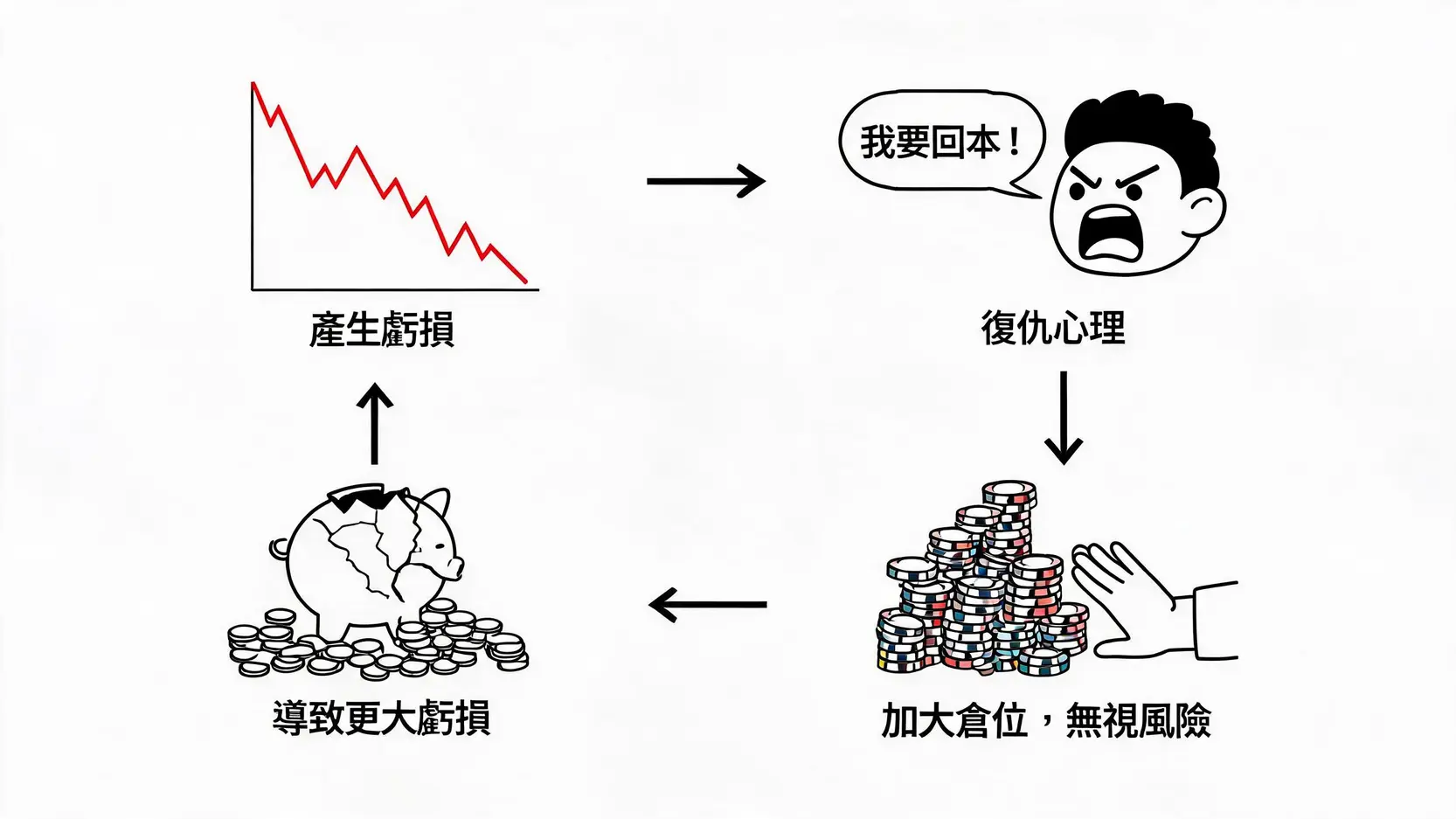
The Destructive Cycle of Revenge Trading
Solution Strategy: Data-Driven Thinking and Maximum Daily Loss Limits
To break this vicious cycle, you must force yourself back toward rationality and data-driven thinking.
- Think in Probabilities: Understand that every trade is an independent probability event within your strategy. Past outcomes do not influence future outcomes. Focus only on correctly executing valid setups within your system.
- Establish a “Circuit Breaker”: Set a maximum daily or weekly loss limit for yourself, (such as 3% of total capital). Once this limit is reached, immediately stop trading, shut down the computer, and leave the market. This effectively prevents continuous emotional losses caused by loss of control.
Mental Barrier 4: Confirmation Bias, You Only See What You Want to See
Confirmation bias is a powerful psychological tendency in which people unconsciously seek, interpret, and remember information that confirms their existing beliefs while ignoring or dismissing evidence that contradicts them. In trading, this becomes a silent killer.
Why Are You Always Looking for Reasons to Support Your Existing Position?
When holding long positions, you naturally focus more on bullish news and search charts for any signal supporting price increases while ignoring bearish news or downside signals. Conversely, when holding short positions, you become especially sensitive to negative information. This bias prevents you from objectively evaluating the complete market picture and traps you inside your own subjective assumptions.
How Social Media and “Echo Chambers” Intensify Your Biases
Modern algorithm-driven recommendation systems have made confirmation bias even more severe. Once you follow influencers on social media who are bullish on a particular asset, your entire information feed becomes filled with bullish opinions, forming an “information echo chamber”. This creates the illusion that everyone in the market shares your perspective, reinforcing your beliefs while causing you to lose awareness of opposing risks.
This phenomenon originates from the shortcuts the human brain uses to process information. Nobel Prize-winning economist Daniel Kahneman provided deep analysis of such cognitive biases through his behavioral economics research. Understanding the existence of these biases is the first step toward making more rational decisions.
Solution Strategy: Build a Contrarian Checklist and Objectively Review Trading Journals
- Build a Contrarian Checklist: Before making any trading decision, force yourself to write down at least three reasons for “againsting the trade”. For example, if you want to go long, actively search for bearish technical signals, fundamental concerns, or negative sentiment indicators.
- Objectively Review Trading Journals: Regularly review your trading records, not only your profitable trades but especially your losing trades. Ask yourself: Did I ignore obvious opposing signals at the time? Did confirmation bias cause me to miss the correct exit opportunity?
- Follow Contrarian Opinion Leaders: Intentionally follow analysts who hold opposing views but present clear logic. This helps you receive balanced information and avoid falling into information echo chambers.
Trading Psychology Stage Matrix (TPSM)
Understanding mental barriers is only the first step, but how can you evaluate your current psychological condition? This “Trading Psychology Stage Matrix” (TPSM) can help you identify your current stage and discover areas for improvement. Please honestly evaluate which stage description best matches you across the following three dimensions.
| Dimension |
Stage 1: Unconscious Beginner |
Stage 2: Struggling Survivor |
Stage 3: Consistent Executor |
| Dimension 1: Discipline Execution |
Trades based on feelings without a fixed strategy, frequently changing methods. |
Has a trading plan, but often fails to execute it strictly due to emotions, occasionally modifying stop-loss or take-profit levels impulsively. |
Executes the trading plan with machine-like discipline, regardless of how fearful or greedy they feel internally. |
| Dimension 2: Emotional Control |
Experiences extreme emotional swings while trading, feeling euphoric during profits and depressed during losses, sometimes even affecting daily life. |
Attempts to control emotions, but is still affected by large floating profits or losses, with occasional impulsive trades occurring. |
Views trading as a probability-based business and experiences almost no emotional fluctuation from the profit or loss of individual trades. |
| Dimension 3: Reaction to Losses |
Unable to accept losses, tending to hold losing positions, average down, or even engage in revenge trading. |
Accepts that losses are part of trading, but still feels frustrated after consecutive losses and may begin doubting the strategy. |
Treats losses as operating costs and learning opportunities, objectively reviews losses afterward, and calmly waits for the next trading opportunity. |
Evaluate Your Current Stage and Areas for Improvement:
Which stage of trader are you currently in? If you find yourself mostly in Stage 1 or Stage 2, there is no need to feel discouraged. It means you have already become aware of the problem. Your top priority should be building and strictly following a complete trading system while establishing a risk management “circuit breaker” mechanism. If you have already entered Stage 3, congratulations, you are on the path toward becoming a professional trader. Your ongoing tasks are continuous improvement and maintaining humility.
FAQ
Q: Is Trading Psychology Based on Talent, or Can It Be Trained Later?
A: Although some people may naturally be calmer and more patient, strong trading psychology is absolutely not a talent. Like building muscle, it can be developed through deliberate practice and training. The key lies in continuous self-awareness, disciplined execution, and systematic review processes. No one is born a master trader. Every successful trader has gone through a long battle against their inner psychological demons.
Q: Why Is It That Even After Reading Many Trading Psychology Books, I Still Cannot Execute Properly in Real Trading?
A: This is similar to watching countless swimming tutorials without ever entering the water. Trading psychology knowledge represents “understanding”, while real trading represents “execution”. Knowing does not equal doing, and the gap between them is enormous. You must transform concepts from books into specific action rules, such as creating trading checklists, maintaining trading journals, and setting maximum loss limits. Only through repeatedly practicing correct behavior can knowledge eventually become a trading instinct.
Q: Why Do I Perform Well on a demo account but Fail Once Real Money Is Involved?
A: This is one of the most common problems because demo accounts lack the most critical factor: real financial pressure. In a demo account, losses are merely numbers and do not create emotional pain, while profits are also just numbers and do not create emotional excitement. However, once real money is involved, emotions such as fear and greed become infinitely amplified. It is recommended to begin live trading with extremely small position sizes (such as risking no more than the cost of a single lunch per trade), allowing yourself to gradually adapt to the psychological pressure of real markets before slowly increasing position sizes.
Q: How Can I Differentiate Between Sticking to a Strategy and Being Stubborn?
A: This is an excellent question. Sticking to a strategy means continuing to execute your trading plan as long as the market has not provided clear evidence that the strategy has failed. Stubbornness, on the other hand, usually comes from confirmation bias and the unwillingness to admit being wrong, even when the market has already presented obvious opposing evidence. The key difference lies in “objective evidence”. Your trading system must include clear “failure conditions”. When these conditions appear, you must acknowledge that the strategy may need adjustment or temporary suspension. That is discipline, not stubbornness.
Conclusion
Mastering trading psychology is the key dividing line between amateur and professional traders. It is not a vague theory, but a structured process of self-training and mindset development. This journey requires us to train our minds through continuous self-awareness and deliberate practice, just as athletes train their bodies. By facing and overcoming the five major mental barriers of fear, greed, gambler’s fallacy, and confirmation bias, while continuously evaluating yourself through self-assessment frameworks, you can truly achieve alignment between knowledge and execution. In doing so, carefully planned strategies, rather than impulsive emotions, will guide every trading decision you make