Break Revenge Trading: Escape Loss & Liquidation Loop

How to Break Free From Revenge Trading: 4 Steps to Escape the Death Spiral of Losses, Overleveraging, and Liquidation
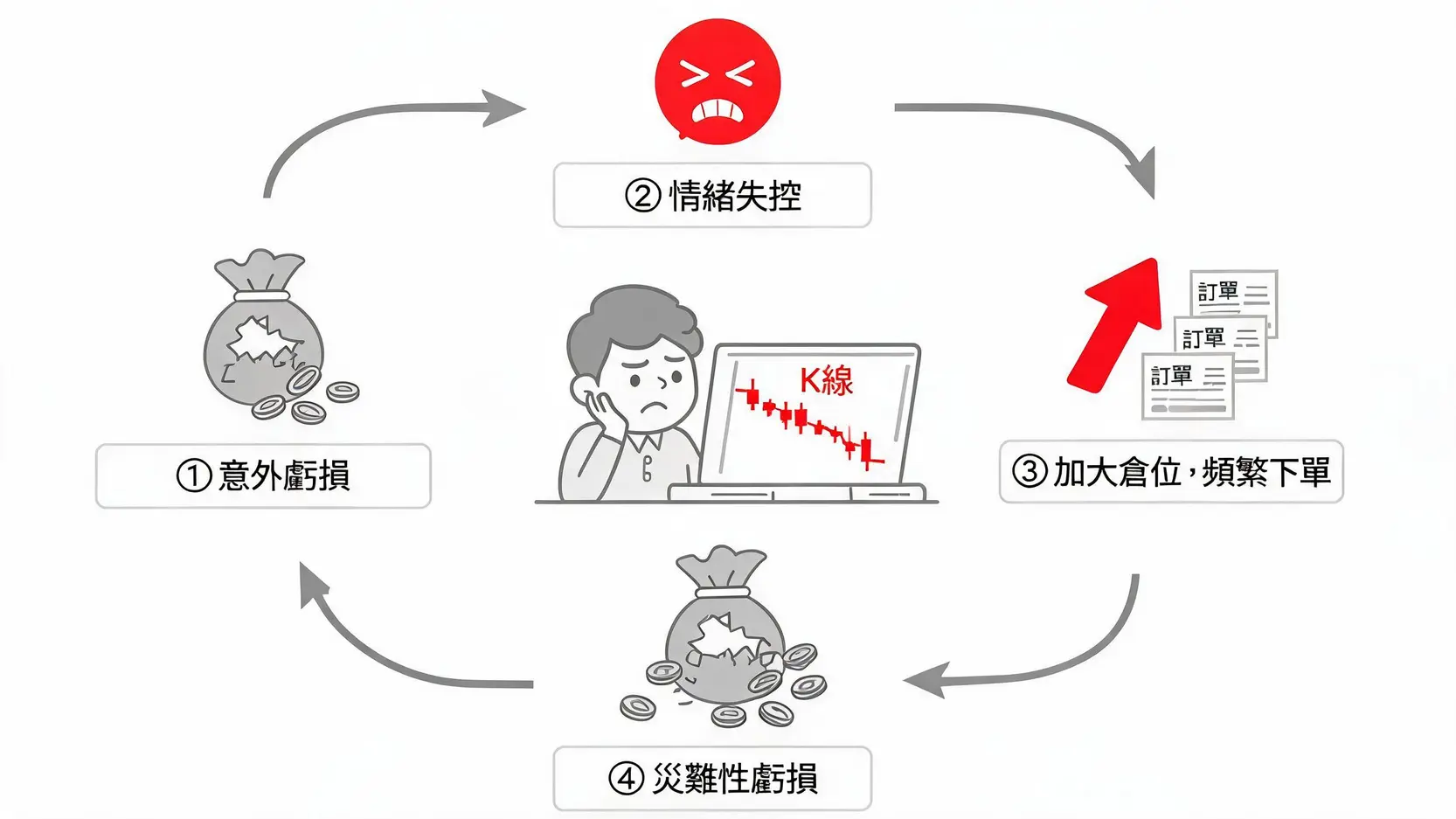
After an unexpected loss, have you ever felt your heart racing, anger boiling inside you, and only one thought filling your mind: “I must recover my losses immediately!”? This unwillingness to accept defeat drives you to increase position sizes and place trades more frequently, trying to “win it all back”. If this scenario feels familiar, then you have likely fallen into the deadly trap of “Revenge Trading”. This is not only a common trading psychology disorder, but also the number one reason why small account losses rapidly evolve into catastrophic liquidations. To escape this situation, you need a systematic method for breaking free from revenge trading. This article will deeply analyze the psychological causes behind emotional loss of control after losses and provide a practical four-step guide, from recognition to elimination, helping you cut off the inner demons and regain control of your trading.

The Death Spiral of Revenge Trading: A Vicious Cycle Driven by Losses and Emotions
Step 1: Recognition and Acceptance, The Early Warning Signs of Revenge Trading
The first step in breaking any bad habit is becoming aware of its existence. Revenge trading is like a hidden demon that appears when you are at your weakest. Learning to identify its early warning signs is the key to preventing it from completely taking over your mind. These signals can be observed from three levels: physiological, psychological, and behavioral.
Physiological Signals: The Red Alerts Sent by Your Body
When intense emotions are triggered, your body is often the first to react. These physiological changes are direct responses from your autonomic nervous system and are almost impossible to hide. When you notice the following symptoms, you must remain alert:
- Rapid Heartbeat: Feeling like your heart is about to burst out of your chest, even while simply sitting in front of the screen.
- Sweaty or Cold Palms: A classic sign of an adrenaline surge, indicating that you are entering a highly stressful “fight or flight” state.
- Short and Rapid Breathing: Unconsciously holding your breath or breathing faster, reducing oxygen supply to the brain and further impairing decision-making.
- Muscle Tension: Especially in the shoulders, neck, and jaw, as your body unconsciously enters a defensive posture.
These physiological signals are your body telling you: “Something is wrong right now, stop for a moment!” Learning to listen to these warnings is the first line of defense against emotions overpowering rationality.
Psychological Signals: The Inner Monologue of “I Must Win”
At the same time as the physiological reactions, a series of irrational and biased thoughts will begin appearing in your mind. These psychological signals are the core driving force behind revenge trading. They may sound persuasive, but they are poisonous paths toward destruction:
- “I must recover my losses immediately!”: This is the most classic thought pattern. It distorts the purpose of trading from “executing a strategy” into “recovering losses”, making you focus on an uncontrollable outcome.
- “The market is targeting me!”: Blaming random losses on malicious market behavior creates a victim mentality. This mindset makes you feel like you are fighting the market instead of following it.
- “The next trade will definitely be right!”: Blindly believing the next trade will recover your losses without any technical analysis support is no different from gambling behavior.
- “I cannot end the day with a loss.”: This obsession forces you to keep trading until you are mentally exhausted or your account is liquidated, completely ignoring whether the market still offers valid opportunities.
Behavioral Signals: The Complete Collapse of Trading Discipline
Once both physiology and psychology are hijacked by emotions, your behavior begins spiraling out of control. These behaviors are the direct causes of substantial losses and are the most observable warning signs:
- Ignoring the Trading Plan: Randomly entering trades while disregarding pre-defined entry points, exit points, signals, and strategies. Your trading plan effectively becomes meaningless.
- Randomly Increasing Position Sizes and Leverage: Attempting to recover multiple small losses with one oversized trade is the fastest shortcut toward liquidation.
- Over-Trading: Executing large numbers of trades within short periods, chasing every small price movement in hopes of gradually recovering losses.
- Removing or Moving Stop-Losses: When price approaches your stop-loss level, you move it further away while hoping for a reversal. This is one of the biggest taboos in trading and the complete opposite of proper loss management.
When you notice yourself displaying multiple signals simultaneously, you can almost certainly conclude that you have entered a revenge trading state. At this point, acknowledging the problem is the beginning of solving it. Do not blame yourself. Instead, immediately proceed to the next step.
Step 2: Physical Separation, Cutting Off the Connection Between Emotions and Trading
Once you recognize that you are caught in the storm of revenge trading, the most effective and direct solution is “physical separation”. Your goal is to forcibly disconnect emotions from the trading buttons, giving your brain a chance to calm down. This step does not require complicated psychological techniques, only determined execution.
The “Shut Down and Cool Off” Method: Force Yourself Away From the Trading Desk After Losses
This is an extremely simple yet highly effective strategy. Once you realize emotions are taking over, perform the following steps:
- Immediately Close All Positions: Do not hesitate or overthink. In your current emotional state, you are no longer capable of making rational decisions, and holding positions will only increase anxiety.
- Close All Trading Software: Out of sight, out of mind. Remove the visual source of stimulation.
- Leave Your Trading Environment: Stand up and physically leave the room. Physical movement helps break emotional stagnation.
- Set a Timer and Force Yourself to Rest for at Least 30 Minutes: During this time, absolutely avoid checking charts, thinking about trades, or consuming any trading-related information.
This 30-minute “cooling-off period” is critical. It allows your heartbeat to normalize, your adrenaline levels to decline, and your brain’s rational thinking center to regain control.
Set a “Maximum Daily Loss Limit”: Your Trading Circuit Breaker
Prevention is always better than treatment. Rather than waiting for emotions to spiral out of control, establish an unbreakable boundary in advance. This boundary is your “maximum daily loss limit”.
- How to Set It: Generally, it is recommended to set it at 1%-2% of total capital. For example, for a US$10,000 account, the maximum daily loss limit would be US$100-US$200.
- How to Execute It: Once total daily losses reach this limit, immediately stop all trading. Close the software and end trading for the day. No matter how “perfect” later opportunities appear, do not touch them.
- Importance: This acts like a circuit breaker installed in your account. It protects you from catastrophic losses when you are at your worst mental state. This is also one of the most fundamental principles of forex trading risk management.
Find Replacement Behaviors: Transform Negative Energy Into Positive Action
During the cooling-off period away from the trading desk, you need activities that shift your attention and help stabilize your emotions more quickly. These “replacement behaviors” should ideally engage both your mind and body:
- Exercise: Go for a walk, run, or do several push-ups. Exercise releases endorphins, natural mood-enhancing chemicals that effectively reduce stress and anxiety.
- Practice Meditation or Deep Breathing: Focus entirely on your breathing and shift your attention away from the market and your losses. Simple abdominal breathing techniques, (such as inhaling for 4 seconds, holding for 4 seconds, and exhaling for 6 seconds) can effectively reduce heart rate.
- Talk to Someone: Speak with a friend or family member who is unrelated to trading. Discuss topics completely unrelated to markets. Pull yourself out of the isolated trading world.
- Read or Listen to Music: Choose relaxing books or music that help calm your thoughts.
Through physical separation, you create a valuable buffer zone that prevents emotional wildfire from burning down your entire account.
Further Reading (Highly Recommended)
Step 3: Cognitive Restructuring, Changing Your Perspective on Losses
Simply suppressing emotions through physical separation is not enough because it only treats the symptoms, not the root cause. To truly break free from revenge trading, you must reshape your perception of “losses”. Most traders view losses as personal failure, incompetence, or malicious attacks from the market. This flawed perception is precisely the breeding ground for revenge-driven emotions.
Accept That Losses Are a Normal Part of Trading, Not Personal Failure
Successful traders understand one basic truth: losses are part of the business cost of trading, just like restaurants must pay for ingredients and rent. No trading system can achieve a 100% win rate. Pursuing perfect trades and trying to capture every market movement is unrealistic fantasy.
- Embrace Probabilistic Thinking: Trading is a probability-based game. Your goal is not to win every trade, but to ensure your total profits exceed your total losses. Understanding this allows you to calmly accept individual losses. As many trading psychology articles emphasize, professionals focus on expectancy rather than individual wins or losses.
- Distinguish Between “Good Losses” and “Bad Losses”:
- Good Losses: You followed your trading plan completely, but the market moved against expectations and hit your stop-loss. This is part of the system and should be accepted.
- Bad Losses: Losses caused by violating trading discipline, emotionally opening positions, failing to set stop-losses, or moving stop-losses. These are the losses you must review and avoid.

Not All Losses Are Equal: The Key Is Whether You Followed Trading Discipline
Once you stop tying losses to your self-worth and instead view them as neutral and necessary operating costs, their emotional destructive power will decrease dramatically.
Writing a Trading Journal: Objectively Reviewing the Causes of Losses Instead of Emotionally Venting
A trading journal is one of the best tools for helping you achieve cognitive restructuring. It forces you to shift from being a subjective emotional participant into an objective data analyst. When recording every losing trade, ask yourself the following questions:
- What was the reason for entering the trade? Did the technical indicators and market structure at the time align with my strategy?
- Was the stop-loss placement reasonable? Was it based on volatility or key support and resistance levels?
- Did I fully follow my trading plan? At which point did hesitation or emotional weakness appear?
- Was this loss a normal drawdown within the strategy, or was it caused by my own mistakes?
- What was my psychological state at the time? Did I feel greed, fear, or impatience?
Through continuous review, you will realize that most painful losses are usually caused by a lack of discipline rather than strategy failure. This helps shift your focus away from “the market caused me to lose money” toward “how can I improve my execution?” This is a critical step in growth.
Focus on the “Process” Instead of the “Outcome”: Did I Follow My Discipline?
In the trading world, the outcome of any individual trade is random and uncontrollable. However, the “process” of trading, including your analysis, planning, execution, and risk management, is entirely within your control. The key to overcoming revenge trading is shifting your self-evaluation standards away from “results” and toward “process”.
At the end of each trading day, instead of asking yourself “Did I make money or lose money today?”, you should ask:
- “Did I follow my trading system 100% today?”
- “Did I properly manage the risk of every trade?”
- “When emotions appeared, did I recognize them quickly and take corrective action?”
As long as your answer to these questions is “yes”, then even if the day ended in losses, you are still a successful trader. This is because you are doing the right things, and as long as you continue doing the right things, long-term positive outcomes (meaning profitability) become only a matter of time. This shift in mindset allows you to free yourself from the pain of losses and achieve inner calm.
Step 4: Build a Firewall, A “Behavioral Contract” Template
The first three steps help you recognize, isolate, and cognitively restructure revenge trading. This final step is about building a solid “firewall” for your trading career. This firewall is your “Behavioral Contract”, a written commitment between you and yourself that contains clear rules along with reward and punishment mechanisms.
What Is a Behavioral Contract? A Sacred Commitment to Yourself
A Behavioral Contract is a psychological tool designed to strengthen self-control by turning commitments into concrete and structured rules. In trading, it transforms vague thoughts such as “I should stay disciplined” into specific, executable, and measurable action guidelines. When you personally write and sign this contract, you establish a higher standard for your own behavior.
Template Content: Clearly Define Trigger Conditions, Response Actions, and Reward/Punishment Mechanisms
An effective trading behavioral contract should contain at least the following three core sections. You may modify them according to your own situation, then print the contract and place it beside your trading screen in the most visible location.
My Trading Discipline Behavioral Contract
I, (Your Name), hereby solemnly commit that, in order to protect my trading capital and mental well-being, I will strictly follow the rules below:
| Trigger Condition |
Response Action |
Reward and Punishment Mechanism |
| 1. When daily losses reach 2% of total capital. | Immediately close all positions, shut down the trading software, and end trading for the day. | Reward for Compliance: Transfer 10% of the potential excess losses avoided that day into an entertainment account.
Punishment for Violation: Reduce the next day’s trading size by half and prohibit trading high-risk instruments. |
| 2. After 3 consecutive losing trades. | Force myself to leave the trading desk for at least 1 hour and review the trading journal for those 3 losing trades. | Reward for Compliance: After completing the review process, allow myself to perform one demo account trade to regain rhythm.
Punishment for Violation: Prohibit trading for the remainder of the day. |
| 3. When thoughts such as “I must recover my losses” or “the market is targeting me” appear. | Immediately stop placing trades, stand up, take 10 deep breaths, and read my trading principles out loud. | Reward for Compliance: Make myself a good cup of tea or coffee as a reward for my self-awareness.
Punishment for Violation: If an unauthorized emotional trade is placed because of this, 50% of the profit (or loss) amount from that trade must be donated to charity. |
| 4. Placing trades impulsively without prior planning. | Before placing any trade, force myself to write down the entry logic, exit logic, and stop-loss logic for that trade on paper. | Reward for Compliance: Conduct weekly statistics, and if 95% of trades were planned in advance, reward myself with a great meal.
Punishment for Violation: Profits from that impulsive trade cannot be included in total profits, while losses must still be fully counted. |
Signed By: ___________________
Date: ___________________
How to Make a Behavioral Contract More Effective? Find an Accountability Partner or Make a Public Commitment
To further strengthen the effectiveness of your contract, you may consider the following two methods:
- Find an Accountability Partner: Share your contract with a trusted family member, friend, or fellow trader. Ask them to remind you when you appear to be losing discipline, or regularly report your execution progress to them. External accountability pressure can significantly improve compliance.
- Make a Public Commitment: If you have your own social media account or blog, consider publicly sharing parts of your contract. Public commitments leverage people’s natural desire to remain consistent with their words and actions, giving you stronger internal motivation.
This behavioral contract is not a set of chains, but a shield designed to protect you. It provides a clear code of conduct amid the violent waves of the market, preventing you from losing direction within emotional turmoil.
Further Reading (Highly Recommended)
FAQ About Breaking Free From Revenge Trading
Q: Can Consecutive Small Losses Also Trigger Revenge Trading?
A: Absolutely. In fact, consecutive small losses, often referred to as “death by a thousand cuts”, are one of the most common causes of revenge trading. A single large loss delivers a massive shock, which may actually cause traders to stop trading temporarily out of fear. However, continuous small losses gradually accumulate frustration and unwillingness to accept failure, causing traders to think, “How can I keep being wrong?”, which often leads to larger revenge-driven attempts to recover everything at once.
Q: If I Have Already Fallen Into Revenge Trading, What Should I Do Immediately?
A: The most important and only correct action is: stop immediately. Do not try to “win back one last trade” or “wait for price to return to breakeven”. Immediately, unconditionally, and without hesitation close all positions. Then execute the “shut down and cool off” method mentioned in Step 2: close the trading software and walk away from the computer. This is the highest level of stop-loss discipline, not just stopping financial losses, but also stopping emotional and behavioral losses.
Q: How Long Does the Recovery Process Usually Take?
A: Breaking free from revenge trading is a long-term process of self-discipline and self-improvement. There is no fixed timeline. It is more like fitness training, requiring continuous practice and maintenance. In the early stages, it may take weeks or even months to build new habits and thought patterns. However, even after becoming a mature trader, these psychological demons may return during periods of stress or poor mental condition. Therefore, these four steps should become permanent core principles throughout your trading career rather than a one-time treatment plan.
Q: Is Revenge Trading the Same as Gambling Addiction?
A: The two are highly related, but not completely identical. Revenge trading is a form of trading psychology disorder, primarily driven by the inability to accept losses and the desperate urge to recover money quickly. Gambling addiction, on the other hand, is a broader impulse-control disorder. However, if revenge trading behavior remains uncontrolled over long periods, occurs frequently, and severely impacts your finances and personal life, it can indeed evolve into or coexist with gambling addiction characteristics. In severe cases, seeking help from a professional psychological counselor is necessary.

From Recognition to Elimination: A Four-Step Practical Guide to Breaking Free From Revenge Trading.
Conclusion
Breaking free from revenge trading is a difficult battle against your inner psychological demons, and its importance is no less critical than any technical analysis or market strategy. This battle does not require more precise indicators, but stronger self-control, stricter discipline, and deeper self-awareness. Through the four major steps introduced in this article, recognizing warning signs, physical separation, cognitive restructuring, and establishing behavioral contracts, you can gradually build an unbreakable psychological firewall. Always remember that the market will always exist, and opportunities will always return, but your capital only exists once. Treat every loss as tuition for learning rather than something that demands revenge. Only then can you truly keep losses within planned limits, escape the deadly spiral of “losses → overleveraging → liquidation”, and steadily move toward the path of becoming a professional trader capable of achieving long-term stable profitability.
Related Articles
-
How to Get Started with Bitcoin? The Complete 2026 Bitcoin Buying Guide for Beginners After watching Bitcoin repeatedly reach new highs in recent years and successfully pass spot ETF reviews in the US and Hong Kong in 2024, officially entering mainstream financial markets, many investors have turned their attention to...2026 年 7 月 20 日
-
Is Gold’s V-Shaped Rebound a Bottom-Fishing Signal? A Complete Guide to Trading Strategies Amid “$100 Price Swings” What Is a Gold V-Shaped Rebound? More Than Just a Technical Pattern The gold market has recently experienced sharp rises and falls, with prices frequently displaying dramatic “gold V-shaped rebounds”. Single-day “$100 price...2026 年 7 月 20 日
-
What Is PPI Data? 2026 Latest Analysis: Understand the Differences from CPI and How It Affects Stock Market Trends With market information constantly changing, do you always hold your breath while waiting for CPI data to be released? But did you know that a more forward-looking inflation indicator, PPI data...2026 年 7 月 20 日