Futures Stop-Loss & Take-Profit Guide (Pro Tips)

Updated: 2026/04/16  |  CashbackIsland

futures-stop-loss-take-profit-guide

Ultimate Guide to Futures Stop-Loss and Take-Profit: Avoid Liquidation, 5 Stop-Loss and Take-Profit Setting Techniques Used by Professional Traders

Have you ever missed the best exit timing in the futures market due to a moment of hesitation, allowing profits to slip away or even turn into losses? Or refused to cut losses, only to end up facing the painful outcome of liquidation? This article will completely change your trading dilemma. Successful futures trading is often not determined by accurately predicting the market, but by precise risk management, with the core being “how to set stop-loss and take-profit”. This article will break down in detail the futures stop-loss setting methods and futures take-profit techniques used by professional traders, helping you build a stable trading system and break free from the cycle of losses driven by intuition. 


Why Stop-Loss and Take-Profit Are the Lifeline of Futures Trading?

In the highly volatile futures market, stop-loss and take-profit are not just trading techniques, but the lifeline that determines whether a trader can survive in the long run. It transforms trading from a gamble into a strategic and disciplined risk management game.


Control Maximum Loss: Set Stop-Loss Levels to Protect Your Trading Capital

Imagine your trading capital as your army on the battlefield. The stop-loss level is the “retreat defense line” you set in advance. Once the situation turns unfavorable and the price reaches this line, you immediately withdraw decisively to preserve your strength. Without this defense line, a single mistaken trade could wipe out your entire army (liquidation). Setting a stop-loss level means that before entering a trade, you already know the maximum loss you can bear, ensuring you will not be eliminated from the market due to a single failed trade.


Overcome Human Weakness: Use Discipline to Defeat Greed and Fear

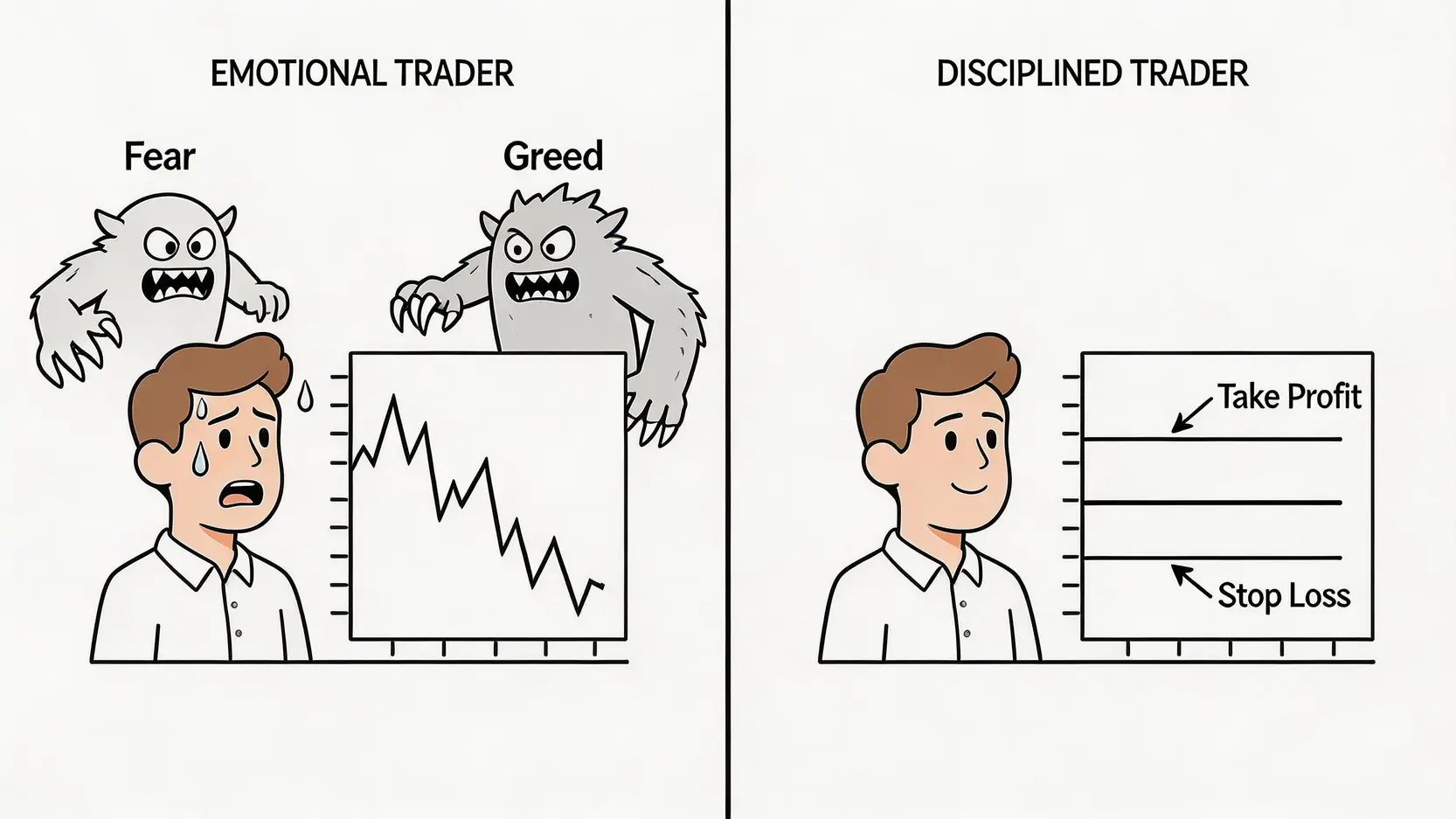
The hardest part of trading is not analyzing the market, but overcoming yourself. When facing losses, human “fear” leads people to hold losing positions, hoping for a reversal, resulting in greater losses; when facing profits, human “greed” drives people to seek more gains and delay closing positions, ultimately losing what they have already earned. Pre-set stop-loss and take-profit levels act like an emotionless strategist, helping you overcome emotional fluctuations and execute your trading plan with iron discipline, avoiding impulsive decisions.

交易者在貪婪與恐懼的情緒影響下做出錯誤決策,與有紀律的交易者使用止損止盈策略形成對比的示意圖。

Stop-Loss and Take-Profit: Use Discipline to Defeat Greed and Fear in Trading.


Lock in Deserved Profits: Master Take-Profit Techniques to Turn Floating Gains into Real Returns

Floating profits (Unrealized Profit) on paper are ultimately just numbers that can disappear at any time due to market reversals. A professional trader must not only know how to control losses but also how to lock in profits. Effective futures take-profit techniques can help you convert these floating gains into actual funds in your account. Only by mastering take-profit can you truly enjoy the rewards of trading success and accumulate capital for the next trade.


Further Reading (Highly Recommended)

【Futures Margin Tutorial】Understand Margin Meaning, Calculation Methods, and Risk Management in One Article

Comprehensive Analysis of Cryptocurrency and Futures Rebate Systems, Easily Reduce Trading Costs!


3 Core Futures Stop-Loss Setting Methods

Setting stop-loss levels is not about randomly drawing a line, but requires decisions based on strategy and market conditions. The following are three of the most mainstream and practical methods, suitable for traders at different stages from beginner to advanced.

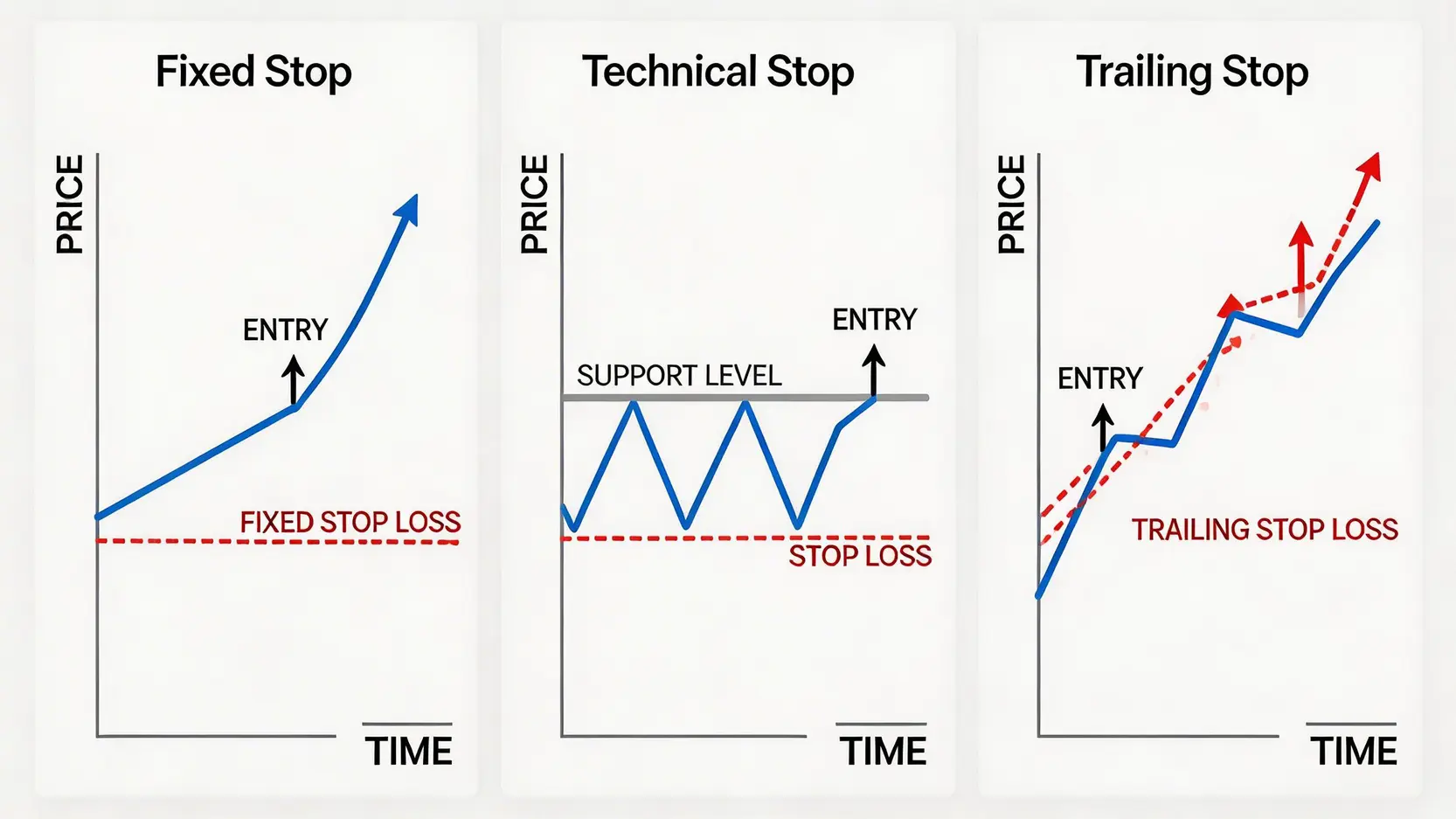
三種期貨止損設定方法的比較圖:固定點數法、技術分析法與移動止損法。

Comparison of the Principles of Three Mainstream Stop-Loss Setting Methods.


Fixed Points/Percentage Stop-Loss Method: The Most Intuitive Beginner Option

This is the simplest and most direct method, ideal for beginners. Traders set a fixed loss limit before entering a trade.

  • Fixed points: For example, when trading Hang Seng Index futures, set the stop-loss 100 points below the entry price.
  • Fixed percentage: For example, set the maximum loss per trade at 2% of total capital. If your account has 10,000 US dollars, the maximum loss is 200 US dollars.

✅ Advantages: Simple and easy to execute, strictly controls loss per trade.

❌ Disadvantages: Relatively subjective and ignores market volatility. In high volatility, it may be easily “stopped out”, while in low volatility, it may be set too wide.


Technical Analysis Stop-Loss Method: Use Support and Resistance Levels and Candlestick Patterns to Set Key Defense Points

This is the method used by most professional traders. It makes your stop-loss settings more justified and truly integrates market structure into your strategy. To learn more, refer to the technical analysis beginner tutorial.

  • Support and resistance levels: In long positions, set the stop-loss below key support levels; in short positions, set it above key resistance levels. These areas are often critical battlegrounds between buyers and sellers, and once broken, may indicate a trend reversal.
  • Candlestick patterns: Use key candlesticks or pattern combinations, such as the lowest point of a long lower shadow or the boundary of an engulfing pattern, as stop-loss levels.
  • Technical indicators: For example, set stop-loss on the opposite side of the Moving Average, or use the ATR (Average True Range) indicator to calculate a reasonable stop-loss distance.

✅ Advantages: Objective and logical, aligned with market structure, with more meaningful stop-loss levels.

❌ Disadvantages: Requires a certain level of technical analysis skills.


Trailing Stop: A Smart Strategy to Let Profits Run While Protecting Gains

Trailing stop is a dynamic stop-loss strategy that automatically adjusts as the market price moves in your favor. Simply put, it is a stop-loss that “only moves forward, never backward”. For example, after opening a long position, you set a 50-point trailing stop. If the price rises by 100 points, your stop-loss moves from 50 points below the entry price to 50 points above it, putting your trade in a risk-free position. If the price continues to rise, the stop-loss will keep moving up, always maintaining a 50-point distance from the highest price. This is a very powerful tool. For an authoritative explanation, refer to the concept of Trailing Stop.

✅ Advantages: Effectively locks in profits and “allows profits to run” during trending markets, with the potential to capture large market moves.

❌ Disadvantages: In ranging markets, it may be triggered too early due to minor pullbacks.


2 Efficient Futures Take-Profit Techniques to Help You Stop Missing Opportunities

Knowing how to stop-loss is survival, but knowing how to take-profit is what leads to success. A good take-profit strategy allows you to steadily lock profits into your pocket and avoid missing opportunities due to greed.

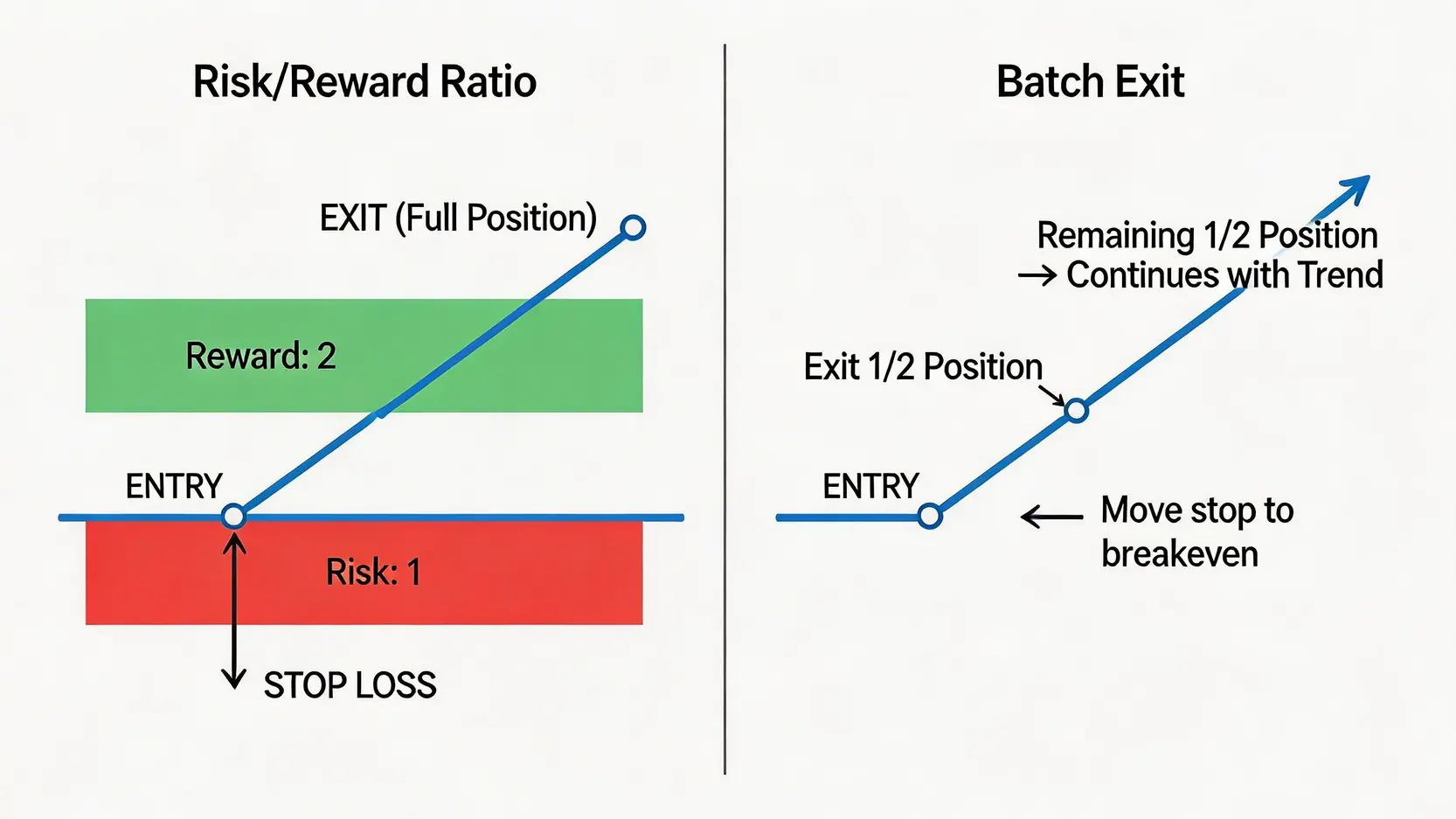
風險回報比設定法與分批止盈策略的操作流程對比示意圖。

Efficient Take-Profit Strategies: Risk-Reward Planning vs. Flexible Partial Position Closing.


Risk-Reward Ratio Method: Plan Your Profit and Loss Before Entering

This is a highly disciplined take-profit method and a core component of professional futures trading risk management. Before opening a position, calculate your expected take-profit level based on your stop-loss level. Common Risk/Reward Ratios are 1:2 or 1:3.

For example: If your stop-loss is set at 50 points (risk of 1), then your first take-profit target should be set at 100 points (reward of 2) or 150 points (reward of 3). This method ensures that your profit potential is significantly greater than your loss risk. Over the long term, even with a win rate of only 50%, your overall account can still achieve positive growth.


Partial Take-Profit Strategy: Balance Profit Lock-In and Future Potential Gains

This is a more flexible and comprehensive strategy, especially suitable for traders dealing with unclear trends or those who want to balance stability with potential upside. The approach is to divide your position into 2 to 3 parts.

  1. First target level: When the price reaches the first preset target (for example, a risk-reward ratio of 1:1.5), close part of the position (such as 1/2).
  2. Move stop-loss to breakeven: At the same time, move the stop-loss of the remaining position to your entry price, ensuring that the worst outcome of the trade is no profit and no loss.
  3. Let profits run: Apply a trailing stop strategy to the remaining position, allowing it to follow the trend and capture larger subsequent moves.

This method perfectly combines the security of locking in profits with the potential for greater returns, making it a favored technique among experienced traders.


Common Mistakes in Setting Stop-Loss and Take-Profit and How to Avoid Them

Learning the methods is not enough, you must also avoid common pitfalls. The following three mistakes are the main causes of losses for many traders and should be carefully avoided.


Mistake 1: Setting Stop-Loss Too Tight and Getting Frequently “Stopped Out” by Market Noise

A common mistake among beginners is setting stop-loss levels too tight, hoping to achieve profits with minimal risk. However, they overlook normal market fluctuations, often referred to as “noise”. An overly tight stop-loss is easily triggered by small pullbacks, causing you to exit too early even when your direction is correct, and miss the larger move. Solution: Refer to the ATR indicator and set your stop-loss at 1.5 or 2 times the ATR distance to allow sufficient room for the trade to breathe.


Mistake 2: Continuously Moving Stop-Loss During Losses, Turning Small Losses into Major Disasters

 This is the most fatal mistake in trading, without exception! When the price approaches your stop-loss level, you hold onto hope and manually move the stop-loss further away, hoping to “hold through it”. This behavior completely contradicts the purpose of setting a stop-loss and is equivalent to destroying your own defense line. A single such action can cause devastating damage to your account. Solution: Discipline! Discipline! Discipline! Once the stop-loss is set, do not change it arbitrarily. Let the market prove whether you are right or wrong, not your hope.

Mistake 3: Never Setting Take-Profit Targets and Letting Large Profits Slip Away

“If I wait a little longer, maybe I can earn more”. This greedy mindset is the main reason profitable trades turn into losing ones. Without a clear take-profit target, you will easily become lost during significant pullbacks and eventually return large profits to the market. Solution: Plan your exit strategy at the time of entry. Whether using a fixed risk-reward ratio or a partial take-profit strategy, you must have a clear plan. 

Further Reading (Highly Recommended)

MT5 Forex Trading Ultimate Guide: Platform Recommendations, Analysis Techniques, and Practical Strategies


Common Questions About Futures Stop-Loss and Take-Profit

Q: What is the ideal “golden ratio” (risk-reward ratio) for stop-loss and take-profit?

A: There is no absolute “golden ratio”, but the industry generally considers a minimum of 1:2. This means that for every trade, your potential profit should be at least twice the risk you are willing to take. This setup allows you to remain profitable overall even with a relatively low win rate (for example, only 40%–50%). For short-term traders, a ratio of around 1:1.5 may be used, while long-term trend traders may aim for 1:3 or even higher returns.

Q: How should I adjust my stop-loss when market volatility increases?

A: When market volatility increases (for example, before and after major economic data releases), fixed-point stop-loss methods become highly risky. In such cases, a volatility-based stop-loss strategy should be used. A practical approach is to apply the ATR (Average True Range) indicator. For example, you can set your stop-loss at 2 times the ATR below the current price. This allows your stop-loss distance to automatically adjust as market volatility expands, helping you better adapt to current conditions and avoid being stopped out by random fluctuations.

Q: Which is better, trailing stop or manual partial closing?

A: Both have advantages and disadvantages and are suitable for different market conditions and trading styles. A trailing stop performs best in strong trending markets, maximizing profits. However, in wide-range sideways markets, it may repeatedly trigger and reduce profits. Manual partial closing is more stable, as it secures part of the profit and reduces psychological pressure, but it may miss further gains in strong trends. A balanced approach is to close half of the position at the first target level and then apply a trailing stop to the remaining position.


Conclusion

In summary, mastering “how to set stop-loss and take-profit” is a fundamental skill for every futures trader and a key dividing line between professionals and amateurs. Whether it is “futures stop-loss level setting” or “futures take-profit techniques”, the core lies in building a disciplined, executable trading plan that suits yourself. Remember, the market is always uncertain, and while we cannot control market direction, we can fully control our losses through strict capital and risk management. Apply the techniques you learned today to your next trade and take your first step toward becoming a professional trader. 

If you liked this article, please share it!

Related Articles

  • Volatility Surface Guide: Skew Trading Strategies
    Practical Applications of Volatility Surfaces: From Options Modeling to Advanced Skew Trading Strategies In options markets, implied volatility is never a flat line. Instead, it forms complex "smile" or "skew" surfaces. For advanced traders, mastering the practical applications of volatility surfaces is equivalent to possessing a lens that reveals market...
    2026 年 6 月 3 日
  • Foreign Capital Flow Model: Track Institutional Money
    Building a Foreign Capital Flow Copy Trading Model: A Stock Market Indicator for Accurately Tracking Institutional Positioning In Asia-Pacific stock markets, foreign capital inflows and outflows often determine the direction of the index. However, simply looking at daily net buy and sell data is no longer enough. Only by building...
    2026 年 6 月 3 日
  • Options Buying Strategies for Extreme Market Risks
    Options Buyer Strategies During Extreme Market Conditions: Black Swan Hedging and Cross-Market Arbitrage During Volatility Surges The most terrifying aspect of financial markets is not a gradual decline, but overnight flash crashes and cross-market capital withdrawals accompanied by volatility surges. In the highly unpredictable global macroeconomic environment of 2026, geopolitical...
    2026 年 6 月 3 日
返回顶部