Forex Pair Types: Major, Minor & Beginner Guide

Updated: 2026/04/03  |  CashbackIsland

currency-pair-types-guide

Ultimate Guide to Types of Currency Pairs: Understand Major and Minor Currency Pairs and Beginner Selection Strategies in One Article

Just stepped into the forex market and felt overwhelmed by the dazzling list of currency pairs, not knowing where to start? Unsure about the differences between major and minor currency pairs, and worried that choosing the wrong trading instrument may lead to unnecessary losses? This article is written to solve your confusion. We will start with the basic concepts of types of currency pairs, analyze the characteristics of different types in depth, and provide a clear guide to help you choose currency pairs, laying a solid foundation for your trading journey. 


What Is a Currency Pair? The Basics You Must Understand Before Trading

In the forex market, all trades involve simultaneously buying one currency and selling another. The combination of these two currencies is what is known as a “currency pair”. Simply put, the exchange rate of a currency pair reflects how much of one currency is needed to purchase another. This is also the first step to understanding all forex trading. An authoritative financial knowledge website, Vantage, also provides a detailed explanation of currency pairs.


Base Currency vs Quote Currency: The Secret to Understanding Exchange Rate Quotes

Each currency pair consists of two currencies and is expressed in a specific format, such as EUR/USD. This quotation structure is actually very simple:

  • Base Currency: The currency on the left side of the slash (/), which is EUR (euro). It is always the basis of pricing and represents “1” unit.
  • Quote Currency: The currency on the right side of the slash, which is USD (US dollar). It represents how many units of the quote currency are needed to purchase 1 unit of the base currency.

For example, if the exchange rate of EUR/USD is 1.0800, it means that 1 euro can be exchanged for 1.0800 US dollars. When you expect the euro to appreciate relative to the US dollar, you would “buy” EUR/USD; conversely, if you expect the euro to depreciate, you would “sell” EUR/USD.

基礎貨幣與報價貨幣示意圖,以EUR/USD為例解釋匯率結構。

EUR/USD Quotation Structure: How much of the quote currency (US dollar) is the value of 1 unit of the base currency (euro).


Bid Price and Ask Price: How Spread Affects Your Trading Costs

When you open a trading platform, you will notice that each currency pair has two prices instead of one:

  • Bid Price: This is the price at which the broker is willing to “buy” the base currency from you. In other words, it is the price at which you, as a trader, can “sell”.
  • Ask Price: This is the price at which the broker is willing to “sell” the base currency to you. In other words, it is the price at which you, as a trader, can “buy”.

The Ask price is usually slightly higher than the Bid price. The small difference between them is called the Spread. The spread is one of the broker’s main sources of profit and is also the implicit cost of each of your trades. The smaller the spread, the lower the trading cost.


Complete Breakdown of Types of Currency Pairs: Master the Three Main Categories at Once

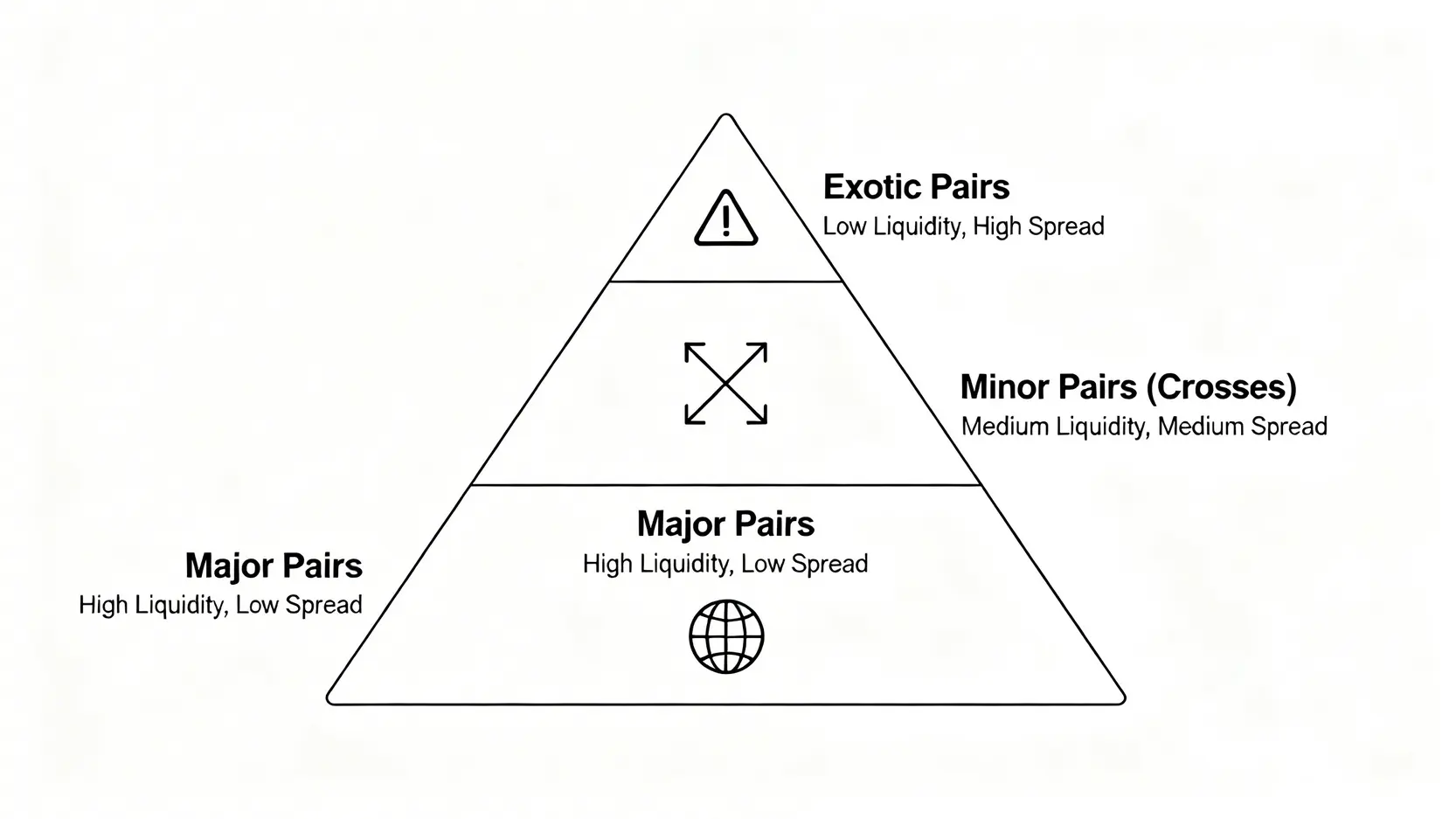
After understanding the basic quotation, the next step is to learn how the thousands of currency pairs in the market are categorized. Generally, based on trading volume, liquidity, and whether they include the US dollar, they can be divided into three types of currency pairs: major currency pairs, minor currency pairs, and exotic currency pairs.

外匯貨幣對金字塔,展示主要、次要和奇異貨幣對的交易量與風險層級。

Currency Pair Pyramid: From high-liquidity, low-risk major currency pairs to low-liquidity, high-risk exotic currency pairs.


Major Pairs: The Core of a Highly Liquid Market

Major currency pairs, as the name suggests, are the most frequently traded pairs globally with the largest number of market participants. Their common feature is that they all include the US dollar (USD) and are paired with currencies from major global economies. Due to their massive trading volume, major pairs usually have the highest liquidity and the lowest spreads, with relatively stable and transparent price movements. This makes them the preferred choice for beginners.

The seven widely recognized major currency pairs include:

  • EUR/USD (euro/US dollar) – The most traded pair in the world, known as “The Fiber”.
  • USD/JPY (US dollar/Japanese yen) – The second most traded pair, known as “The Gopher”.
  • GBP/USD (British pound/US dollar) – Highly volatile, known as “The Cable”.
  • USD/CHF (US dollar/Swiss franc) – The franc is a traditional safe-haven currency, known as “The Swissy”.
  • AUD/USD (Australian dollar/US dollar) – A commodity currency, related to commodity prices, known as “The Aussie”.
  • USD/CAD (US dollar/Canadian dollar) – Also a commodity currency, highly correlated with oil prices, known as “The Loonie”.
  • NZD/USD (New Zealand dollar/US dollar) – A commodity currency influenced by agricultural prices, known as “The Kiwi”.


Minor Pairs (Crosses): Cross Currency Pairs Without the US Dollar

Minor currency pairs, also known as cross currency pairs (Cross-Currency Pairs), refer to pairs that do not include the US dollar but are composed of currencies from other major economies. For example, combinations between the euro, British pound, and Japanese yen.

Although their liquidity is lower than that of major pairs, the market is still quite active. Minor pairs tend to have slightly higher spreads and may exhibit greater volatility. For traders with some experience, minor pairs provide more diversified trading opportunities, allowing them not to focus solely on the movement of the US dollar.

Common minor currency pairs include:

  • EUR/GBP (euro/British pound)
  • EUR/JPY (euro/Japanese yen)
  • GBP/JPY (British pound/Japanese yen)
  • AUD/JPY (Australian dollar/Japanese yen)
  • CHF/JPY (Swiss franc/Japanese yen)


Exotic Pairs: A High-Risk, High-Return Choice

Exotic currency pairs consist of one major currency (usually the US dollar) paired with a currency from an emerging market economy or a smaller country. For example, the US dollar against the Singapore dollar or Hong Kong dollar.

The characteristics of these pairs are:

  • Low liquidity: Fewer market participants and lower trading volume.
  • Very high spreads: Trading costs are much higher than major and minor pairs.
  • Extreme volatility: Easily affected by political and economic events in the respective country, leading to sharp price fluctuations.

While exotic pairs may offer very high returns, their risks are equally significant, making them unsuitable for inexperienced beginner traders. Common exotic pairs include USD/SGD (US dollar/Singapore dollar), USD/HKD (US dollar/Hong Kong dollar), EUR/TRY (euro/Turkish lira), etc.


Key Comparison: What Are the Differences Between Major and Minor Currency Pairs? Understand at a Glance with One Table

To help you clearly understand the differences between types of currency pairs, we have compiled the following comparison table, allowing you to quickly grasp the distinctions between major and minor currency pairs, as well as their differences from exotic currency pairs.

Characteristics Major Currency Pairs (Majors) Minor Currency Pairs (Minors) Exotic Currency Pairs (Exotics)
Included Currencies Must include the US dollar (USD) Do not include the US dollar, composed of other major currencies One major currency + one emerging market currency
Liquidity Very high Medium to high Low
Trading Spread Very low Relatively low Very high
Volatility Relatively low Moderate Very high
Predictability Abundant information and rich analytical resources, relatively high Less information, more complex analysis Easily affected by unexpected events, low predictability
Suitable for Beginners, conservative traders Experienced traders Experienced traders seeking high risk and high return


Liquidity and Trading Volume: Why Beginners Should Prioritize Major Currency Pairs?

For beginners, the greatest advantage of choosing major currency pairs lies in their “high liquidity”. High liquidity means that there are always a large number of buyers and sellers at any given time, which brings several benefits:

  1. Fast and stable execution: You can easily enter or exit positions at your desired price level, with a lower likelihood of slippage.
  2. Low trading costs: As mentioned earlier, high liquidity directly leads to lower spreads, reducing your trading costs.
  3. Abundant analytical resources: Almost all financial news and analysis reports focus on major currency pairs, allowing beginners to easily access a wealth of information to support decision-making.


Volatility and Risk: Opportunities and Challenges of Minor Currency Pairs

The volatility of minor currency pairs is usually higher than that of major currency pairs, making it a double-edged sword. On one hand, greater price fluctuations mean larger potential profit opportunities; on the other hand, it also represents higher risk. Prices may move sharply against you in a short period of time. Therefore, trading minor currency pairs requires stricter risk management strategies, such as setting Stop Loss orders.


Further Reading (Highly Recommended)

Forex Trading Platform Recommendations: A Must-Read Guide for Beginners to Choose Safe and Reliable Brokers


Beginner Guide: How to Choose Your First Currency Pair?

After understanding the characteristics of different currency pairs, the next key question is: how to choose a currency pair? There is no standard answer, but you can follow a clear decision-making process to find the most suitable starting point for your personal situation.


Step One: Assess Your Risk Tolerance and Trading Style

First, honestly evaluate yourself. What type of trader are you?

  • Conservative: If you dislike seeing large fluctuations in your account and prefer steady progress, then without a doubt, you should start with major currency pairs.
  • Balanced: Once you have a certain level of market understanding, you can consider adding some relatively liquid minor currency pairs, such as EUR/JPY or GBP/JPY, to seek more opportunities.
  • Aggressive: If you have a very high risk tolerance and possess in-depth knowledge of specific emerging markets, you may consider allocating a small portion of your capital to exotic currency pairs under strict capital management. However, this is absolutely not suitable for beginners.


Step Two: Match Your Trading Time With the Most Active Currency Pairs

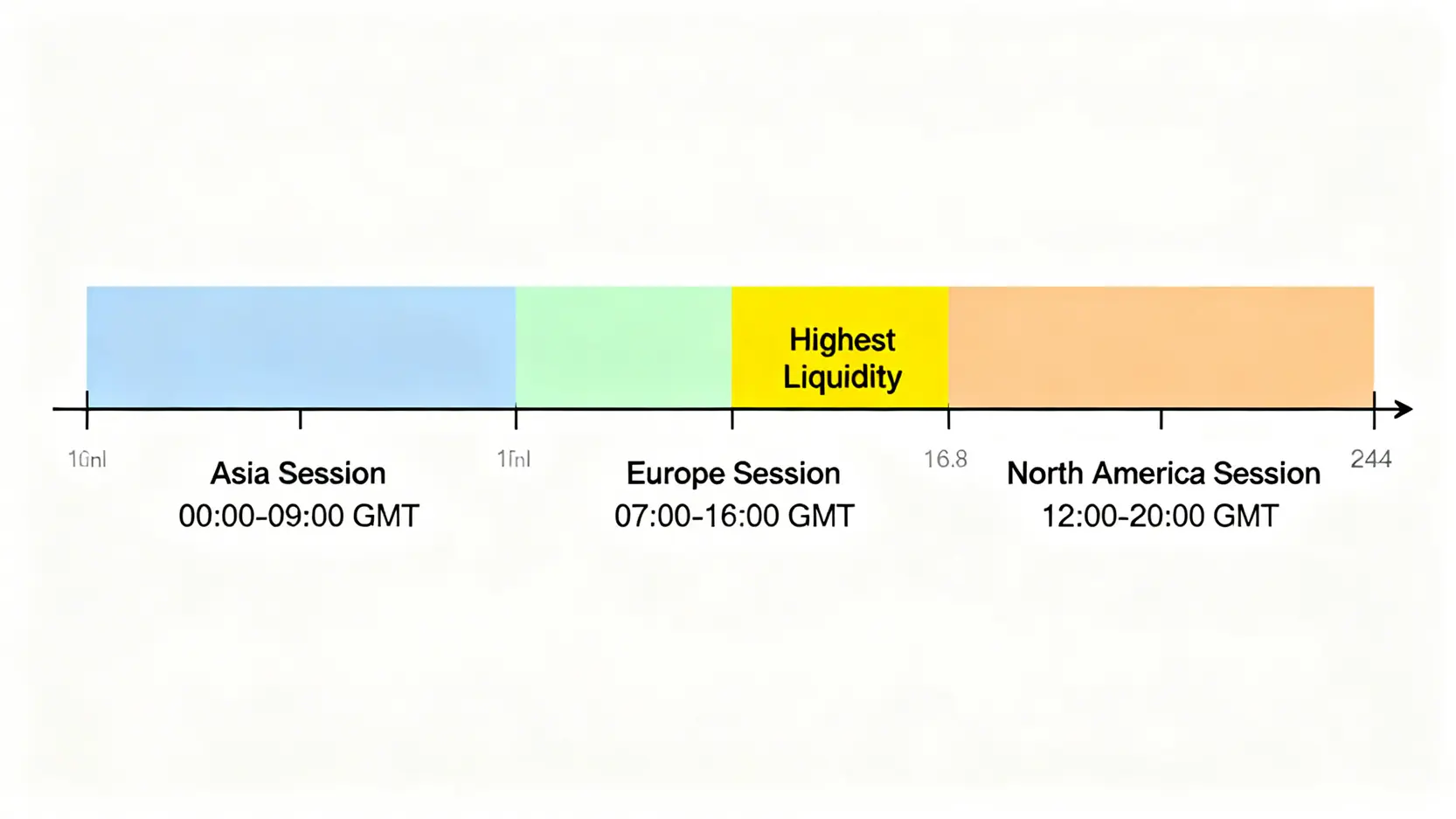
The forex market operates 24 hours a day, but activity levels vary across different sessions. Market activity is mainly determined by the overlap of the three major trading sessions:

  • Asian Session (Tokyo): Currency pairs related to the Japanese yen (JPY), Australian dollar (AUD), and New Zealand dollar (NZD) are the most active.
  • European Session (London): Trading volume for currency pairs related to the euro (EUR), British pound (GBP), and Swiss franc (CHF) increases significantly.
  • North American Session (New York): The US dollar (USD) and Canadian dollar (CAD) become the market focus.

全球外匯市場三大交易時段重疊時間圖,標示出最佳交易時間。

Forex Market Prime Time: The overlap between the London and New York sessions offers the highest liquidity.

The best trading time is usually the overlap between the London and New York sessions (approximately 8 PM to 12 AM Beijing time), when market liquidity is at its highest, spreads are the lowest, and volatility is most active. If you can only trade during Asian hours, then focusing on USD/JPY or AUD/USD would be a more sensible choice. 

Step Three: Start Practicing With Major Currency Pairs (EUR/USD, USD/JPY Recommended)

Based on the above considerations, the final recommendation for beginners is to start your trading journey with EUR/USD or USD/JPY.

Why these two?

  • EUR/USD: As the most traded currency pair in the world, it offers the lowest spreads, highest liquidity, and the richest analytical resources. Its price movements are relatively stable, making it suitable for beginners to practice technical analysis and risk management.
  • USD/JPY: With trading volume second only to EUR/USD, it also features low spreads and high liquidity. Its price movements often show clearer trends, which is helpful for learning how to identify market direction.

By starting with these two currency pairs, you can focus on learning core trading skills without being distracted by excessive market noise. Once you can trade consistently in these markets, you can gradually expand to other currency pairs.


Common Questions About Choosing Currency Pairs (FAQ)

Q: Which currency pair has the highest trading volume?

A: EUR/USD (euro/US dollar) is the most traded and most liquid currency pair in the global forex market, accounting for nearly one quarter of the average daily global forex trading volume. This makes its trading costs (spreads) usually the lowest and the most closely watched market by traders worldwide.

Q: When is the best time to trade currency pairs?

A: Generally, when the trading hours of two major financial markets overlap, it is when trading activity is highest and liquidity is best. Among them, the overlap between the London and New York sessions (approximately GMT 13:00 – 17:00, equivalent to 8 PM to 12 AM Beijing time) is the most active prime time in the global market, particularly suitable for trading major currency pairs related to Europe and the US.

Q: Should beginners completely avoid exotic currency pairs?

A: Yes, it is strongly recommended that beginners completely avoid trading exotic currency pairs. They have poor liquidity, extremely high spreads, and prices can easily gap or fluctuate sharply due to single political or economic events, making risk very difficult to control. Before accumulating sufficient trading experience and establishing a solid risk management system, it is best to focus on major currency pairs.

Q: What are cross currency pairs? How are they different from minor currency pairs?

A: Cross currency pairs and minor currency pairs are essentially synonymous, both referring to currency pairs that do not include the US dollar (USD). The term originated because before the widespread use of electronic trading, if you wanted to exchange euros for Japanese yen, banks had to perform two conversions internally: first converting euros to US dollars (EUR/USD), and then converting US dollars to Japanese yen (USD/JPY). Today, cross currency trading can be executed directly without going through the US dollar.


Conclusion

In summary, successful forex trading begins with a deep understanding and correct selection of currency pairs. This article has provided a detailed introduction to types of currency pairs and an in-depth comparison of the core differences between major and minor currency pairs. Remember, for beginners, starting with major currency pairs that offer high liquidity, transparent information, and low trading costs (especially EUR/USD and USD/JPY) is the best strategy to reduce initial risk and learn steadily. The most important next step is to open a demo account and apply what you have learned today in a risk-free environment to practice your currency pair selection and trading strategies.

If you liked this article, please share it!

Related Articles

  • Volatility Surface Guide: Skew Trading Strategies
    Practical Applications of Volatility Surfaces: From Options Modeling to Advanced Skew Trading Strategies In options markets, implied volatility is never a flat line. Instead, it forms complex "smile" or "skew" surfaces. For advanced traders, mastering the practical applications of volatility surfaces is equivalent to possessing a lens that reveals market...
    2026 年 6 月 3 日
  • Foreign Capital Flow Model: Track Institutional Money
    Building a Foreign Capital Flow Copy Trading Model: A Stock Market Indicator for Accurately Tracking Institutional Positioning In Asia-Pacific stock markets, foreign capital inflows and outflows often determine the direction of the index. However, simply looking at daily net buy and sell data is no longer enough. Only by building...
    2026 年 6 月 3 日
  • Options Buying Strategies for Extreme Market Risks
    Options Buyer Strategies During Extreme Market Conditions: Black Swan Hedging and Cross-Market Arbitrage During Volatility Surges The most terrifying aspect of financial markets is not a gradual decline, but overnight flash crashes and cross-market capital withdrawals accompanied by volatility surges. In the highly unpredictable global macroeconomic environment of 2026, geopolitical...
    2026 年 6 月 3 日
返回顶部