Taiwan Index Options Margin Risk Beginner Guide

Updated: 2026/05/22  |  CashbackIsland

tx-options-seller-margin-risk

What Happens if a Taiwan Index Options Seller Has Insufficient Margin? A Complete Beginner’s Guide to the Risks

Many people in the market view options seller strategies as a stable “rental income” approach, enjoying the steady cash flow brought by a high win rate. However, behind this seemingly attractive strategy lies a truth that most people deliberately ignore: under extreme market conditions, the margin risk for Taiwan Index options sellers is close to unlimited. When offset margin becomes insufficient, what you may face is not a small loss, but forced liquidation severe enough to wipe out your account, or even a negative balance disaster. This article will start from the basics, taking you deep into the mechanics behind options margin calculation formulas, while exposing the critical risk management details that every seller trader must never overlook. 


Core Concepts of Options Sellers: Why You Need to Care About Margin?

Before entering the options market, you must first understand one core concept: becoming a seller (short position) essentially means acting as the “house”. What you earn is the premium paid by buyers, while betting that the price will not break through your strike price at expiration. This role as the house also creates a completely different risk profile from that of buyers (players).


Being the House vs. Being the Player: The Fundamental Difference Between Sellers and Buyers

Let’s use a simple analogy to understand:

  • Options buyers (players): Like buying lottery tickets. You pay a fixed premium (ticket cost), and if the market moves as expected, your profits may multiply several or even dozens of times. If the prediction is wrong, your maximum loss is simply the entire premium paid. Limited risk, unlimited profit.
  • Options sellers (the house): Like running a casino. You collect premiums from buyers, and as long as the market does not move significantly, that income is yours to keep. However, if the market experiences violent fluctuations (black swan events), the strike price difference you may need to pay could far exceed the premium collected. Limited profit, unlimited loss.

選擇權買方與賣方的風險與回報對比圖,顯示買方風險有限獲利無限,而賣方獲利有限虧損無限。

Options Buyers vs. Sellers: The Fundamental Difference Between Risk and Reward

It is precisely this “unlimited loss” characteristic that makes the margin system a crucial part of seller trading.


The Nature of Seller Risk: Limited Profit, Unlimited Loss

When selling one options contract, the maximum profit you can earn is the premium received at the beginning. However, the potential loss is theoretically unlimited. For example, when selling a Call option, if the market price surges aggressively, your losses will expand rapidly alongside the rising index, with absolutely no upper limit. This asymmetric risk structure is the nightmare every options seller must constantly remain alert to.


The Role of Margin: Not a Cost, but a Risk Deposit

Many beginners mistakenly believe margin is a “trading cost”, which is a fatal misunderstanding. In reality, margin is more like a “deposit” or “performance guarantee”. Its purpose is to ensure that if your market view is wrong and losses occur, your account still contains enough funds to fulfill the contract and pay your counterparty (the buyer). This money is not spent, but temporarily frozen by the futures broker until your position is closed. Therefore, understanding how margin is calculated and changes over time is the critical first step in understanding your own risk tolerance.


A Must-Read for Taiwan Index Options Sellers: Complete Breakdown of Margin Calculation Formulas

If you want proper seller-side risk control, you cannot ignore how margin is calculated. Taiwan Index options margin is not a fixed amount, but dynamically adjusted by the Taiwan Futures Exchange based on factors such as market volatility. The core formula revolves around three key values: A, B, and C. 

What Are A Value, B Value, and C Value? Detailed Explanation of the Taiwan Futures Exchange Definitions

These three values are the core parameters used by the Taiwan Futures Exchange to evaluate the risk of a single options position, and they are periodically adjusted according to market conditions. Their meanings are as follows:

  • A Value (Taiwan Index options risk margin): Measures the risk created by price fluctuations. When market volatility intensifies, the A Value is increased, meaning you must prepare more margin to handle potential price swings.
  • B Value (Minimum Taiwan Index options risk margin): A fixed minimum margin threshold. Its purpose is mainly to prevent traders from underestimating extreme risks when trading deep out-of-the-money options with extremely low premiums.
  • C Value (Taiwan Index options straddle and strangle combination margin): Specifically used to calculate margin requirements for combination strategies such as Straddles and Strangles.

You can check the latest A, B, and C Values at any time on the official Taiwan Futures Exchange website, which is crucial for accurately calculating your capital requirements.


Single Position Margin Formula: Premium Market Value + Max (A Value – Out-of-the-Money Value, B Value)

For individually sold Call or Put positions, the margin formula is as follows:

Seller Margin = Premium Received + (A Value – Out-of-the-Money Value), and must not be lower than Premium Received + B Value.

Expressed more directly as a mathematical formula:

Margin = Premium Market Value + Max(A Value – Out-of-the-Money Value, B Value)

選擇權賣方保證金計算公式的圖解,顯示總保證金由權利金市值加上風險金(取 A 值減價外值與 B 值中的較大者)構成。

Illustration of the Seller Margin Structure

The “Out-of-the-Money Value” here refers to the difference between the strike price and the current underlying index price (positive values only). For example, if the Taiwan Index futures are currently at 23,000 points and you sell one Call with a strike price of 23,500 points, the out-of-the-money value is 500 points. The purpose of this design is that the closer the position is to at-the-money (smaller out-of-the-money value), the higher the risk, and therefore the higher the required margin.


Combination Strategy Margin Calculation: Margin Efficiency of Straddles, Strangles, and Spread Orders

The risk of naked short positions is extremely high, which is why many experienced traders use “spread orders” or “Straddle/Strangle strategies” to lock in risk and reduce margin requirements. For example:

  • Selling Straddles/Strangles: Simultaneously selling Call and Put options with the same strike price (Straddle) or different strike prices (Strangle). Margin calculation uses the more favorable C Value formula: Premium Market Value + Max(C Value, A Value – Difference Between the Midpoint of the Two Strike Prices and the Market Price).
  • Bull/Bear Spreads for Puts and Calls: Simultaneously selling one strike price while buying another further out-of-the-money strike price. Since the purchased position provides protection for the seller position, margin requirements are greatly reduced, requiring only the “difference in strike price points”. For example, selling a 23500 Call while buying a 23600 Call results in margin of (23600 – 23500) * NT$50/point = NT$5,000 (excluding premium).

By constructing spread orders, you can transform originally “unlimited loss” risk into “limited loss” risk, which is also one of the most important aspects of seller-side risk management. 

The Chain Reaction of Insufficient Margin: A Critical Moment in Seller Risk Management

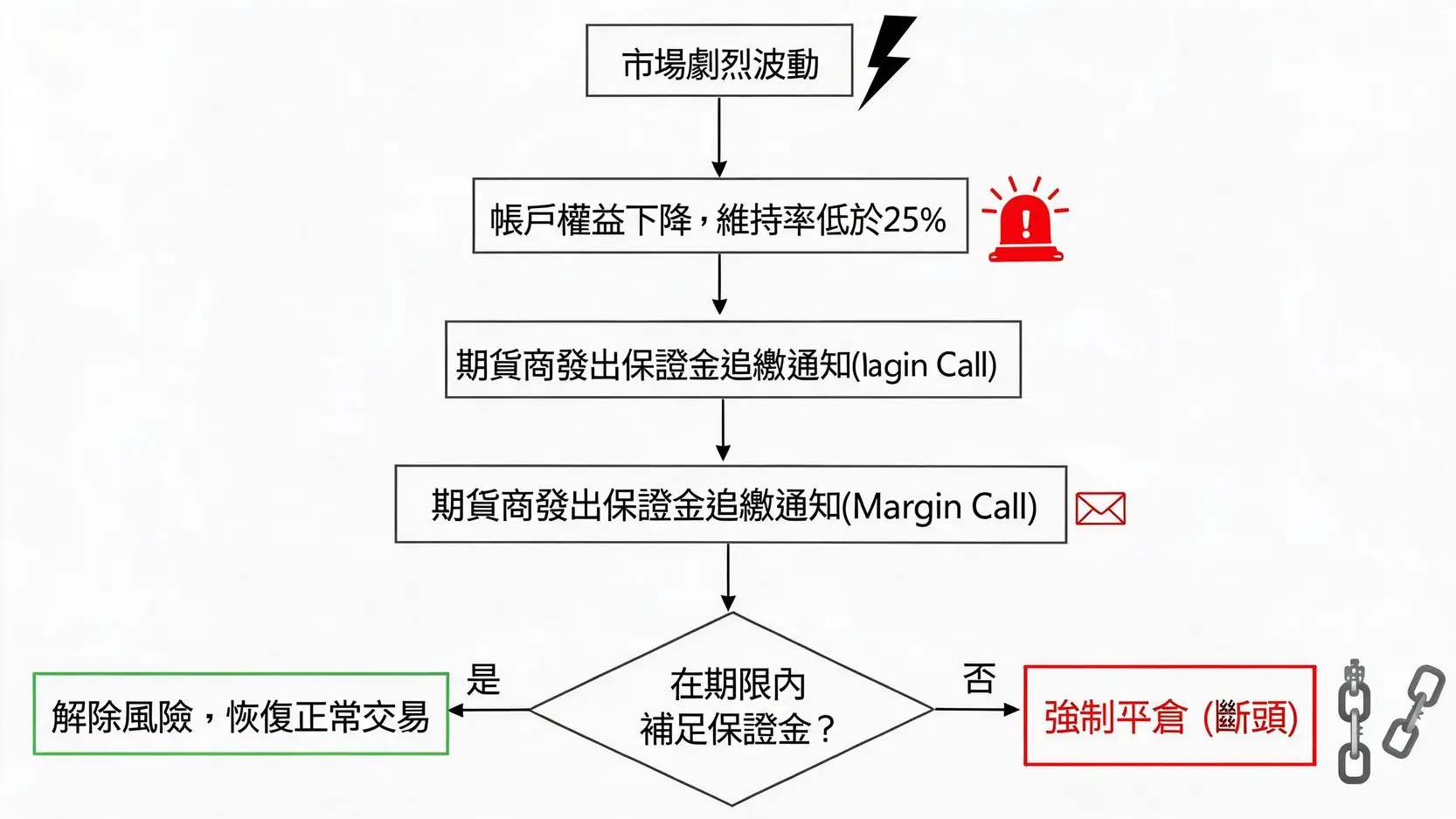
When market volatility intensifies and causes your account equity to decline rapidly, the warning signal for insufficient margin will be triggered. The entire process is like a chain of falling dominoes, where mishandling any single step could lead to catastrophic consequences.

保證金追繳與強制平倉流程圖,展示從維持率不足到可能被斷頭的完整步驟。

The Chain Reaction of Insufficient Margin: From Margin Calls to Forced Liquidation


What Is the Maintenance Ratio? The Danger Signal Below 25%

In your trading account, there is an extremely important indicator called the “Risk Indicator” or “Equity Maintenance Ratio”. Its calculation formula is:

Maintenance Ratio = (Total Account Equity / Total Required Margin for Open Positions) * 100%

This ratio represents the extent to which your account’s net value covers the required margin. According to Taiwan Futures Exchange regulations, when this figure falls below 25% after settlement, the futures broker must issue a “Margin Call” notice.

The Margin Call Process During Intraday Volatility

Receiving a margin call means you must replenish funds before 12:00 PM on the next business day to restore the account to the “initial margin” level, meaning the maintenance ratio must return above 100%. If you fail to replenish the funds in time, the futures broker has the right to proceed to the next step: forced liquidation.

It is worth noting that although official regulations only require a margin call when the post-settlement ratio falls below 25%, many futures brokers’ risk management departments closely monitor clients’ maintenance ratios during market hours. If intraday market conditions deteriorate severely and the maintenance ratio drops rapidly, an “intraday margin call” emergency situation may occur.


The Execution Mechanism and Consequences of Forced Liquidation

If you fail to replenish the margin within the required timeframe, the futures broker will execute “forced liquidation”, commonly known as being “wiped out”.

  • Execution Method: The futures broker will directly force-sell (or buy back) your open contracts from your account at market price or the nearest available price until your maintenance ratio rises above 25%.
  • Terrifying Consequences: You have absolutely no control over the liquidation price. During periods of poor liquidity or violent price swings, execution prices may be extremely unfavorable, causing your actual losses to far exceed expectations. Worse still, if losses after liquidation exceed your total account equity, a “negative balance” situation will occur, and you will still need to repay the deficit to the futures broker.


Black Swan Stress Test: If the Market Crashes 3,000 Points, Is Your Margin Enough?

No amount of theory is more impactful than a real market shock. A mature seller trader must conduct stress testing on positions and prepare for the worst-case scenario.


Simulated Scenario: Using the March 2020 Market Crash as an Example of Seller Margin Changes

Looking back at March 2020, global stock markets collapsed within a short period due to panic surrounding the COVID-19 pandemic. Taiwan stocks fell nearly 3,000 points from their peak within just a few weeks. Under such extreme market conditions:

  1. Implied Volatility Surged: Market panic spread rapidly, causing options implied volatility (IV) to spike from 20% to over 60%, leading to a sharp increase in premium prices and dramatically expanding unrealized losses on seller positions.
  2. Margin A Value Increased: In response to rising risks, the Taiwan Futures Exchange urgently raised the margin A Value. This meant that even if your position remained unchanged, the required margin automatically increased, further compressing your maintenance ratio.

Under this double impact, out-of-the-money seller positions that originally appeared safe could face margin calls or even forced liquidation within just a few days.


How to Calculate Your Maximum Risk Tolerance

Before establishing any seller position, ask yourself one question: “If the index suddenly surges or crashes 1,000 or 2,000 points against my position tomorrow, what will happen to my account?”

You can use your broker’s simulation tools or manually calculate:

  • Estimated Losses: Calculate the theoretical losses on your options positions under extreme price scenarios.
  • Estimated Margin Changes: Consider the possibility of rising volatility and increased A Values, then estimate the additional required margin.
  • Review the Maintenance Ratio: Subtract the estimated losses from your account equity, then divide it by the increased total required margin to determine whether the maintenance ratio remains within a safe range.


Defensive Strategies: The Importance of Spread Orders and Dynamic Hedging

When facing unpredictable black swan events, the best defense is preparation in advance. Instead of simply selling naked positions, it is better to establish controllable-risk strategies from the start:

  • Spread Orders: As mentioned earlier, constructing Call or Put spread orders is the most effective method for converting unlimited losses into limited losses.
  • Dynamic Hedging: When the market begins showing unfavorable signals, you can hedge by buying futures or further out-of-the-money options to reduce the overall Delta risk of your portfolio.


Conclusion

In summary, understanding and respecting the margin risks of Taiwan Index options sellers is an essential step toward becoming a mature seller trader. This article not only breaks down the details of options margin calculation formulas, but also emphasizes the absolute importance of seller-side risk management during extreme market conditions through stress-testing scenarios. Options seller strategies are indeed powerful tools, but only after establishing comprehensive defensive mechanisms and capital management plans can you consistently collect premiums in the market, instead of being mercilessly carried out during the next black swan event. 

FAQ

Q: What Is the Difference Between Margin Calculation for Selling Calls and Selling Puts?

A: The calculation formula is exactly the same, which is “Premium Market Value + Max(A Value – Out-of-the-Money Value, B Value)”. The only difference lies in how the “Out-of-the-Money Value” is calculated. For selling Calls, the out-of-the-money value is “Strike Price – Current Index Price”; for selling Puts, the out-of-the-money value is “Current Index Price – Strike Price”.

Q: If Margin Is Insufficient, Will the Futures Broker Immediately Force Liquidate My Position?

A: Not immediately. Under the standard process, when your account’s “post-settlement” maintenance ratio falls below 25%, the futures broker will issue a margin call notice on the same day. You must replenish the required funds “before 12:00 PM on the next business day”. If the funds are not replenished before the deadline, the futures broker will then begin executing forced liquidation. However, please note that during periods of extreme market volatility, some futures brokers may adopt stricter intraday risk control measures.

Q: Does a Spread Order Combination Always Require Less Margin?

A: Yes, in the vast majority of cases, spread orders (such as Bull Call Spreads or Bear Put Spreads) require significantly lower margin than selling a single naked options position. This is because the long position within the spread provides protection for the short position, locking in the maximum possible loss. As a result, the risk deposit (margin) charged by the futures broker is naturally much lower.

Q: How Can I Check the Latest Taiwan Futures Exchange Margin Requirements?

A: The best way to check the latest and most accurate margin A, B, and C Values is to visit the official Taiwan Futures Exchange website directly and navigate to the “Clearing Services” > “Margin Requirement Table” page. Any announcements from futures brokers should be verified against the official exchange information.

编者
Evan Lin

Evan Lin

我是Evan Lin,从大学时期开始接触外汇交易,至今已有多年实战经验,熟悉技术分析与EA策略,热衷于研究市场脉动与风险管控,喜欢分享实战经验和交易技巧,和大家一起学习、一起进步!

If you liked this article, please share it!

Related Articles

  • Hong Kong VASP License Guide 2026 for Web3 Firms
    Complete Guide to Virtual Asset Trading Platform (VASP) License Applications: A 2026 Hong Kong Web3 Compliance Practical Guide At the pivotal moment of 2026, as global financial digitization accelerates at an unprecedented pace, Hong Kong has firmly established itself as a leading Web3 compliance hub in Asia and around the...
    2026 年 6 月 3 日
  • CNH-CNY Arbitrage Guide 2026: Spread & Hedging
    2026 Offshore Renminbi Range-Bound Arbitrage Trading Guide: Mastering the CNH-CNY Spread and a Profit Guide to Hedging Through Two-Way Volatility Against the combined influence of global macroeconomic developments and international trade policies, the foreign exchange market in 2026 has become increasingly complex. The Renminbi exchange rate often exhibits a pattern...
    2026 年 6 月 3 日
  • Friday Taiwan Index Options: NFP Trading Strategy
    Friday Taiwan Index Options Buyer Strategies: Precisely Capturing Explosive Market Moves From Non-Farm Payroll Data Many investors often complain that options buyers have low win rates, frequently predicting the direction correctly but ultimately losing to time decay. However, under the new dual-settlement system, short-term volatility and event-driven trading have created...
    2026 年 6 月 3 日
返回顶部