Japan YCC Exit: BOJ Policy, Rate Hike & Impact

Updated: 2026/04/28  |  CashbackIsland

japan-ycc-policy-exit-guide

Japan YCC Policy Ends Explained: Understanding Yield Curve Control Exit, Interest Rate Timeline, and 5 Major Investment Impacts

The Bank of Japan has officially bid farewell to the negative interest rate era and ended its eight-year Japanese government bond Yield Curve Control (YCC) policy, delivering a major shock to global financial markets. This significant YCC policy adjustment has far-reaching implications. Are you worried about how it will impact your Japanese yen deposits or Japanese stock investments? Or are you trying to understand how to position for the future Bank of Japan interest rate hike timeline? This article provides a complete analytical guide, from the basic concept of YCC policy, its adjustment impact, to the future tightening path, helping you grasp all key information and navigate market changes with ease. 


What Is Yield Curve Control (YCC)? Why Is the Bank of Japan Exiting It?

To understand the significance of this policy shift, we first need to understand what YCC is and why the Bank of Japan is making this change now.


Background and Objectives of YCC: A Review of a Decade of Ultra-Loose Monetary Policy

Yield Curve Control (YCC) is a non-traditional monetary policy tool introduced by the Bank of Japan (BOJ) in 2016. Before that, Japan had already implemented years of quantitative and qualitative easing (QQE), yet inflation remained subdued. YCC had a more direct objective: To anchor the yield of 10-year Japanese government bonds (JGBs) around 0%.

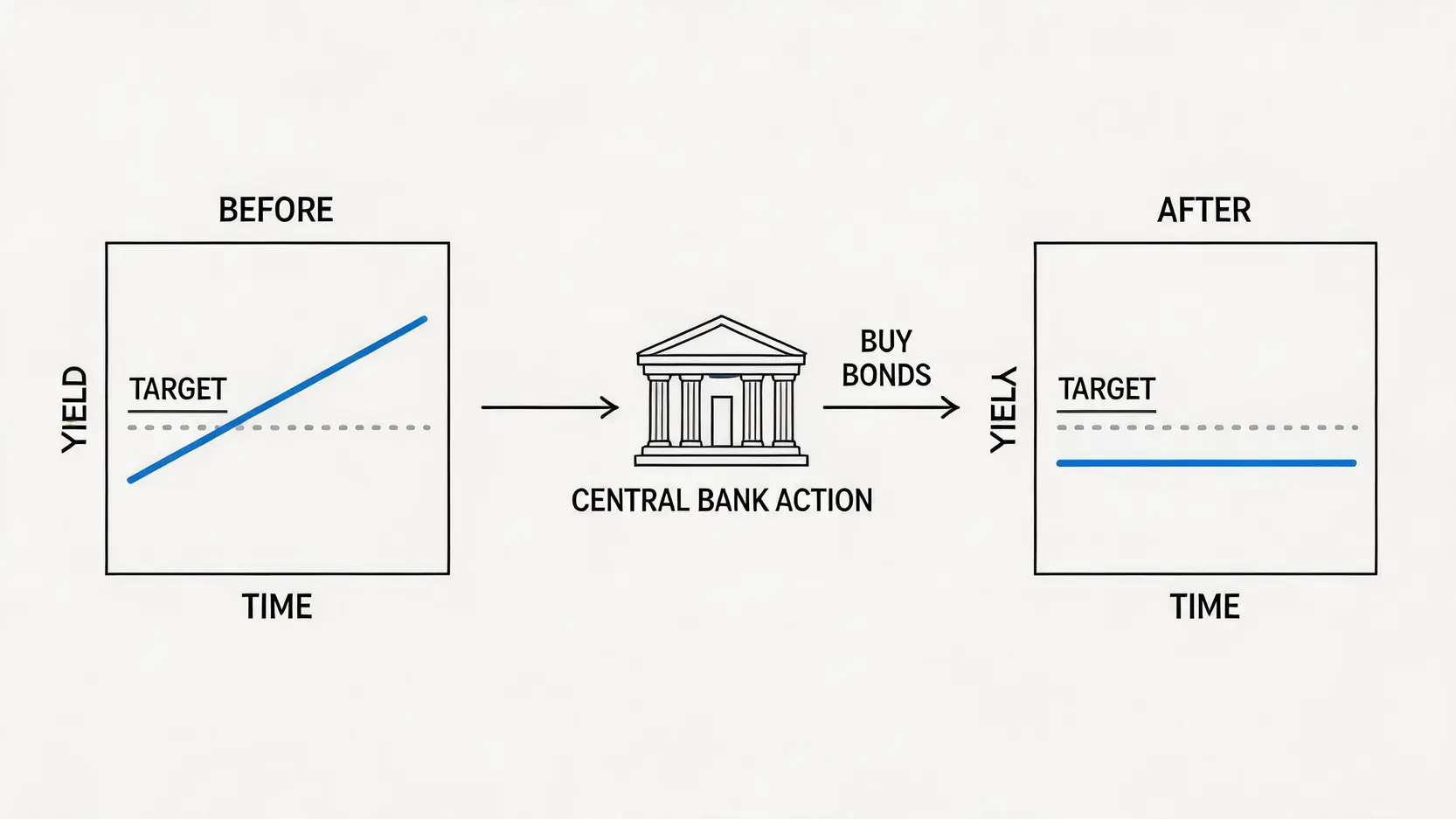
The mechanism was simple and aggressive: when the 10-year government bond yield approached the target range, the Bank of Japan would step in and purchase unlimited amounts of bonds, pushing prices up and keeping yields down. The policy aimed to:

孳息率曲線控制(YCC)政策運作原理示意圖,顯示央行如何透過購買債券將公債息率壓低至目標區間。

Diagram: How the Bank of Japan uses YCC policy to “control” bond yields

  • Lower borrowing costs for businesses and individuals, stimulating investment and consumption.
  • Ensure the entire yield curve remains at a low level, providing a stable financial environment for the economy.
  • Signal to the market the central bank’s long-term commitment to maintaining accommodative policy, thereby lifting inflation expectations.

Although this ultra-loose policy helped stabilize the economy to some extent, it also led to side effects such as market dysfunction and an excessively expanded central bank balance sheet.


Inflation Achieved? Three Key Reasons Behind the Bank of Japan’s Decision to Adjust the YCC Policy

After years of effort, Japan’s economy finally showed signs of structural transformation, prompting the Bank of Japan to move toward monetary policy normalization. Behind the impact of the YCC policy adjustment are three main reasons:

  1. Sustainable achievement of the inflation target: Global supply chain issues combined with rising energy prices have finally pushed Japan’s Consumer Price Index (CPI) to remain above the 2% target. More importantly, this year’s “Shunto” (spring wage negotiations) recorded the largest wage increase in three decades. The Bank of Japan judges that a positive wage-price cycle may be forming, meaning inflation is no longer temporary.
  2. Pressure from excessive yen depreciation: Against the backdrop of major global central banks entering tightening cycles, Japan’s continued YCC policy widened interest rate differentials, causing the yen to depreciate sharply, worsening imported inflation and placing significant pressure on households.
  3. Restoring market mechanisms: The long-term YCC policy distorted price discovery in the bond market. Exiting YCC allows government bond yields to be determined by market forces again, supporting healthier financial market development.


Comprehensive Impact Analysis of YCC Policy Adjustment

The Bank of Japan’s exit from the YCC policy marks the end of the last major negative interest rate economy in the world. This transition not only affects Japan domestically but also creates ripple effects globally. Investors must understand its potential impact across different asset classes.


Further reading (Highly Recommended)

Overseas Stock Investment Guide: From Asset Stocks and Gold Concept Stocks to Japan Tesla Analysis…

What Does “USD Hedged” Mean in Funds? Essential Safe-Haven Currency and AUD Hedging Strategies


Impact on the Japanese Yen Exchange Rate: Appreciation Trend or Temporary Move?

In theory, tighter monetary policy and the end of interest rate control should support currency appreciation. The market generally expects that as the Bank of Japan gradually raises interest rates, the interest rate gap between Japan and countries such as the US will narrow, which is positive for the yen. However, market reactions are often more complex.

  • Short-term volatility: Since the market had already priced in the exit of YCC, the announcement may instead trigger “buy the rumor, sell the fact” pressure, causing the yen to weaken in the short term rather than strengthen.
  • Medium to long-term trend: The key lies in the Bank of Japan’s future pace of rate hikes. If the central bank remains dovish and hikes slower than expected, the yen’s appreciation potential may be limited. Conversely, if inflation data remains strong and forces faster tightening, the yen could enter a longer-term appreciation trend. For deeper insights into yen movements, refer to a more comprehensive guide.


Impact on the Japanese Stock Market (Nikkei): Challenges and Opportunities

The impact of YCC adjustment on Japanese equities is two-sided. On one hand, tighter monetary policy means higher funding costs, which is theoretically negative for equity valuations. In particular, large export-oriented companies (such as automakers and electronics firms) may face pressure on overseas profits due to yen appreciation.

On the other hand, the end of ultra-loose monetary policy also signals that Japan is officially moving out of the “lost three decades” and returning to a healthy growth trajectory. This supports domestic demand sectors such as banking, insurance, retail, and real estate. The financial sector in particular benefits, as normalization of interest rates helps expand lending margins and improve profitability. Investors need to reassess Japanese stock market strategies, shifting from export-driven themes toward domestic recovery opportunities. 

Structural Changes in the Japanese Government Bond (JGB) Market

For the Japanese government bond market, this is the most direct and severe impact. The yield levels previously controlled by the central bank will now be determined by the market. This means:

  • Rising yields: With the removal of YCC constraints, 10-year government bond yields are expected to gradually rise to levels more aligned with economic fundamentals. Investors can refer to official data from the Ministry of Finance of Japan to track changes.
  • Bond prices fall: Based on the principle that “bond prices and yields are inversely related”, a rise in yields means that the prices of existing bonds will decline.
  • Increased market volatility: Without the central bank’s strong support, JGB prices will become more sensitive to economic data, inflation expectations, and global market sentiment, leading to significantly higher volatility.


Global Financial Market Ripple Effects

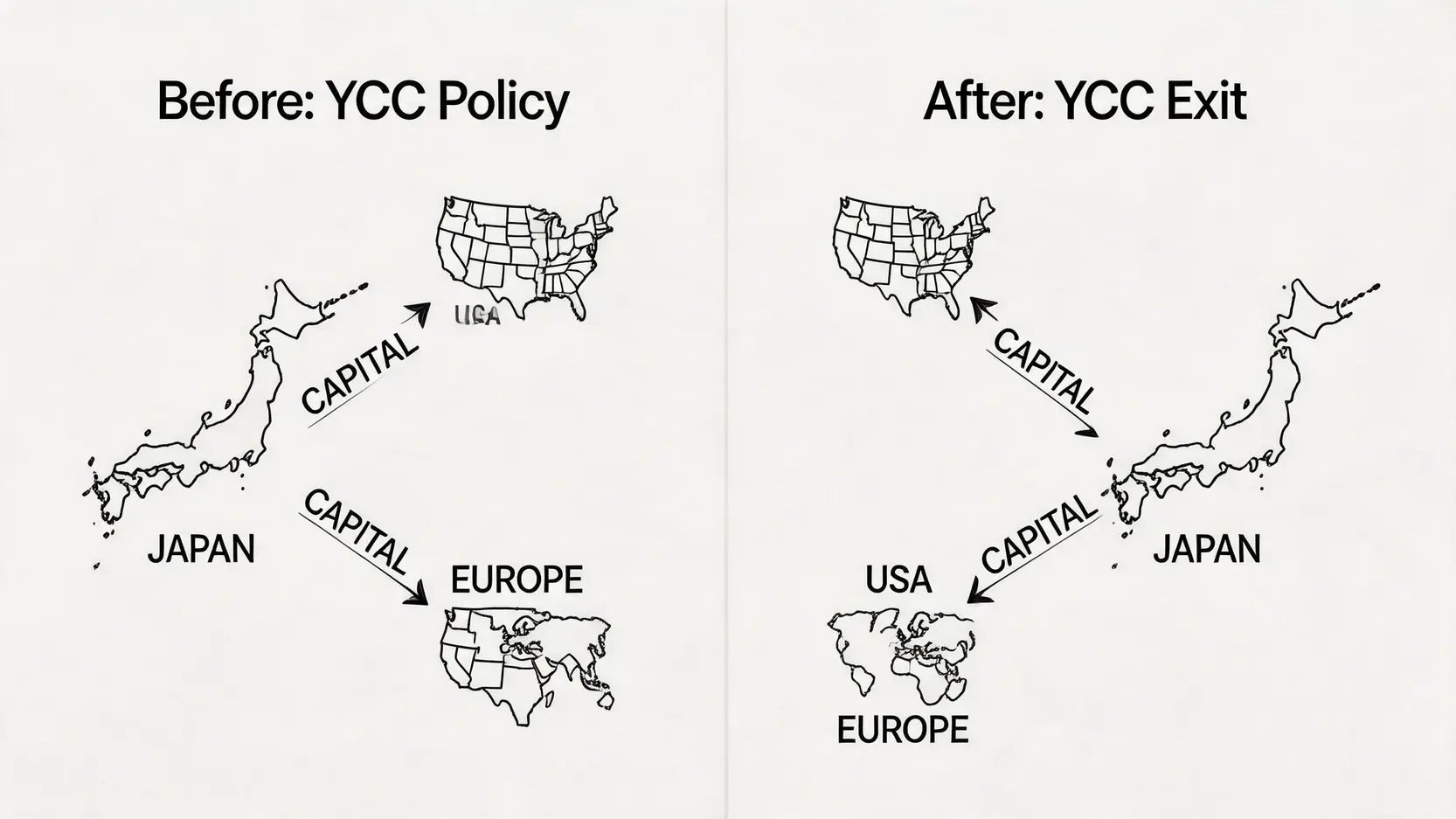
Japan is the world’s largest creditor nation, and its massive pension and insurance funds hold significant global assets. In the past, due to extremely low domestic bond yields, these “Japanese institutional investors” had to seek higher returns overseas, including US Treasuries, European bonds, and global equities.

Now, as Japanese bond yields rise and domestic assets become more attractive, some capital may flow back to Japan. This could trigger:

日本央行結束 YCC 政策對全球資金流動的影響示意圖,顯示資金從海外市場回流日本的趨勢。

Global Ripple Effects of YCC Exit: Yen Capital May “Return Home” From Overseas

  • Global liquidity tightening: Large-scale capital may be withdrawn from US and European markets, potentially pushing up borrowing costs in those economies.
  • Pressure on high-risk assets: Global risk appetite may decline, putting pressure on high-valuation assets such as technology stocks.
  • “Carry trade” unwinding: The widely used strategy of borrowing low-interest yen to invest in higher-yielding currencies “carry trade” may reverse, triggering significant volatility in related currency pairs.


Bank of Japan Interest Rate Timeline and Future Path Forecast

Ending YCC is only the first step toward monetary policy normalization. The market’s focus has now shifted to the next question: When will the Bank of Japan raise interest rates again, and how fast will the pace be?


Further reading (Highly recommended)

Overseas Stock Investment Guide: From Asset Stocks and Gold Concept Stocks to Japan Tesla Analysis…

USD to TWD Exchange Rate Explained: A Complete Guide to Yen Trends and RMB Conversion


2026 Bank of Japan Monetary Policy Meeting Schedule Overview

To help investors track key timing points, below is the expected 2026 Bank of Japan monetary policy meeting schedule. Statements and the governor’s press conferences following each meeting remain key focus events for the market.

Meeting Month Expected Date

Key Focus

January 20–21 Early-year economic outlook and inflation assessment
March 17–18 Evaluation of spring wage negotiations results
April 27–28 Quarterly economic and price outlook report
June 12–13 Mid-year policy review
July 28–29 Quarterly economic and price outlook report
September 21–22 Assessment of summer economic data
October 27–28 Quarterly economic and price outlook report
December 18–19 Year-end policy assessment and outlook for the coming year


Market Expectations: When Will the Next Rate Hike Be, and How Large Will It Be?

The current mainstream view in the market is that the Bank of Japan will adopt an extremely cautious “small steps, slow pace” strategy. After the first rate hike, the central bank is expected to spend several months observing economic data to confirm the stability of wage growth and inflation before considering the next move.

  • Timing forecast: If economic data remains stable, the market generally expects the next rate hike to occur in the third or fourth quarter of 2026.
  • Magnitude forecast: Each rate hike is expected to be 25 basis points (0.25%), raising the policy rate from the current 0–0.1% range to 0.25%, and then gradually moving toward 0.5%.

Everything depends on data. Any signs of economic slowdown or easing inflation could lead the Bank of Japan to delay its rate hike timeline.


Long-Term Interest Rate Normalization Challenges and Investment Outlook

The Bank of Japan is walking a tightrope. On one hand, it must control inflation and return interest rates to normal levels. On the other hand, it must avoid tightening too quickly, which could burst asset bubbles or severely damage the heavily indebted government’s fiscal position.

For investors, this means market volatility will become the new normal. The simple strategy of betting on yen depreciation and Japanese stock gains is over. In the future, investors who can adapt to interest rate changes and deeply analyze structural shifts in Japan’s domestic economy will be the ones who find opportunities in this new era.


Frequently Asked Questions (FAQ)

Q: Will traveling to Japan become more expensive after YCC ends?

A: In the medium to long term, if the yen strengthens due to rate hike expectations, you will be able to exchange fewer yen for the same amount of foreign currency, which means travel costs such as transportation, accommodation, and shopping in Japan may become more expensive. However, exchange rates fluctuate significantly in the short term, so immediate increases are not guaranteed. It is advisable to monitor exchange rates before traveling.

Q: Is now a good time to buy Japanese yen?

A: It depends on your objective. If you are buying for travel or practical needs, you may consider accumulating yen in batches at relatively favorable exchange rates. If it is for investment purposes, although there is long-term appreciation potential, short-term movements are still highly influenced by the Bank of Japan’s tightening pace and global economic conditions, so risks remain elevated and caution is required.

Q: Should I sell my Japanese stock funds now?

A: Not necessarily. The impact of YCC adjustment on Japanese equities is “short-term negative, long-term positive”. In the short term, yen appreciation may pressure export companies, but in the long term, monetary normalization supports overall economic fundamentals. It is recommended to review your fund holdings. If exposure is mainly in domestic demand sectors such as financials and retail, the outlook remains positive. If heavily weighted toward export-oriented companies, their ability to manage currency risk should be assessed.

Q: How will Bank of Japan rate hikes affect mortgage rates?

A: The policy rate set by the Bank of Japan serves as a benchmark for short-term interest rates, while mortgage rates (especially fixed-rate mortgages) are more closely tied to long-term yields such as the 10-year government bond yield. As YCC ends and rates gradually rise, long-term yields are expected to increase moderately, which will gradually push up domestic mortgage rates in Japan.


Conclusion

In summary, the Bank of Japan’s exit from the YCC policy and the start of an interest rate hike cycle mark a major step toward monetary policy normalization and the end of an era. The impact of this YCC policy adjustment is profound, reshaping everything from the yen exchange rate to global capital flows. Whether in forex, equities, or bond markets, investors should closely monitor the Bank of Japan’s interest rate timeline and continuously reassess their asset allocation strategies to navigate volatility and capture emerging opportunities in this new environment.

编者
Evan Lin

Evan Lin

我是Evan Lin,从大学时期开始接触外汇交易,至今已有多年实战经验,熟悉技术分析与EA策略,热衷于研究市场脉动与风险管控,喜欢分享实战经验和交易技巧,和大家一起学习、一起进步!

If you liked this article, please share it!

Related Articles

  • Hong Kong VASP License Guide 2026 for Web3 Firms
    Complete Guide to Virtual Asset Trading Platform (VASP) License Applications: A 2026 Hong Kong Web3 Compliance Practical Guide At the pivotal moment of 2026, as global financial digitization accelerates at an unprecedented pace, Hong Kong has firmly established itself as a leading Web3 compliance hub in Asia and around the...
    2026 年 6 月 3 日
  • CNH-CNY Arbitrage Guide 2026: Spread & Hedging
    2026 Offshore Renminbi Range-Bound Arbitrage Trading Guide: Mastering the CNH-CNY Spread and a Profit Guide to Hedging Through Two-Way Volatility Against the combined influence of global macroeconomic developments and international trade policies, the foreign exchange market in 2026 has become increasingly complex. The Renminbi exchange rate often exhibits a pattern...
    2026 年 6 月 3 日
  • Friday Taiwan Index Options: NFP Trading Strategy
    Friday Taiwan Index Options Buyer Strategies: Precisely Capturing Explosive Market Moves From Non-Farm Payroll Data Many investors often complain that options buyers have low win rates, frequently predicting the direction correctly but ultimately losing to time decay. However, under the new dual-settlement system, short-term volatility and event-driven trading have created...
    2026 年 6 月 3 日
返回顶部