USD to TWD Exchange Rate: Guide to Yen & RMB Trends

Updated: 2026/03/24  |  CashbackIsland

exchange-rate-usd-jpy-cny-guide

USD to TWD Exchange Rate Explained: A Complete Guide to Yen Trends and RMB Exchange

Whether you are traveling abroad, investing overseas, or engaging in international trade, accurately understanding real time exchange rates is the crucial first step in making decisions. Are you struggling to interpret complex bank rate quotes or predict the future direction of the USD to TWD exchange rate? Or trying to identify the best timing in TWD to JPY trends, or check the latest RMB to TWD rates to avoid exchange losses? This comprehensive exchange rate guide provides a one stop overview of the latest rates, professional trend analysis, and practical exchange strategies for three major currencies: USD, JPY, and RMB, helping you make smarter financial decisions. 


USD to TWD Exchange Rate (USD/TWD): Real Time Overview and Long Term Trend Analysis

The US dollar, as the world’s dominant reserve currency, plays a critical role in shaping the exchange rate of the New Taiwan Dollar. For individuals involved in overseas education, property investment, or US stock trading, closely monitoring its movements is essential.


Today’s USD to TWD Real Time Rates (with Major Bank Comparison Table)

Exchange rates vary slightly across banks, and for large transactions, even “small differences” can accumulate into a significant amount. Below is a sample comparison of major banks to give you an overview. Please note that actual rates are subject to the bank’s quoted rates at the time of transaction.

Bank Currency Cash Buying Rate Cash Selling Rate Spot Buying Rate Spot Selling Rate
Bank of Taiwan US Dollar (USD) 32.00 32.67 32.35 32.45
Mega Bank US Dollar (USD) 32.02 32.69 32.37 32.47
Cathay United Bank US Dollar (USD) 31.98 32.71 32.33 32.48
E.Sun Bank US Dollar (USD) 32.01 32.71 32.36 32.46

Note: The above data is for illustration purposes only and does not represent real time exchange rates. It is for reference only.


Three Key Factors That Influence the US Dollar Exchange Rate

Exchange rate movements are not random. They are driven by multiple economic and political forces. Understanding these factors can help you assess the future direction of the USD to TWD exchange rate:

  • Federal Reserve (Fed) Policy: When the Fed adopts tightening monetary policies such as rate hikes, capital flows into USD assets to earn higher returns, pushing the dollar higher. Conversely, rate cuts or easing policies may weaken the USD.
  • Key Economic Data: Indicators such as Non Farm Payrolls (NFP) and Consumer Price Index (CPI) reflect the health of the US economy. Strong data typically boosts confidence in the USD, while weak data has the opposite effect.
  • Global Risk Sentiment: During geopolitical conflicts or financial crises, investors tend to move funds into “safe haven” assets like the US dollar, causing short term spikes in demand.

一張概念圖,說明影響美金匯率的三大因素:聯準會政策、經濟數據與全球避險情緒。

Three Core Drivers Behind USD Strength: Central Bank Policy, Economic Data, and Risk Sentiment

Understanding these factors is essential for making informed decisions. For further reading, refer to Will the Euro Continue to Fall? 2025 EUR Exchange Rate Analysis and 5 Key Factors Forecast. Although it focuses on the euro, the core concepts such as central bank policy and economic data are equally applicable. 

TWD to JPY Trends (TWD/JPY): In Depth Analysis and Best Timing for Currency Exchange

For Taiwanese travelers who frequently visit Japan, the TWD to JPY exchange rate is a key factor in travel budgeting. In recent years, the weakness of the yen has made “when is the best time to exchange currency” a widely discussed topic.


Will the Yen Continue to Fall? Identifying the Sweet Spot from Historical Trends

In recent years, the Bank of Japan (BOJ) has maintained an ultra loose monetary policy, creating a sharp contrast with the tightening cycles of major global central banks. This has led to a sustained depreciation of the yen. For Taiwanese travelers, this means that the same amount of TWD can be exchanged for more JPY.

From historical trends, when the TWD to JPY exchange rate falls below 0.22, it is generally considered a favorable “sweet spot”. However, exchange rates are highly dynamic. Future policy changes by the Bank of Japan and actions by the Federal Reserve will continue to influence the yen’s trajectory. Instead of trying to time the absolute bottom, adopting a phased buying strategy can help spread risk and average out costs. 

Further Reading (Highly Recommended)

[Forex Trading Guide 2024]: The Ultimate Beginner’s Guide from 0 to 1!

How to Buy the S&P 500? A Beginner’s Guide: 3 Investment Methods and VOO vs SPY Comparison


Japan Travel Exchange Guide: Online FX vs Counter Exchange

There are two main ways to exchange yen: traditional bank counter exchange and increasingly popular online foreign exchange services. Each has its own advantages and disadvantages:

  • Counter Exchange: Simple and intuitive, allowing immediate cash exchange. However, it is limited to banking hours and usually uses the “cash selling rate”, which is less favorable than spot rates.
  • Online FX: Allows you to lock in a better spot selling rate online, then collect cash at a designated branch or airport. Many banks also offer preferential rate discounts, making it the preferred choice for cost conscious users. For detailed steps, refer to 2025 Online FX Guide: From Beginner to Advanced, Master Online Banking in One Article, there is a full tutorial.

一張對比圖,比較線上結匯與臨櫃換鈔的優缺點,包含時間彈性與匯率優劣。

Online FX vs Counter Exchange: One Chart to Help You Understand Which Option Suits You Best.


CNY to TWD Exchange Rates (CNY/TWD): Practical Guide and Key Considerations

With increasingly frequent cross-strait trade and travel, demand for exchanging RMB (CNY) into TWD continues to exist. Understanding the rules and limitations of RMB exchange rates can make your currency exchange process smoother.


How to Understand Bank RMB Exchange Rates? A Complete Guide to the Difference Between “Spot” and “Cash”

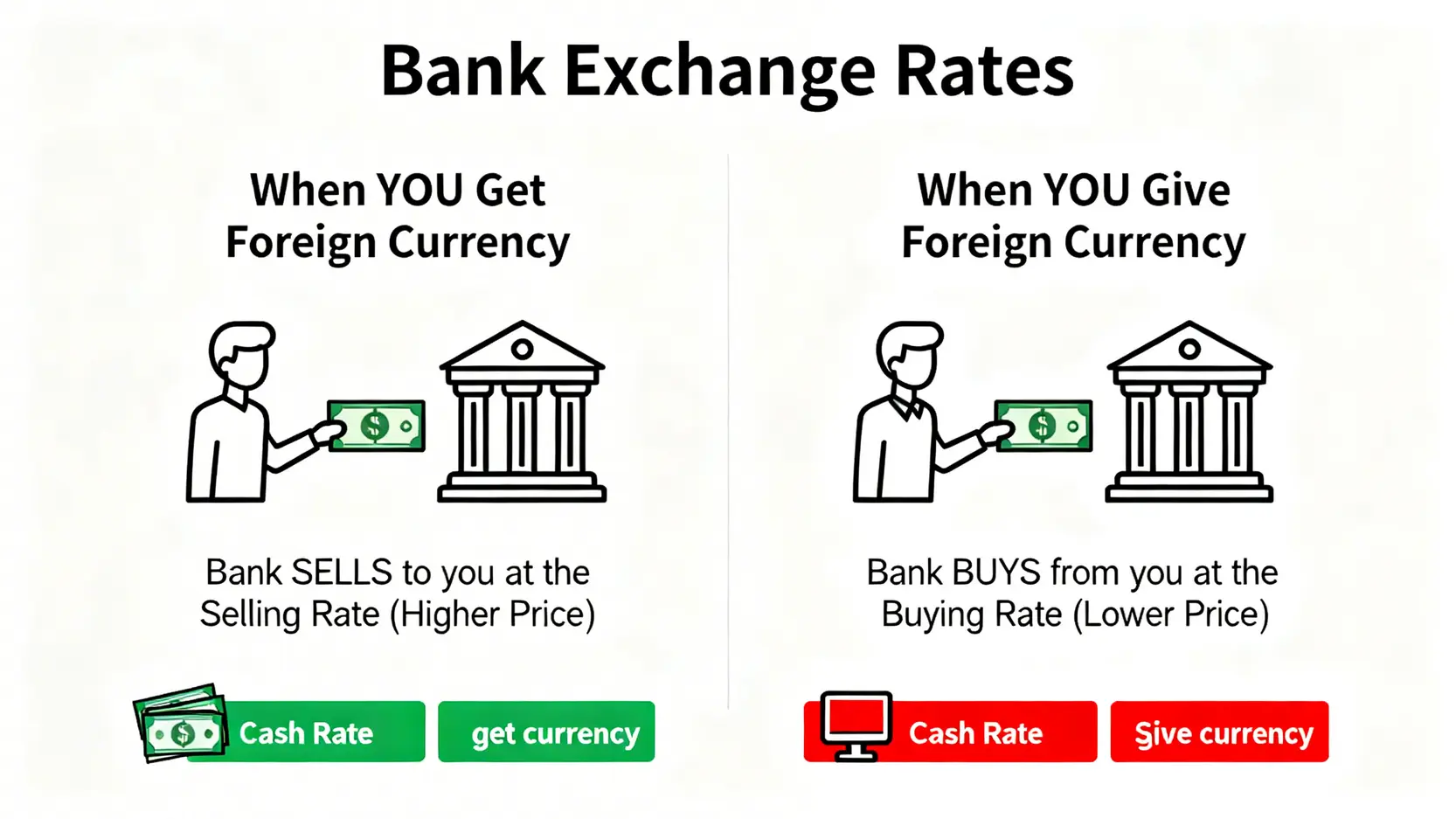
When looking at bank exchange rates, you will see two types of prices: “spot” and “cash”, each with its own “buying” and “selling” rates. Their meanings are as follows:

  • “Selling rate”: The price at which the bank “sells” foreign currency to you. This is the rate you need to focus on. The lower the number, the more favorable it is.
  • “Buying rate”: The price at which the bank “buys” foreign currency back from you.
  • “Cash” exchange rate: Applies to transactions involving physical banknotes. Because banks incur storage and transportation costs, the rate is usually less favorable (with a higher selling rate and a lower buying rate).
  • “Spot” exchange rate: Applies to non-physical currency transactions, such as transfers between foreign currency accounts. The exchange rate is usually more favorable than cash rates.

一張示意圖解釋銀行牌價中的「買入價」與「賣出價」,以及「即期」與「現鈔」的差別。

Buying rate, selling rate, always leaving you confused? One chart to instantly reveal the secret behind bank exchange rates.

Simply put, when you want to exchange TWD for RMB cash, you should look at the “cash selling rate”.


Main Channels for Exchanging RMB in Taiwan and Daily Limit Explanation

At present, the main channels for exchanging RMB cash in Taiwan are government-designated banks (such as Bank of Taiwan and Mega Bank) as well as licensed currency exchange outlets. One important point to note is that Taiwan imposes a daily limit on RMB exchange.

According to current regulations, each person may exchange up to RMB 20,000 per day through an account. The same limit also applies to RMB cash exchange. If there is a need for a larger amount, it may be necessary to split the exchange across multiple days or have different family members assist with the process. 

Frequently Asked Questions About Currency Exchange (FAQ)

Q: What identification documents are needed to exchange foreign currency?

A: When exchanging currency at a bank counter, please make sure to bring your personal identification card. If you are a foreign national, you must provide your passport or residence permit. If the transaction is handled through a corporate account, relevant company registration documents and an authorization letter must also be prepared.

Q: What is the difference between the “cash selling” rate and the “spot selling” rate?

A: “Cash selling rate” is the price at which the bank sells you foreign currency in physical cash. As there are handling costs for physical banknotes, the price is higher. “Spot selling rate” is the price at which the bank sells you foreign currency through account transfer, without the cost of physical banknotes, so the exchange rate is usually more favorable. If you are using online currency exchange, the more favorable spot exchange rate is usually applied.

Q: Which is better, online FX or counter exchange?

A: For those seeking better exchange rates and greater time flexibility, “online FX” is usually the better choice. You can place an order online at a more favorable spot rate at any time within 24 hours, then collect the currency at the agreed time. Counter exchange is more suitable for those unfamiliar with online operations or those with urgent needs, but the exchange rate cost may be slightly higher.

Q: Are there any fees for currency exchange?

A: At banks in Taiwan, when exchanging TWD for foreign currency cash, most banks do not charge an additional handling fee, as the cost is already included in the spread between buying and selling rates. However, if you withdraw foreign currency cash from a foreign currency account, some banks may charge a fee based on the amount.


Conclusion

In summary, gaining a deeper understanding of the logic behind the USD to TWD exchange rate, TWD to JPY trends, and CNY to TWD rates is not only an important part of overseas travel or investment planning, but also essential knowledge for making smart spending decisions. Many factors influence exchange rates, from international political and economic developments to central bank policies in different countries, all of which are closely interconnected. Before making any large currency exchange transaction, be sure to check the latest real time rates from major banks and make good use of tools such as online FX to maximize efficiency and protect every part of your assets.

编者
Evan Lin

Evan Lin

我是Evan Lin,从大学时期开始接触外汇交易,至今已有多年实战经验,熟悉技术分析与EA策略,热衷于研究市场脉动与风险管控,喜欢分享实战经验和交易技巧,和大家一起学习、一起进步!

If you liked this article, please share it!

Related Articles

  • Order Flow Analysis Tools: Track Institutional Activity
    In-Depth Review of Intelligent Order Flow Detection Tools: Understanding Institutional Activity and Identifying Real Market Buying and Selling Pressure What Is Order Flow, and Why Is It a “Leading Indicator” for Price Prediction? Candlestick charts and technical indicators can be misleading, but the real-money "Order Flow" within the market cannot....
    2026 年 6 月 4 日
  • Social Sentiment Indicators: Predicting Stock Trends
    Social Sentiment Quantitative Indicators: Mining PTT and Dcard Discussions to Predict Stock Prices What Are Social Sentiment Quantitative Indicators, and Why Are They Becoming Increasingly Important? In an era of information overload, financial markets are no longer driven solely by cold financial statements and macroeconomic data. The "Shipping King" phenomenon...
    2026 年 6 月 4 日
  • Taiwan FSC Futures Broker Verification Guide
    Avoid Fraudulent Platforms! A Visual Guide to Taiwan FSC Licensed Futures Merchant Verification and Scam Prevention In recent years, driven by heightened volatility in global financial markets and the impact of monetary easing policies worldwide, more investors have begun seeking diversified investment instruments. However, underground futures operators and overseas fraudulent...
    2026 年 6 月 4 日
返回顶部