2026 Beginner Investing Guide: Passive Investing

2026 Beginner Investing Guide: Passive Investing in 5 Steps
In today’s era, where inflation continues to erode purchasing power, beginner investing is no longer an elective course, but an essential skill that everyone must master. Many people feel lost when they first enter the financial markets, and the most common question they ask is: how should beginners start investing? In fact, through a systematic beginner investing tutorial, you will discover that building your own wealth snowball is not as difficult as imagined. This article will start from the underlying logic and guide you step by step through the essential concepts and practical steps of investing.
Beginner Investing Tutorial: Why You Should Take Action Now?
The global economic environment in 2026 is full of variables, from the AI arms race among tech giants to adjustments in monetary easing policies by central banks around the world, and market volatility seems to have become the norm. However, this is precisely the best time for wealth redistribution. Simply keeping funds in the bank may seem safe, but in reality, you are bearing the hidden cost of declining purchasing power every day.

Inflation Erosion vs. Compound Growth: Two Possible Paths for Your Money
The key to taking the first step toward wealth growth is recognizing that “time” is your greatest weapon. The compounding effect needs time to develop. The earlier you invest your funds in high-quality investment tools, the steeper your future return curve will become. Many people fall into the misconception of “I’ll start investing when I have a large sum of money” at the beginning, but in fact, making small regular investments is the most stable way to start. As long as you find the right direction, the power of accumulating little by little can definitely help you build a considerable fortress of wealth.
How Should Beginners Start Investing? 5 Core Steps to Building Wealth
To build a solid financial foundation, you cannot rely solely on intuition or listen to market stock tips. Following the five core steps below can greatly improve your long-term odds of success:

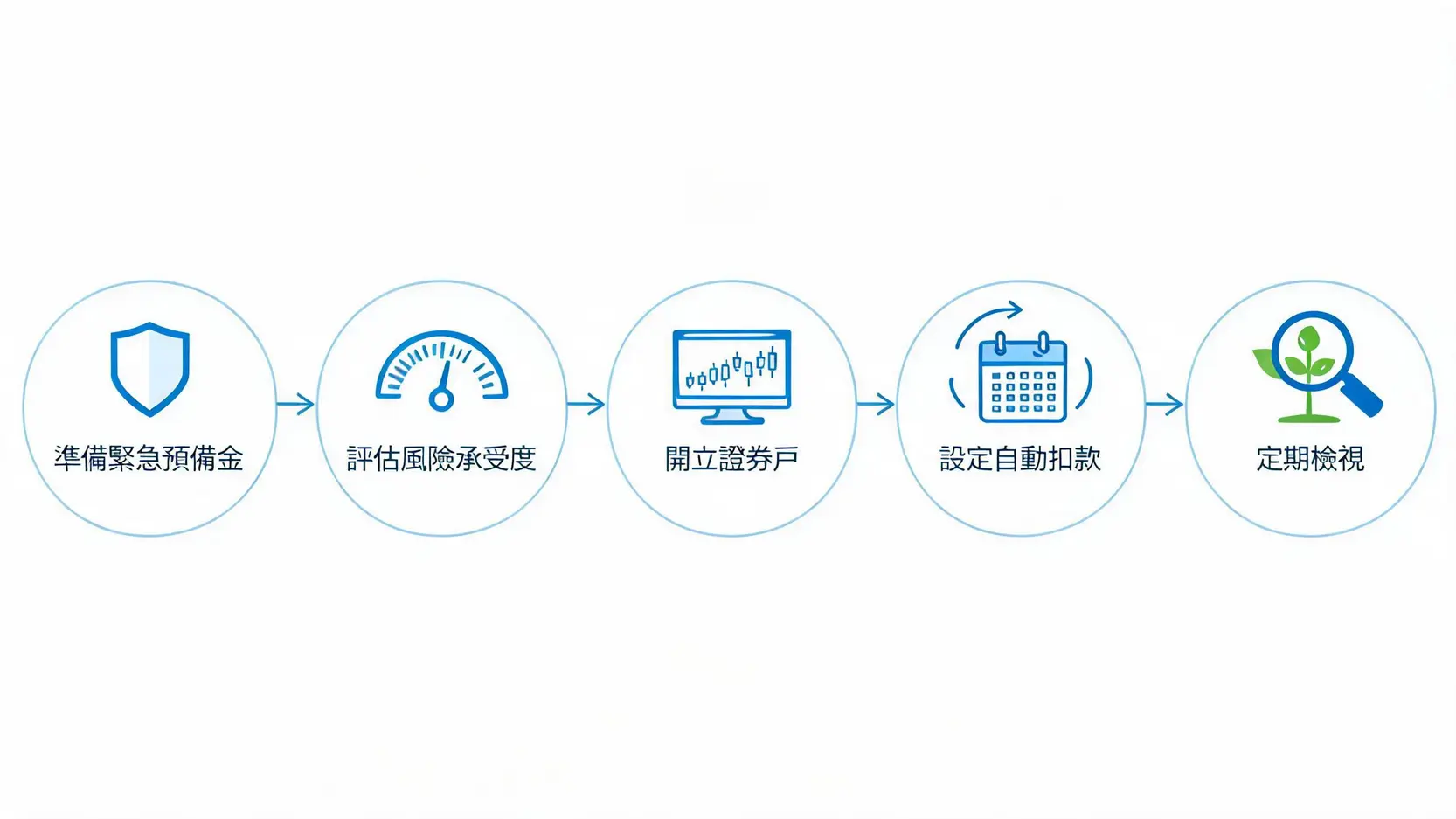
Beginner Investing: The Five Cornerstones of Building Wealth
- Step 1: Prepare an emergency fund. Before investing any money in the market, make sure you have at least 6 to 12 months of living expenses in your account. This money is your safety net, ensuring that when unexpected situations arise, you will not be forced to sell assets cheaply at market lows.
- Step 2: Assess your risk tolerance. Everyone has different financial conditions and psychological resilience. Are you pursuing high risk and high returns, or stable income? Clarifying this point allows you to choose the corresponding strategy.
- Step 3: Open a suitable securities account. To do a good job, one must first sharpen one’s tools. Choosing a broker with reasonable fees and a user-friendly interface is the first step. If you want to participate in the world’s largest capital market, you can refer to this article, [2026 US Stock Investing for Beginners] The Ultimate Guide to US Stock Investing for Beginners: Understand Account Opening in One Article, and open the door to overseas capital markets for yourself.
- Step 4: Set up automated deductions, also known as regular fixed investments. The best way to overcome human weaknesses is to build automated discipline. After receiving your salary each month, automatically transfer a fixed proportion of funds into your account, forcing yourself to participate in the market.
- Step 5: Review regularly, but do not over-intervene. Markets will always rise and fall. Reviewing your holdings once every six months or once a year is enough. Avoid frequent trading due to short-term fluctuations, which only wastes money on transaction fees.
What Is Passive Investing? The Wealth Multiplication Strategy Best Suited for Office Workers
Among the many financial strategies, what passive investing is definitely a core concept that everyone must understand in depth. So-called passive investing refers to not trying to predict highs and lows or beat the market through frequent buying and selling, but instead choosing to track a specific market index, such as the S&P 500 Index or the Taiwan Weighted Index, to obtain the long-term average return of the overall market.
This strategy is highly regarded by experienced investors worldwide because it has three major advantages. The first is low cost, as there is no need to pay high manager management fees. The second is high transparency, as you clearly know which constituent stocks you have bought. The last is emotional separation, as you do not need to watch the market every day or guess whether the market will rise or fall, making it highly suitable for busy office workers.
Long-term historical data has repeatedly proven that the vast majority of active strategies often struggle to outperform broad market indices over a ten- or twenty-year horizon. Therefore, investing funds in broad market indices is the best foundation for achieving steady growth. To understand the power of index-based strategies, this article, S&P 500 Annual Return Guide: Data Analysis of Historical Returns and the Best US Stock ETFs, provides very detailed objective data support.
Stocks, ETFs, and Funds: How to Build a Long-Term Investment Portfolio?
After understanding the basic strategies, the next step is to choose suitable financial tools. The three most common tools in the market are individual stocks, ETFs (Exchange-Traded Funds), and mutual funds. Each has different characteristics, which directly affect the final effectiveness and resilience of how a long-term investment portfolio is built.
| Investment Tool | Risk Level | Management Method | Suitable For |
| Individual Stocks | High | Requires self-research on financial reports and market trends, with active buying and selling | Investors with ample time for research and extremely high risk tolerance |
| ETF (Exchange-Traded Funds) | Medium | Tracks market indices, passively managed, automatically eliminating weaker holdings and keeping stronger ones | People who pursue steady asset growth and do not want to spend time watching the market |
| Mutual Funds | Medium to high | Professional teams and managers actively manage and select stocks | Investors willing to pay higher management fees in exchange for professional management |
For those who are just getting started, prioritizing high-quality broad market ETFs is the choice with the highest odds of success. An ETF is like a comprehensive gift package that bundles dozens or even hundreds of quality companies for you, allowing you to instantly achieve risk diversification by buying just one fund. If you want to gain a deeper understanding of the underlying operating mechanism of mutual funds, the official investor education website under the US Securities and Exchange Commission (SEC) provides a highly authoritative explanation: Investor.gov Introduction to Mutual Funds.
Further Reading (Highly Recommended)
How to Build a Long-Term Investment Portfolio? Learn 5 Beginner Strategies in One Article
What Are the Investment Risks? A Pitfall Avoidance Guide Every Beginner Investor Must Know
While pursuing profits, you must also know how to defend. Many people easily lose themselves in a bull market and overlook potential crises. What are the investment risks? Common types include the following:

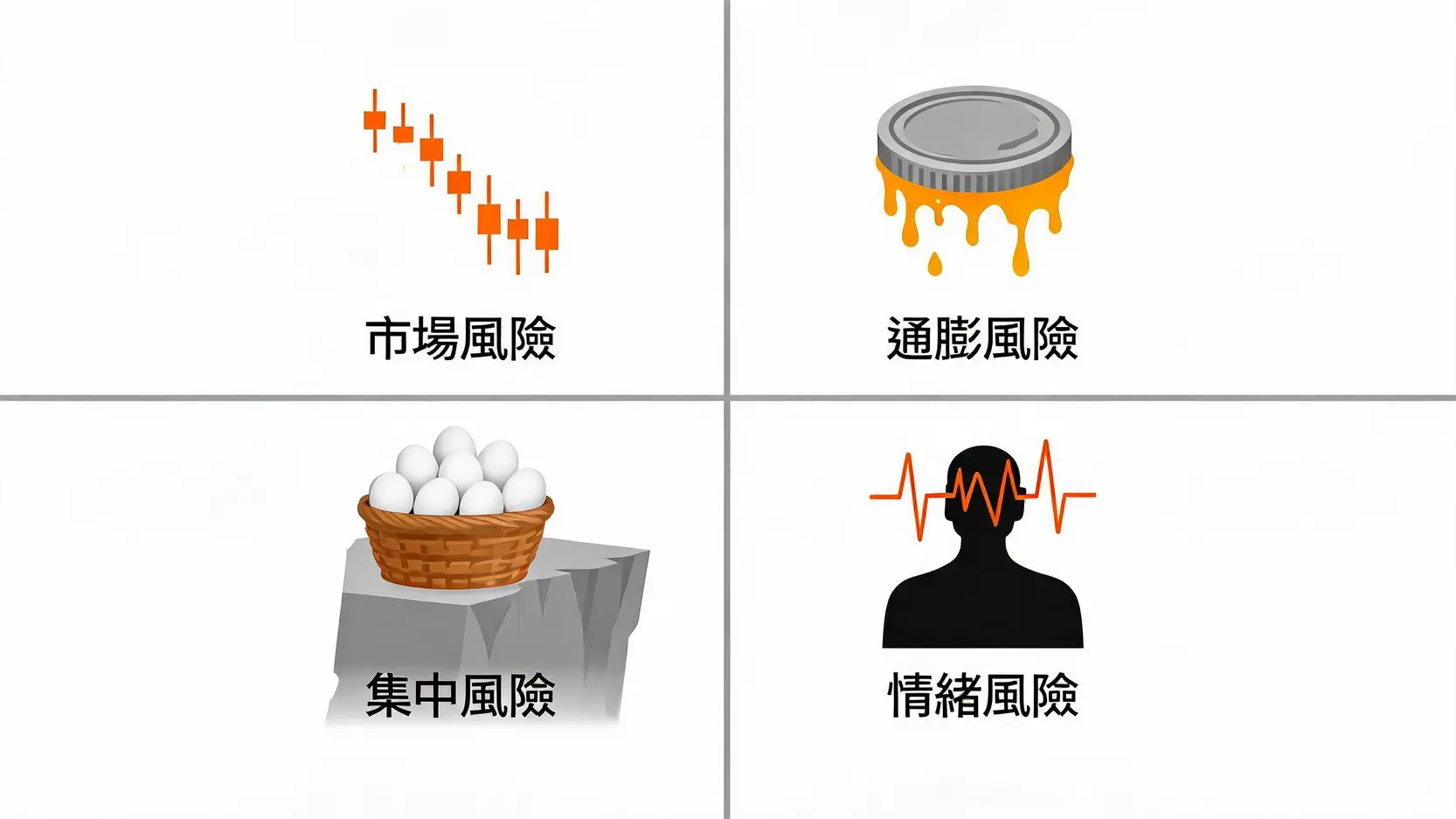
Understanding and Avoiding Four Common Investment Risks
- Market Risk: A poor overall economic environment causes asset prices to fall across the board. This type of systemic crisis cannot be completely avoided, but volatility can be smoothed out by extending the holding period.
- Inflation Risk: If the nominal return is lower than the inflation rate, real purchasing power is still shrinking. This is also why simply keeping money in bank fixed deposits is another extremely high-risk behavior in the long run.
- Concentration Risk: Putting all funds heavily into a single stock or single industry sector. Once that industry faces headwinds or policy pressure, the assets may suffer a devastating blow.
- Psychological Risk: Blindly chasing highs when the market is extremely euphoric, or cutting positions and selling into declines when the market is panicking. This kind of emotion-driven decision-making is often the main cause of severe losses.
Only by understanding risk can you truly manage risk. Before officially entering the market, it is recommended that you carefully read this article, What Are Investment Risks? A Complete Analysis of 5 Common Types of Investment Risks for Beginners, and build a solid financial safety net for yourself.
Conclusion
The capital market is a marathon that tests patience, not a 100-meter sprint in pursuit of overnight wealth. Building the right mindset, choosing a suitable passive investment strategy, using low-cost tools such as ETFs to diversify risk, and maintaining discipline are the most stable path toward financial freedom. The market in 2026 is still full of various opportunities and challenges. Do not let short-term fear or greed disrupt your own rhythm. As long as you stick to long-term and stable asset allocation, time and compound interest will eventually give you the richest returns. Start reviewing your financial situation now and take the brave first step.
Frequently Asked Questions (FAQ)
Q: Can beginners start investing with limited capital?
A: Absolutely. Many well-known brokers now support fractional share trading or regular fixed investments with very low entry barriers. Even if it is only a few thousand Taiwan dollars or a few hundred ringgit per month, as long as you start early, the compound interest effect accumulated over the long term can still be very impressive.
Q: What Is the Difference Between Passive Investing and Dividend Stock Investing?
A: The two concepts may seem similar, but they are fundamentally different. “Dividend stock investing” usually refers to selecting specific individual company stocks with high dividend yields and holding them for the long term, with risk highly concentrated in the operations of a single company. “Passive investing”, on the other hand, is mostly done by buying broad market index ETFs, which is equivalent to buying high-quality companies across the entire market. The risk is more diversified, and you do not need to bear the risk of an individual company going bankrupt or declining on its own.
Q: What should beginners do when the stock market plunges?
A: A stock market pullback is a normal phenomenon in the economic cycle. As a rational participant who values the long term, a sharp decline is instead an excellent opportunity to use the same amount of capital to buy more units, lowering the average holding cost. Please stay calm, confirm whether you have prepared an emergency fund, and then continue executing your original regular fixed investment plan. Do not sell at a loss during extreme market panic.
Q: How do you choose the first ETF suitable for beginners?
A: For beginners, it is strongly recommended to start with broad market ETFs that track a wide market, such as related products tracking the US S&P 500 Index, or ETFs tracking the local total market index. These products have extremely high liquidity, low management fees, and cover the most competitive leading companies in the market, making them the best first choice for building a core asset portfolio.
Related Articles
-
How to Get Started with Bitcoin? The Complete 2026 Bitcoin Buying Guide for Beginners After watching Bitcoin repeatedly reach new highs in recent years and successfully pass spot ETF reviews in the US and Hong Kong in 2024, officially entering mainstream financial markets, many investors have turned their attention to...2026 年 7 月 20 日
-
Is Gold’s V-Shaped Rebound a Bottom-Fishing Signal? A Complete Guide to Trading Strategies Amid “$100 Price Swings” What Is a Gold V-Shaped Rebound? More Than Just a Technical Pattern The gold market has recently experienced sharp rises and falls, with prices frequently displaying dramatic “gold V-shaped rebounds”. Single-day “$100 price...2026 年 7 月 20 日
-
What Is PPI Data? 2026 Latest Analysis: Understand the Differences from CPI and How It Affects Stock Market Trends With market information constantly changing, do you always hold your breath while waiting for CPI data to be released? But did you know that a more forward-looking inflation indicator, PPI data...2026 年 7 月 20 日