US Stock Market Guide 2026: Beginner Investing Basics

[2026 US Stock Market Basics] The Ultimate Beginner’s Guide to Investing in US Stocks: Understand Account Opening, Trading, and Stock-Picking Strategies in One Article!
Want to invest in the world’s leading companies like Apple and NVIDIA and share in the growth dividends of industry leaders, but feel held back by unfamiliarity with the US stock market? Confused about US stock market basics such as “how to buy US stocks” or “how to apply for a US stock trading account”? Do not worry. This ultimate guide, designed specifically for beginners investing in US stocks, starts from zero and breaks down US stock account setup step by step, helps you understand trading rules, and provides practical stock-picking strategies, so you can easily take your first step into US stock investing and begin your wealth-building journey.
Why Invest in US Stocks? Four Key Advantages Beginners Should Know
When we talk about investing, the US stock market is often an option that cannot be ignored. For beginners, it is not only a gateway to participating in global economic momentum, but also offers many advantages that other markets may struggle to match. Understanding these advantages is the first step to building long-term investment confidence.
Advantage One: Easy Access to the World’s Leading Companies
Many well-known brands in daily life, such as the iPhone in your hand (Apple), the Windows system on your computer (Microsoft), and even the Coca-Cola you drink (Coca-Cola), are all US-listed companies. Investing in US stocks means you can directly become a shareholder of these world-class businesses and share in the profits and growth potential they generate in global markets, rather than only being a consumer.
Advantage Two: Massive Market Size and Extremely High Liquidity
The US has the world’s two largest stock exchanges: the New York Stock Exchange (NYSE) and the Nasdaq Stock Market (NASDAQ). Its enormous market scale attracts capital from around the world, with very high daily trading volume. The benefit is “strong liquidity”. Whether you want to buy or sell, you can usually find a counterparty quickly and complete the trade with ease, avoiding the awkward situation of “wanting to sell but being unable to”.
Advantage Three: Low Entry Barrier, Trade From Just One Share
Unlike some markets that require buying in board lots at a time (such as hundreds or thousands of shares), US stocks trade in units of “one share”. This significantly lowers the entry barrier for beginners. Even with a budget of only a few hundred dollars, you can buy shares of a company you like. In recent years, many brokers have also introduced “fractional share” trading, allowing you to invest smaller amounts, such as US$50 or US$100, to buy a portion of high-priced stocks and achieve more flexible asset allocation.
Advantage Four: Transparent Financial Reporting and a Mature Regulatory System
The US financial regulatory framework is relatively mature. Regulatory bodies led by the US Securities and Exchange Commission (SEC) impose strict disclosure requirements on listed companies. Businesses must publish detailed financial reports each quarter, and any material information that may affect share prices must also be disclosed promptly. This highly transparent environment helps investors access more symmetrical information and make more informed decisions. For more information on investor protection, you may refer to the official resources on the US Securities and Exchange Commission’s Investor.gov.
[US Stock Account Setup Tutorial] Five-Step Account Opening Guide, the First Step to Buying US Stocks
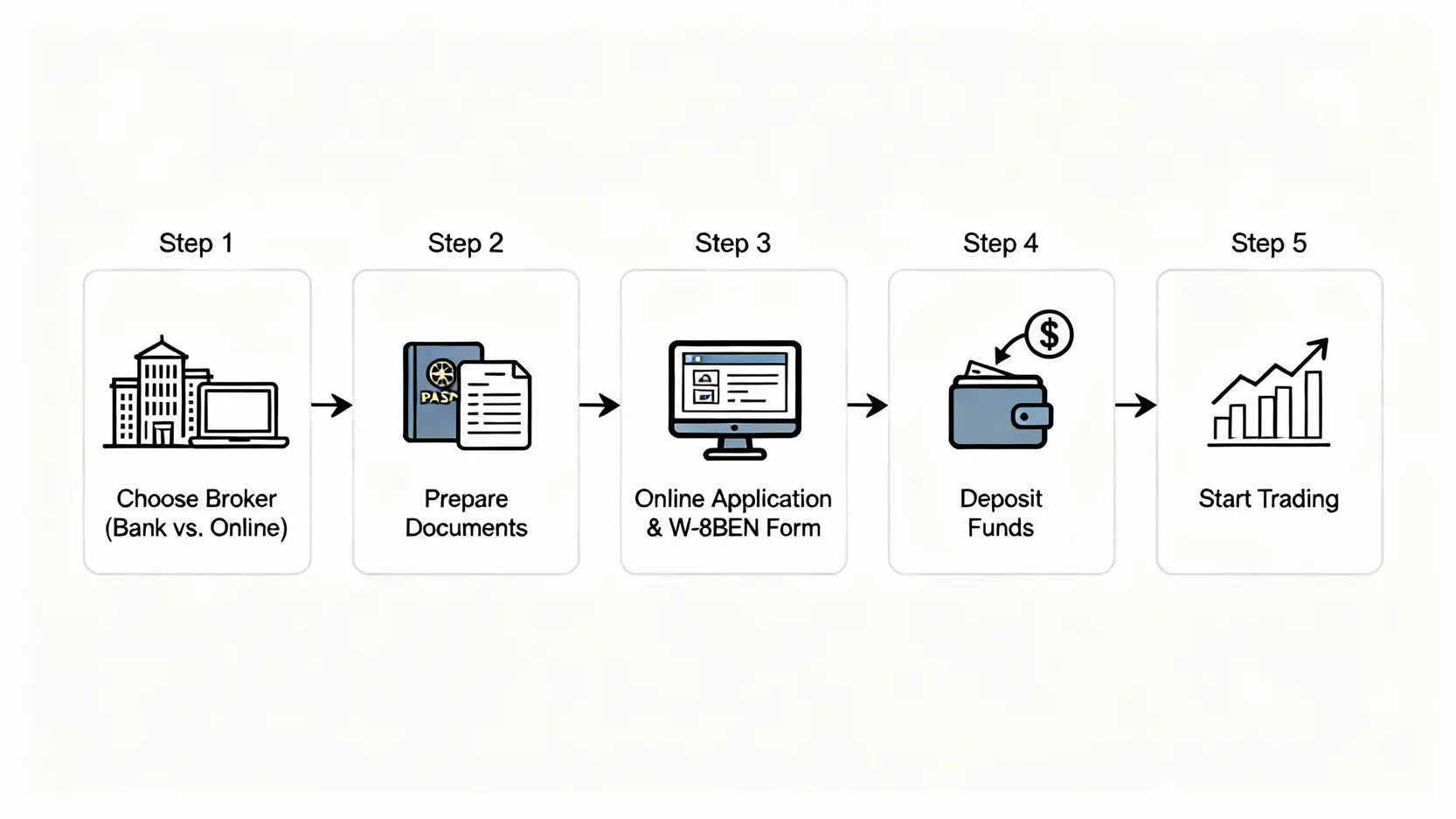
After understanding the appeal of US stocks, the next step is putting it into practice. Opening a US stock trading account is the first step to “buying US stocks”. The process is simpler than you might think, and most of it can now be completed online. Below is the complete five-step account opening guide.

Step One: Choose the US Stock Broker That Suits You
Choosing a reliable platform is crucial. There are two main options: traditional banks and online brokers. Each has its own pros and cons and suits investors with different needs.
Banks vs. Online Broker Platforms Comparison
| Comparison Item | Traditional Banks (such as HSBC, Bank of China) | Online Brokers (such as Interactive Brokers, Firstrade, TD Ameritrade) |
| Fees | Higher, often with minimum charges | Very low, sometimes commission-free |
| Account Opening Convenience | May require an in-branch visit | Fully online process, can be completed as fast as the same day |
| Trading Products | More limited, mainly stocks | Extensive, including stocks, ETFs, options, futures, and more |
| Currency Exchange Rates | Larger exchange rate spreads | Smaller exchange rate spreads, more competitive |
| Suitable For | Investors who prefer in-person services and already have bank accounts | Investors seeking low costs, frequent trading, and a wide range of tools |
Overall, for beginners seeking lower costs and higher efficiency, online brokers are the more advantageous choice. If you would like a more detailed comparison of broker platforms, you may refer to [2025 US Stock Options Tutorial] Understand Options in One Article! From Firstrade Account Opening to Four Major Trading Strategies, which also mentions the features of different brokers.
Step Two: Prepare the Required Documents for Account Opening
Before starting the online application, please prepare the following documents. In most cases, only electronic files or clear photos are required:
- Proof of identity: A valid passport or identity card.
- Proof of address: A bank statement, utility bill, or government letter issued within the past three months, clearly showing your name and address.
Step Three: Submit the Online Application and Complete the W-8BEN Form Tutorial
After choosing a broker, go to its official website, click “Open an Account”, and follow the system instructions to fill in your personal information, including your name, contact details, employment status, and investment experience. During the process, you will need to complete a form called “W-8BEN”. This form is very important!
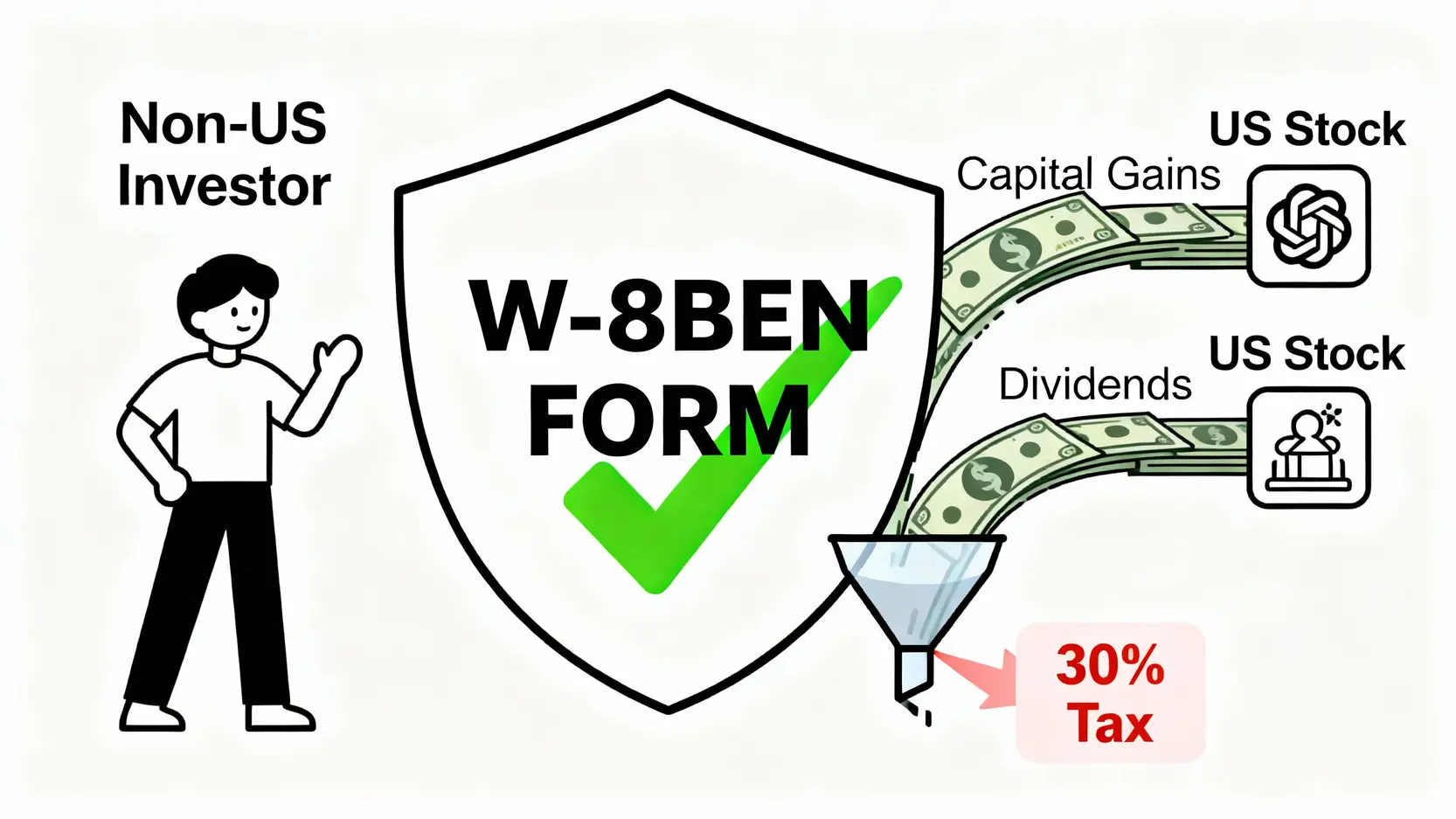
What Is the W-8BEN Form?
This is a tax form for non-US residents used to declare your foreign status and exempt you from US capital gains tax. After completing it, you do not need to pay tax to the US government on the price difference you earn from selling stocks. Dividend tax will be withheld at 30% (or according to the tax treaty between your region and the US). This form is valid for three years, and your broker will remind you to update it before it expires.
Step Four: Deposit Funds Into Your Investment Account
After your account is approved, the next step is to deposit funds (commonly referred to as “funding”). Common funding methods include:
- Bank wire transfer (TT): The most traditional method, relatively fast, but banks will charge a fee.
- ACH / eDDA: Electronic direct debit authorization, usually free, but the initial setup may take a few days.
- Wise (formerly TransferWise): A popular third-party platform in recent years, with exchange rates and fees that are usually more favorable than banks.
Beginners are advised to compare the total cost (fees + exchange rate spread) across different methods and choose the one that suits them best.
Further Reading (Highly Recommended)
What Is the S&P 500? A Beginner’s Investment Guide: Understanding Constituents, ETFs, and How to Buy
US Stock Trading Tutorial: Order Placement Process and Key Considerations for Beginners
Once the funds arrive, congratulations! You can start your first trade. Before clicking the “Buy” button, spending a few minutes understanding US stock trading rules can help you avoid many unnecessary mistakes.
Must-Know US Stock Market Trading Hours and Rules
The US stock market has fixed trading sessions and is divided into daylight saving time and standard time.
- Regular trading hours: US Eastern Time 09:30 – 16:00
- Asia time reference (daylight saving time): Hong Kong, Taiwan, Malaysia time 21:30 – 04:00
- Asia time reference (standard time): Hong Kong, Taiwan, Malaysia time 22:30 – 05:00
In addition, there are “Pre-market” and “After-hours” trading sessions. However, trading volume is lower and price volatility may be higher in these sessions, so beginners may focus on regular trading hours first.
Market Order vs. Limit Order? Understanding Common Order Types
When placing an order, the broker will ask you to choose an order type. The two most common are:
- Market order:
Executed immediately at the best available market price. The advantage is that execution is highly likely, while the disadvantage is that the execution price may differ from the price you saw when placing the order, especially during high volatility. - Limit order:
You specify the highest price you are willing to pay to buy, or the lowest price you are willing to accept to sell. The order will only be executed when the market price reaches or is better than your specified price. The advantage is cost control, while the disadvantage is that if the price never reaches your level, the order may not be filled.
For beginners, if you are investing in highly liquid large-cap stocks, a market order is a simple option. But if you want to control your entry cost precisely, using a limit order is recommended.
Trading Fees, Dividend Tax, and Capital Gains Tax Explained
The costs of investing in US stocks mainly consist of three parts:

- Trading fees: Many online brokers have implemented commission-free trading for stocks and ETFs, but may still charge minimal platform fees or SEC fees.
- Dividend tax: As a non-US resident, dividends distributed by US-listed companies are subject to a 30% withholding tax. This is handled automatically by the broker.
- Capital gains tax: This is where the benefit of completing the W-8BEN form comes in. For non-US residents, profits earned from buying and selling stocks are tax-exempt.
What Should Beginners Buy When Investing in US Stocks?
After opening an account and understanding the rules, the most exciting question is: “What should beginners buy when investing in US stocks?” In the early stages, it is best to focus on stability and simplicity, and avoid chasing short-term hot stocks with extremely high risk.
Lazy Investor’s First Choice: Index ETFs That Track the Broad Market
If you do not want to spend time researching individual stocks, index ETFs (Exchange-Traded Funds) are an excellent starting point. An ETF is like a basket containing dozens or even hundreds of stocks. Buying a single ETF is equivalent to diversifying across all its constituents, effectively reducing the risk of a single company experiencing major problems.
- VOO (Vanguard S&P 500 ETF): Tracks the most representative S&P 500 Index, allowing you to invest in the 500 largest listed companies in the US in one go, with very low management fees.
- QQQ (Invesco QQQ Trust): Tracks the Nasdaq 100 Index. Its constituents are mainly technology giants such as Apple, Microsoft, and Amazon. Volatility is higher, but growth potential is also greater.
Steady Growth: Start With Blue-Chip Stocks You Know
Another strategy is to begin with “blue-chip stocks” that you are familiar with and trust in daily life. These companies are usually industry leaders with global operations, stable business models, and the ability to generate consistent cash flow and pay dividends.
- Apple (AAPL): A global leading technology company with a strong brand moat.
- Microsoft (MSFT): A giant spanning software and cloud computing, with a highly diversified business.
- Coca-Cola (KO): A long-term holding of Warren Buffett and a classic defensive value stock.
Starting your US stock investing journey with these high-quality assets helps build long-term investment confidence and patience.
Frequently Asked Questions About US Stock Market Basics (FAQ)
Q: How much money do I need at minimum to invest in US stocks?
A: In theory, there is no minimum amount requirement. Because US stocks can be bought share by share, and many brokers offer fractional share trading, you can start investing with as little as US$100 (about HK$780). The key is to build the habit of consistent contributions and let compounding grow your assets.
Q: Do Hong Kong, Taiwan, or Malaysia residents need to pay tax when trading US stocks?
A: Two main types of tax are involved. The first is dividend tax, where dividends received are subject to a 30% withholding tax. The second is capital gains tax, meaning profits from selling stocks. As long as you are a non-US resident and have completed the W-8BEN form, you are fully exempt, which is a major advantage for overseas investors.
Q: Which US stock trading account is best? How should I choose?
A: When choosing a US stock trading account, you should consider several factors: 1) fees (whether it is commission-free and the level of platform fees); 2) platform stability and ease of use; 3) customer service (whether Chinese-language support is available); 4) product variety. For beginners, Firstrade and TD Ameritrade are widely popular due to their user-friendly Chinese interfaces and commission-free policies. For more professional investors, Interactive Brokers offers more powerful trading tools and a wider range of products.
Q: What is the W-8BEN form? What happens if I forget to complete it?
A: The W-8BEN form is an identity declaration for non-US tax residents, used to exempt capital gains tax and confirm the withholding tax rate on dividends. If it is not completed or has expired, the broker may withhold your taxes at US resident tax rates, including taxing your trading profits. Therefore, you must ensure the form remains valid at all times.
Conclusion
In summary, investing in US stocks as a beginner is not as complicated as it seems. By following this guide, from choosing the right broker and completing your US stock account application to understanding basic trading rules and tax knowledge, you can easily buy your first US stock. The most important thing is not chasing overnight riches, but continuously learning and patiently holding high-quality assets, so the US stock market can become a powerful tool for growing your wealth. Take action now, take the first step toward financial freedom, and start your US stock investing journey!
Related Articles
-
Practical Applications of Volatility Surfaces: From Options Modeling to Advanced Skew Trading Strategies In options markets, implied volatility is never a flat line. Instead, it forms complex "smile" or "skew" surfaces. For advanced traders, mastering the practical applications of volatility surfaces is equivalent to possessing a lens that reveals market...2026 年 6 月 3 日
-
Building a Foreign Capital Flow Copy Trading Model: A Stock Market Indicator for Accurately Tracking Institutional Positioning In Asia-Pacific stock markets, foreign capital inflows and outflows often determine the direction of the index. However, simply looking at daily net buy and sell data is no longer enough. Only by building...2026 年 6 月 3 日
-
Options Buyer Strategies During Extreme Market Conditions: Black Swan Hedging and Cross-Market Arbitrage During Volatility Surges The most terrifying aspect of financial markets is not a gradual decline, but overnight flash crashes and cross-market capital withdrawals accompanied by volatility surges. In the highly unpredictable global macroeconomic environment of 2026, geopolitical...2026 年 6 月 3 日