HIBOR Guide: Impact on HK Mortgages & Rates

HIBOR Simplified Guide: How Does the Hong Kong Interbank Offered Rate Affect Your Mortgage? A Complete Interest Rate Trend Strategy
Are rising mortgage interest costs putting pressure on you recently? Every fluctuation in the Hong Kong Interbank Offered Rate (HIBOR) directly affects the wallets of hundreds of thousands of H-Plan mortgage holders. Especially in a rising interest rate cycle, understanding how interbank rates impact mortgages and keeping track of the latest HIBOR trends has become essential knowledge for every homeowner. This article provides a complete breakdown of the HIBOR definition, analyzes market trends and key drivers, and explains how it affects your mortgage repayments, helping you make the most informed financial decisions.
What Is the Hong Kong Interbank Offered Rate (HIBOR)?
The Hong Kong Interbank Offered Rate (HIBOR) refers to the interest rate at which banks in Hong Kong lend to each other. It is not only a reflection of funding costs within the banking system but also one of the most important short-term benchmark interest rates in Hong Kong’s financial market.
Official Definition and Role of HIBOR: Why Is It a Key Indicator in Hong Kong’s Financial Market?
In simple terms, banks sometimes have temporary surplus or shortage of funds. HIBOR represents the cost of borrowing within the banking system to manage these short-term liquidity needs. When Bank A has excess funds, it may lend to Bank B, and the interest rate of this transaction is the interbank rate. This rate reflects the “tightness” of liquidity in the banking system:
- When liquidity is abundant: banks have no funding pressure, lending activity decreases, and HIBOR falls.
- When liquidity is tight: banks need funds more urgently and are willing to pay higher interest rates, causing HIBOR to rise.
Since HIBOR directly affects banks’ funding costs, it is widely used in pricing financial products, most notably the “H-Plan” mortgage, which is based on HIBOR.
How Is HIBOR Calculated? Understanding the Banking Quote Mechanism
HIBOR is not set by a single institution but is driven by the market. Its calculation process is transparent:
- Quoted banks: The Hong Kong Association of Banks designates 20 active banks in the interbank market as contributing banks.
- Daily quotations: At 11:00 a.m. on each business day, these banks submit the interest rates at which they are willing to lend Hong Kong dollars to other banks.
- Calculation method: To avoid extreme values, the highest three and lowest three quotes are excluded.
- Final rate: The average of the remaining 14 quotes is used to determine the HIBOR for different tenors, from overnight to 12 months.
This mechanism ensures the credibility and market representativeness of HIBOR, making it a reliable benchmark rate.
HIBOR Trend Analysis: Understanding the Key Drivers of Market Movements
To forecast mortgage interest rate trends, it is essential to understand the forces behind HIBOR movements. In recent years, HIBOR has remained at elevated levels, pushing many H-Plan mortgage holders close to their capped interest rates.
Recent HIBOR Trends: Will It Remain High or Gradually Decline?
Looking at the past one to two years, HIBOR has risen sharply from low levels due to global macroeconomic conditions, particularly the Federal Reserve’s rate hikes. Although interest rates are currently relatively high, the market generally expects HIBOR to gradually decline as the US rate-hiking cycle peaks. However, the speed and extent of this decline remain uncertain and depend on several key factors.
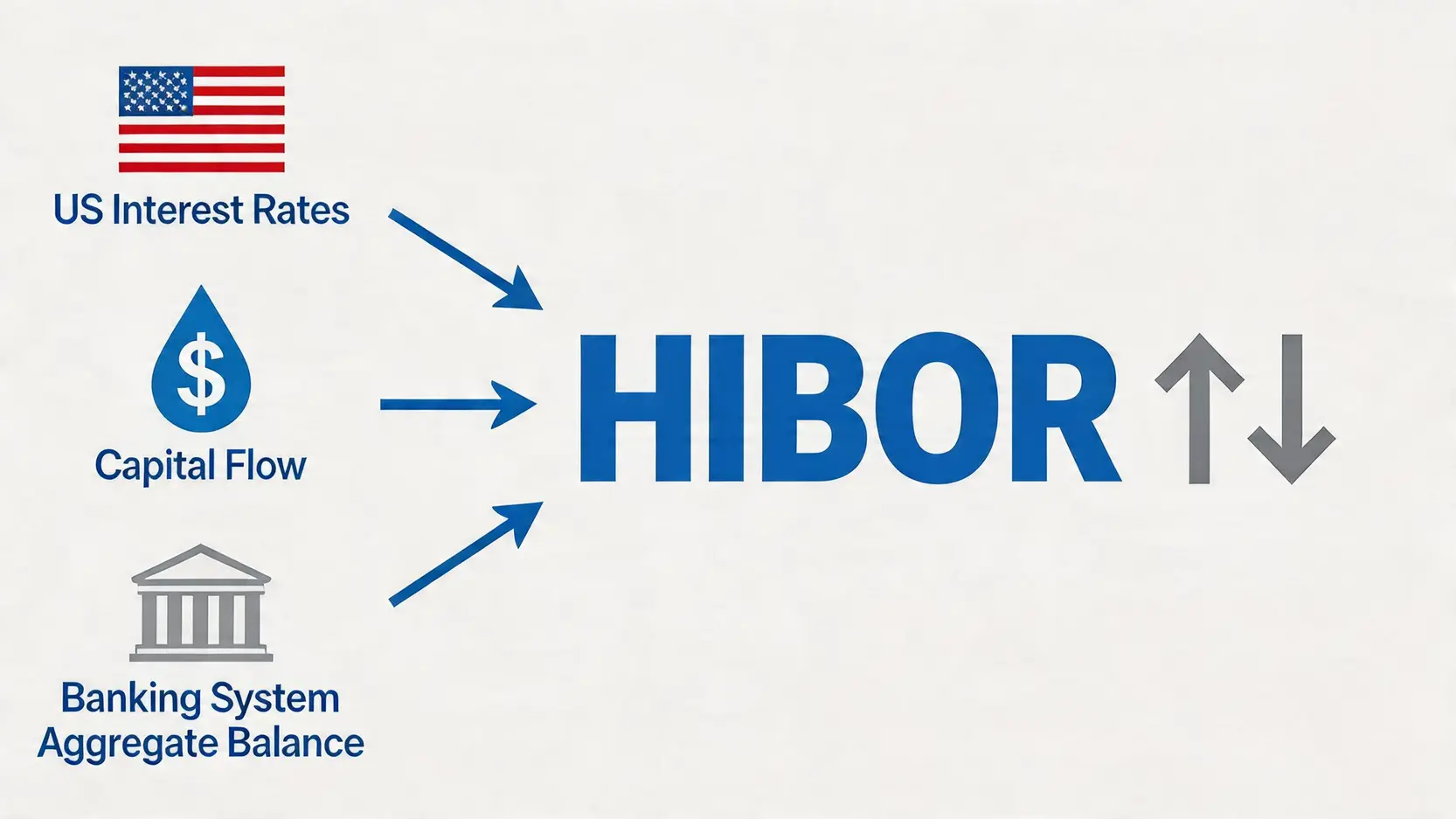
Three Major Factors Affecting HIBOR: US Interest Rates, Capital Flows, and Banking System Balances
HIBOR fluctuations are not random. They are mainly driven by three forces:
- US monetary policy: Due to Hong Kong’s Linked Exchange Rate System pegged to the US dollar, Hong Kong interest rates generally follow US rates. When the Federal Reserve raises rates, USD yields rise, and to prevent capital outflow from HKD to USD, Hong Kong interest rates (including HIBOR) must also increase. To understand more, you can refer to our detailed analysis on the [2026 US interest rate timeline] Fed meeting dates, latest announcements, and market impact.
- Capital flows: Global capital inflows and outflows directly affect liquidity in Hong Kong. When large IPOs lock up significant funds or risk-off sentiment drives capital outflows, HKD liquidity decreases, pushing HIBOR higher. Conversely, capital inflows put downward pressure on HIBOR.
- Banking system balance: This refers to the total balance held by licensed banks in their settlement accounts with the Hong Kong Monetary Authority (HKMA). It is a key indicator of liquidity in the banking system. A higher balance indicates abundant liquidity and lower HIBOR pressure, while a lower balance indicates tighter liquidity and rising HIBOR.

Three core factors influencing HIBOR trends
Recommended Reading (Highly Recommended)
2026 US Interest Rate Timeline: Fed Meeting Dates, Latest Results, and Market Impact
How Does the Interbank Rate Affect Your Mortgage Repayments? Full Comparison of H-Plan and P-Plan Mortgages
For most homeowners, the biggest concern is how interbank rates affect mortgage repayments. In Hong Kong, the two main mortgage plans are the H-Plan and the P-Plan, and HIBOR is the core benchmark for the H-Plan.
H-Plan (HIBOR-Based Mortgage) Interest Rate Formula: HIBOR + Margin
The calculation of the actual mortgage rate under an H-Plan is very straightforward:
H-Plan effective interest rate = HIBOR reference rate + bank fixed margin
For example, assume a bank offers a plan of “H + 1.3%,” and today’s one-month HIBOR is 4.5%. Your actual mortgage rate would be 4.5% + 1.3% = 5.8%. The “H” usually refers to the one-month HIBOR, as it best reflects market movements in a timely manner.
What Is the “Capped Interest Rate” (Cap Rate)? Your Mortgage Safety Net
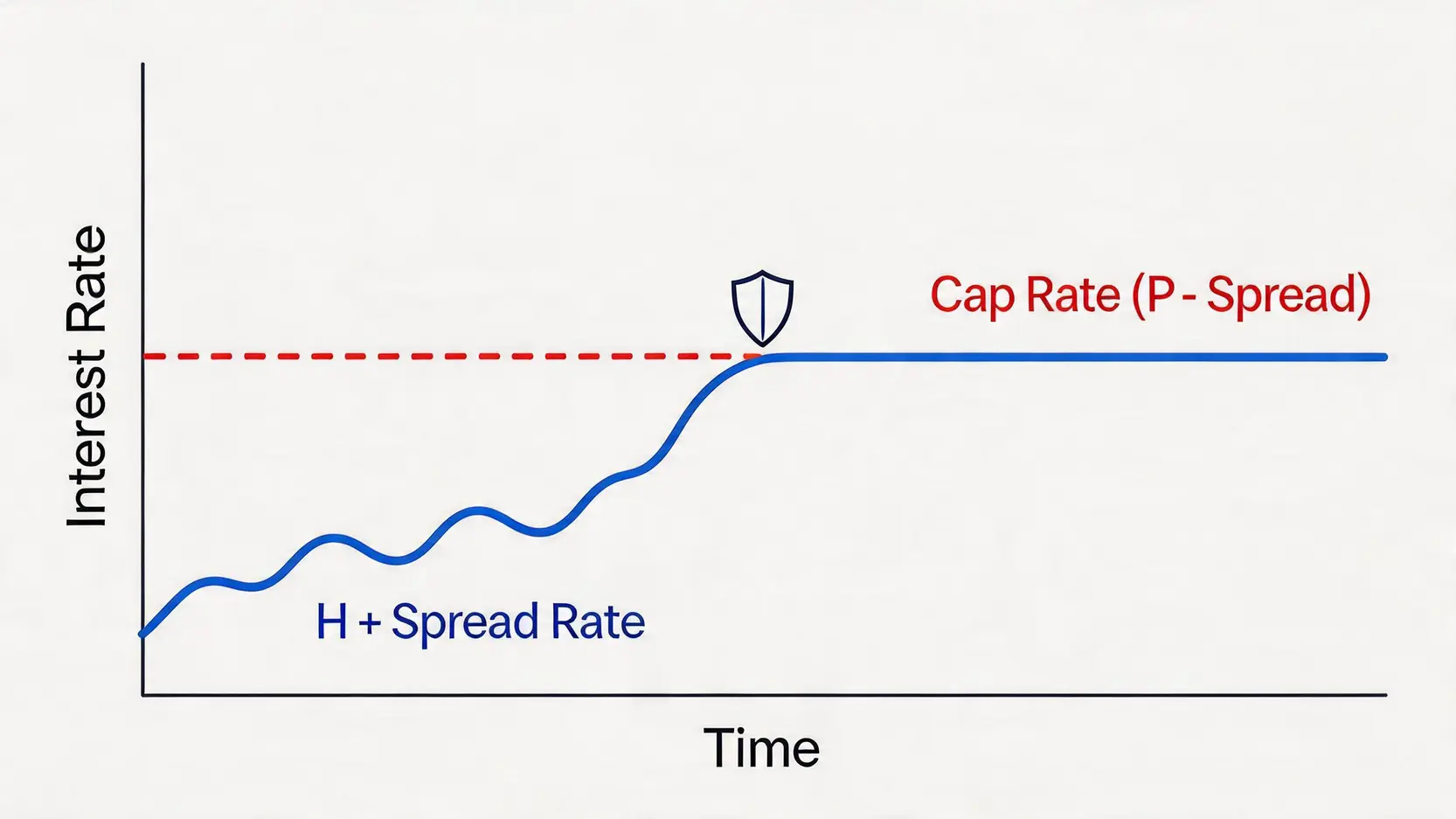
At this point, you may worry: if HIBOR keeps rising indefinitely, will mortgage payments become uncontrollable? This is where the “capped interest rate” comes in. Almost all H-Plan mortgages include an interest rate ceiling based on the Prime Rate (P).
Capped interest rate = Prime Rate (P) − bank fixed margin
For example, if the current Prime Rate is 6.125% and the bank offers a cap of “P – 2%,” then your capped rate would be 6.125% – 2% = 4.125%. When the calculated H + 1.3% exceeds 4.125%, the bank will only charge you 4.125%. This mechanism acts as a “safety net” for your mortgage repayments, preventing interest rates from rising indefinitely.

How the H-Plan “capped interest rate” mechanism provides a safety net for your mortgage repayments.
H-Plan vs. P-Plan: Which Should You Choose in a Rising Interest Rate Cycle?
The H-Plan and P-Plan each have their pros and cons. The choice depends on your expectations of interest rate trends and your risk tolerance. We can compare them in a simple table:
| Characteristics | H-Plan (HIBOR-based mortgage) | P-Plan (Prime-based mortgage) |
| Interest rate basis | HIBOR + fixed spread | Prime Rate (P) − fixed spread |
| Volatility | High, closely follows the market with daily fluctuations | Low volatility, as changes in P are relatively lagging and stable |
| Advantages | Can benefit from lower interest rates in a declining rate cycle or low interest environment | Interest rate movements are more predictable, resulting in stable repayments |
| Disadvantages | In a rising interest rate cycle, rates increase quickly, leading to higher repayment pressure (but protected by a cap rate) | Usually unable to benefit from ultra-low market interest rates |
| Suitable users | Suitable for homeowners who can tolerate interest rate volatility and are seeking lower potential interest costs | Suitable for homeowners who prefer stability and do not want frequent changes in repayment amounts |
In the current rising interest rate environment, although H-Plan mortgages have already reached their capped interest rates, the cap is usually similar to or slightly lower than P-Plan mortgage rates. Combined with expectations that interest rates may decline in the future, more than 90% of homeowners still choose the H-Plan mortgage scheme.
Frequently Asked Questions (FAQ)
Q: Which HIBOR tenor is usually used, one-month or three-month?
A: Currently, the vast majority of H-Plan mortgages in Hong Kong use the “one-month HIBOR” as the benchmark. This is because the one-month rate best reflects changes in market funding costs in a timely manner and has the highest transparency. Although other tenors of HIBOR exist in the market, for mortgages, you only need to focus on movements in the one-month HIBOR.
Q: What happens to my H-Plan mortgage payments if HIBOR remains high?
A: There is no need to worry. As mentioned earlier, H-Plan mortgages include a “capped interest rate” mechanism. Once HIBOR plus the bank’s spread exceeds the capped level, your mortgage interest will be locked at the cap and will not rise further indefinitely. In the current high-interest environment, the vast majority of H-Plan borrowers are effectively paying their capped rate.
Q: Where can I check the latest daily HIBOR rates?
A: The Hong Kong Association of Banks (HKAB) is the official institution that publishes HIBOR data. You can visit the official website of the Hong Kong Association of Banks after 11:30 a.m. on each business day to view the latest HIBOR rates across all tenors. Many major financial news websites and banking apps also update this data simultaneously.
Q: What is the difference between HIBOR and HONIA? Will HONIA replace HIBOR in the future?
A: HONIA (Hong Kong Dollar Overnight Index Average) is a risk-free benchmark rate based on actual transactions, while HIBOR is based on quoted rates. As the global trend moves toward risk-free rates, HONIA may become more widely used in the long term and could even replace HIBOR in certain financial products. However, in the foreseeable future, especially in the residential mortgage market, HIBOR remains the dominant benchmark.
Conclusion
In summary, the Hong Kong Interbank Offered Rate (HIBOR) is not just a financial term, but a core factor that directly affects your monthly mortgage repayments. By understanding its definition, recognizing the three key drivers of HIBOR trends (US interest rates, capital flows, and banking system balances), and making good use of the capped interest rate mechanism in H-Plan mortgages, homeowners can better plan their personal finances and make more informed decisions in a changing market. Staying informed about market developments is the key to managing mortgage costs and navigating interest rate cycles smoothly.
Related Articles
-
The Taiwan Dollar Surges Past 31.5! With Hot Money and Foreign Capital Inflows, Is This an Opportunity or a Risk? An In-Depth Analysis The Capital Frenzy: The Three Major Drivers Behind the Taiwan Dollar Breaking Above 31.5 The New Taiwan dollar has recently become the absolute focal point of the...2026 年 6 月 10 日
-
Taiwan Dollar Appreciation and Hot Money Inflows! An Investor's Action Guide: Should You Buy Stocks, Bonds, or Exchange for US Dollars at This Stage? One of the hottest topics in the market recently has been the capital-driven rally fueled by foreign investors' consecutive net buying of Taiwan stocks, pushing the...2026 年 6 月 10 日
-
Hot Money Flows Into Taiwan's Bond Market: Understanding the Causes, Impact, and Investor Response Strategies in One Article One of the hottest topics in the market recently is "hot money flowing into Taiwan's bond market". Why have these fast-moving international funds, which come and go like the wind, chosen the...2026 年 6 月 10 日