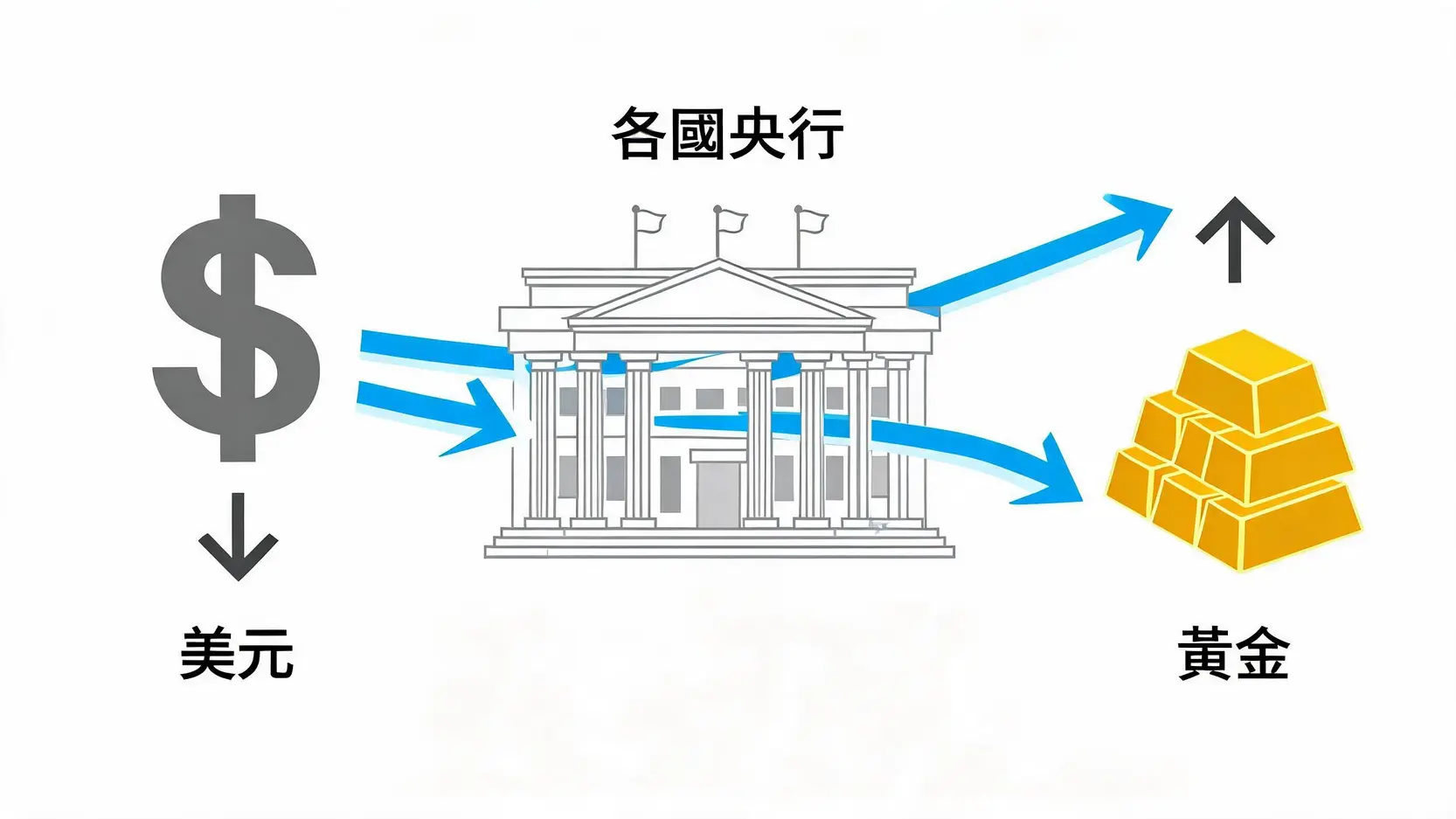
Global central banks diversify reserves and increase gold holdings
No Counterparty Risk: Gold’s Status as the Final Settlement Asset
The biggest difference between gold and sovereign bonds (such as US Treasury bonds) is that gold has no counterparty risk. Bonds issued by any country carry the implicit risk of issuer default, but gold itself is a physical asset whose value does not depend on the promise of any government or financial institution. When geopolitical tensions rise or the global financial system faces pressure, gold’s safe-haven attribute as the “final settlement asset” becomes more prominent, making it the ballast for central banks to stabilize finance and safeguard national economic security.
The Boosting Effect of Central Bank Gold Purchases on Market Confidence
Central bank actions often carry indicator significance. When multiple central banks around the world, especially those of major economies such as China, India, and Turkey, continue to buy gold on a large scale, it undoubtedly sends a strong signal to the market: gold’s importance in the global monetary system is rising again. This official behavior greatly boosts market confidence, attracting more institutional investors and individual investors to include gold in their asset allocation, thereby forming a positive cycle and pushing up gold’s long-term value.
Further Reading (Highly Recommended)
Physical gold, passbooks, ETFs, and futures: Pros, cons, and cost comparison of 5 major channels
Factor Three: Jewelry and Industrial Demand That Form Gold’s Value
In addition to its financial attributes, gold’s physical properties as a precious metal also give it stable demand in the consumer and industrial sectors, forming a solid foundation for total gold demand.
Cultural and Consumer Demand: The Gold Jewelry Market Represented by India and China
In many cultures around the world, gold is not only a symbol of wealth, but also carries deep cultural meaning. Especially in the two major gold-consuming countries, India and China, gold jewelry is indispensable on important occasions such as weddings and festivals. This culturally rooted consumer demand is highly seasonal and relatively stable, contributing massive demand to the gold market every year. As these countries’ economies develop and people’s wealth grows, demand for gold jewelry is also expected to rise steadily.
High-Tech Applications: The Indispensability of Gold in Electronic Products
You may not know that the smartphone and computer in your hands both contain tiny amounts of gold. Because gold has excellent conductivity, corrosion resistance, and ductility, it plays a key role in the electronics industry. Gold is widely used to manufacture high-performance connectors, switches, relays, and bonding wires for chips. With the booming development of high-tech industries such as 5G, artificial intelligence (AI), the Internet of Things (IoT), and electric vehicles, demand for precision electronic components is increasing, which also means that industrial application demand for gold will continue to exist, providing another dimension of support for gold prices.
[Differentiated Highlight] The Long-Term Impact of the Rise of the Emerging Market Middle Class on Gold Demand
This is a key point in understanding future gold demand. As economies in emerging markets such as Asia, Africa, and Latin America grow rapidly, hundreds of millions of people will enter the middle class. This not only means their disposable income will increase, but also represents their pursuit of wealth preservation and improved quality of life. This will drive gold demand in two ways:
- Consumption upgrade: Demand for gold jewelry and accessories will expand from traditional cultural demand to everyday fashion consumption.
- Awakening investment awareness: The emerging middle class will seek investment tools beyond traditional bank savings to protect their wealth, and gold is often one of their first choices due to its cultural recognition and value-preservation function.
This structural shift will inject continuous momentum into the global gold market over the coming decades.
Factor Four: Global Economic Growth and Market Uncertainty Driving Gold Prices
What makes gold unique is that it can demonstrate its value in different economic cycles, showing a dual characteristic of being suitable in both favorable and adverse conditions.
The Wealth Effect During Economic Expansion: Driving Gold Consumer Demand
When the global economy is in a period of growth and prosperity, people’s income increases and wealth accumulates, creating the so-called “wealth effect”. Consumers become more willing to purchase luxury goods and investment products such as gold jewelry, gold bars, and gold coins. At this time, gold’s consumer goods attribute is activated. Especially in emerging markets, economic growth is often accompanied by stronger physical gold demand, thereby forming support for gold prices.
The Safe-Haven Effect During Economic Recessions: Capital Flows Into Gold for Protection
Conversely, when the global economy faces recession risks, financial markets experience severe volatility, or geopolitical crises break out, investors’ risk-avoidance sentiment rises sharply. At this time, gold’s attribute as a safe-haven asset shines. Capital withdraws from assets such as the stock market and high-risk bonds, and flows into gold, which is regarded as a “safe haven”. Because gold has a relatively low correlation with most financial assets, it can help diversify risk and preserve capital in an investment portfolio. From the 2008 financial tsunami to recent geopolitical conflicts, gold’s safe-haven value has been verified repeatedly.
Factor Five: Mining Supply Constraints Affecting Gold’s Value
The basic principle of economics tells us that price is jointly determined by supply and demand. Earlier, we discussed the four major drivers of demand, while supply-side constraints are also a key factor supporting gold’s long-term value.
Bottlenecks in Global Gold Production and Rising Mining Costs
Gold is a non-renewable resource. After thousands of years of mining, large gold mines that are easy to extract have become increasingly rare. Many experts believe that global gold production may already have reached the plateau of “peak gold” (Peak Gold), and the possibility of a significant increase in production in the future is extremely low. At the same time, mining difficulty and costs are also continuously rising:
- Declining ore grades: Newly discovered gold mines generally have lower ore grades (meaning the amount of gold contained per ton of ore), requiring more rock to be processed in order to extract the same amount of gold.
- Increasing mining depth: The deeper the veins are mined, the higher the requirements for technology, energy, and safety.
- Environmental and regulatory costs: Global requirements for environmental protection and mining regulation are becoming increasingly strict, increasing the operating costs of mining companies.
Continuously rising mining costs essentially set a constantly rising “floor price” for gold prices.
Changes in Recycled Gold Supply
In addition to newly mined gold, another part of market supply comes from “recycled gold”, meaning gold recovered and refined from old jewelry and old electronic products. The supply of recycled gold is highly sensitive to gold prices. When gold prices rise sharply, more people are encouraged to sell old gold jewelry, increasing recycled gold supply; conversely, when gold prices are weak, supply decreases. However, recycled gold supply is ultimately limited and cannot fundamentally change the pattern of constrained total gold supply. It plays more of a role as a market price regulator, rather than the main force of supply.
Frequently Asked Questions (FAQ)
Q: Are gold prices and the stock market correlated over the long term?
A: There is an interesting “negative correlation” between gold and the stock market. Generally speaking, when the stock market performs strongly and investor risk appetite is high, capital may flow into equities, making gold relatively less attractive. However, when the stock market falls and market panic spreads, gold’s safe-haven attribute becomes more prominent, and capital flows from the stock market into the gold market, driving gold prices higher. Therefore, adding a certain proportion of gold to asset allocation can effectively hedge against downside risks in the stock market and serve as “portfolio insurance”.
Q: Will cryptocurrencies replace gold?
A: Although cryptocurrencies such as Bitcoin are often referred to as “digital gold”, the two are still fundamentally very different. Gold has thousands of years of historical consensus, physical existence, no counterparty risk, and is an officially recognized reserve asset by central banks worldwide. By contrast, cryptocurrencies have a much shorter history, extremely high price volatility, strict regulatory uncertainty, and their value is highly dependent on network and power infrastructure. In the short term, cryptocurrencies are more like high-risk speculative assets and are unlikely to replace gold’s position as the ultimate store of value and safe-haven tool.
Q: How should ordinary investors allocate gold based on these long-term factors?
A: After understanding these long-term drivers, ordinary investors should view gold as a strategic asset rather than a tool for short-term speculation. The recommended allocation ratio is usually between 5% and 15% of the total investment portfolio. There are many ways to invest. For example, those pursuing convenience and low costs can choose gold ETFs; those who wish to save regularly can consider bank gold passbooks; while those who value physical ownership and ultimate protection can buy physical gold bars or coins. The key is to hold gold continuously over the long term based on your own risk tolerance and investment goals.
Q: What is the gold price forecast for the next decade?
A: No one can accurately predict prices. However, judging from the five long-term drivers above, the structural forces supporting gold prices remain solid. Factors such as high global debt, the de-dollarization trend, the normalization of geopolitical risks, and bottlenecks in mining supply all provide strong support for gold’s long-term value. Although gold prices may fluctuate in the short term due to factors such as interest rate policy and US dollar trends, in the long run, gold’s core value in resisting inflation and diversifying risk remains unchanged.
Conclusion
In summary, gold’s long-term value is not determined by short-term speculative sentiment, but supported by five deeply rooted structural factors. It is not only the ultimate weapon against currency depreciation, but also the reserve cornerstone used by central banks around the world to stabilize finance; it not only satisfies cultural consumption and advanced industrial demand, but also demonstrates unique dual value in both favorable and adverse economic conditions; finally, its increasingly constrained supply further ensures its inherent scarcity. Understanding these fundamentals that drive gold’s long-term value can help investors build stronger confidence and view gold as a core asset that can move through economic cycles, rather than a short-term trading chip that follows the crowd.