Chaos-Era Investing: 5 War-Time Asset Strategies

Updated: 2026/05/13  |  CashbackIsland

war-investment-strategy

Chaos-Era Investment Guide: Understanding Geopolitical Risks and Deploying Assets With 5 Major War-Time Investment Strategies

With global conflicts occurring frequently, from the Russia-Ukraine war to rising tensions in the Middle East, the “definition of geopolitical risk” has become an unavoidable topic for every investor. When markets experience sharp volatility due to war concerns, do you feel anxious and unsure how to respond? Many investors are concerned about the impact of geopolitics on the stock market and are searching for effective war-time investment strategies. This article will fundamentally explain geopolitical risks, analyze their real impact on stock markets in depth, and provide 5 practical strategies to help you stand firm during turbulent times, protect and grow your wealth, and achieve optimal asset allocation. 


What Is Geopolitical Risk and Why Must You Pay Attention to It in 2026?

In today’s highly globalized financial markets, even minor regional developments can trigger major market waves. Understanding the essence of geopolitical risk is the first step toward developing effective investment strategies. It is not merely a newspaper headline, but a key variable affecting the value of your investment portfolio.


The Complete Definition of Geopolitical Risk: It Is More Than Just War

Geopolitical Risk refers to conflicts and tensions arising from political, economic, or military interactions between nations, with the potential to negatively impact the economies, financial markets, and global stability of other countries. It covers a very broad range of issues and extends far beyond traditional warfare. Simply put, any political event capable of influencing cross-border capital flows, supply chain stability, or market confidence falls within the scope of geopolitical risk. The authoritative financial information website Taiwan Academy of Banking and Finance also identifies it as one of the important factors affecting financial stability.


Common Types of Risk: Military Conflicts, Economic Sanctions, Terrorism, and Political Instability

To better understand the concept, geopolitical risks can generally be divided into the following categories:

  • Military Conflicts: This is the most direct and impactful type, including wars between nations, civil wars, or proxy wars. Such events directly destroy infrastructure and disrupt production and trade.
  • Economic Sanctions: Countries or international organizations apply pressure on targeted nations through trade restrictions, tariff barriers, or financial blockades. These actions can severely damage the sanctioned country’s economy while disrupting global supply chains linked to related industries.
  • Terrorism: Although terrorist attacks are usually localized events, they can trigger large-scale public panic, negatively affecting sectors such as tourism and aviation while increasing security costs for businesses.
  • Political Instability: This includes election disputes, regime changes, domestic protests, or coups. Such events create policy uncertainty and undermine foreign investor confidence.


Current Global Hotspots: Which Regions Could Impact Markets?

As we enter 2026, several geopolitical hotspots still deserve close investor attention:

  • Eastern Europe: The aftereffects of the Russia-Ukraine war continue to unfold, influencing global energy and food prices while reshaping Europe’s security structure.
  • Middle East: Conflicts involving Israel and neighboring countries, along with the Iranian nuclear issue, continue to threaten the world’s most important oil supply chains. Any escalation could trigger a sharp surge in oil prices.
  • Indo-Pacific Region: Strategic competition between the US and China remains a long-term focal point. Issues involving the Taiwan Strait and the South China Sea could trigger severe market risk-off sentiment if miscalculations occur.

Monitoring developments in these regions can help investors assess potential market shocks in advance and prepare suitable chaos-era asset allocation strategies.


The Real Impact of Geopolitics on the Stock Market: Panic, Collapse, or Opportunity?

When wars or conflicts erupt, many investors instinctively engage in panic selling. But is the impact of geopolitics on the stock market really that simple? Historical data analysis reveals a far more complex and thought-provoking picture.


Historical Backtesting: Do Stock Markets Really Decline Long Term After Wars Break Out?

The answer may surprise you: not necessarily. History shows that market declines triggered by geopolitical events are often short-term knee-jerk reactions. According to research from LPL Financial, since World War II, most major military conflicts have seen US stocks (represented by the S&P 500 Index) recover losses or even move higher within 6 to 12 months after the event.

For example:

  • 1990 Iraq Invasion of Kuwait: Following the outbreak of the conflict, the S&P 500 Index fell nearly 17% within approximately six months. However, after multinational coalition intervention, markets rebounded rapidly, and the index moved higher one year later.
  • 2001 9/11 Terrorist Attacks: The stock market was closed for several days after the attacks, and after reopening, the market plunged approximately 12% within one week. However, the Federal Reserve quickly cut interest rates and injected liquidity, leading the market to rebound roughly one month later.
  • 2022 Russia-Ukraine War: Although the initial outbreak caused significant global market volatility, investor focus soon shifted toward inflation and central bank policy. Certain defense and energy stocks even rallied against the broader trend.

Historical data shows that market panic usually peaks when the impact of the event is strongest. However, as long as conflicts do not escalate into global large-scale wars, economic fundamentals ultimately remain the key driver of long-term stock market trends.


Short-Term Shocks vs. Long-Term Trends: Average Market Recovery Time From Panic to Recovery

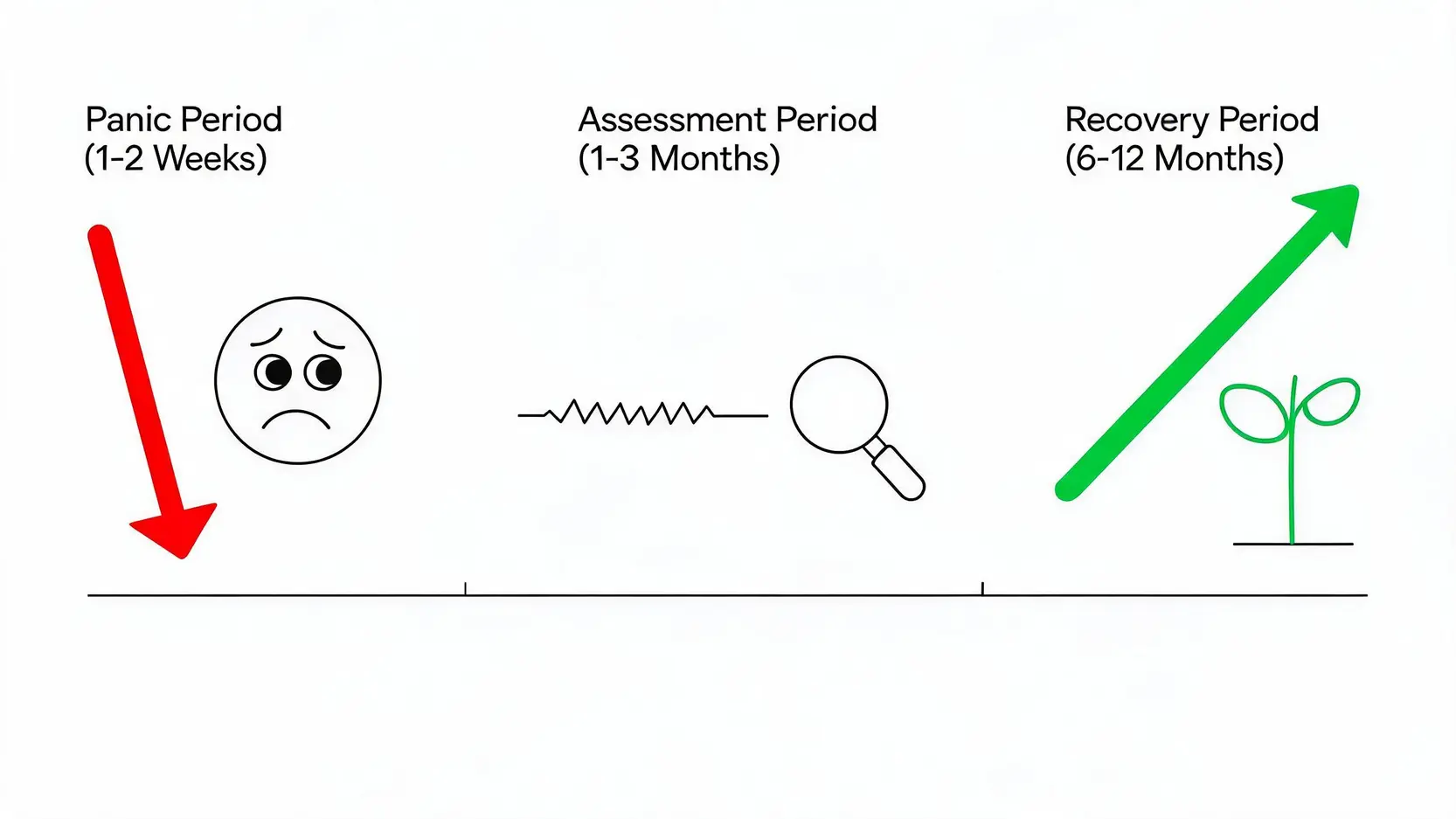
Markets are more resilient than many people imagine. Generally speaking, the recovery process following geopolitical-driven market panic can be divided into several stages:

  1. Panic Phase (1-2 Weeks): During the initial outbreak of an event, uncertainty is at its highest, and selling pressure is strongest.
  2. Assessment Phase (1-3 Months): Markets begin evaluating the actual scope and duration of the event’s impact. Volatility remains high, but differing market views start to emerge.
  3. Recovery Phase (6-12 Months): As the situation gradually becomes clearer or is absorbed by markets, capital begins flowing back into fundamentally strong assets, and markets gradually recover losses.

地緣政治風險下股市從恐慌到恢復的三階段時間線示意圖。

Three-Stage Illustration of Market Reactions Following Geopolitical Events

Of course, this is only a general time framework. The actual recovery speed depends on the scale of the event and the health of the global economy. The key point is that rational investors should avoid making irrational decisions during the initial panic phase.


The Fate of Different Assets: Why Gold, Oil, and the US Dollar Rise During Turbulent Times?

During market turmoil, not all assets decline. Certain assets become safe havens for capital due to their safe-haven characteristics or supply-demand dynamics. This represents the classic “chaos-era asset allocation” mindset.

  • Gold: As a store of value for thousands of years, gold is not tied to the sovereign credit of any country, making it the ultimate safe-haven asset against currency depreciation and political uncertainty. To learn more about gold allocation strategies, refer to this article: “Gold-Silver Ratio Investment Strategy: How to Calculate and Interpret It to Capture the Best Gold and Silver Trading Opportunities”.
  • Oil (Energy): Many geopolitical hotspots (such as the Middle East and Eastern Europe) are major oil-producing regions. Wars or sanctions can disrupt crude oil supplies, naturally driving oil prices higher when demand remains unchanged, benefiting energy-related stocks.
  • US Dollar: As the world’s primary reserve and settlement currency, global capital tends to flow into the perceived safety of the US Treasury market during crises, strengthening the US dollar.

Understanding the different behavior of these assets during turbulent periods forms the foundation of effective war-time investment strategies.


Further Reading (Highly Recommended)

Gold-Silver Ratio Investment Strategy: How to Calculate and Interpret It to Capture the Best Gold and Silver Trading Opportunities

Complete Foreign Currency Account Guide: Understand Foreign Currency Passbook Functions and Account Opening Uses to Easily Manage Global Wealth!


Chaos-Era Asset Allocation: 5 Major War-Time Investment Strategies, From Defense to Offense

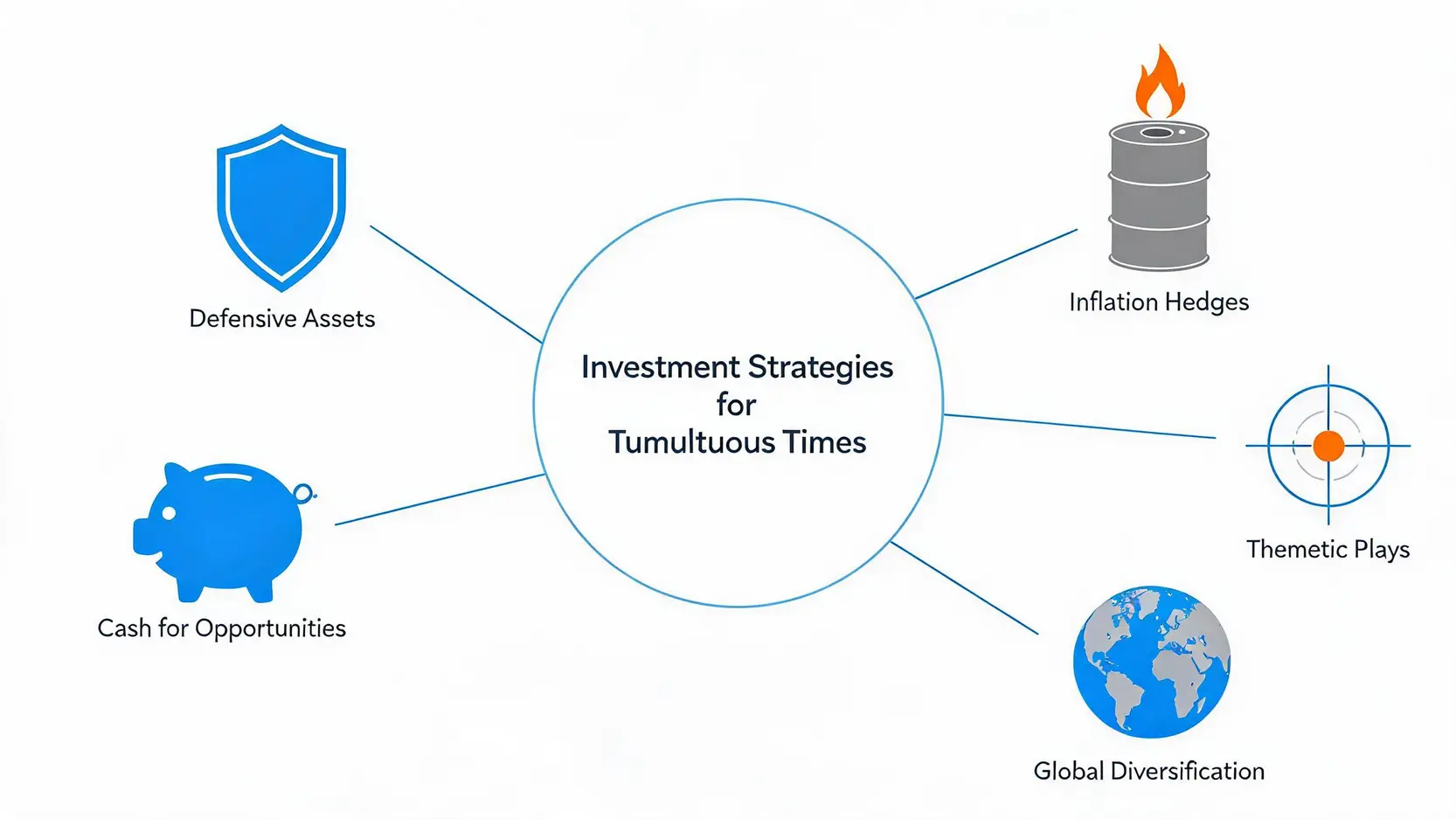
When facing geopolitical risks, smart investors do not sit still and wait. Instead, they adopt strategies that balance both defense and offense. Below are five major war-time investment strategies to help you achieve comprehensive chaos-era asset allocation.

五大戰爭投資策略概念圖,包含防禦、通膨、主題、分散和機會型部署。

Five Major Investment Strategies for Managing Geopolitical Risks


Strategy 1 [Defensive Allocation]: Increase Exposure to Traditional Safe-Haven Assets Such as Gold and the US Dollar

This is the most classic defensive strategy. When market uncertainty rises, appropriately increasing the proportion of safe-haven assets in your portfolio can effectively reduce overall asset declines. Besides physical gold, you may also consider gold ETFs, gold futures, or assets denominated in strong currencies (such as the US dollar or Swiss franc) as your first line of defense.


Strategy 2 [Inflation Allocation]: Position in Energy and Commodity-Related Stocks

Wars often drive inflation higher, especially for commodities connected to conflict regions. Military actions consume enormous amounts of energy, while economic sanctions may disrupt raw material supplies. Therefore, positioning in energy companies such as oil and natural gas, as well as stocks or funds related to agricultural products and base metals, may allow investors to benefit during inflationary environments.


Strategy 3 [Thematic Allocation]: Focus on Defense, Aerospace, and Cybersecurity Stocks

As geopolitical tensions intensify, governments around the world often increase defense budgets. This directly benefits defense industries and aerospace equipment manufacturers. In addition, modern warfare is no longer limited to physical battlefields. Cyber warfare has become equally important, making cybersecurity companies increasingly strategic. These sectors represent thematic investment opportunities with clear growth drivers during turbulent times.


Strategy 4 [Diversification Allocation]: Global Asset Allocation to Reduce Single-Market Risk

“Do not put all your eggs in one basket” is a golden rule of investing, especially when facing geopolitical risks. The impact of conflicts is often regional. A crisis in one area may have little impact on another region or may even create opportunities. Through global asset allocation strategies, investors can spread capital across different countries and industries to effectively reduce the impact caused by a single geopolitical event. 

Strategy 5 [Opportunity Allocation]: Maintain Partial Cash Positions and Wait for Oversold Buying Opportunities

“Be greedy when others are fearful.” Irrational panic selling during market fear often drives the share prices of many quality companies down to highly attractive levels. During turbulent times, maintaining a certain proportion of cash or highly liquid assets is not only for risk management, but also to ensure sufficient “ammunition” to buy undervalued assets when opportunities emerge. This is an advanced strategy that transforms crises into opportunities.


Common Questions About Geopolitical Risk Investing

Q: Geopolitical risks are rising. Should I sell all my stocks?

A: Absolutely not. Historical data shows that panic selling often causes investors to sell at the lowest point in the market. A more rational approach is to reassess and adjust your investment portfolio. Based on the five major strategies mentioned in this article, investors should increase defensive assets and position in sectors that may benefit, rather than liquidating all stock holdings. Stay calm and focus on long-term goals.

Q: Besides gold and oil, what other safe-haven tools are recommended?

A: Besides traditional safe-haven assets such as gold and oil, you may also consider the following tools: 1. US Treasury bonds: Widely regarded as one of the safest assets in the world. 2. High-credit-rated corporate bonds: These can provide stable cash flow during stock market volatility. 3. Utility stocks: Such as electricity and water companies, which enjoy stable demand and are less affected by economic cycles, giving them defensive characteristics. 4. Consumer staples stocks: Regardless of economic conditions, people still need to purchase food, medicine, and daily necessities, making related companies relatively stable in operation.

Q: During wars or turbulent periods, are technology stocks and growth stocks still worth investing in?

A: This requires careful differentiation. Generally speaking, high-valuation technology and growth stocks face greater downside pressure when market risk-off sentiment rises and interest rates potentially move higher. However, not all technology stocks are the same. For example, companies focused on cybersecurity, military technology, or large technology platforms with strong cash flow and pricing power may still demonstrate resilience. Investors should become more selective, focusing on companies with long-term competitive advantages and healthy financial conditions, rather than blindly selling all technology stocks.


Conclusion

In summary, although geopolitical risks create market uncertainty, history has shown that panic is often temporary. Smart investors do not lose composure during turbulent times. Instead, they carry out rational asset “allocation” based on clear “war-time investment strategies”. By understanding the true “impact of geopolitics on the stock market” and effectively applying the five major strategies provided in this article, from defensive gold allocation to opportunity-based cash positioning, investors can find opportunities amid crises. Review your investment portfolio today and prepare thoroughly for the next market shock.

If you liked this article, please share it!

Related Articles

  • Volatility Surface Guide: Skew Trading Strategies
    Practical Applications of Volatility Surfaces: From Options Modeling to Advanced Skew Trading Strategies In options markets, implied volatility is never a flat line. Instead, it forms complex "smile" or "skew" surfaces. For advanced traders, mastering the practical applications of volatility surfaces is equivalent to possessing a lens that reveals market...
    2026 年 6 月 3 日
  • Foreign Capital Flow Model: Track Institutional Money
    Building a Foreign Capital Flow Copy Trading Model: A Stock Market Indicator for Accurately Tracking Institutional Positioning In Asia-Pacific stock markets, foreign capital inflows and outflows often determine the direction of the index. However, simply looking at daily net buy and sell data is no longer enough. Only by building...
    2026 年 6 月 3 日
  • Options Buying Strategies for Extreme Market Risks
    Options Buyer Strategies During Extreme Market Conditions: Black Swan Hedging and Cross-Market Arbitrage During Volatility Surges The most terrifying aspect of financial markets is not a gradual decline, but overnight flash crashes and cross-market capital withdrawals accompanied by volatility surges. In the highly unpredictable global macroeconomic environment of 2026, geopolitical...
    2026 年 6 月 3 日
返回顶部