Taiwan Strait Risk: HKD & RMB FX Strategy Guide

Impact of Taiwan Strait Premium on Exchange Rates: HKD and RMB Trends and Taiwan Strait Crisis Investment Strategies
As cross-strait relations become increasingly tense, the Taiwan Strait situation has become a key variable influencing global financial markets. Investors are widely concerned about how the so-called “impact of Taiwan Strait premium on exchange rates” will affect the stability of HKD and RMB. In the face of a potential Taiwan Strait crisis, what kind of Taiwan Strait crisis investment strategies should we adopt to protect our wealth? More importantly, the impact of the Taiwan Strait situation on HKD and the influence of cross-strait relations on RMB exchange rates are no longer theoretical discussions, but risks that every investor must confront. This article, from the perspective of an experienced investor, provides an in-depth analysis of the real impact of the Taiwan Strait situation on key currencies and offers 5 practical asset hedging strategies to help you move steadily forward in an uncertain market.
What is the Taiwan Strait Risk Premium? How Does It Affect Global Exchange Rates?
Before discussing specific investment strategies, it is necessary to understand a core concept: the “Taiwan Strait risk premium”. Although it sounds academic, it is essentially the “insurance cost” that the market assigns to potential conflict risks.
Definition and Causes of the Taiwan Strait Risk Premium
Simply put, the Taiwan Strait risk premium refers to the additional return investors require when holding assets related to Taiwan, Hong Kong, or mainland China (such as stocks, bonds, or currencies) to compensate for potential losses caused by instability in the Taiwan Strait situation. When tensions rise, the risk premium surges; when tensions ease, the premium declines.
- Military activity: Any military exercises or naval deployments by either side will directly trigger market risk aversion and push up the risk premium.
- Political statements: High-level political remarks and shifts in foreign policy are interpreted by the market as signals of future relations.
- Diplomatic relations: Changes in US-China relations, especially the clarity or ambiguity of US policy toward Taiwan, are the most critical external factor affecting the risk premium.
This premium is directly reflected in asset prices. For example, Taiwan stocks and Hong Kong stocks may trade at a discount, while the exchange rates of the New Taiwan dollar, HKD, and RMB may all come under depreciation pressure.
How Geopolitical Risks Transmit from Taiwan to HKD and RMB Markets
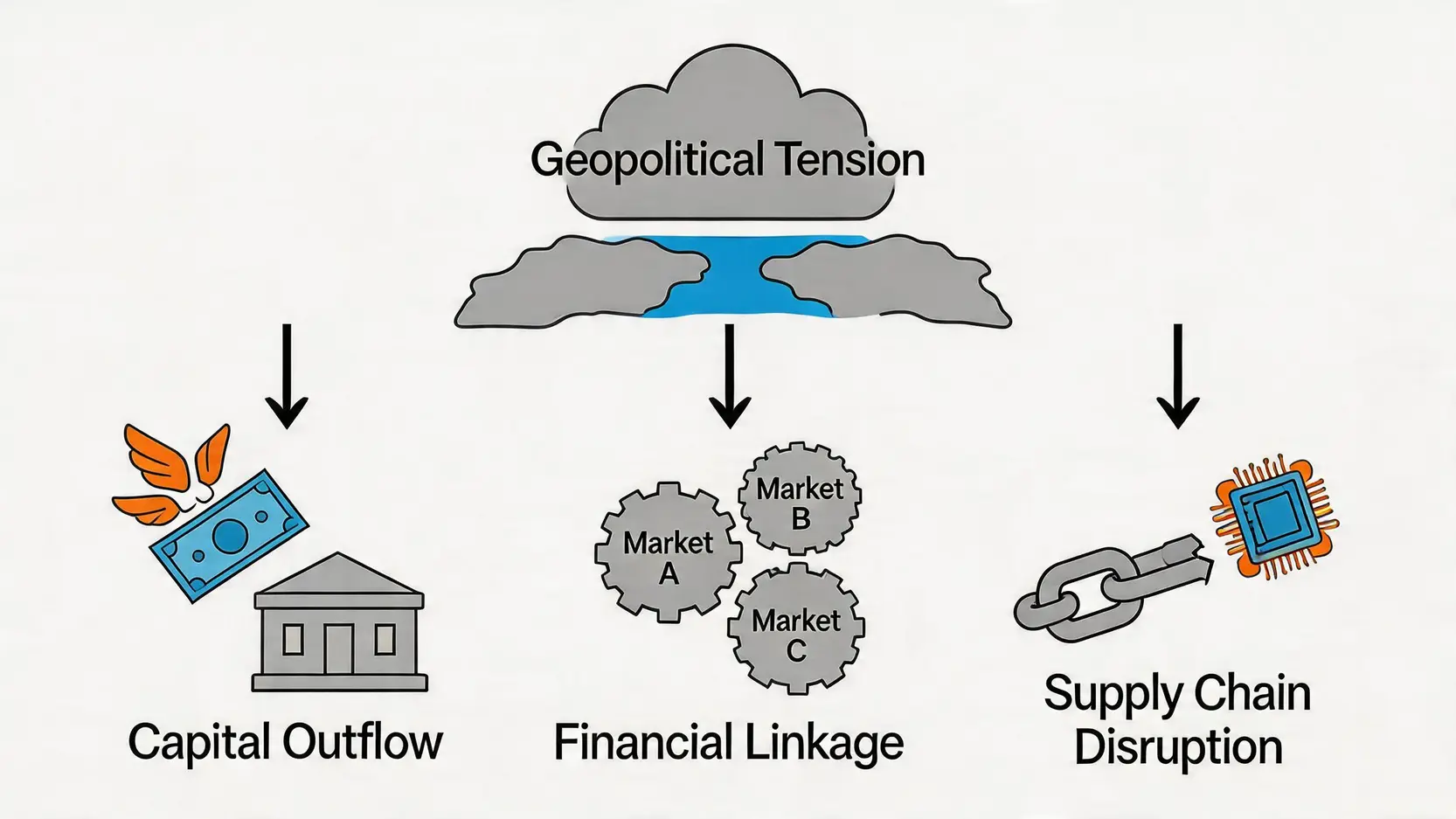
Fluctuations in the Taiwan Strait do not only affect Taiwan itself. The risks are transmitted to Hong Kong and mainland China through the following channels, creating a chain reaction:
- Capital flow channel: Once risk sentiment rises, international capital seeks safe havens. The first targets for withdrawal are perceived high-risk regions such as Taiwan, Hong Kong, and mainland China. This large-scale capital outflow creates significant selling pressure on HKD and RMB.
- Financial market linkage: As an international financial center, Hong Kong’s stock market (Hong Kong stocks) is closely linked with mainland China’s stock market (A shares). Many Chinese companies are listed in Hong Kong, and foreign capital mainly enters and exits A shares through Hong Kong. Panic triggered by a Taiwan Strait crisis leads investors to sell assets across China, Hong Kong, and Taiwan simultaneously, creating a “domino effect”.
- Supply chain shock: Taiwan plays a crucial role in the global semiconductor industry. Any conflict could disrupt the global technology supply chain, severely impacting China’s trade and manufacturing-based economy, thereby weakening the fundamental value of RMB.

Diagram of the three major transmission channels of geopolitical risk
It is precisely because of this high level of interconnectedness that understanding the relationship between geopolitical risks and investments is essential.
Full Analysis of Key Currency Trends Under Escalating Taiwan Strait Situation
When the Taiwan Strait risk premium rises, different currencies react differently depending on their characteristics and economic fundamentals. Below is an analysis of the potential trends of key currencies.
Impact on HKD: Challenges and Potential Risks Facing the Linked Exchange Rate System
Since 1983, HKD has been pegged to the US dollar under the Linked Exchange Rate System, which has long been regarded as the cornerstone of Hong Kong’s financial stability. However, under extreme geopolitical pressure, this system will face severe challenges.
- Capital outflow pressure: In the event of a Taiwan Strait crisis, the most immediate impact will be large-scale capital withdrawal from Hong Kong. Investors will convert HKD assets into US dollars for safety, pushing the HKD exchange rate toward the weak-side Convertibility Undertaking level of 7.85.
- HKMA intervention: The Hong Kong Monetary Authority (HKMA) would then need to intervene by selling US dollars and buying HKD to defend the peg. This would deplete Hong Kong’s foreign reserves and tighten market liquidity.
- Interest rate surge risk: A side effect of defending the peg is a sharp rise in Hong Kong’s local interest rates (HIBOR). High interest rates would severely damage the stock and real estate markets and could even trigger an economic recession.
Although Hong Kong has substantial foreign reserves and can defend the peg in the short term, long-term capital outflows and economic shocks remain potential risks for HKD.
Impact on RMB: How Cross-Strait Relations Affect Onshore and Offshore RMB Exchange Rates
Tension in cross-strait relations has a direct negative impact on RMB exchange rates, with significant divergence between the onshore (CNY) and offshore (CNH) markets.
- Offshore RMB (CNH) bears the brunt: The CNH market is mainly driven by international investors and is more sensitive to market sentiment. When the Taiwan Strait situation deteriorates, CNH faces strong selling pressure, and depreciation is usually greater than that of onshore RMB.
- Onshore RMB (CNY) is relatively controlled: CNY is strictly managed by the People’s Bank of China (PBoC) with daily trading bands. The central bank can stabilize the exchange rate through fixing the central parity rate, tightening liquidity, or using countercyclical factors to prevent excessive panic.
- Capital controls may tighten: To prevent large-scale capital outflows from destabilizing financial stability, the Chinese government may further tighten capital controls during crises, restricting cross-border fund flows for both corporations and individuals.
New Taiwan Dollar and US Dollar as Safe-Haven Roles Analysis
In the scenario of a Taiwan Strait crisis, the New Taiwan dollar (TWD) and US dollar (USD) sit at opposite ends of the spectrum.
- New Taiwan dollar (TWD): As the center of risk, TWD would face the most direct and severe depreciation pressure. Capital flight and concerns over Taiwan’s economic outlook would cause its exchange rate to drop sharply in a short period.
- US dollar (USD): In any major global crisis, the USD’s safe-haven status is reinforced. Capital flows out of risky assets worldwide and into perceived safe US assets (such as US Treasury bonds). Therefore, a Taiwan Strait crisis would almost certainly strengthen the US dollar index (DXY).
【2026 Latest】5 Major Investment Hedging Strategies Under a Taiwan Strait Crisis

Five Core Investment Strategies for Responding to Geopolitical Risks
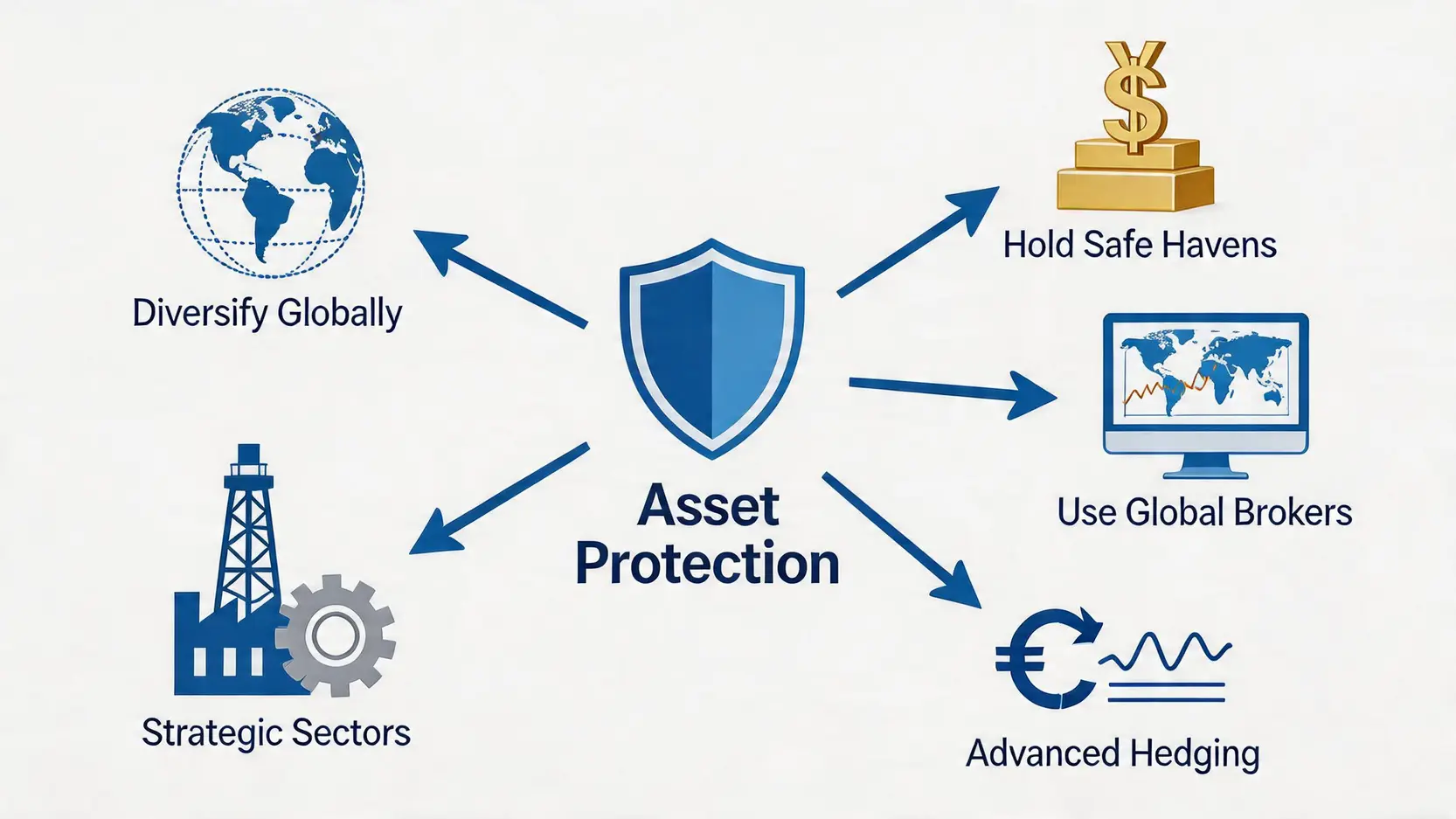
Faced with the complex and unpredictable Taiwan Strait situation, rather than anxiously speculating whether a conflict will occur, it is better to take practical action and build an investment portfolio capable of withstanding geopolitical risks. The following are five core Taiwan Strait crisis investment strategies:
Strategy 1: Diversified Asset Allocation to Reduce Single-Market Risk in China, Hong Kong, and Taiwan
This is the most fundamental and important principle. If your investment portfolio is overly concentrated in Hong Kong, mainland China, or Taiwan equities, it will be highly vulnerable when geopolitical risks materialize. True diversification is not only about holding stocks across different industries, but also about spreading across countries and asset classes.
- Reduce exposure to China, Hong Kong, and Taiwan assets and increase allocation to developed markets such as the US, Europe, and Japan.
- You can use US ETFs (such as those tracking the S&P 500 or global markets like VT) to achieve a one-click global diversified allocation.
Strategy 2: Increase Holdings in Traditional Safe-Haven Assets (Gold, USD, JPY)
When markets enter panic mode, capital flows into traditional safe havens. Including a certain proportion of safe-haven assets in your portfolio is like buying insurance for your wealth.
- US dollar: The most direct safe-haven tool. You may hold US dollar cash or invest in USD-denominated money market funds.
- Gold: A timeless hard asset against war and turmoil. Gold is not affected by any sovereign credit and is the ultimate store of value. Investment methods include physical gold, gold ETFs (such as GLD), or gold savings accounts.
- Japanese yen: Although its safe-haven status has weakened in recent years due to Bank of Japan monetary easing, it is still an option for many Asian capital flows during regional instability.
Further Reading (Highly Recommended)
Gold Investment Beginner’s Guide: 5 Major Channels Explained, Understanding Benefits and Risks
What is the S&P500? Beginner Investment Guide: Constituents, ETFs, and How to Buy
Strategy 3: Focus on “Defense Stocks” and Energy and Commodities Opportunities
Crises always create opportunities. Heightened geopolitical tensions often drive up specific sectors.
- Defense stocks: Rising global defense spending directly benefits major defense contractors such as Lockheed Martin (LMT) and Raytheon Technologies (RTX) in the US.
- Energy and commodities: War and blockades severely disrupt global supply chains, especially energy (oil and natural gas) and critical minerals. Holding related commodities or energy equities can partially hedge against geopolitical losses.
Strategy 4: Use Overseas Brokers for Global Asset Allocation
To truly achieve global diversification, having an overseas brokerage account that allows access to multiple markets is essential. This is not only for convenience, but also for asset protection.
- Remove geographic restrictions: Overseas brokers (such as Interactive Brokers and Firstrade) allow direct access to US stocks, European stocks, Japanese stocks, and various ETFs without being limited by local markets.
- Asset segregation: Keeping part of your assets in international financial institutions can effectively isolate extreme local risks, such as capital controls or financial system instability.
Strategy 5: Consider Alternative Investments and Currency Hedging
For more risk-tolerant investors, advanced strategies may be considered.
- Short risk currencies: When trends are clear, forex margin trading can be used to selectively short currencies most affected (such as offshore RMB CNH or New Taiwan dollar TWD), while going long USD or JPY.
- Invest in volatility index (VIX): The VIX, known as the “fear index”, rises when markets expect sharp volatility. It can be traded via related ETFs or futures as a hedge against stock market declines.
- Cryptocurrencies: Bitcoin and other cryptocurrencies are sometimes referred to as “digital gold” and may exhibit safe-haven characteristics during certain crises. However, due to extremely high volatility, they should only be used as a satellite allocation with a very small portfolio weight.
Conclusion
In summary, under the current complex international situation, a deep understanding of the impact of the Taiwan Strait premium on HKD and RMB exchange rates has become essential knowledge for every investor. Everyone should reassess their asset allocation and adopt a diversified and global investment strategy to reduce dependence on a single market. In the face of a potential Taiwan Strait crisis, staying rational and alert, and preparing a comprehensive asset hedging plan in advance is not about creating panic, but rather the most reliable way to protect personal and family wealth stability. Only by being fully prepared can one remain composed in a volatile market and safeguard hard-earned gains.
FAQ: Common Questions About Taiwan Strait Crisis and Investment
Q: If a conflict breaks out in the Taiwan Strait, what will happen to my Hong Kong stocks and A shares?
A: It is almost certain that Hong Kong stocks (Hang Seng Index) and A shares (Shanghai Composite Index) will experience a sharp and rapid decline in the early stage of a conflict. The main reasons include panic-driven selling, large-scale capital outflows, and extremely pessimistic expectations for China’s economic outlook. Market liquidity may dry up instantly, leading to a situation where “prices exist but no trading occurs”. The subsequent trend will depend on the scale and duration of the conflict as well as the international response.
Q: Will the Hong Kong Monetary Authority intervene in the HKD exchange rate?
A: Yes. Under the design of the Linked Exchange Rate System, when HKD reaches the weak-side Convertibility Undertaking level of 7.85 per US dollar, the Hong Kong Monetary Authority is obligated to intervene by using foreign exchange reserves to sell US dollars and buy HKD in order to maintain exchange rate stability. Hong Kong holds substantial foreign exchange reserves, sufficient to handle short-term large-scale shocks, but prolonged intervention would deplete reserves and push up local interest rates, creating economic pressure.
Q: In the long term, how should I adjust my MPF portfolio to respond to geopolitical risks?
A: First, review the allocation to “Hong Kong and China equity funds” within your MPF. If the allocation is too high, consider gradually reducing it and increasing exposure to “global equity funds”, “US equity funds”, or even “global bond funds”. This helps diversify geopolitical risk and prevents your retirement savings from being heavily impacted by a crisis in a single region. Regular review and dynamic adjustment based on risk conditions is key for long-term investing.
Q: Is RMB a safe-haven asset during a Taiwan Strait crisis?
A: No. Traditional safe-haven assets (such as the US dollar, Japanese yen, Swiss franc, and gold) are characterized by high liquidity, stable value, and transparent financial systems in their issuing countries. RMB is still subject to capital controls, is not freely convertible, and is located at the center of geopolitical tension. Therefore, during a Taiwan Strait crisis, RMB is considered a risk asset rather than a safe-haven asset and may face depreciation pressure.
Related Articles
-
In-Depth Review of Intelligent Order Flow Detection Tools: Understanding Institutional Activity and Identifying Real Market Buying and Selling Pressure What Is Order Flow, and Why Is It a “Leading Indicator” for Price Prediction? Candlestick charts and technical indicators can be misleading, but the real-money "Order Flow" within the market cannot....2026 年 6 月 4 日
-
Social Sentiment Quantitative Indicators: Mining PTT and Dcard Discussions to Predict Stock Prices What Are Social Sentiment Quantitative Indicators, and Why Are They Becoming Increasingly Important? In an era of information overload, financial markets are no longer driven solely by cold financial statements and macroeconomic data. The "Shipping King" phenomenon...2026 年 6 月 4 日
-
Avoid Fraudulent Platforms! A Visual Guide to Taiwan FSC Licensed Futures Merchant Verification and Scam Prevention In recent years, driven by heightened volatility in global financial markets and the impact of monetary easing policies worldwide, more investors have begun seeking diversified investment instruments. However, underground futures operators and overseas fraudulent...2026 年 6 月 4 日