Futures vs Stocks: Should You Invest? Key Guide

Updated: 2026/04/14  |  CashbackIsland

futures-vs-stocks-guide

【Futures vs Stocks】Beginner Investment Guide: Should You Buy Futures or Stocks? 5 Key Differences to Help You Decide!

Confused about entering the investment market but constantly overwhelmed by “futures” and “stocks”? Should you buy futures or stocks? Many people hear that futures allow you to use a small amount of capital to control a large position, but also worry about extremely high risk; while stocks are relatively stable, they may seem to lack explosive upside. This article will thoroughly explain the core topic of futures vs stocks, and deeply analyze the differences between futures and stocks from definitions, trading mechanisms, to risk and return, helping you make the most informed investment decision based on your own situation. 


Core Definitions of Futures vs Stocks: The Difference Between Ownership and Contracts

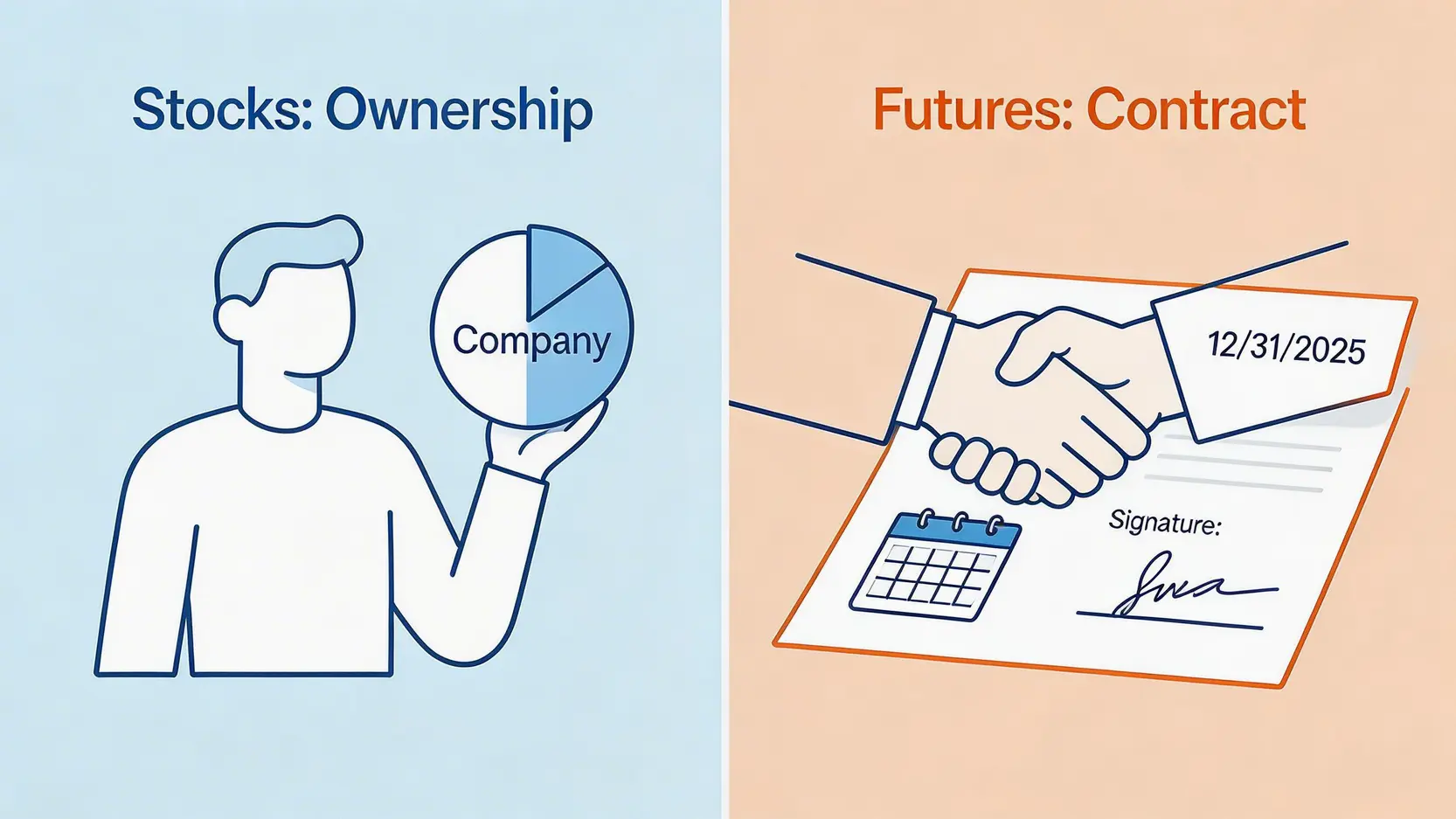
To understand the differences between futures and stocks, we must start from their most fundamental definitions. One represents ownership in a company, while the other is a contract for future trading. The two concepts are completely different.


What Are Stocks: Buying Company Shares, Becoming a Shareholder, and Sharing the Company’s Growth Value

Buying stocks means you are purchasing a portion of “ownership” in a listed company. You become a shareholder of that company, even if you only hold one share. This means:

  • Profit sharing: You have the right to share the company’s profits (in the form of dividends) and benefit from price appreciation when the company grows in value.
  • Voting rights: As a shareholder, you have voting rights in major corporate decisions.
  • Long-term holding: As long as the company does not go bankrupt or get acquired, you can hold the stock indefinitely and enjoy its long-term growth value.

Simply put, investing in stocks is like becoming a small owner of the company, and your returns are closely tied to its future development.


What Are Futures: Buying Standardized Contracts That Commit to Trading at a Future Date, with an Expiration Date

Futures are completely different. What you trade is not “ownership” but a legally binding “standardized contract”. This contract specifies that at a future date (the expiration date), a specific quantity of a commodity or financial asset will be bought or sold at a predetermined price. Examples include gold futures, crude oil futures, or index futures.

  • Standardized: Each futures contract, such as contract size, expiration month, and pricing unit, is standardized by the exchange.
  • Obligated transaction: Regardless of how market prices change at expiration, both parties are obligated to fulfill the contract. However, most traders close their positions before expiration.
  • No ownership: Buying index futures does not mean you own any of the underlying stocks in the index. You are simply speculating on the future direction of the index.

一張圖說明股票與期貨的核心分別:股票代表擁有公司的一部分所有權,而期貨則是一份關於未來交易的合約。

Stocks represent “ownership” while futures are “future contracts”.


Further Reading (Highly Recommended)

How to Reduce Investment Risk? 5 Major Risk Management Strategies and Practical Diversification Guide

【Hong Kong Cryptocurrency Trading】Crypto Investment Beginner Guide: 5 Steps to Buying and Selling Ethereum


【Comparison Chart】Futures vs Stocks at a Glance: 5 Key Differences

To help you better understand the differences between futures and stocks, we have compiled the following comparison table covering five core dimensions that investors care about most.

Comparison Items Futures Stocks
Leverage and Capital Requirements Margin trading, high leverage, only a small portion of the contract value is required. Usually requires full payment, leverage must be obtained through additional margin financing.
Trading Duration Has a specific expiration date, positions must be closed or rolled over before expiry. No expiration date can be held indefinitely.
Trading Costs Commission fees + transaction tax (usually lower). Commission fees + transaction tax + other miscellaneous fees.
Trading Direction Both long (buy) and short (sell) positions are equally easy. Long positions are easier; short selling has more restrictions and higher costs.
Risk and Return High risk, high return; potential losses may exceed principal.

Relatively lower risk; maximum loss is limited to the total invested capital.


Key 1: Leverage and Capital Requirements (Futures Margin System vs Stocks’ Full-Payment Trading)

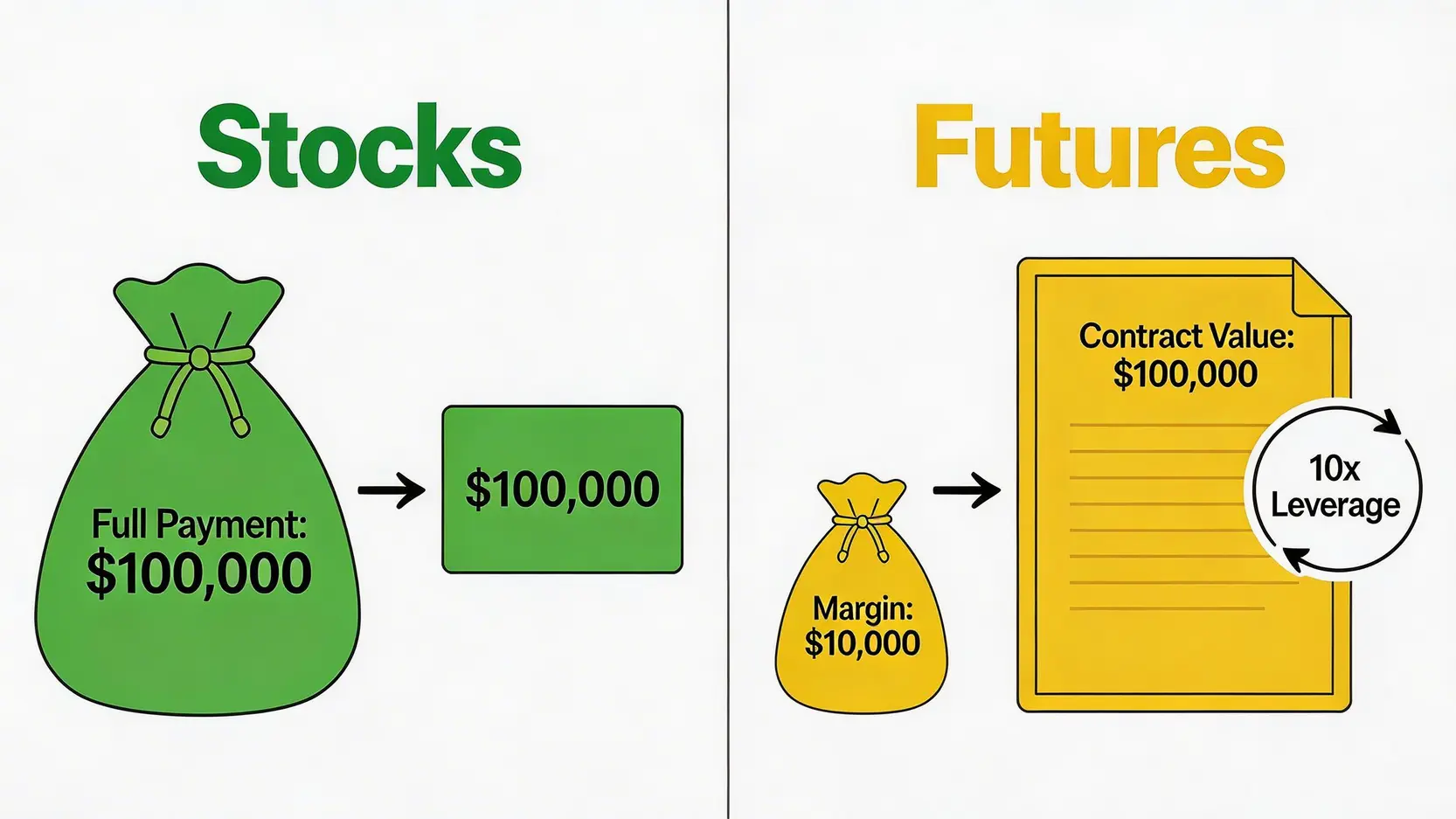
This is the most significant difference in futures vs stocks. Futures use a “margin system”, where traders only need to deposit a certain amount of funds known as “margin” (usually 5%–15% of the total contract value) to control a much larger position. This margin trading mechanism creates significant leverage. For example, you may only need 50,000 in margin to trade an index futures contract worth 1,000,000, resulting in up to 20x leverage.

In contrast, stock trading typically requires “full-payment trading”. If you want to buy 1,000,000 worth of stocks, you must pay the full 1,000,000 (excluding margin financing cases). This makes the capital requirement for stocks relatively higher, and the leverage effect much lower than futures.

期貨與股票的槓桿與資金要求對比圖,顯示期貨只需少量保證金即可交易高價值合約,而股票需要全額付款。

Futures margin allows you to control large positions with small capital, while stocks usually require full payment.


Key 2: Trading Duration and Holding Period (Futures Expiration vs Stocks’ Unlimited Holding)

One advantage of stocks is their “time value”. As long as the company you invest in continues to operate, you can hold the stock for years or even decades, allowing your capital to compound over time. However, futures have a strict “expiration date”. For example, if you buy a March contract, it will expire on a specified settlement date in March. At that point, the contract becomes invalid and is settled. To maintain your position, you must “roll over” before expiration, which means closing the current contract and opening a new one for a later month, resulting in additional trading costs.


Key 3: Trading Costs and Taxes (Futures Tax Advantage vs Stock Trading Costs)

In terms of trading costs, futures generally have an advantage. Both include brokerage commissions, but the main difference lies in “transaction taxes”. In many regions, futures transaction taxes are significantly lower than stock transaction taxes. For short-term traders who trade frequently, this tax difference can lead to substantial long-term savings and directly impact overall performance.


Key 4: Trading Direction and Flexibility (Futures Easy Long & Short vs Stock Short-Selling Restrictions)

When you expect prices to rise, you “go long” (buy). When you expect prices to fall, you “go short” (sell). In futures trading, long and short positions are completely symmetrical and equally easy to execute. However, stock short selling is much more complicated. You need to first “borrow shares” from the broker (meaning you borrow stocks to sell). This not only creates the pressure of forced buyback, but may also involve additional costs such as interest. Moreover, not all stocks are easy to borrow, resulting in more limitations.

Key 5: Risk and Return Potential (High Risk High Return in Futures vs Relative Stability in Stocks)

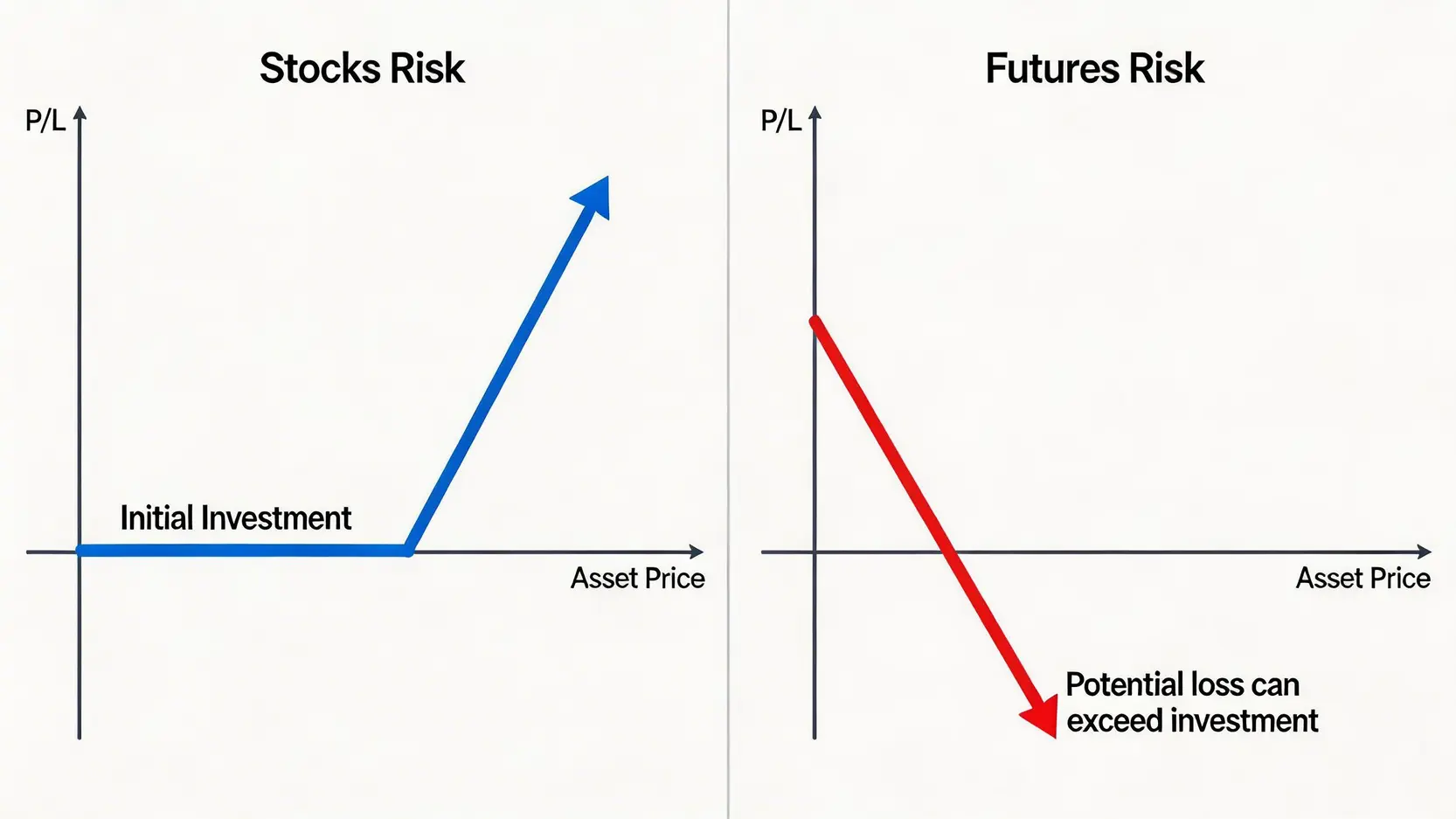
High leverage is a double-edged sword. It amplifies both profits and losses. In futures trading, if the market moves against you, losses may exceed your initial margin, known as “blow-up risk” which may require additional capital injection. In stock investing, the worst-case scenario is losing your entire principal (for example, if a company goes bankrupt), but you will not end up in debt. Therefore, futures carry significantly higher risk than stocks, but also offer far greater return potential.

期貨與股票的風險回報對比圖,顯示股票最大虧損為投入的本金,而期貨的潛在虧損可能超過本金。

Stock losses are limited to your principal, while futures leverage trading can result in losses exceeding your capital.


Should You Buy Futures or Stocks? Match Your Investment Personality

After understanding the key differences between futures and stocks, you may still wonder: which one should I choose? There is no single correct answer. It depends entirely on your personal situation, investment goals, and risk tolerance.


3 Types of Investors Suitable for Stocks: Those Seeking Long-Term Stable Growth, Dividend Income, and Lower Risk Tolerance

  1. Long-term value investors: If you believe in fundamental analysis, selecting quality companies, and holding them long term to benefit from growth, stocks are your best choice.
  2. Dividend income seekers: For investors looking to build passive income, many stable dividend-paying stocks can provide consistent cash flow, something futures cannot offer.
  3. Risk-averse beginners: For those new to investing who want lower volatility while learning the market, stocks provide a more stable environment to build foundational knowledge.


3 Types of Investors Suitable for Futures: Short-Term Traders, Hedgers, and High-Risk Tolerant Professionals

  1. Short-term trading experts: If you are skilled in technical analysis and can accurately predict short-term market movements, futures offer excellent tools due to high leverage and low costs.
  2. Portfolio hedgers: If you hold a large stock portfolio but fear short-term market corrections, you can short index futures to hedge risk without selling your holdings.
  3. Disciplined professionals: Futures trading requires strict discipline, risk control, and stop-loss execution. Only experienced traders who can handle high pressure and fast decision-making are suitable for this high-risk market.


FAQ: Common Questions About Futures vs Stocks

Q: Should beginners start with stocks or futures?

A: For most beginners, it is strongly recommended to start with stocks. Stocks have a relatively simple structure and more controllable risk. By first becoming familiar with price fluctuations, fundamental analysis, and technical analysis in the stock market, you can build a solid investment foundation and psychological resilience. If you remain interested later, you may then consider allocating a small portion of capital to try futures trading.

Q: Will futures trading definitely lead to total loss? How can risk be controlled?

A: Not necessarily, but the risk is indeed very high. Successful futures traders all follow strict risk management strategies. Key points include: 1. Strict stop-loss: decide in advance at what loss level you will exit unconditionally. 2. Light position sizing: never allocate all your capital to a single trade; each position should only use a small portion of total funds. 3. Understand leverage: be fully aware of the actual contract value you are controlling, not just the margin required.

Q: How is stock futures different from regular stocks?

A: Stock futures are futures contracts based on a “single underlying stock”. They carry all characteristics of futures, such as high leverage, expiration dates, and flexible long/short trading. Compared with directly buying the stock, the main difference is that you can control an equivalent stock position with a much smaller margin. However, you also bear leverage risk, expiration pressure, and do not have shareholder rights (such as dividends or voting rights).

Q: Can futures be held long-term like stocks?

A: In theory, yes, but in practice it is complicated and costly. Since futures contracts expire, long-term positions require periodic “rollover” which means closing the expiring contract and opening a new one with a later expiration date. This process incurs additional transaction costs, and price differences between contract months (contango or backwardation) may also reduce long-term returns.


Conclusion

In summary, futures and stocks are two financial instruments designed for different purposes, with no absolute “good” or “bad”, only “suitable” or “not suitable”. Before deciding whether to choose futures or stocks, it is essential to clearly understand their core differences. Stocks are a relatively stable way to share in corporate growth, suitable for long-term investing. Futures, on the other hand, are tools for short-term speculation or risk hedging using high leverage, better suited for experienced and disciplined traders. We hope this comprehensive analysis of futures vs stocks helps you find the investment path that suits you best and take a more stable first step toward profitability.

If you liked this article, please share it!

Related Articles

  • Volatility Surface Guide: Skew Trading Strategies
    Practical Applications of Volatility Surfaces: From Options Modeling to Advanced Skew Trading Strategies In options markets, implied volatility is never a flat line. Instead, it forms complex "smile" or "skew" surfaces. For advanced traders, mastering the practical applications of volatility surfaces is equivalent to possessing a lens that reveals market...
    2026 年 6 月 3 日
  • Foreign Capital Flow Model: Track Institutional Money
    Building a Foreign Capital Flow Copy Trading Model: A Stock Market Indicator for Accurately Tracking Institutional Positioning In Asia-Pacific stock markets, foreign capital inflows and outflows often determine the direction of the index. However, simply looking at daily net buy and sell data is no longer enough. Only by building...
    2026 年 6 月 3 日
  • Options Buying Strategies for Extreme Market Risks
    Options Buyer Strategies During Extreme Market Conditions: Black Swan Hedging and Cross-Market Arbitrage During Volatility Surges The most terrifying aspect of financial markets is not a gradual decline, but overnight flash crashes and cross-market capital withdrawals accompanied by volatility surges. In the highly unpredictable global macroeconomic environment of 2026, geopolitical...
    2026 年 6 月 3 日
返回顶部