US Interest Rate Trends: Futures & CME FedWatch Guide

Updated: 2026/04/09  |  CashbackIsland

us-interest-rate-fedwatch-guide

Complete Analysis of US Interest Rate Trends: Quickly Understand Interest Rate Futures and CME FedWatch Tool Forecasting Techniques

Every Federal Reserve (Fed) interest rate decision affects global markets, but are you still struggling to interpret complex US interest rate trend charts? Or have you heard of US interest rate futures but don’t know how to apply them? Market trends change in an instant, and mastering the data means gaining the edge. This article starts with the core concept of the federal funds rate and guides you step by step to master the skills to interpret US interest rate trends, providing a complete CME FedWatch Tool tutorial so you can use market data to accurately predict the next rate hike or cut, making your investment decisions more informed. 


What Are US Interest Rates? Understand US Interest Rate Trend Charts Through Key Indicators

Before diving into forecasting tools, you must first establish a solid foundation. Understanding the core of US interest rates, the federal funds rate is the starting point for interpreting all market expectations. Changes in this figure directly affect global capital flows and asset prices.


Core Concept: Definition and Importance of the Federal Funds Rate

The terms “US rate hike” or “rate cut” refer to the Federal Open Market Committee (FOMC) adjusting the target range of the “federal funds rate”. This is not a rate set directly by the government but the interest rate used by US banks when lending to each other to meet overnight reserve requirements.

Although it is merely an interbank lending rate, its importance is unparalleled:

  • Financial Market Foundation: It serves as the basis for all short-term interest rates, affecting everything from commercial loans and credit card rates to mortgages.
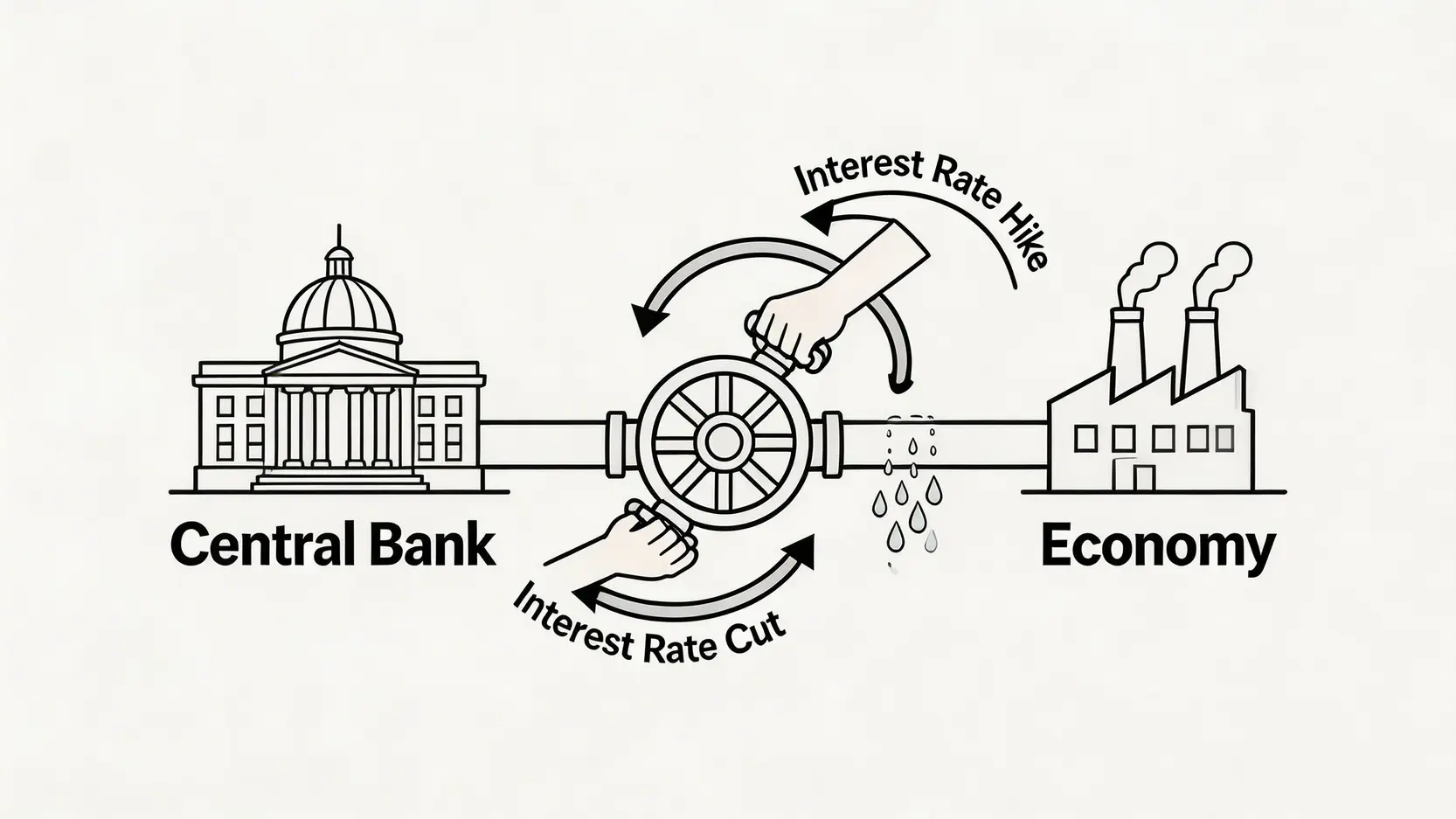
  • Primary Tool of Monetary Policy: The Fed uses open market operations buying and selling government securities to influence market liquidity and keep the federal funds rate within the target range. Raising rates tightens market liquidity to curb inflation, while cutting rates releases funds to stimulate the economy.
  • Global Economic Indicator: As the world’s primary reserve currency, changes in the federal funds rate guide global capital flows, deeply impacting exchange rates, stock markets, and bond markets worldwide. For a deeper understanding, see Investopedia’s detailed explanation of the Fed’s interest rate policies.

聯準會升息與降息的貨幣政策傳導機制示意圖

By adjusting rates, the Fed acts like a faucet, regulating market liquidity to influence the overall economy.


How to Correctly Interpret US Interest Rate Trend Charts? Understand Hiking and Cutting Cycles From Historical Data

Understanding history is the key to anticipating the future. A long-term US interest rate trend chart is like a condensed economic history, recording decades of economic fluctuations and policy responses. The key to interpreting this chart is identifying “hiking cycles” and “cutting cycles”。

  • Hiking Cycle: When the economy overheats and inflation pressures rise, the Fed initiates a hiking cycle, gradually raising rates to cool the economy. For example, in 2022, to combat the worst inflation in decades, the Fed implemented an aggressive rate-hiking campaign.
  • Cutting Cycle: When the economy shows signs of recession and unemployment rises, the Fed enters a cutting cycle, lowering borrowing costs to stimulate consumption and investment. For instance, after the 2008 financial crisis and the 2020 COVID-19 outbreak, the Fed quickly reduced rates to near zero.

By observing interest rate trend charts, investors can analyze the current rate level in historical context and compare it with overall economic indicators such as inflation and employment to predict potential future trends. History may not repeat exactly, but it often rhymes remarkably.


Further Reading (Highly Recommended)

2025 Ultimate Guide to Forex Fundamental Analysis: From Economic Data to Central Bank Decisions

US Stock Futures Tutorial: 5 Steps to Trade Dow/Nasdaq Futures (2026 Lazy Pack)


The Ultimate Rate Forecasting Tool: Complete CME FedWatch Tool Tutorial

If interest rate trend charts review history, the CME FedWatch Tool is a telescope for seeing the future. Provided by the Chicago Mercantile Exchange (CME Group), this free tool has become essential for investors worldwide to forecast Fed rate decisions.


What Is the CME FedWatch Tool? Why Is It a Market Expectation Indicator?

The CME FedWatch Tool calculates, in real time, the probability of a rate hike, cut, or hold at the next FOMC meeting based on the market prices of 30-Day Fed Fund Futures. It is not an official forecast but reflects the consensus of market participants putting real money on the line.

Whenever new economic data is released (e.g., CPI, nonfarm payrolls) or Fed officials make hawkish (tightening) or dovish (easing) remarks, interest rate futures prices change, and the probabilities on the FedWatch Tool update accordingly, accurately reflecting shifts in market expectations.


Step-by-Step Tutorial: How to Use the FedWatch Tool to Check Rate Hike or Cut Probabilities

Using the tool is simple and requires only a few steps to grasp market trends:

  1. Visit the Official Website: Search “CME FedWatch Tool” in your browser or go directly to the CME Group website.
  2. Select the Meeting Date: Upcoming FOMC meeting dates are displayed at the top. Click different dates to see market expectations for that meeting.
  3. View Probability Distribution: The page displays the probabilities of different target rate ranges in a dashboard or table. The current rate is highlighted, alongside the market’s predicted new rate range and corresponding probability after the next meeting.
  4. Compare Historical Changes: The tool often provides probabilities from “the previous day”, “one week ago”, and “one month ago”, allowing you to quickly compare shifts in market sentiment.


Data Interpretation: Understand Probabilities of Different Rate Ranges and Market Consensus

The key to interpreting the data is “comparison”. Suppose the current rate range is 5.25% – 5.50%. On the FedWatch Tool, you might see:

  • 5.25% – 5.50% probability at 90%: The market widely expects the Fed to “hold rates steady”.
  • 5.50% – 5.75% probability at 70%: The market strongly expects a “0.25% rate hike”.
  • 5.00% – 5.25% probability at 80%: The market anticipates a “0.25% rate cut”.

When a rate range probability exceeds 50%, the market has formed a preliminary consensus. The higher the number, the stronger the consensus. Investors can use this data to position their portfolios in advance to respond to potential market volatility.


What Are US Interest Rate Futures? Their Intrinsic Connection to Rate Forecasts

To fully understand how the CME FedWatch Tool works, you must know its data source, US interest rate futures. This helps you not only understand what it does but why it works.


Introduction to Rate Futures: Definition, Function, and Trading Purpose

US interest rate futures are financial derivatives allowing parties to agree to buy or sell a contract based on the federal funds rate at a predetermined price on a specific future date. Their core functions include:

  • Hedging: Banks, large funds, or corporations can use rate futures to lock in future borrowing costs or investment returns, mitigating risks from rate fluctuations.
  • Speculation: Traders anticipating a rate increase can sell rate futures; conversely, if expecting a rate decrease, they can buy rate futures to profit from the price difference. For more foundational futures trading knowledge, refer to this introductory futures tutorial.


Underlying Principle: How CME FedWatch Tool Uses Rate Futures Data for Forecasting

The magic of the CME FedWatch Tool lies in interest rate futures prices. Its calculation is roughly as follows:

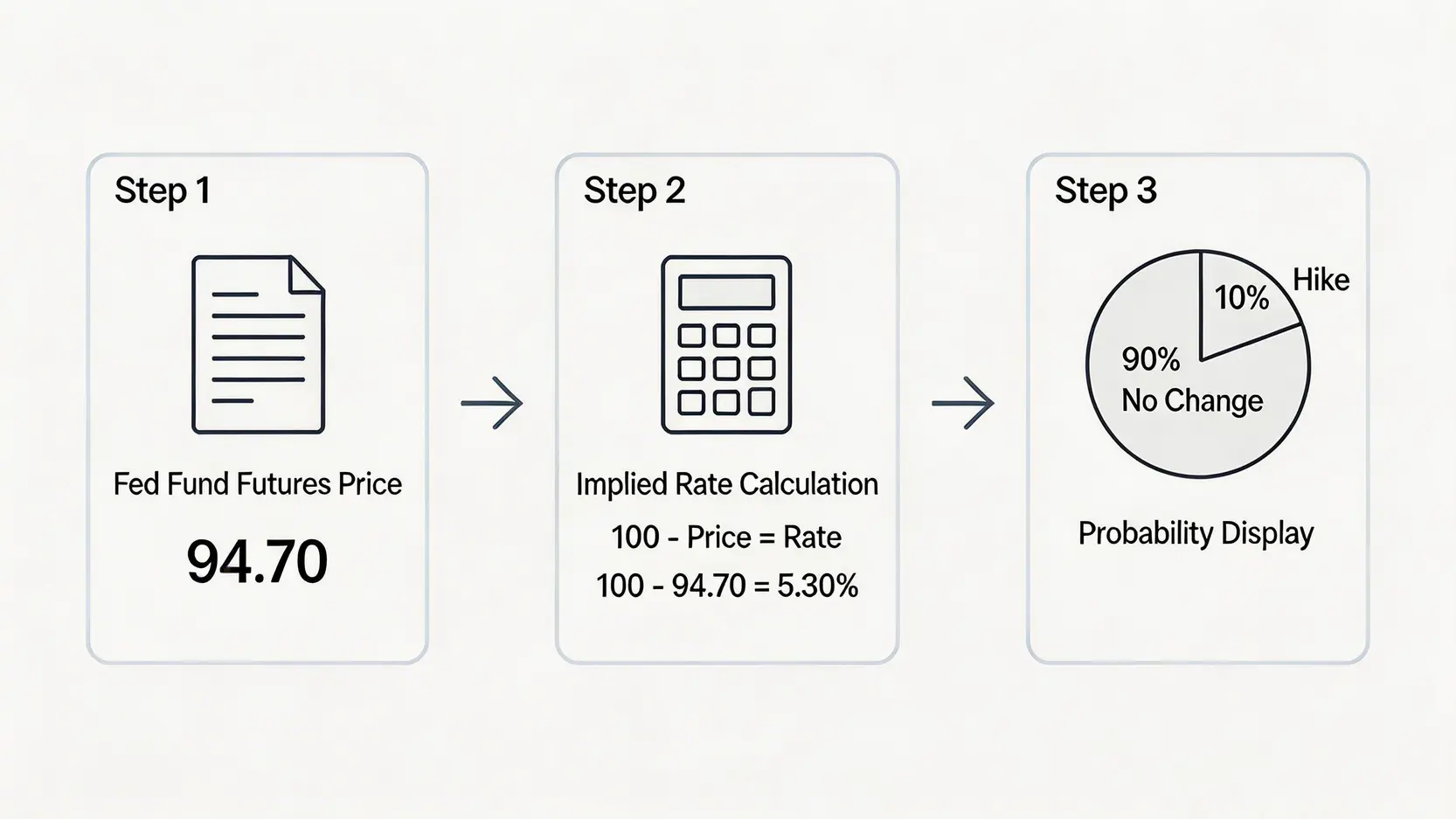
  1. CME lists and trades “30-Day Fed Fund Futures”, with contract prices calculated as 100 minus the average effective federal funds rate for each day of the month.
  2. For example, if the market expects next month’s average rate to be 5.30%, the futures price would theoretically approach 100 – 5.30 = 94.70.
  3. The CME FedWatch Tool reads these futures contracts’ real-time market prices to infer the market’s implied average rate expectations.
  4. Combined with the Fed’s usual practice of adjusting rates in 0.25% increments, the tool uses statistical models to calculate the probability of different rate decisions (a 0.25% hike, a 0.25% cut, or no change).

CME FedWatch Tool 運作原理流程圖,從利率期貨價格到升降息機率

The CME FedWatch Tool converts market interest rate futures prices into intuitive rate hike or cut probabilities.

In simple terms, fluctuations in interest rate futures prices directly reflect the market’s collective judgment on the future direction of rates, and the FedWatch Tool translates these complex price data into probability indicators that ordinary investors can easily understand.


Further Reading (Highly Recommended)

2025 Ultimate Guide to Forex Fundamental Analysis: From Economic Data to Central Bank Decisions

US Stock Futures Tutorial: 5 Steps to Trade Dow/Nasdaq Futures (2026 Lazy Pack)


Frequently Asked Questions (FAQ)

Q: What is an FOMC meeting? How many times a year does it take place?

A: FOMC refers to the Federal Open Market Committee, the key body within the US Federal Reserve (Fed) responsible for setting monetary policy. Its main duty is to determine the target range for the federal funds rate. By convention, the FOMC holds eight regular two-day meetings each year in Washington, D.C., roughly every six weeks. A policy statement is released after each meeting, and the chair holds a press conference, which is closely watched by global markets. In special circumstances, emergency meetings may also be convened.

Q: What specific effects do rate hikes or cuts have on the stock, bond, and forex markets?

A: Generally:

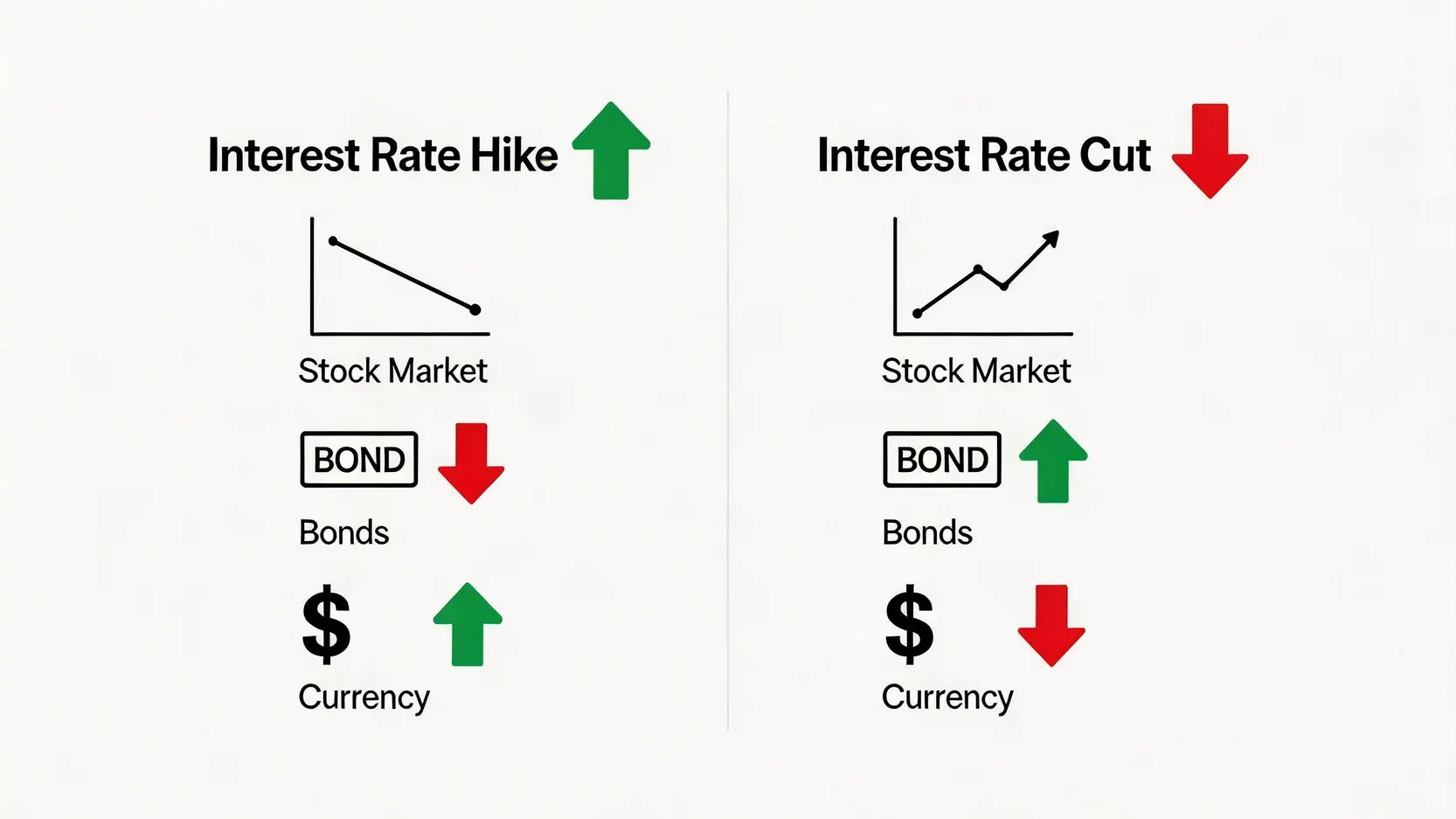
  • Stock Market: Rate hikes are usually negative for stocks as they increase corporate borrowing costs and may slow economic growth. Rate cuts have the opposite effect, stimulating the economy and generally benefiting stocks.
  • Bond Market: Interest rates and bond prices move inversely. When rates rise, newly issued bonds offer higher coupons, reducing the appeal of existing bonds and causing their prices to fall. Rate cuts tend to push bond prices higher.
  • Forex Market: Rate hikes attract international capital seeking higher returns, typically boosting the domestic currency (e.g., the US dollar). Rate cuts may lead to capital outflows, causing currency depreciation.

升息與降息對股市、債市及匯市的影響對比圖

Rate hikes and cuts generally have opposite effects across major financial markets.

Q: How accurate is the CME FedWatch Tool?

A: The CME FedWatch Tool is quite accurate as meetings approach, as it reflects the collective expectations of numerous professional institutions and traders. The market usually digests all known information effectively. However, it is not a crystal ball; its forecast probabilities can change rapidly with new economic data or unexpected events. Therefore, it is an excellent tool to observe market sentiment dynamics but should not be considered a 100% guarantee.

Q: Besides the CME FedWatch Tool, what other tools can monitor rate expectations?

A: Another important indicator is the “US Treasury Yield Curve”. In particular, the spread between the 2-year and 10-year Treasury yields serves as a key measure of market expectations for future economic health and interest rate trends. When short-term rates exceed long-term rates known as a “yield curve inversion” it is often viewed as a warning of a potential recession and may signal that the Fed could need to cut rates in response.


Conclusion

In summary, mastering US interest rate trends is essential for every investor. From understanding the fundamental federal funds rate to interpreting hiking and cutting cycles in historical charts, and then skillfully using the CME FedWatch Tool, a powerful market expectation instrument, you can transform the insights embedded in US interest rate futures into a solid foundation for your investment decisions. Data does not lie; it reflects the market’s most authentic consensus. Start applying these techniques now to add data-backed confidence and foresight to your investment portfolio.

编者
Evan Lin

Evan Lin

我是Evan Lin,从大学时期开始接触外汇交易,至今已有多年实战经验,熟悉技术分析与EA策略,热衷于研究市场脉动与风险管控,喜欢分享实战经验和交易技巧,和大家一起学习、一起进步!

If you liked this article, please share it!

Related Articles

  • Order Flow Analysis Tools: Track Institutional Activity
    In-Depth Review of Intelligent Order Flow Detection Tools: Understanding Institutional Activity and Identifying Real Market Buying and Selling Pressure What Is Order Flow, and Why Is It a “Leading Indicator” for Price Prediction? Candlestick charts and technical indicators can be misleading, but the real-money "Order Flow" within the market cannot....
    2026 年 6 月 4 日
  • Social Sentiment Indicators: Predicting Stock Trends
    Social Sentiment Quantitative Indicators: Mining PTT and Dcard Discussions to Predict Stock Prices What Are Social Sentiment Quantitative Indicators, and Why Are They Becoming Increasingly Important? In an era of information overload, financial markets are no longer driven solely by cold financial statements and macroeconomic data. The "Shipping King" phenomenon...
    2026 年 6 月 4 日
  • Taiwan FSC Futures Broker Verification Guide
    Avoid Fraudulent Platforms! A Visual Guide to Taiwan FSC Licensed Futures Merchant Verification and Scam Prevention In recent years, driven by heightened volatility in global financial markets and the impact of monetary easing policies worldwide, more investors have begun seeking diversified investment instruments. However, underground futures operators and overseas fraudulent...
    2026 年 6 月 4 日
返回顶部