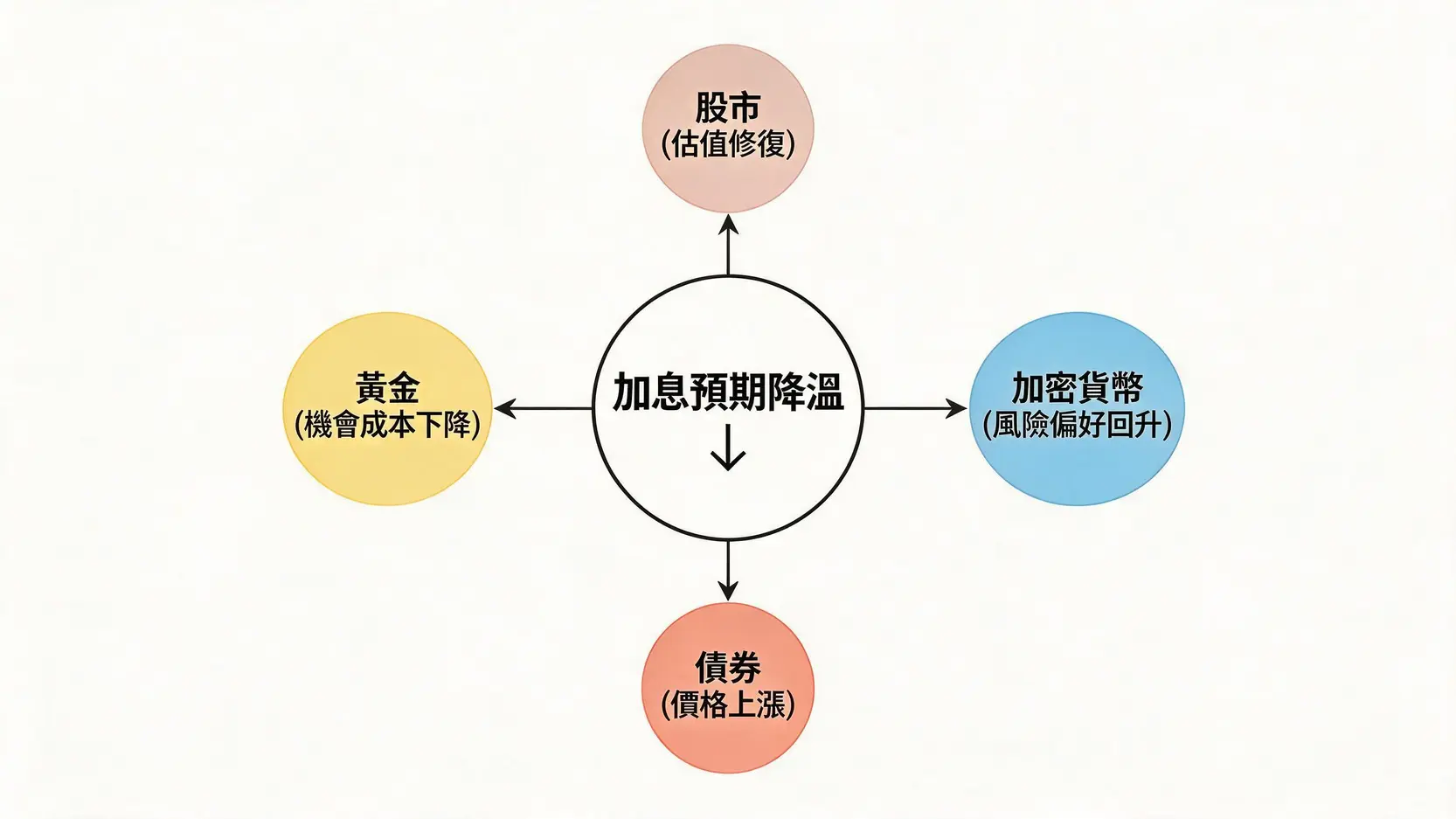
Changes in Interest Rate Expectations Redirect Capital Across Major Asset Classes.
Can the Stock Market Finally Breathe? Potential Support for Technology and Growth Stocks
Interest rates are a key variable in determining stock valuations, particularly those of growth stocks. Higher interest rates reduce the discounted value of future cash flows, which has an especially severe impact on technology and growth stocks that depend on future earnings. Now, as rate hike expectations cool:
- Valuation Pressure Eases: A more stable interest rate outlook creates room for a valuation recovery in technology stocks. Lower funding costs make investors more willing to pay a premium for their future growth potential.
- Corporate Earnings Improve: For technology companies that require continuous financing to support research, development, and expansion, a peak in interest rates means that future borrowing costs may decline, helping to improve their earnings outlook and cash flow conditions.
Therefore, as market risk appetite recovers, growth assets led by technology stocks may be among the first to benefit and could experience a rebound. Interested investors can study the 2025 Volatile Market Survival Guide: Hedging Allocations With Hong Kong Technology Stocks and REITs Amid US Stock Market Volatility … to learn more positioning strategies.
Further Reading (Highly Recommended)
2025 Volatile Market Survival Guide: Hedging Allocations With Hong Kong Technology Stocks and REITs Amid US Stock Market Volatility …
US Treasury Market Recovers: Understanding the Inverse Relationship Between Bond Prices and Yields
The bond market responds most directly to interest rates. There is a clear inverse relationship between bond prices and yields. When the market expects future interest rates to decline or remain unchanged:
- Yields Decline: The market no longer demands higher interest rate compensation, causing yields on newly issued and secondary-market bonds to fall.
- Bond Prices Rise: Existing bonds with fixed coupon rates become relatively more attractive, causing their prices to rise. Long-term US Treasury bonds are particularly sensitive to interest rate changes, meaning their price gains may be more significant.
For investors seeking stable returns, locking in the current relatively high yields while pursuing potential capital gains from future price appreciation has become an attractive strategy.
Gold and Industrial Metals: Why Do They Rise When Rate Hike Expectations Cool?
As a non-interest-bearing asset, gold prices are heavily influenced by opportunity cost (which refers to the interest income forgone by holding gold). Cooling rate hike expectations are positive for gold:
- Lower Opportunity Cost: When interest rates stop rising, the opportunity cost of holding gold falls, increasing its attractiveness as a store of value.
- Expectations of a Weaker US Dollar: A shift in Federal Reserve policy usually leads to a weaker US dollar. Because gold is priced in US dollars, depreciation of the US dollar makes gold cheaper for buyers using other currencies, thereby stimulating demand.
As for industrial metals, although their prices are mainly affected by industrial demand and economic conditions, if the change in Federal Reserve policy expectations successfully leads to an “economic soft landing” rather than a recession, it will help boost global manufacturing activity and support the demand outlook for industrial metals such as copper and aluminium.
Changes in Risk Sentiment in the Bitcoin and Cryptocurrency Markets
Bitcoin and other cryptocurrencies are generally regarded by the market as high-risk speculative assets. During tightening cycles, declining liquidity places significant pressure on their prices. When rate hike expectations cool, market risk appetite usually improves:
- Return of Liquidity: Capital begins to flow out of safe-haven assets in search of higher returns, and some funds may flow back into high-risk asset classes, including cryptocurrencies.
- Reduced Macroeconomic Pressure: An improvement in the macro monetary environment provides relatively accommodative external conditions for the cryptocurrency market, helping it move away from a downward trend driven purely by panic.
However, it must be emphasised that the cryptocurrency market is still affected by multiple factors, including regulatory policies, technological developments, and its own industry cycle. An improved macroeconomic environment is only one factor, and investors must still approach its high volatility with caution.
Investment Strategies for the Second Half of 2026: Practical Positioning for a Federal Reserve Policy Shift
Faced with changes in the market environment, investors with different risk preferences should adopt different response strategies. Below are positioning recommendations for conservative and aggressive investors.
Conservative Investors: How Should the Stock-Bond Allocation Ratio Be Adjusted?
For investors seeking steady asset growth, the key lies in “rebalancing”.
- Increase Allocations to High-Quality Bonds: Consider gradually increasing the proportion of highly rated corporate bonds or US Treasury bonds in the portfolio. This can not only lock in yields that remain relatively high by historical standards, but also provide opportunities for capital appreciation during a potential future rate-cut cycle.
- Select High-Quality Blue-Chip Stocks: In terms of stock allocation, the focus should be on blue-chip companies with healthy financial positions, stable cash flows, strong competitive moats, and the ability to pay dividends consistently. These companies demonstrate stronger defensive qualities amid economic uncertainty.
- Maintain Diversification: Do not put all your eggs in one basket. Allocating to alternative assets such as gold can further diversify risk and hedge against potential black swan events.
Aggressive Investors: How Can Rotation Opportunities in Cyclical Sectors Be Identified?
For aggressive investors with a higher risk tolerance, market turning points are often the best opportunities to generate excess returns.
- Position in High-Growth Technology Stocks: As mentioned earlier, interest rate-sensitive technology and growth stocks are among the biggest beneficiaries. Investors may consider buying on dips in leading technology companies that were unfairly sold off during previous corrections but still have strong fundamentals and long-term innovation capabilities.
- Monitor Cyclical Sectors: If the economy achieves a soft landing, demand in cyclical sectors such as consumer goods, industrials, and financials will recover. Identifying leading companies in these sectors may generate substantial returns.
- Use Derivatives: Experienced investors may consider using derivatives such as options to amplify potential returns while keeping risks under control.
Regardless of the strategy adopted, thorough investment risk management is indispensable.
Further Reading (Highly Recommended)
2025 Volatile Market Survival Guide: Hedging Allocations With Hong Kong Technology Stocks and REITs Amid US Stock Market Volatility …
Potential Risks That Must Be Monitored: The Possibility of an Expectations Reversal and How to Respond
Market expectations are not fixed. The greatest risk is a “resurgence of inflation”. If inflation begins rising again for any reason (such as geopolitical conflicts causing energy prices to surge once more), the Federal Reserve may be forced to return to a hawkish stance and raise interest rates again. This would cause market expectations to reverse by 180 degrees, placing asset prices under a new round of selling pressure.
Response Strategies:
- Maintain Flexibility: Do not overcommit to a single direction. The portfolio should maintain a certain degree of liquidity so that adjustments can be made quickly if market conditions suddenly change.
- Set Stop-Loss Levels: Establish a reasonable stop-loss level for every investment and strictly maintain discipline to prevent small losses from turning into major disasters.
- Continue Monitoring Key Data: Closely monitor monthly CPI and NFP reports, as well as speeches by Federal Reserve officials, to stay informed about the latest changes in the macroeconomic environment.
Frequently Asked Questions (FAQ)
Q: What Direct Impact Do Federal Reserve Rate Hikes or Rate Cuts Have on Hong Kong?
A: Because Hong Kong operates a linked exchange rate system under which the Hong Kong dollar is pegged to the US dollar, Hong Kong’s monetary policy generally needs to follow that of the US. When the Federal Reserve raises interest rates, the Hong Kong Monetary Authority usually also raises its base rate to maintain exchange rate stability. This is transmitted directly to the Hong Kong Interbank Offered Rate (HIBOR), causing mortgage rates for residents and borrowing costs for companies to rise, thereby placing pressure on the property market and the overall economy. Conversely, when the Federal Reserve cuts interest rates, Hong Kong’s interest rate environment also becomes more accommodative.
Q: What Is the Federal Funds Rate Dot Plot, and How Does It Affect Market Expectations?
A: The federal funds rate dot plot is a chart published by the Federal Reserve in its quarterly Summary of Economic Projections (SEP). Each “dot” on the chart represents an anonymous projection by a Federal Reserve official (including the Chair, governors, and regional Federal Reserve Bank presidents) for the federal funds rate over the coming years and in the longer term. It is not an official commitment to a future interest rate path, but is more like a survey of intentions. However, the market interprets changes in the median dot to assess the Federal Reserve’s overall internal policy stance (whether hawkish or dovish), thereby affecting expectations for future interest rate trends. Detailed explanations of the dot plot can be found on the websites of authoritative financial institutions.
Q: Does Cooling Inflation Data Necessarily Mean That Interest Rates Will Be Cut?
A: Not necessarily. Cooling inflation is a “necessary condition” for the Federal Reserve to consider ending rate hikes or even shifting towards rate cuts, but it is not a “sufficient condition”. The Federal Reserve does not focus only on a single month’s data, but places greater importance on whether the downward “trend” in inflation is sustainable. It needs to be confident that inflation is steadily returning to its long-term target of 2%. In addition, labour market conditions, financial system stability, and the economic growth outlook are all factors that must be considered in its decisions. While inflation remains above the target level, even if the data cools, the Federal Reserve may keep interest rates at a higher level for some time (Higher for Longer) to ensure that inflationary pressure is fully contained.
Conclusion
In summary, cooling Federal Reserve rate hike expectations have brought a turning point after a prolonged period of monetary tightening, creating an opportunity for major asset classes to be repriced. From the recovery of stock market valuations and the rebound in bond prices to easing pressure on gold and certain risk assets, investors appear to be entering a more favourable macroeconomic environment. However, this path will not be smooth, and the risk of resurgent inflation remains the Sword of Damocles hanging over the market. Identifying the signals behind the data, understanding how different assets respond, and flexibly adjusting and diversifying allocations according to personal risk tolerance will be essential for navigating the changing market environment and achieving steady asset growth in the second half of 2026.