Hong Kong Forex Regulations: HKMA, Tax & Reporting Guide

Hong Kong Foreign Exchange Trading Regulations Quick Guide: HKMA Guidelines, Taxation, and Reporting Requirements Explained
Want to trade forex in Hong Kong, an international financial center, but feel overwhelmed by complex Hong Kong foreign exchange trading regulations and licensing requirements? Worried about unintentionally crossing regulatory red lines due to unclear foreign exchange reporting requirements? This article consolidates the latest guidelines from the Hong Kong Monetary Authority (HKMA) and provides a clear and in-depth analysis of the core regulations of the Hong Kong foreign exchange market, allowing you to fully understand key information on licensing applications, tax treatment, and fund reporting in one go, ensuring your investment activities are safe, compliant, and steadily advancing. Understanding these HKMA foreign exchange guidelines is the first step in safeguarding your funds.
Who Are the Core Regulatory Authorities for Forex Trading in Hong Kong?
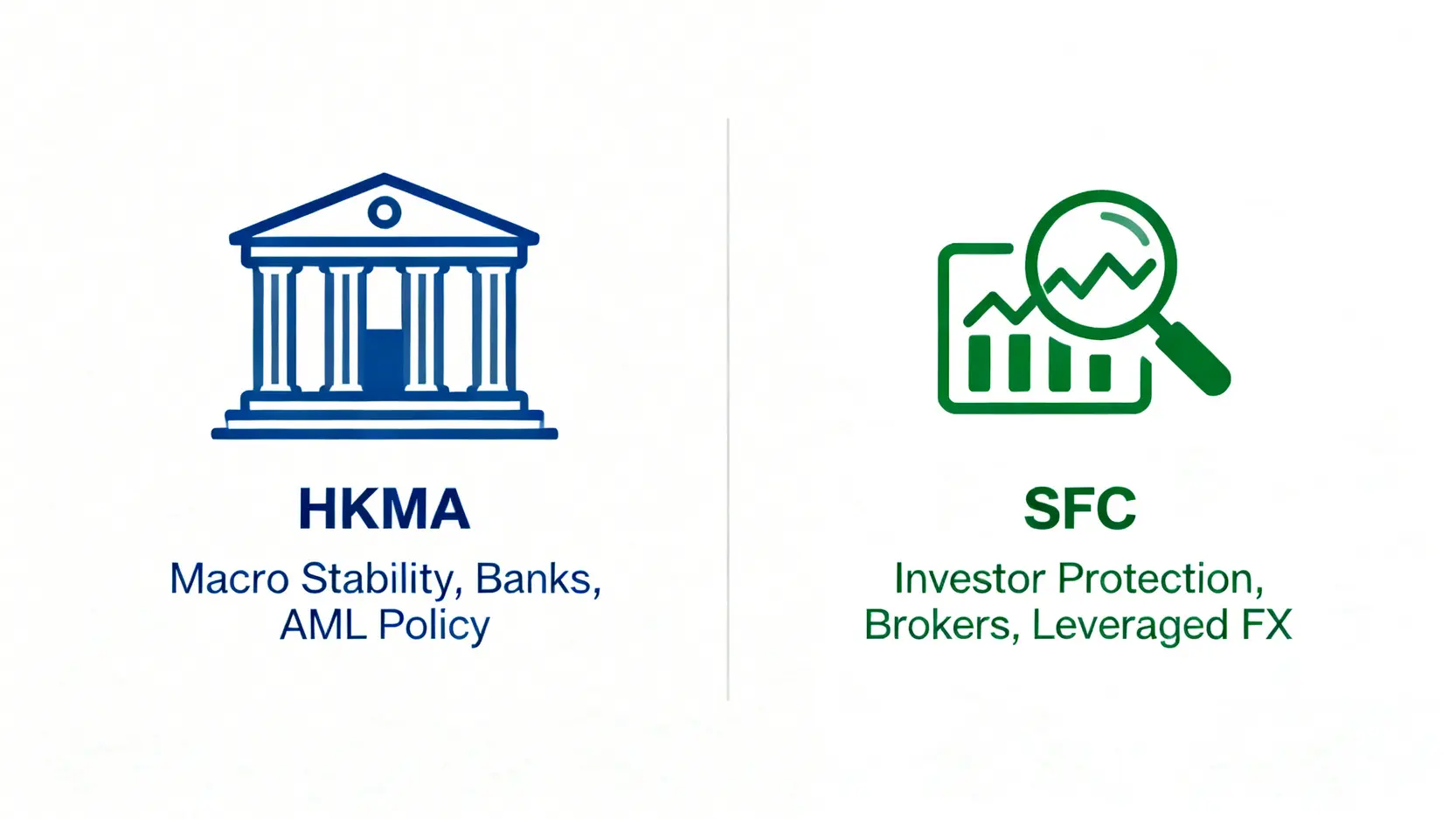
In Hong Kong, the regulatory framework of the foreign exchange market is jointly established by two major institutions, each performing its own role to ensure market fairness, transparency, and stability. Understanding their roles is the foundation for comprehending Hong Kong foreign exchange trading regulations.
The Role and Responsibilities of the Hong Kong Monetary Authority (HKMA)
The Hong Kong Monetary Authority (HKMA), referred to as the HKMA, is Hong Kong’s central banking institution. Its core responsibilities include maintaining the stability of the Hong Kong dollar exchange rate, managing the Exchange Fund, and promoting the stability and soundness of the financial system. Although the HKMA does not directly regulate the day-to-day operations of forex trading, it formulates macro-level regulatory policies and guidelines, particularly for the foreign exchange business activities of authorized institutions (i.e., banks). The HKMA also closely monitors the market to ensure that the banking system complies with anti-money laundering (AML) and counter-financing of terrorism (CFT) regulations, which have a direct impact on the movement of large sums of funds.
The Regulatory Scope of the Securities and Futures Commission (SFC)
The Securities and Futures Commission (SFC), referred to as the SFC, is an independent statutory body responsible for regulating Hong Kong’s securities and futures markets. For investors, the SFC plays a more direct role. All companies or platforms engaging in “leveraged foreign exchange trading” in Hong Kong must obtain a license issued by the SFC (typically a Type 3 license – leveraged foreign exchange trading). The responsibilities of the SFC include:
- Licensing and supervision: approving and regulating licensed corporations to ensure they have sufficient financial capability and compliance standards.
- Enforcement of regulations: investigating and penalizing market misconduct, such as providing unauthorized trading services or misleading promotions.
- Investor protection: formulating investor protection measures, enhancing market transparency, and ensuring investors trade in a fair environment.

In simple terms, the HKMA is responsible for macro-level financial stability and the banking system, while the SFC focuses on specific trading activities, especially higher-risk leveraged trading, directly safeguarding investor interests.
Further Reading (Highly Recommended)
Do You Need a License to Trade Forex in Hong Kong? Clarifying Leveraged Forex Trading Licensing Requirements
Many beginner investors ask: “Do I need to apply for a license to trade forex in Hong Kong?” The answer is: for individual investors, it is generally not required. The key lies in the type of trading you participate in and whether the platform providing the service is compliant. Understanding leveraged foreign exchange trading licensing requirements is crucial.
Key: What Is “Leveraged Foreign Exchange Trading”?
“Leveraged foreign exchange trading” refers to a trading method where investors only need to deposit a relatively small margin to control a contract with a notional value far exceeding that margin. The leverage effect can amplify potential profits, but it also amplifies potential losses and may even result in losses exceeding the initial capital. For example, a leverage ratio of 100:1 means that with a margin of USD 1,000, you can operate a forex contract worth USD 100,000. Due to its high-risk nature, this type of trading is a key focus of regulation by the SFC.

Differences Between Individual Investors and Licensed Corporations
The distinction here is very clear:
- Individual investors: as clients, you do not need to hold any license to conduct leveraged foreign exchange trading on compliant platforms. Your responsibility is to ensure that the trading platform you choose is a legally licensed institution authorized by the SFC.
- Licensed corporations (trading platforms/brokers): any company operating leveraged foreign exchange trading businesses in Hong Kong and providing trading services to the public must apply to the SFC for a Type 3 (leveraged foreign exchange trading) license under the “Securities and Futures Ordinance”. Operating such businesses without a license constitutes a criminal offense.
How to Check Whether a Trading Platform Holds a Compliant License?
Choosing a safe and reliable trading platform is the first step toward successful investing. Before committing any funds, you must conduct verification. The following are the steps to check whether a platform holds a compliant leveraged foreign exchange trading license:
- Visit the SFC official website: go to the SFC Public Register.
- Enter the platform name: input the company name of the trading platform you are considering (in Chinese or English) into the search bar.
- Verify the license type: carefully review the search results. Ensure the company holds a “Type 3 regulated activity – leveraged foreign exchange trading” license. Also check whether the license status is “active” or “licensed”.
- Beware of unlicensed or overseas platforms: if the company cannot be found, the license type does not match, or the license has expired, it is very likely not regulated under Hong Kong laws. Using such platforms means your investment will not be protected by local regulations.
Investment warning: do not trust claims that “the company is headquartered overseas, so a Hong Kong license is not required”. As long as its business involves providing services to the Hong Kong public, it must comply with Hong Kong regulations.
Hong Kong Foreign Exchange Reporting Requirements: Do Large Fund Transfers Need to Be Reported?
Whether funds can flow freely and whether large transactions require reporting are key concerns for many traders. Regarding Hong Kong foreign exchange reporting requirements, it is essential to understand Hong Kong’s unique financial status and its related anti-money laundering regulations.
Hong Kong’s Free Port Policy and Foreign Exchange Control Status
Hong Kong is one of the world’s most free economies and implements a free port policy for capital. This means:
- No foreign exchange controls: in Hong Kong, individuals and businesses can freely hold, exchange, and transfer various currencies without any legally imposed limits.
- Free flow of funds: whether it is investment profits, principal, or other funds, they can be legally and freely remitted into or out of Hong Kong.
At the government level, Hong Kong does not have standard foreign exchange reporting requirements. You are not required to proactively report to any government department (such as the HKMA) simply because you have conducted a large foreign exchange transaction or fund transfer.
Bank-Level AML Regulations and Reporting of Large Transactions
Although there is no government-level reporting requirement, the concept of “reporting” does exist at the banking operational level. This is not directed at forex trading itself, but arises from international obligations to combat money laundering and terrorist financing.
According to HKMA guidelines, all banks in Hong Kong must implement strict customer due diligence (CDD) and transaction monitoring procedures. This is reflected in:
- Large cash transactions: if large amounts of physical cash deposits or withdrawals are involved (usually HKD 80,000 or above, or equivalent foreign currency), bank staff may inquire about the source and purpose of funds and make internal records.
- Suspicious Transaction Reports (STR): banks have a legal obligation to submit “STRs” to the “Joint Financial Intelligence Unit” (JFIU). This is not based purely on the transaction amount, but on the pattern, frequency, and nature of the transaction. For example, a large remittance inconsistent with a customer’s financial background, or frequent and rapid fund transfers without clear commercial reasons, may be considered suspicious transactions.
What does this mean for investors?
As long as your source of funds is legitimate and the purpose of the transaction is valid (i.e., investment returns), there is no need to be overly concerned even with relatively large fund inflows and outflows. Banks may conduct routine inquiries, and you only need to truthfully explain that the funds are used for personal forex investment. The purpose of this mechanism is to screen illegal activities, not to restrict legitimate investment behavior.
Do You Need to Pay Tax on Forex Trading Profits? A Detailed Explanation of Hong Kong Forex Tax Regulations
Taxation is a key factor affecting final investment returns. Fortunately, Hong Kong’s tax system is extremely friendly to investors, which is also one of its advantages as an international financial center. Understanding Hong Kong forex tax regulations allows you to plan your finances more precisely.
The Advantage of No Capital Gains Tax in Hong Kong
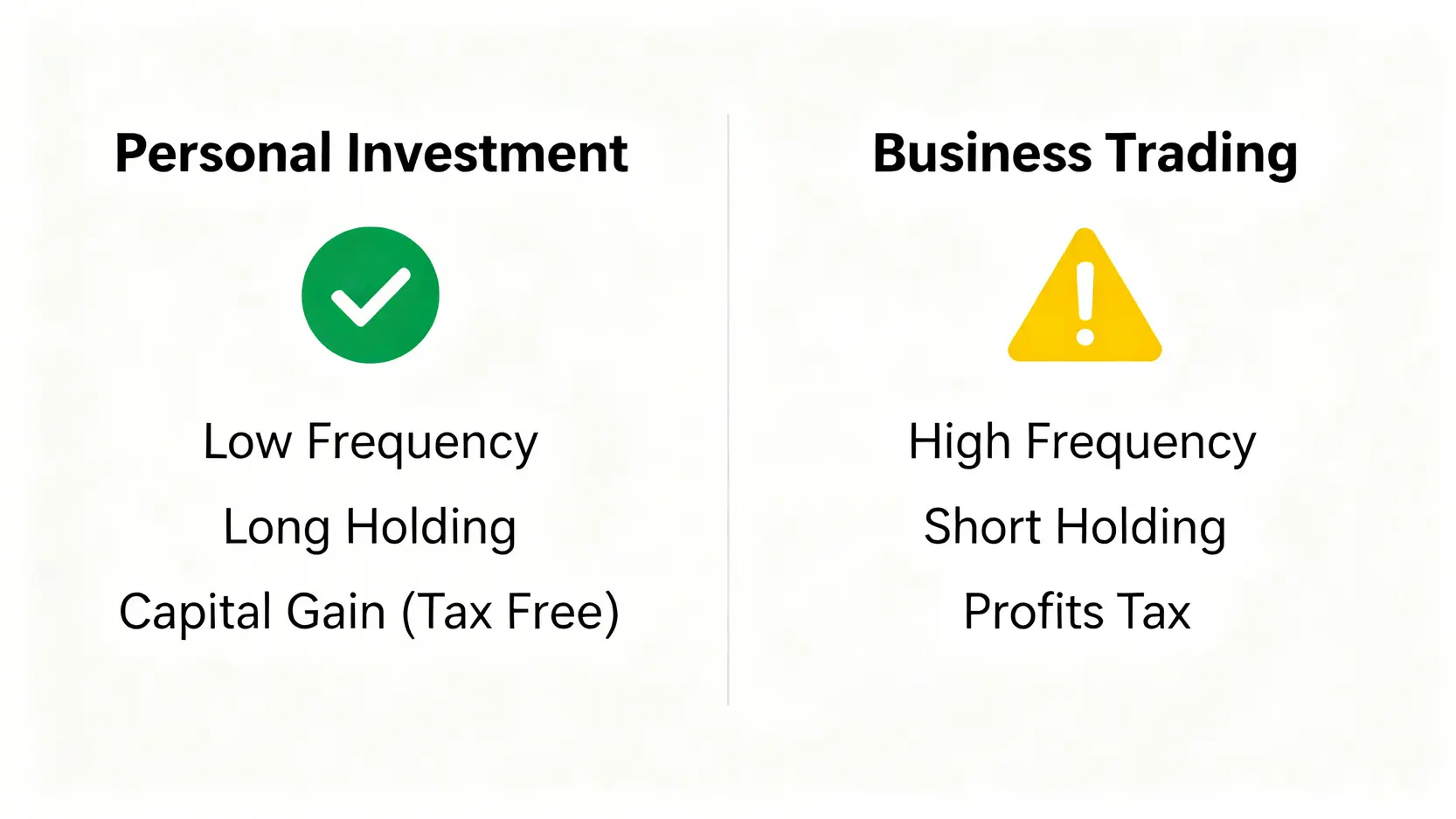
One major feature of Hong Kong’s tax system is that there is no Capital Gains Tax. This means that if you are an individual investor, profits earned from trading financial instruments such as forex, stocks, and funds are generally not subject to any tax. This applies to the vast majority of retail and individual traders.
How to Distinguish Between “Investment” and “Business Operation”? Tax Status Is Key
Although capital gains from personal investment are tax-exempt, the Inland Revenue Department (IRD) distinguishes between gains of a “capital nature” and profits derived from “business operations”. If your trading activities are deemed to constitute carrying on a “trade, profession, or business” in Hong Kong, then the related profits are subject to Profits Tax.
The IRD considers a series of factors, commonly known as the “badges of trade”, to determine whether an activity constitutes a “business operation”, including:
- Trading frequency: whether transactions are conducted frequently. High-frequency trading may be regarded as a business activity.
- Holding period: whether the holding period of the asset (in this case: forex contracts) is long or short. Short-term trading is more likely to be considered business in nature.
- Intent: whether the original intention of acquisition was long-term appreciation or short-term resale for profit.
- Operational pattern: whether the trading activity has a commercial nature, such as setting up an office, employing staff, and conducting systematic trading.

For the vast majority of investors who trade forex using their personal surplus funds, their activities are classified as personal investment, and the resulting profits are capital in nature, thus not subject to taxation. However, if you are a full-time trader with large-scale and highly frequent trading activities, the classification of your tax status may become more complex.
Further Reading (Highly Recommended)
Frequently Asked Questions (FAQ)
Q: Is it completely legal for individuals to trade forex in Hong Kong?
A: Yes, it is completely legal. Hong Kong residents have the right to trade foreign exchange and enjoy free movement of funds. The key is that if you participate in “leveraged foreign exchange trading”, you must ensure that it is conducted through a licensed corporation holding a Type 3 license issued by the Hong Kong Securities and Futures Commission (SFC), so that your investment is protected under local regulations.
Q: Is there a daily transaction limit for forex trading in Hong Kong?
A: No. As a free port, Hong Kong does not impose any statutory limits on foreign exchange trading or fund transfers. Regardless of the amount, funds can flow freely in and out. Although banks may monitor large or suspicious transactions, this is based on anti-money laundering compliance requirements rather than restrictions on legitimate transactions.
Q: If I use an overseas forex trading platform, will it still be regulated under Hong Kong laws?
A: This is a gray area, but the answer tends toward “not protected”. If an overseas platform has not obtained a license in Hong Kong but provides services to Hong Kong residents, it may itself be in breach of the “Securities and Futures Ordinance”. For investors, if a dispute arises (such as platform closure or inability to withdraw funds), since the platform is not under the jurisdiction of the SFC, it will be difficult to recover losses through Hong Kong legal channels, and the investment risk is extremely high.
Q: What specific guidelines does the HKMA have for forex trading platforms?
A: The HKMA’s primary guidelines are directed at authorized institutions (banks) and their foreign exchange business, ensuring they have robust risk management and internal control systems. The authority that directly regulates forex trading platforms (especially leveraged forex brokers) is the SFC. The SFC imposes strict requirements on licensed platforms, including capital requirements, client fund segregation rules, trade execution standards, and disclosure requirements, to comprehensively protect investors.
Conclusion
In summary, Hong Kong provides forex traders with a world-class environment of freedom and convenience. There are no foreign exchange controls, and individual investors enjoy the significant advantage of capital gains tax exemption. However, this freedom is not without regulation. All market participants must strictly comply with the regulatory framework jointly established by the HKMA and the SFC. In particular, when it comes to high-risk leveraged foreign exchange trading, choosing a trading platform that holds a valid SFC license is the cornerstone of safeguarding your funds and avoiding investment traps. Before engaging in any trading, thoroughly understanding the latest Hong Kong foreign exchange trading regulations and HKMA foreign exchange guidelines is an essential lesson for every prudent investor.
Related Articles
-
US Crude Oil Inventories Fall for 13 Consecutive Weeks: Are Oil Prices About to Soar? Complete Analysis of the Latest Market Impact in 2026 International oil prices have recently shown signs of rising. Are you also worried about higher living costs? This is closely related to the major news that...2026 年 7 月 20 日
-
Understanding the US$80 WTI Crude Oil Threshold: Five Core Factors Influencing Oil Prices and the Latest Investment Strategies Recently, global market attention has once again turned to the energy market, with WTI crude oil prices repeatedly fluctuating around the US$80 threshold as bulls and bears engage in an intense battle....2026 年 7 月 20 日
-
NOK/USD Energy Market Analysis: How Do Oil and Natural Gas Prices Drive the Norwegian Krone? The Norwegian krone (NOK) is one of the currencies most heavily influenced by energy prices worldwide, and its exchange rate against the US dollar (USD) is often closely linked to international oil and natural gas...2026 年 7 月 20 日