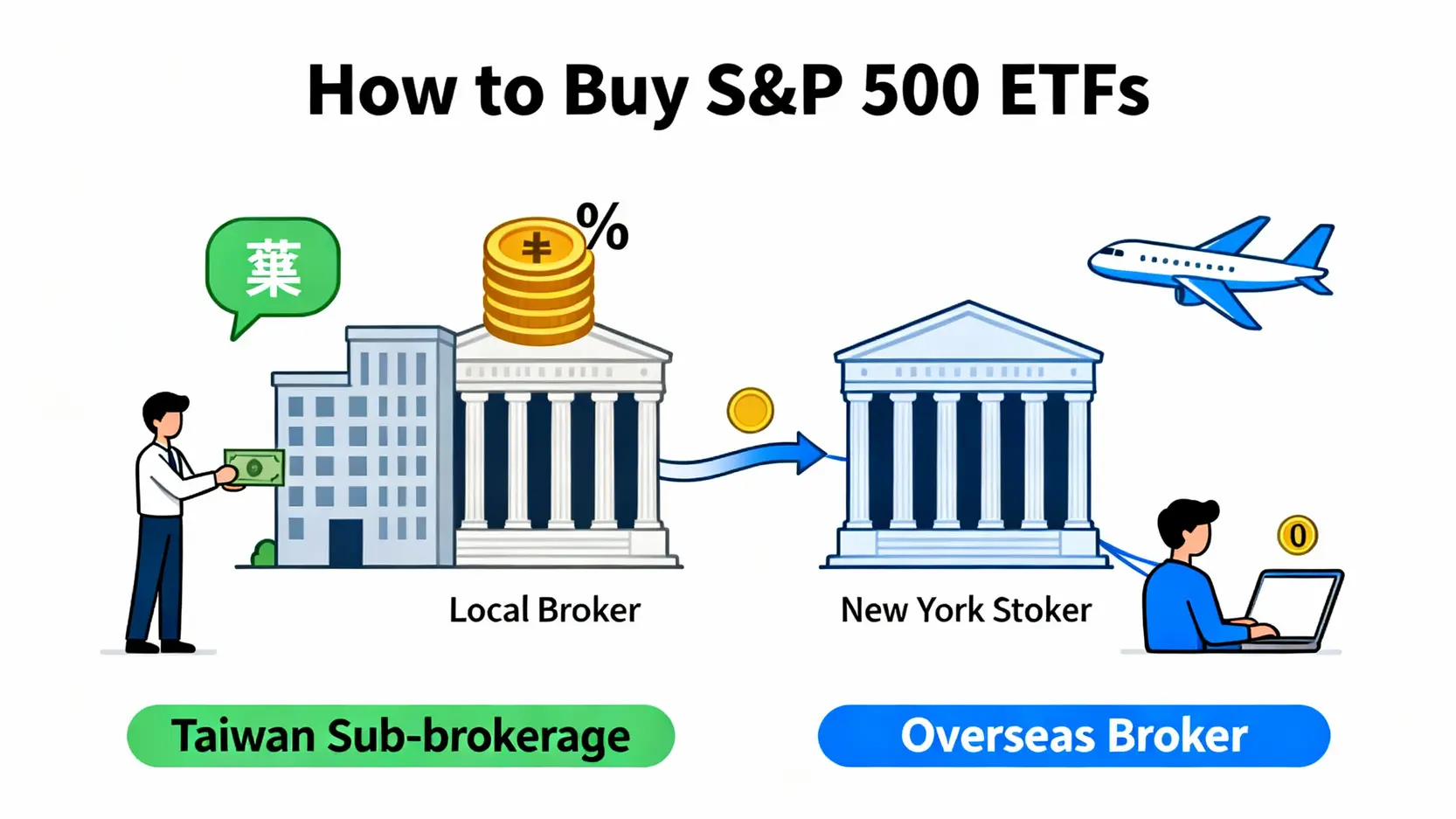
Sub-Brokerage vs. Overseas Brokers: A Single Chart to Understand the Trade-Off Between Cost and Convenience.
Using Taiwan Stock Brokers’ Sub-Brokerage Services: Pros and Cons Analysis
Sub-brokerage refers to placing orders for US stock ETFs through your existing Taiwan stock brokerage account, with the broker executing the trades overseas on your behalf. This is the most painless entry-level approach.
- Pros:
- Convenient and hassle-free: You can operate using a familiar Taiwan stock trading app, and funds do not need to be remitted overseas.
- Chinese-language support: If issues arise, Chinese-speaking customer service is available for immediate assistance.
- Simpler tax handling: Estate tax procedures are relatively straightforward.
- Cons:
- Higher trading costs: Commissions are usually 0.5% to 1% of the transaction amount, with minimum charges (for example, US$15 to US$35), making it very uneconomical for small investments.
- No dividend reinvestment (DRIP): Dividends received cannot be automatically reinvested, resulting in cash drag.
To learn more about a detailed comparison of sub-brokerage fees, you can refer to our in-depth analysis.
Opening an Overseas Brokerage Account: Pros and Cons Analysis
This involves opening a brokerage account directly in the US (such as Charles Schwab or Interactive Brokers) and wiring funds to the US for trading. This is currently the lowest-cost option.
- Pros:
- Very low trading costs: Many brokers offer “zero commission” trading for US stocks and ETFs.
- Powerful features: Supports dividend reinvestment (DRIP), maximizing the compounding effect.
- Broader investment choices: In addition to ETFs, you can invest in a wider range of financial products.
- Cons:
- Account opening and remittance process: You need to complete the online account opening process in English and wire funds internationally, which involves additional wire transfer fees.
- Tax considerations: Foreign investors must complete the W-8BEN form to reduce withholding tax, and if total assets are high, more complex US estate tax issues may arise in the future.
- Customer service communication: Primarily conducted in English, which may be inconvenient for some investors.
Which Should I Choose? Selection Advice for Beginners
🤔 How should you decide? Here is a simple guideline:
- Choose sub-brokerage: If you are at an early stage of investing, with relatively small individual investment amounts (for example, below US$5,000), and do not want to deal with complex account opening and remittance procedures, the convenience of sub-brokerage may suit you better.
- Choose an overseas broker: If you plan to invest large amounts over the long term (for example, single investments above US$10,000 or regular long-term contributions), the zero-commission advantage of overseas brokers can save you substantial costs and maximize your investment efficiency.
[Core Comparison] Which of the Three Major S&P 500 ETFs (VOO, SPY, IVV) Should You Choose?
When you decide to invest in the S&P 500 through ETFs, you will find three of the largest and most well-known ETFs on the market: VOO, SPY, and IVV. They all track the same index and have very similar performance, but there are still subtle differences. The next step in learning how to invest in the S&P 500 is choosing the one that suits you best.
Summary of Expense Ratios, Asset Size, and Tracking Error
When comparing these three ETFs, the main factors to focus on are as follows:
- Expense ratio: This is the annual management fee charged by the ETF issuer to investors and directly affects your long-term returns. Lower is better.
- Assets under management (AUM): Represents how much capital the ETF manages. A larger size usually means better liquidity and potentially narrower bid-ask spreads.
- Tracking error: Measures the difference between the ETF’s performance and that of the index it tracks. A smaller error indicates closer replication of the index.
- Issuer: VOO is issued by Vanguard, SPY by State Street SPDR, and IVV by iShares (BlackRock). All three are among the world’s leading asset management companies.
VOO vs. SPY vs. IVV: A One-Table Comparison to Understand the Differences and Final Selection Recommendations
| Ticker |
Full Name |
Issuer |
Expense Ratio |
Key Features |
| VOO |
Vanguard S&P 500 ETF |
Vanguard |
0.03% |
Lowest expense ratio, structured as an ETF rather than a trust, supports dividend reinvestment, and is best suited for long-term holders. |
| SPY |
SPDR S&P 500 ETF Trust |
State Street |
0.09% |
The longest track record, the largest size, and the highest trading volume, with excellent liquidity, making it the top choice for short-term traders and options traders. |
| IVV |
iShares CORE S&P 500 ETF |
iShares |
0.03% |
The same expense ratio as VOO, with overall performance very close to VOO in all aspects, and also an excellent choice for long-term investing. |
Final Selection Recommendations:
- 🏆 For the vast majority of long-term investors: Choose VOO or IVV. They offer the lowest expense ratio (0.03%), which saves you more costs over the long run and maximizes the compounding effect.
- For professional traders or options traders: Choose SPY. Its unmatched liquidity and highly active options market provide greater trading flexibility.
Frequently Asked Questions (FAQ)
How much money do I need at minimum to invest in the S&P 500?
This depends on your investment channel. Through an overseas broker, you can buy just one share of an ETF, with the amount being approximately one-tenth of the current S&P 500 index level (for example, if the index is at 5,000 points, one ETF share is about US$500). Some brokers even offer “fractional shares”, allowing you to start investing with as little as US$1! If you invest through sub-brokerage, you need to consider minimum commission charges, and it is generally more cost-effective for single investments of at least US$1,000 to US$2,000.
Does the S&P 500 pay dividends? How often are they paid?
Yes. Companies included in the S&P 500 index pay dividends, and therefore ETFs that track the index (such as VOO, SPY, and IVV) also distribute the dividends they receive to investors. Dividends are usually paid quarterly, which means four times a year. You can choose to receive the dividends in cash, or automatically reinvest them to purchase more shares through the DRIP feature offered by overseas brokers.
Do I need to consider exchange rate risk when buying S&P 500 ETFs?
Yes. Because S&P 500 ETFs are denominated in US dollars, exchange rate exposure arises when you convert Taiwan dollars or other currencies into US dollars to invest. If you later convert US dollars back into Taiwan dollars, a depreciation of the US dollar will reduce part of your gains, while an appreciation will generate additional returns. However, for long-term investing, the growth of the asset itself is usually the primary source of returns. The impact of exchange rate fluctuations tends to be smoothed out over the long term, so there is no need for excessive concern.
Is it possible for the S&P 500 to fall to zero?
In theory, this is almost impossible. The S&P 500 represents the 500 strongest companies in the US. For it to fall to zero would mean that all 500 leading companies (including Apple and Microsoft) have gone bankrupt. If that were to happen, the global economic system would likely have already collapsed, and any currency you hold might have lost its value as well. Therefore, this is an extreme and unrealistic concern.
Conclusion
In summary, for investors who want to participate in the long-term growth of the US market, S&P 500 index ETFs are undoubtedly the best entry-level choice. This article has provided a detailed analysis of various ways to invest in the S&P 500, from ETFs and futures to CFDs, and compared the pros and cons of sub-brokerage and overseas brokers. It also offered an in-depth comparison of mainstream ETFs such as VOO, SPY, and IVV. Now that you fully understand how to buy the US S&P 500, it is time to choose a broker and investment instrument that suits you and begin your passive income journey. Take action now and let top US companies grow your wealth!