Derivatives Regulation 2026: Key Rules & Responses

Derivative Trading Supervision and Administration Measures Take Effect in November! Key Provisions and Response Strategies
Entering the second half of 2026, the global macroeconomic environment remains highly uncertain. Amid the dual pressures of monetary easing policies and geopolitical competition, volatility in commodity prices and foreign exchange markets remains elevated. To lock in costs and profits, an increasing number of companies are turning to financial derivatives. At the same time, the upcoming implementation of the Administrative Measures for the Supervision and Administration of Derivatives Trading in November has generated significant discussion throughout Asia’s financial sector. This means that the over-the-counter derivatives market, which has long lacked unified regulation, is about to enter an era of strict and comprehensive look-through supervision.
For corporates and financial institutions participating in both domestic and international markets, carefully studying the key provisions of the Administrative Measures for the Supervision and Administration of Derivatives Trading and proactively developing response strategies for corporate hedging activities has become an urgent priority. This article analyzes this landmark regulation, widely regarded by the industry as a “compliance watershed”, from the perspective of an experienced investor, helping you navigate market volatility while avoiding regulatory pitfalls. For the original document, please refer to the China Securities Regulatory Commission’s announcement of the Administrative Measures for the Supervision and Administration of Derivatives Trading.
Background and Key Provisions of the Administrative Measures for the Supervision and Administration of Derivatives Trading
Filling the Regulatory Gap: From the Futures and Derivatives Law to Practical Implementation
Looking back over the development of financial markets during the past decade, the over-the-counter derivatives market experienced a prolonged period of largely unchecked expansion. In the absence of a clear overarching legal framework, some institutions used derivatives for highly leveraged speculation and, under the banner of financial innovation, created extremely complex structured investment products to circumvent traditional position limits and capital controls. This not only accumulated substantial systemic risks but also caused significant losses for many small and medium-sized enterprises lacking specialized expertise.
Following the global financial crisis, strengthening oversight of the OTC derivatives market became a global consensus. In China, the introduction of the “Futures and Derivatives Law” in 2022 finally established the top-level legal framework for the derivatives market. As an implementing regulation issued by the CSRC, these Measures translate broad legal principles into practical regulatory standards. Their core philosophy centers on “functional regulation” and “look-through supervision”. Regulators will no longer rely solely on the name of a contract when determining its nature, but will instead examine the economic purpose of the transaction, the underlying assets, and the flow of funds. This represents a significant milestone in improving market integrity and ensuring that finance serves the real economy.
Types of Regulated Derivative Contracts and Definition of Market Participants
Under the new rules, the scope of regulated derivatives has been significantly expanded. Common instruments such as Forwards, Interest Rate Swaps (IRS), Credit Default Swaps (CDS), as well as increasingly popular complex OTC Options and Total Return Swaps (TRS), will all fall under regulatory oversight.
From the perspective of market participants, not only licensed financial institutions such as securities firms, futures companies, and commercial banks will be required to comprehensively upgrade their risk management systems, but also corporates engaging in derivatives transactions, particularly manufacturing enterprises that rely on derivatives to hedge international trade settlements and commodity exposures in products (such as crude oil, copper, and agricultural commodities). Companies that continue to adopt a “regulatory gray area” mindset may face frozen trading accounts or substantial fines once the Administrative Measures for the Supervision and Administration of Derivatives Trading take effect in November.
Trader Classification and Differentiated Access Standards: The Foundation of Corporate Hedging Response Strategies
Qualification Requirements for Professional and Ordinary Traders
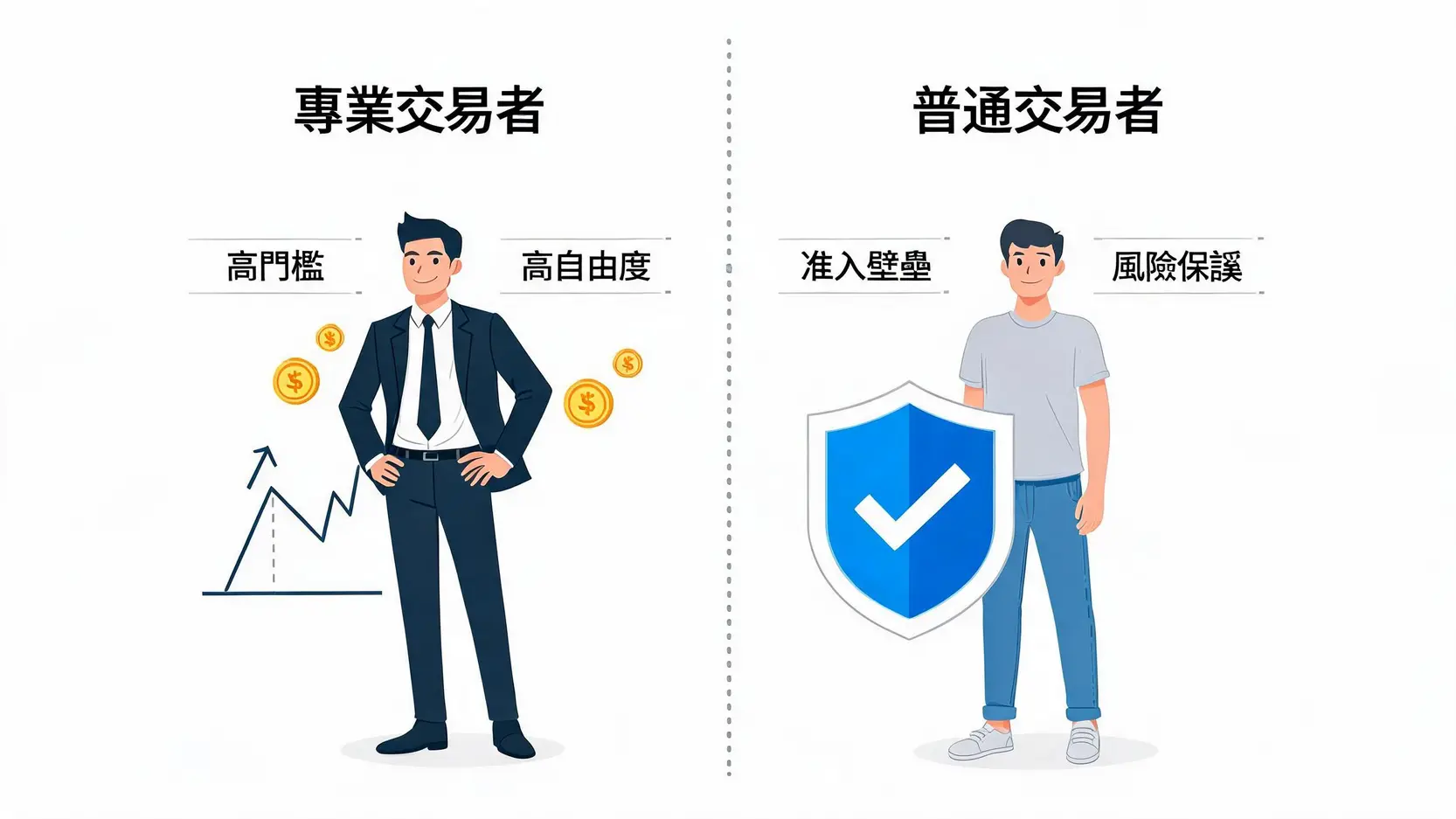
The reality of financial markets is that higher returns always come with higher risks, and the leverage embedded in derivatives magnifies those risks many times over. Accordingly, the new regulations place significant emphasis on the principle of investor suitability management, categorizing market participants as either professional traders or ordinary traders and applying differentiated access standards.
For professional traders (including large institutional investors and enterprises or individuals) meeting high-net-worth thresholds, participants must satisfy specified capital requirements, (such as minimum net asset levels) and demonstrate relevant investment experience. These participants are considered capable of identifying and bearing higher levels of risk and therefore enjoy greater flexibility in terms of available products and leverage limits.
By contrast, regulators have established much stricter entry barriers for ordinary traders. For certain highly leveraged derivatives with complex structures and difficult-to-assess risks, regulators have effectively adopted a “prohibition” approach. This differentiated framework is intended to protect market participants with lower risk tolerance and prevent isolated default events from escalating into systemic crises.

Trader Classification and Differentiated Access Standards in the Derivatives Market
Application of Suitability Requirements in Account Opening and Compliance Preparation
In practical terms, KYC (Know Your Customer) and suitability assessment procedures conducted by financial institutions will become more stringent than ever. When applying for derivatives trading accounts, corporates will no longer be able to proceed merely by having a legal representative sign a simple risk disclosure acknowledgment.
Instead, they will be required to provide a comprehensive package of supporting documentation capable of withstanding rigorous regulatory scrutiny. This requires companies to establish robust corporate hedging response strategies. To assist organizations in preparing for the new regulatory environment, the following derivatives compliance preparation checklist is recommended:
- Proof of Genuine Commercial Purpose: Detailed spot trading contracts, import and export declarations, or future procurement plans demonstrating that the scale of derivatives transactions corresponds to actual underlying exposures.
- Internal Authorization Procedures: Board resolutions or shareholder approvals specifically authorizing derivatives activities, clearly defining trading authority and maximum loss thresholds.
- Risk Management Policies and Procedures: Independent middle- and back-office monitoring systems, including Mark-to-Market valuation procedures and contingency plans for margin liquidity management.
- Qualified Personnel: Evidence that the organization employs traders and risk management professionals with relevant financial certifications or extensive market experience.
Chief Financial Officers and legal teams must work closely together to ensure that every derivatives transaction can withstand the regulator’s most fundamental question: What is the genuine commercial purpose of this transaction? Does it constitute legitimate hedging, or speculative activity disguised as hedging?
Further Reading (Highly Recommended)
Comparing Chinese and International Derivatives Regulation and Compliance for Foreign Institutions and Cross-Border Derivatives Trading
Identifying Competitive Blind Spots: Key Differences in Domestic and International Margin Systems
As global trade continues to deepen, an increasing number of multinational corporations and foreign institutions are participating in Asian markets. However, many institutions accustomed to operating under International Swaps and Derivatives Association (ISDA) standards may face significant adaptation challenges under the upcoming regulatory regime.
One of the most important differences between Chinese and international regulation lies in margin system design. In international OTC markets, counterparties can often customize margin arrangements through Credit Support Annexes (CSA), and highly rated institutions may receive partial margin exemptions. Under the new regulatory framework, however, regulators have introduced highly specific requirements governing Initial Margin (IM), Variation Margin (VM), eligible collateral types, and applicable haircut schedules in order to mitigate credit risk transmission.
This means that entities involved in foreign and cross-border derivatives trading compliance must reassess their liquidity management frameworks. During periods of extreme market stress, companies must determine whether they possess sufficient cash reserves to meet sudden Margin Calls. Otherwise, forced liquidations caused by liquidity shortages may become unavoidable.
Filing Procedures and Practical Guidance for Overseas Institutions Conducting Derivatives Business in China
For overseas institutions seeking long-term participation in China’s domestic market, operating legally and compliantly is the only viable path. The new regulations establish clear filing and reporting requirements for overseas institutions conducting derivatives business within China.
This is not merely an administrative process involving form submissions and approvals. It is a comprehensive test of an institution’s overall compliance capabilities. First, overseas institutions must demonstrate that their home jurisdictions maintain sound financial regulatory systems and have entered into cross-border regulatory cooperation arrangements with the China Securities Regulatory Commission. Second, during business operations, institutions must appoint domestic clearing agents or connect transaction data to designated trade repositories for real-time reporting.
This emphasis on transparency and licensed operations reflects a broader global regulatory trend. Much like the licensing regime governing compliant cryptocurrency exchanges in Hong Kong, proactively embracing compliance and operating transparently has become the prerequisite for earning institutional trust and attracting capital.
Preventing Cross-Border Regulatory Arbitrage: The Power of Big Data Look-Through Supervision
Big data supervision and AI-driven anomaly detection have become central tools of financial enforcement in 2026. Faced with increasingly complex and interconnected derivatives structures, regulators no longer rely on static reports submitted after the fact. Instead, they have established unified derivatives trade repositories that enable continuous, real-time, look-through supervision.
As a result, even if institutions attempt to disguise activities through multiple layers of offshore special purpose vehicles (SPVs) or use structures such as total return swaps to conceal their activities, the ultimate beneficial owners, the true source of funds, and the final destination of capital flows will remain fully visible under the scrutiny of regulatory big data systems.

Big Data Look-Through Supervision: Making the True Flow of Funds Behind Complex Derivatives Contracts Fully Transparent
This is especially true for sensitive instruments involving cross-border capital flows and foreign exchange hedging, such as NDF transactions (Non-Deliverable Forwards), which are commonly used by corporates. Regulators will rigorously scrutinize the genuine trade-related needs underlying such transactions. Preventing speculative arbitrage through derivatives as a channel for hot money flows that could undermine financial system stability is one of the core principles behind the implementation of the Administrative Measures for the Supervision and Administration of Derivatives Trading in November.
Frequently Asked Questions About the Derivatives Regulatory Measures
Q: On what date in November will the Administrative Measures for the Supervision and Administration of Derivatives Trading take effect?
A: According to the official announcement, the Measures will formally take effect on November 16, 2026. This means there is very little time left for the market to adapt. All financial institutions and corporations engaged in derivatives trading must complete a comprehensive review of their internal compliance frameworks and upgrade their operational systems before this date to ensure seamless business continuity and full regulatory compliance.
Q: How will the new Measures affect corporations using derivatives for hedging purposes?
A: The policy direction of the new regulations is very clear: to strongly encourage and support real-sector enterprises in reasonably using derivatives for hedging based on genuine business needs. At the same time, authorities will crack down heavily on activities that are “hedging in name, speculation in substance”. Before conducting transactions, companies must provide financial institutions with sufficient documentation demonstrating the underlying spot business activities and prove that the transaction size is consistent with their actual risk exposure. If a company is found to be using derivatives for speculative trading beyond its legitimate business needs, it may face significant compliance risks and severe penalties.
Q: What penalties may apply to derivatives transactions that violate the Measures?
A: Under the authority granted by the new regulations, regulators possess highly powerful enforcement tools. If institutions or individuals are found to have used derivatives to circumvent position limits, engage in insider trading, manipulate market prices, or if financial institutions fail to properly implement investor suitability requirements, penalties may range from public warnings, substantial fines, and confiscation of all illegal gains. In severe cases, regulators may suspend or revoke derivatives business licenses and pursue legal liability against senior management and other directly responsible individuals in accordance with the law.
Q: What are the most significant compliance blind spots for foreign institutions participating in China’s domestic derivatives market?
A: For foreign institutions, the greatest challenge lies in adapting quickly to China’s market-specific look-through reporting requirements and strict margin regulations. The core principle of compliance for foreign and cross-border derivatives trading is absolute business transparency. Any attempt to exploit differences between domestic and overseas regulations or accounting standards for regulatory arbitrage through complex structures may be precisely identified through interconnected regulatory big data systems, potentially triggering compliance violations.
Conclusion: Responding Effectively to the New Regulatory Landscape Created by the November Implementation of the Administrative Measures for the Supervision and Administration of Derivatives Trading
As the implementation date of the Administrative Measures for the Supervision and Administration of Derivatives Trading draws closer, the rules governing derivatives markets throughout Asia have undergone a fundamental transformation. This is far more than a document for legal or compliance departments to archive. It is a core regulatory framework that directly affects corporate cash flow security, risk exposure management, and cross-border strategic planning.
For every market participant, now is the ideal time to conduct a comprehensive review of existing derivatives contracts, optimize liquidity and risk management models, and upgrade internal trading authorization procedures. We must recognize that embracing compliance is never an obstacle to business growth. Rather, it is the anchor that ensures corporate longevity and sustainable wealth creation amid turbulent financial markets. By preparing early, positioning strategically, and implementing comprehensive response measures, market participants can transform from passive observers into proactive leaders in the new era of derivatives regulation.
Related Articles
-
In-Depth Review of Intelligent Order Flow Detection Tools: Understanding Institutional Activity and Identifying Real Market Buying and Selling Pressure What Is Order Flow, and Why Is It a “Leading Indicator” for Price Prediction? Candlestick charts and technical indicators can be misleading, but the real-money "Order Flow" within the market cannot....2026 年 6 月 4 日
-
Social Sentiment Quantitative Indicators: Mining PTT and Dcard Discussions to Predict Stock Prices What Are Social Sentiment Quantitative Indicators, and Why Are They Becoming Increasingly Important? In an era of information overload, financial markets are no longer driven solely by cold financial statements and macroeconomic data. The "Shipping King" phenomenon...2026 年 6 月 4 日
-
Avoid Fraudulent Platforms! A Visual Guide to Taiwan FSC Licensed Futures Merchant Verification and Scam Prevention In recent years, driven by heightened volatility in global financial markets and the impact of monetary easing policies worldwide, more investors have begun seeking diversified investment instruments. However, underground futures operators and overseas fraudulent...2026 年 6 月 4 日