Crude Oil Futures Guide 2026: Trends & Investing

Updated: 2026/05/13  |  CashbackIsland

crude-oil-futures-trading-guide

How to Buy Crude Oil Futures? A 2026 Beginner’s Guide to Oil Futures Investing, Understanding Oil Price Trend Analysis and Global Market Impacts

Global oil prices fluctuate sharply, not only affecting the pulse of the global economy, but also making crude oil one of the most popular markets for investors seeking profit opportunities. However, when it comes to “how to buy crude oil futures”, many people feel both curious and intimidated. Do you also want to learn how to get started with oil futures investing but do not know where to begin? This article provides the most comprehensive beginner’s guide to oil futures investing, covering everything from basic concepts and account opening procedures to in-depth oil price trend analysis, allowing you to fully understand the key knowledge behind crude oil futures trading and learn how to capture opportunities in volatile markets.


What Are Crude Oil Futures and Why Are They So Popular Among Investors?

Before discussing how to buy crude oil futures, it is essential to first understand their nature. Crude oil futures do not involve directly purchasing physical barrels of oil. Instead, they are standardized financial contracts that allow traders to buy or sell a specified quantity of crude oil at a predetermined price on a future date.


Definition of Crude Oil Futures: A Contract Predicting Future Oil Prices

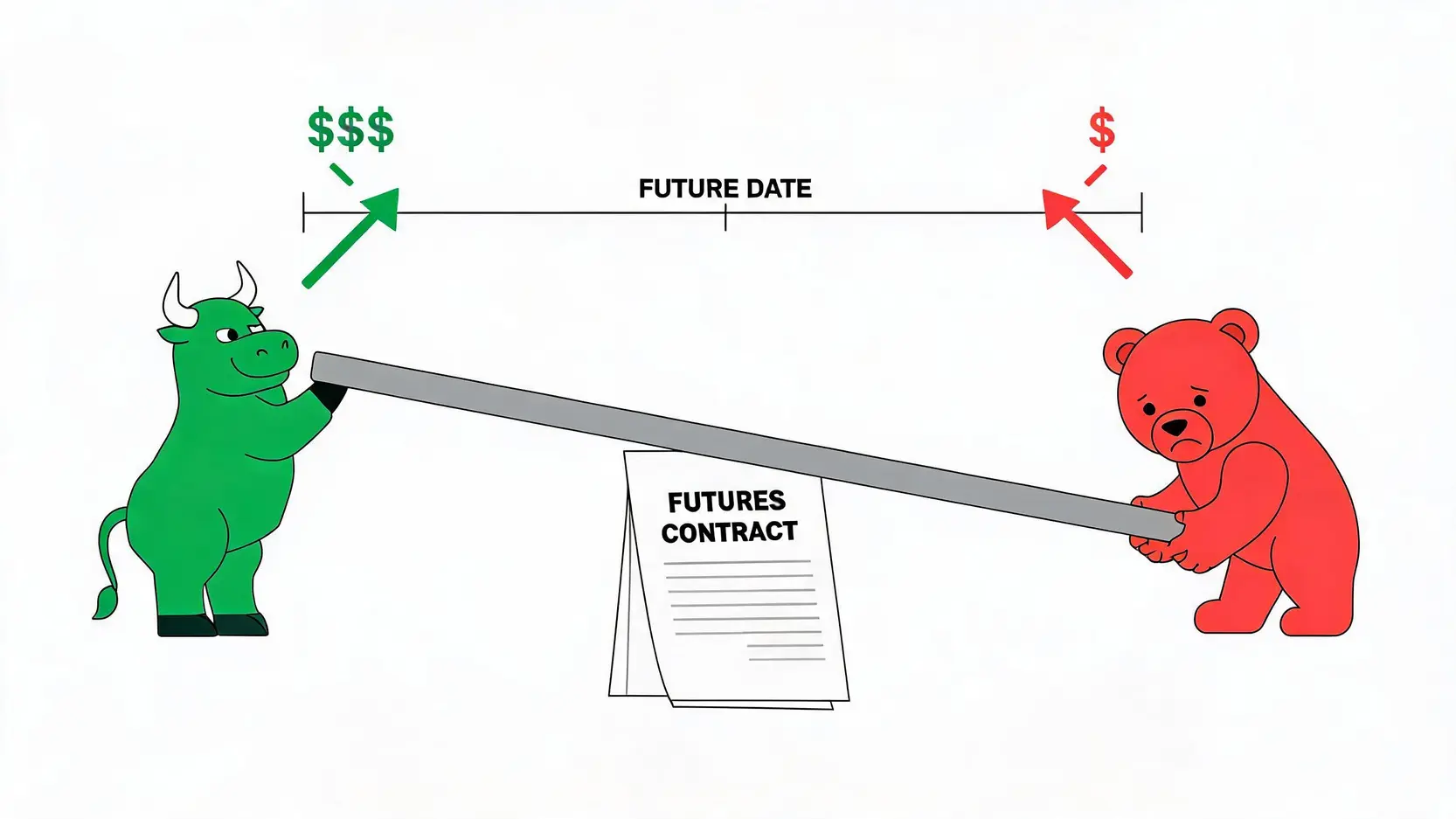
Simply put, crude oil futures are “certificates for future transactions”. Buyers (Long positions) expect oil prices to rise in the future and therefore lock in a lower purchase price in advance. Sellers (Short positions) expect oil prices to fall and seek to lock in a higher selling price. Most futures traders do not actually proceed with physical delivery. Instead, before the contract expires, they close their positions through reverse transactions (selling after buying, or buying after selling) to profit from the price difference. This makes crude oil futures a pure price speculation and hedging instrument.

原油期貨合約概念圖,顯示買家(做多)預期價格上漲,而賣家(做空)預期價格下跌。

Crude Oil Futures: A Bullish and Bearish Contract on Future Prices


The 3 Major Advantages and Potential Risks of Investing in Crude Oil Futures

Crude oil futures attract investors mainly because of the following advantages, although each advantage also comes with risks:

  • High Leverage Effect: Investors only need to deposit a portion of the total contract value as “margin” to control crude oil contracts worth tens of thousands or even hundreds of thousands of US dollars. This means potential profits can be magnified, but losses may also exceed the original invested capital.
  • Two-Way Trading Opportunities: Whether oil prices rise or fall, profit opportunities exist. If you expect prices to rise, you can “go Long” (buy). If you expect prices to fall, you can “go Short” (sell). This provides extremely high market flexibility.
  • High Market Liquidity: Crude oil is one of the most heavily traded commodities in the world. A large number of market participants ensures orders can be executed quickly, while bid-ask spreads remain relatively small.

However, high return potential always comes with high risk. Crude oil prices are highly sensitive to geopolitical events and economic data, resulting in sharp price volatility. Leverage is also a double-edged sword. If market movements go against expectations, losses can accumulate extremely quickly and may even trigger a “Margin Call”.


Beginner’s Guide: Comparing the 3 Mainstream Crude Oil Investment Tools

For beginners who want exposure to oil price movements, there are alternatives to crude oil futures that are more indirect and have lower entry barriers. Understanding their differences can help you choose the oil futures investment method best suited to your needs. 

Direct Participation: Crude Oil Futures (WTI vs. Brent) Contract Specifications and Trading Methods

Direct futures trading is the investment method most closely linked to actual oil price movements. There are two major benchmark crude oils in the market:

  • WTI (West Texas Intermediate): Primarily produced in the US and serves as the benchmark crude oil for North America. Its futures contracts are traded on the New York Mercantile Exchange (NYMEX) under the symbol CL.
  • Brent Crude: Produced in the North Sea and serves as the pricing benchmark for Europe, Africa, and the Middle East. Its futures contracts are traded on the Intercontinental Exchange (ICE) under the symbol BRN.

The prices of both benchmarks are highly correlated, although supply-demand dynamics, inventory levels, and transportation costs can create price spreads between them. Trading futures requires opening an account through a specialized futures broker and understanding contract specifications, such as each contract representing 1,000 barrels of crude oil and the minimum price fluctuation being USD 0.01.


Indirect Investment: Advantages and Disadvantages of Oil ETFs and Oil Stocks

If the leverage and risks of futures trading feel too high, you may consider the following two indirect investment methods:

  • Crude Oil ETFs (Exchange-Traded Funds): These are as convenient to trade as stocks and can be bought and sold directly through a securities account. They typically track crude oil futures prices, such as the well-known USO (United States Oil Fund). Their advantages include low capital requirements and no need to manage contract expirations. However, disadvantages include management fees and potential performance drag caused by futures rollover costs (Contango) during long-term holding periods. For more details, you may refer to ETF investment tutorials.
  • Oil Company Stocks: This involves purchasing shares of major oil companies such as Exxon Mobil (XOM) or Chevron (CVX). These companies’ share prices are positively correlated with oil prices, but they are also influenced by company operations, financial reports, and dividend policies, meaning their movements do not perfectly mirror oil prices.


Comparison Summary: Which Method Is Most Suitable for You?

To help you make a clearer decision, below is a comparison summary of the three investment tools:

Investment Tool Suitable For

Advantages

Disadvantages
Crude Oil Futures Professional Traders, Speculators Seeking High Leverage, Hedgers High Leverage, Two-Way Trading, Closely Tracks Oil Prices High Risk, High Capital Requirements, Has Expiration Dates
Crude Oil ETFs Retail Investors, Investors Who Do Not Want to Handle Futures Contracts Convenient Trading, Low Entry Barrier, Relatively Lower Risk Management Fees, Tracking Errors, Losses From Rollover Costs
Oil Stocks Value Investors, Investors Seeking Dividend Income Potential Dividend Income, Supported by Company Fundamentals Not Fully Synchronized With Oil Prices, Affected by Individual Company Risks


Oil Price Trend Analysis: Understanding the 4 Key Factors Affecting Global Oil Prices

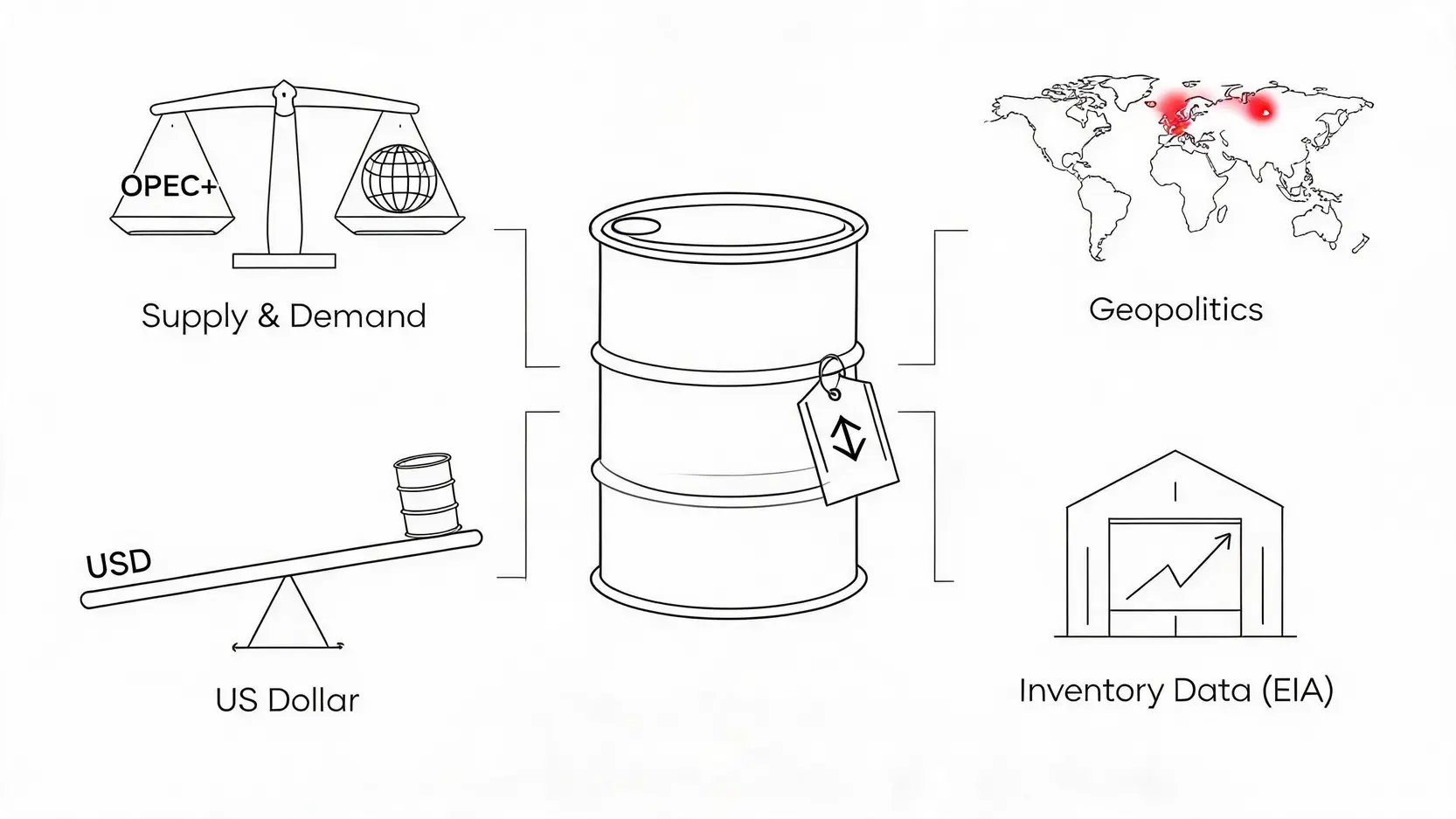
No matter which investment tool you choose, understanding the factors affecting global oil prices is the foundation of profitability. Oil price fluctuations result from the complex interaction of the global macroeconomy, but they can mainly be summarized into the following four key factors:

影響國際油價的四大關鍵因素圖解:供需關係、地緣政治、美元匯率與庫存數據。

The Four Major Driving Forces Behind Global Oil Prices


Supply and Demand: The Impact of OPEC+ Production Decisions and Global Economic Recovery

This is the most fundamental factor. On the supply side, the focus is on the “Organization of the Petroleum Exporting Countries and Allies” (OPEC+), whose production increase or cut decisions directly impact market supply. On the demand side, oil consumption is closely tied to global economic conditions. When the economy is strong, industrial and transportation fuel demand rises, pushing oil prices higher. Conversely, economic slowdowns suppress demand and drive oil prices lower.


Geopolitics: How Do Middle East Tensions and the Russia-Ukraine Conflict Affect Oil Prices?

Crude oil is a highly politicized commodity. Any developments in major oil-producing regions (such as the Middle East or Russia) including wars, political instability, or sanctions, may trigger market concerns over “supply disruptions”, causing oil prices to surge sharply within a short period. Therefore, monitoring international news is essential for crude oil traders.


US Dollar Exchange Rate: The Negative Correlation Between the US Dollar and Oil Prices

Global crude oil is mainly priced in US dollars. When the US dollar strengthens, crude oil becomes more expensive for countries using other currencies, which suppresses demand and puts pressure on oil prices. Conversely, when the US dollar weakens, oil becomes relatively cheaper, stimulating demand and supporting higher prices. Therefore, the movement of the US Dollar Index (DXY) is an important reference indicator for analyzing oil prices.


Inventory Data: Understanding the Importance of the EIA Inventory Report

The US Energy Information Administration (EIA) releases its Weekly Petroleum Status Report every Wednesday, with commercial crude oil inventory data being a major market focus. The interpretation is generally as follows:

  • Inventory Declines More Than Expected: Indicates strong demand or tight supply, which is bullish for oil prices.
  • Inventory Increases More Than Expected: Indicates weak demand or oversupply, which is bearish for oil prices.

This data often triggers sharp market volatility immediately after release, making it a key event for short-term traders.


How to Buy Crude Oil Futures? A 4-Step Practical Trading Guide

After understanding all the background knowledge, if you decide to trade crude oil futures, the following practical steps will guide you through your first crude oil futures trade.


Step 1: Choose a Reliable Futures Broker and Complete Account Opening

Choosing a broker regulated by recognized authorities (such as the US NFA or the UK FCA) is extremely important. Factors to consider include trading costs (commissions and fees), platform stability, customer service quality, and whether demo accounts are provided for practice.


Step 2: Deposit Margin and Understand the Leverage Effect

After opening your account, you need to deposit the “initial margin” required for futures trading. This amount is determined by the exchange, although brokers may require higher levels. You must clearly understand the “maintenance margin” requirement. When your account equity falls below this level, you may face “forced liquidation” risks. Always remember that leverage magnifies profits but also accelerates losses.


Step 3: Learn How to Read Futures Quotes and Understand Order Types

Futures quotes usually include the product symbol (CL), contract month, latest price, and price changes. When placing trades, you will commonly use several basic order types:

  • Market Order: Executes immediately at the best available market price.
  • Limit Order: Specifies a price, and the trade will only execute when the market reaches or improves upon that price.
  • Stop Order: Used to control losses. When the price reaches your preset stop-loss level, the order automatically converts into a market order to close the position.


Step 4: Develop Your Trading Strategy and Risk Management Plan

This is the most important step. Successful traders never place trades based purely on intuition. Your strategy may be based on technical analysis (such as trendlines, moving averages, or RSI indicators) or on fundamental analysis (by monitoring OPEC meetings and EIA data releases). More importantly, you must establish a strict investment risk management plan, such as:

  • Set Stop-Loss Levels: Before entering every trade, determine the maximum loss you are willing to accept if your analysis is wrong.
  • Control Position Sizes: Do not allocate all your capital to a single trade. Ideally, losses from any one trade should remain within 1-2% of total capital.
  • Remain Rational: Avoid emotional revenge trading or increasing positions after losses. Always follow your trading discipline.


Crude Oil Futures FAQ

Q: How much capital is needed to trade crude oil futures?

A: The required capital depends on the “initial margin” set by the exchange. Using WTI crude oil futures as an example, the margin requirement for one standard contract (1,000 barrels) is typically between several thousand and USD 10,000, and it will be adjusted according to market volatility. In addition, there are also smaller “Mini” or “Micro” crude oil futures contracts with lower margin requirements, making them more suitable for beginners with limited capital.

Q: What is the difference between New York crude oil futures (WTI) and Brent crude oil futures?

A: The main differences lie in production origin, pricing benchmarks, and delivery locations. WTI serves as the North American benchmark and is lighter and sweeter in quality, making it more suitable for gasoline refining. Brent is the pricing benchmark for more than two-thirds of global crude oil supplies and is slightly heavier in quality. Although their prices are highly correlated, geopolitical events or regional supply-demand imbalances may widen the price spread between the two, creating arbitrage trading opportunities.

Q: What should I do when a crude oil futures contract expires?

A: As a speculator, you must close your position before the “First Notice Day” or the “Last Trading Day”. Otherwise, you may theoretically be required to take physical delivery of 1,000 barrels of crude oil, which would result in substantial storage and transportation costs. If you wish to continue holding your position, you need to “Rollover” before expiration by closing the expiring contract while simultaneously opening a new contract for the following month.

Q: What is the future rollover?

A: Rollover refers to closing a futures contract that is about to expire while simultaneously opening a new contract for the next month in order to maintain the original Long or Short position. This process incurs trading costs, and the price spread between different contract months (whether Contango or Backwardation) will affect the holding cost after rollover.

Q: How high is the leverage for crude oil futures trading?

A: The leverage ratio is not fixed. It depends on the ratio between the “total contract value” and the “initial margin”. For example, if oil prices are USD 80 per barrel, one contract would have a total value of 80 × 1,000 = USD 80,000. If the exchange requires an initial margin of USD 8,000, then the leverage used would be 10 times. Leverage fluctuates based on oil prices and changes in margin requirements.


Conclusion

In summary, understanding how to buy crude oil futures is not only about learning how a financial product works, but also about developing a comprehensive understanding of the factors affecting global oil prices and the macroeconomy. From comparing basic oil futures investment tools to conducting in-depth oil price trend analysis, this article aims to help you build a solid knowledge framework. Always remember that all investments involve risk, especially highly leveraged futures trading. Before committing real capital, make sure to practice extensively through a demo account and always prioritize risk management. This is the essential principle for navigating the highly volatile oil market steadily.

If you liked this article, please share it!

Related Articles

  • Stock Pledge Guide: Process, Risks & Maintenance Ratio
    Unable to Borrow Money Through Stock Pledge Loans? Uncovering Brokerage Funding Shortages and the FSC’s Deleveraging Policy When you urgently need funds or want to add to your positions, but do not want to sell your high-quality holdings, what should you do? “Stock pledge” is the secret weapon that helps...
    2026 年 7 月 9 日
  • What Is Stock Lending? Beginner’s Guide & Strategies
    What Is Stock Lending? A Guide to Earning Interest on Idle Stocks, Asset Activation Strategies Every Dividend Investor Should Learn, and a Full Breakdown of Brokerage Settings Are the stocks in your hands stuck in long-term losses, or are you holding quality stocks that you are reluctant to sell? Instead...
    2026 年 7 月 9 日
  • 2026 Bond Yield Guide: Treasuries, ETFs & Yield Curve
    2026 Bond Yield Full Guide: US Treasury Trends, Inversion Analysis, and Bond ETF Allocation In the vast ocean of the investment market, whether you prefer the dramatic waves of the stock market or the steady reliability of fixed income, there is one core indicator that no market participant can ignore,...
    2026 年 7 月 9 日
返回顶部