Bull vs Bear Market: Definition, Traits & Strategies

Complete Analysis of Bull and Bear Markets: Understanding the Definition of a Bull Market, Characteristics of a Bear Market, and Optimal Investment Strategies
You often hear news reports or investment articles mention “bull market” and “bear market”, but do you truly understand their meanings? Many beginner and even experienced investors often miss opportunities due to misjudging market trends or suffer significant losses when the market reverses. Truly understanding the definition of a bull market and the characteristics of a bear market is the first step in formulating successful bear market investment strategies. This article will explain in the simplest way the definitions and origins of bull and bear markets, as well as the optimal strategies for different market conditions, helping you grasp market trends easily and avoid blindly chasing price movements.
What Are Bull and Bear Markets? Definitions, Characteristics, and English Terms at a Glance
In financial markets, “bull” and “bear” symbolize two completely opposite market trends. Simply put, a bull market represents rising markets, while a bear market represents falling markets. These terms are not only applicable to the stock market but can also describe bonds, cryptocurrencies, real estate, or any asset market with price fluctuations.
Bull Market Definition: 3 Key Signals of a Continuously Rising Market
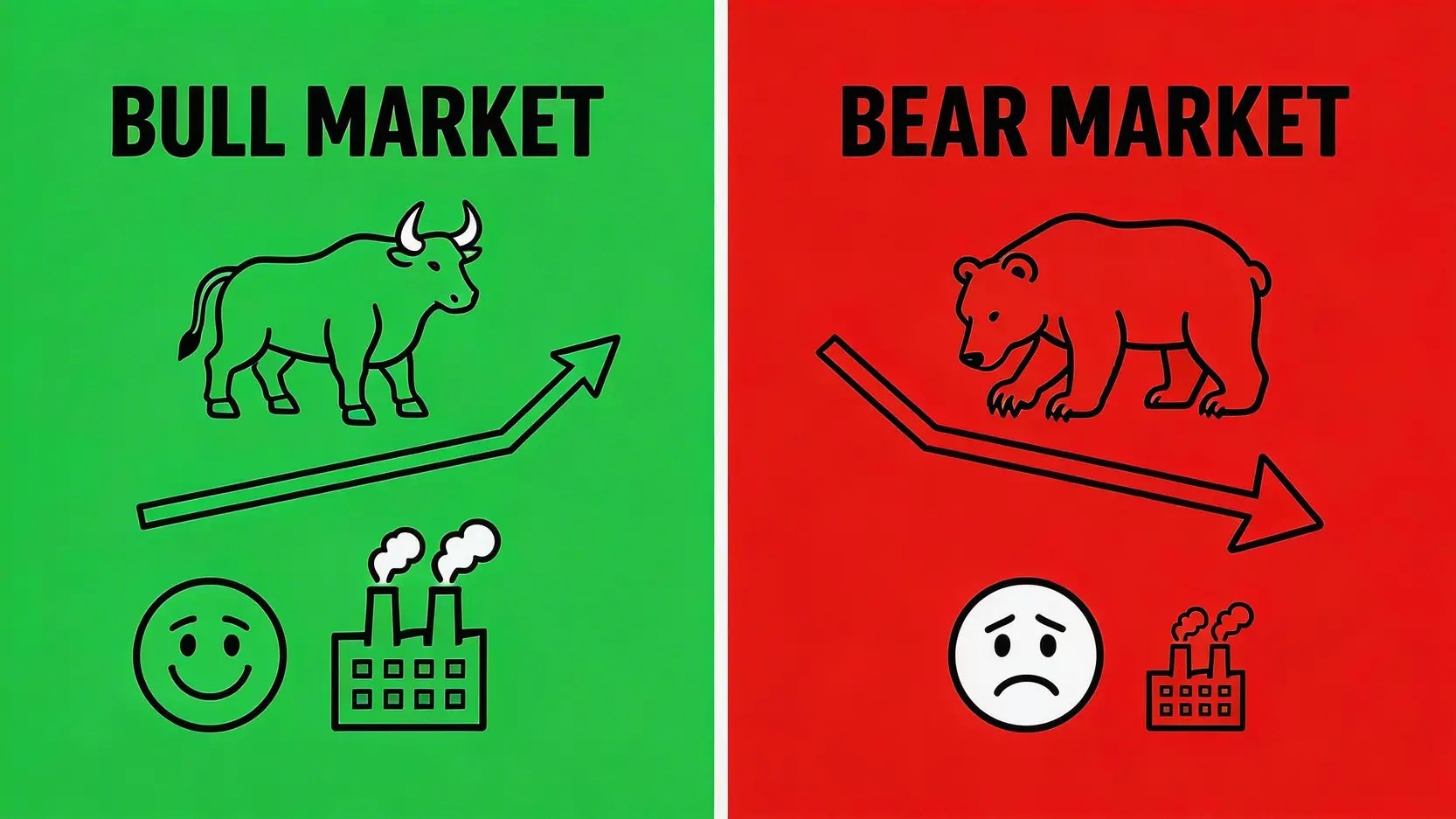
The English term for a bull market is Bull Market. The common bull market definition is when a major market index (such as the US S&P 500) rises more than 20% from its recent low, and the market broadly expects the upward trend to continue. During a bull market, overall market sentiment is optimistic, investor confidence is high, and participants are willing to invest more capital. Bull markets are usually accompanied by the following clear signals:
- Strong Economic Fundamentals: National GDP growth is stable, unemployment is low, and corporate profits continue to increase. A strong economy provides a solid foundation for rising stock prices.
- Surging Investor Confidence: Market sentiment is generally optimistic, and both retail and institutional investors actively buy assets, believing prices will keep rising. “Buy and Hold” becomes the mainstream strategy.
- Abundant Liquidity: Central banks may adopt lower interest rate policies (monetary easing), reducing borrowing costs. More hot money chases high-return assets, further driving up stock prices.
Bear Market Definition: 3 Key Warnings of a Continuously Falling Market
The English term for a bear market is Bear Market. In contrast to a bull market, a bear market is defined as when a market index falls more than 20% from its recent high, with pessimism prevailing. Investor confidence is fragile, panic selling occurs frequently, driving prices further down in a vicious cycle. Before a bear market arrives, the following warnings usually appear:
- Signs of Economic Recession: GDP growth slows or turns negative, inflation is high, and unemployment rises. Uncertain economic outlooks lead to declining corporate profit expectations.
- Pervasive Market Fear: Investors increase risk aversion, withdrawing funds from higher-risk assets like stocks and seeking safe-haven assets such as gold or government bonds.
- Disappointing Corporate Earnings: Many listed companies report revenues and profits below expectations or issue profit warnings, directly affecting their stock prices and dragging down the entire market.

Bull Market vs. Bear Market: Key Differences at a Glance
Further Reading (Highly Recommended)
How to Position Yourself in Bull and Bear Markets? Key Indicators and Beginner Investment Strategies
After understanding the meaning of bull and bear markets, it is even more important to learn how to judge which phase the market may be in and adopt corresponding investment strategies. While no indicator can predict the market with 100% accuracy, observing key indicators can greatly improve your judgment.
Learn to Read 2 Key Indicators and Master Timing for Buying and Selling
To identify transitions between bull and bear markets, in addition to the 20% rise or fall definition, investors can refer to the following two types of indicators:
- Technical Analysis Indicators:
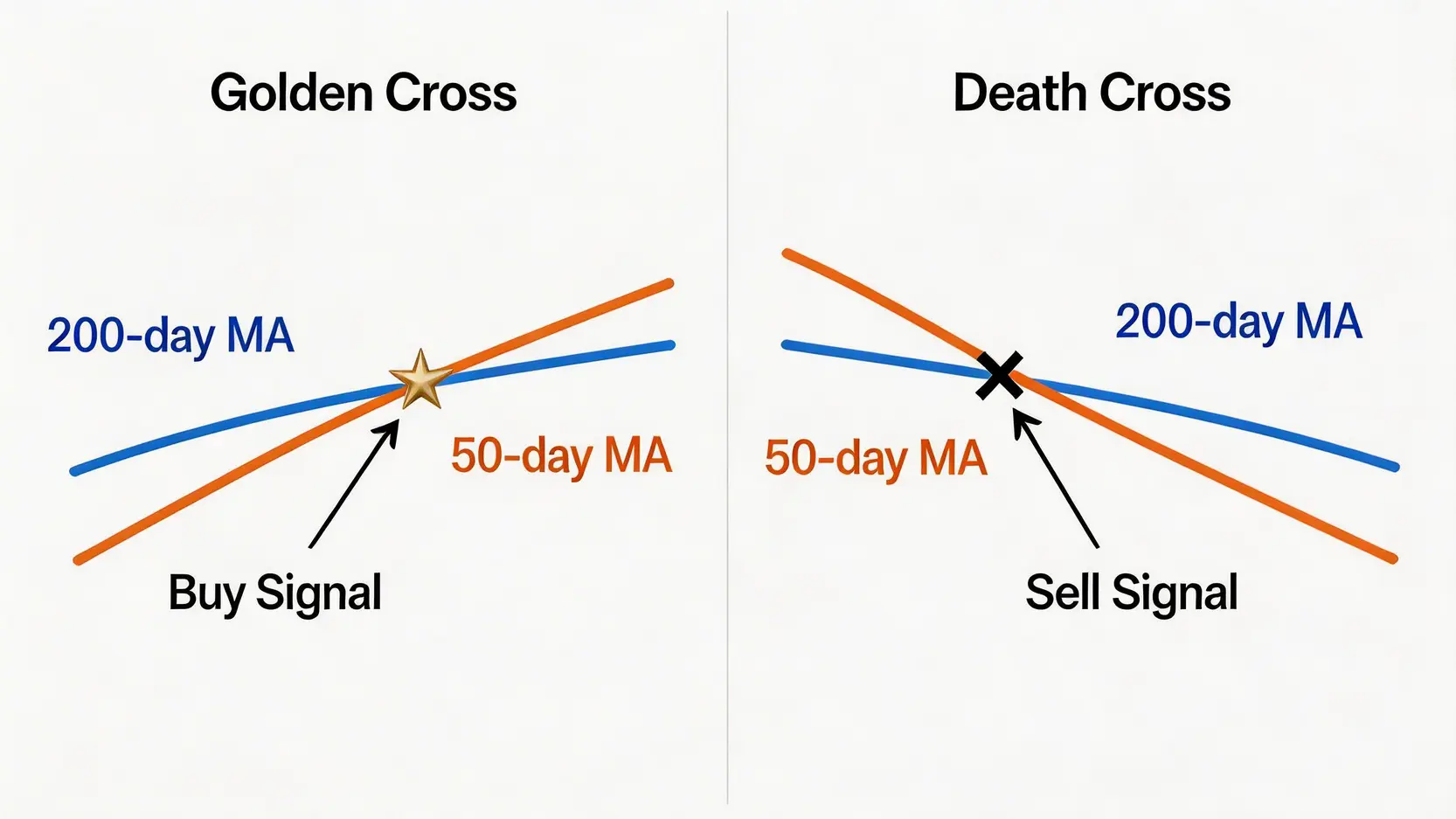
This method predicts future trends by analyzing past price and volume data. Common indicators include:- Moving Average (MA): For example, when a short-term moving average (such as the 50-day line) crosses above a long-term moving average (such as the 200-day line), it is called a “golden cross”, a potential bull market signal. Conversely, when the 50-day line falls below the 200-day line, it is a “death cross”, a potential bear market warning.
-

- Illustration of Technical Analysis: Golden Cross vs. Death Cross
- Relative Strength Index (RSI): This indicator measures the strength of price momentum. An RSI above 70 is generally considered “overbought”, indicating a potential market pullback; below 30 is “oversold”, suggesting a possible rebound.
- Market Sentiment Indicators:
These indicators reflect overall market fear and greed.- VIX Index (Volatility Index): Also called the “Fear Index”. When the VIX spikes, it indicates that the market expects significant future volatility and panic is high, usually coinciding with a bear market. Conversely, a low VIX indicates market calm, commonly seen in bull markets.
Investment Strategy Differences Between Bull and Bear Markets
Different market phases require completely different strategies. Knowing how to follow the trend is essential for long-term survival in the investment market.
Market Phases Core Strategies Asset Allocation Recommendations Bull Market Follow the Trend to Maximize Returns - Increase Holdings in Growth Stocks: Sectors such as technology and consumer discretionary typically perform well.
- Index ETFs: Investing in ETFs that track major indices is the simplest way to participate in bull market gains.
- Maintain Full Positions or Moderate Leverage: Actively engage in the market to avoid missing upward opportunities.
Bear Market Defend and Counterattack, Prioritize Capital Preservation - Increase Defensive Assets: Stocks in utilities, consumer staples, and healthcare sectors tend to be more resilient.
- Raise Cash Ratio: Keep sufficient cash on hand to wait for better buying opportunities.
- Allocate to Safe-Haven Assets: Assets such as gold and government bonds generally perform better during bear markets.
- Buy in Batches / Dollar-Cost Averaging: Accumulate quality assets at low prices through bottom-fishing or regular investment strategies.
Further Reading (Highly Recommended)
Common Questions About Bull and Bear Markets (FAQ)
Q: How long do bull or bear markets usually last?
A: There is no fixed answer, but historical data shows that bull markets generally last much longer than bear markets. Since World War II, the US S&P 500 index’s bull markets have averaged around 5–6 years, while bear markets have averaged only about 1–2 years. Each bull-bear cycle is unique, so past data should be used only as a reference.
Q: What is the interesting origin of the terms “bull” and “bear”?
A: The most widely accepted explanation is based on the way these animals attack. Bulls thrust their horns upward, symbolizing rising market prices, while bears swipe their paws downward, symbolizing falling prices. Another historical origin traces back to 18th-century London “bear-skin jobbers”, who sold bear skins they did not yet own (similar to modern “short selling”) and hoped to repurchase them at a lower price to earn a profit. Hence, “Bear” became associated with a declining market.
Q: How should investment portfolios be adjusted during a bear market?
A: The core goal in a bear market is “capital preservation”. The first step is to review and reduce portfolio risk, potentially increasing allocations to cash, short-term government bonds, and safe-haven assets like gold. At the same time, reduce holdings in growth stocks bought at high prices, with weak fundamentals, or overvalued. Conservative investors can focus on defensive stocks with stable cash flow and high dividends, such as utilities or consumer staples companies.
Q: Are there signs that a bull market is ending?
A: The late stages of a bull market usually show warning signals. For example: market sentiment becomes extremely euphoric, even casual observers discuss stocks; many companies with weak fundamentals see their prices inflated; overall market valuations (such as P/E ratios) far exceed historical averages; and central banks begin frequent and large interest rate hikes to combat inflation. When these signals appear simultaneously, caution is warranted.
Conclusion
In summary, deeply understanding the meaning of bull and bear markets and the economic logic behind them is fundamental for any mature investor. Market bull-bear cycles are an unavoidable natural phenomenon. Rather than trying to predict exact market highs or lows, it is better to recognize the characteristics of each phase and formulate appropriate strategies. Whether the market is in a booming bull market or a fearful bear market, mastering the correct bull market definitions and response plans allows investors to remain calm, navigate market fluctuations steadily, and ultimately achieve long-term wealth growth.
- Illustration of Technical Analysis: Golden Cross vs. Death Cross
Related Articles
-
How to Get Started with Bitcoin? The Complete 2026 Bitcoin Buying Guide for Beginners After watching Bitcoin repeatedly reach new highs in recent years and successfully pass spot ETF reviews in the US and Hong Kong in 2024, officially entering mainstream financial markets, many investors have turned their attention to...2026 年 7 月 20 日
-
Is Gold’s V-Shaped Rebound a Bottom-Fishing Signal? A Complete Guide to Trading Strategies Amid “$100 Price Swings” What Is a Gold V-Shaped Rebound? More Than Just a Technical Pattern The gold market has recently experienced sharp rises and falls, with prices frequently displaying dramatic “gold V-shaped rebounds”. Single-day “$100 price...2026 年 7 月 20 日
-
What Is PPI Data? 2026 Latest Analysis: Understand the Differences from CPI and How It Affects Stock Market Trends With market information constantly changing, do you always hold your breath while waiting for CPI data to be released? But did you know that a more forward-looking inflation indicator, PPI data...2026 年 7 月 20 日