Bear Market Investing: 5 Bottom-Fishing Strategies

Bear Market Investment Strategy: What Should You Buy in a Bear Market? 5 Bottom-Fishing Strategies and a Complete Guide to Monthly Stock Investing
Watching the market continue to decline while the value of your portfolio keeps shrinking can understandably make you feel anxious. In reality, however, a bear market is not the end of the world. Instead, it is a golden opportunity for long-term investors to position themselves for wealth growth. This article will provide you with a complete bear market investment strategy, from clarifying what to buy in a bear market, to analyzing the pros and cons of monthly stock investing, and sharing practical bottom-fishing strategies to help you turn crisis into opportunity, accumulate high-quality assets during market lows, and prepare for the next bull market.
What Exactly Is a Bear Market? First, Recognize the Enemy
Before discussing any bear market investment strategy, it is essential to clearly understand what a bear market is. Knowing yourself and your opponent ensures victory in every battle.
Definition of a Bear Market: How Much of a Decline Counts?
In financial markets, a bear market is generally defined as when a major market index (such as the S&P 500 Index in the US or the Hang Seng Index in Hong Kong) falls more than 20% from its recent peak. This decline does not occur overnight and usually lasts for a period of time, ranging from several months to potentially more than a year. In contrast, a bull market refers to a period when the market continues to rise.
The Three Stages of a Bear Market: Understanding Where You Are
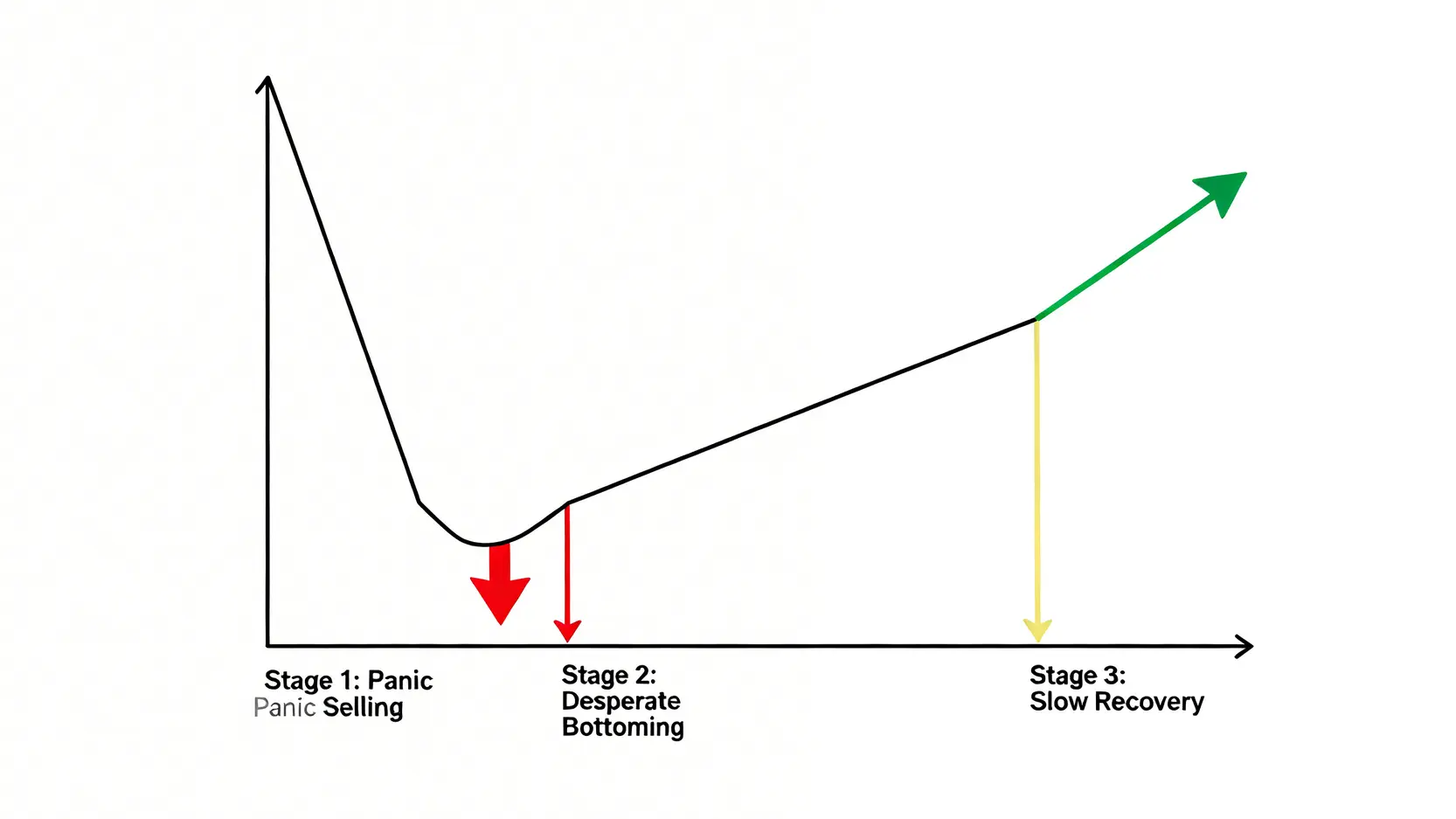
The development of a bear market is not a straight line. It usually goes through different stages, and understanding which stage you are currently in can help you adjust your bottom-fishing strategies and mindset:
- Stage One: Panic Selling Phase
Market sentiment shifts sharply from optimism to pessimism. Investors panic and sell assets due to various negative factors (such as economic recession concerns or interest rate hike expectations) causing stock prices to plunge rapidly. During this stage, trading volume is high and volatility is extremely elevated. - Stage Two: Despair and Bottom Formation Phase
After a sharp decline, the downward momentum begins to slow. Market trading volume shrinks, and investor sentiment becomes broadly pessimistic, with many even losing interest in the market. During this period, stock prices tend to fluctuate repeatedly at low levels and appear lifeless, but this is often when value investors begin gradually accumulating positions.
- Stage Three: Gradual Recovery Phase
When economic data shows early signs of improvement, or when the market has absorbed all negative news, some forward-looking capital begins to flow back into the market. Stock prices slowly recover, market confidence gradually returns, and the foundation is laid for the arrival of the next bull market.

What Should You Buy in a Bear Market? Four Asset Allocation Suggestions
When facing a bear market, the most critical question is: “What should you buy in a bear market?” Proper asset allocation is the key to navigating a bear market safely. The following four types of assets are worth considering to help you build a well-balanced investment portfolio that combines both offense and defense.
Defensive Choice: High-Dividend Stocks and the Consumer Staples Sector
During economic downturns, people still need to pay for utilities such as water, electricity, and gas, and continue purchasing food and medicine. As a result, companies in sectors such as utilities, consumer staples, and healthcare tend to have relatively stable earnings and are less affected by economic cycles. Leading companies in these sectors often distribute stable dividends and are commonly referred to as “high-dividend stocks” or “income stocks”. In a bear market, these dividends can provide investors with steady cash flow and help cushion the impact of asset declines.
Steady Growth: High-Quality Index ETFs (Such as VOO, QQQ)
For investors who do not want to spend time researching individual stocks, exchange-traded funds (ETFs) are an excellent choice. During a bear market, you can gradually buy ETFs that track the broader market, such as:
- VOO (Vanguard S&P 500 ETF): Tracks the US S&P 500 Index, allowing you to invest in 500 of the most representative large companies in the US with a single investment.
- QQQ (Invesco QQQ Trust): Tracks the Nasdaq 100 Index, mainly concentrated in technology giants, with higher volatility but also greater potential returns.
By investing in ETFs, you can achieve diversified investment at a relatively low cost, effectively reducing the risk of a single company experiencing a “major negative event”. If you want to learn more about ETFs, you can refer to this VIX ETF investment guide and comprehensive risk analysis.
Safe-Haven Assets: The Role of Bonds and Gold
Traditionally, government bonds (especially US Treasury bonds) and gold are considered safe havens during periods of market turbulence. This is because they have a relatively low correlation with the stock market. When the stock market falls sharply, capital tends to flow into these safe-haven assets, helping their prices remain stable or even rise. In a bear market investment strategy, allocating a certain proportion of bonds or gold ETFs can effectively reduce the overall volatility of your investment portfolio.
Core Strategy: Is Monthly Stock Investing in a Bear Market the Winning Formula?
In a bear market, many people stop investing out of fear. However, history has shown that monthly stock investing during a bear market is often the key strategy that allows long-term investors to ultimately come out ahead. Behind this approach lies a powerful investment method known as dollar-cost averaging.
The Power of Dollar-Cost Averaging (DCA): Averaging Costs and Diversifying Risk
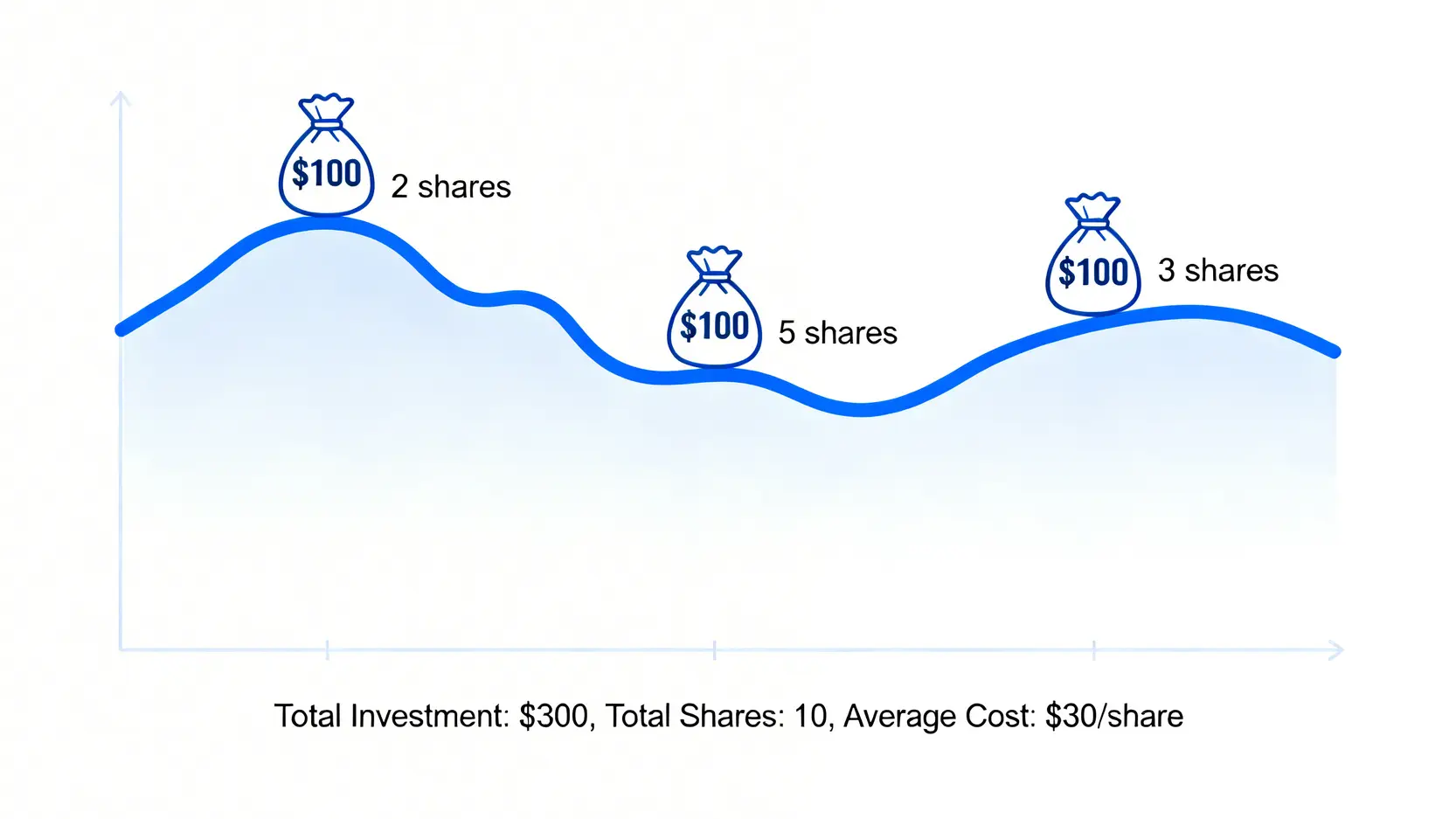
Dollar-Cost Averaging (DCA) refers to regular fixed-amount investing. Regardless of market conditions, you invest a fixed amount at a fixed time (such as on the first day of every month). This approach has two major advantages:
- Automatically “sell high and buy low”: When stock prices are high, your fixed amount can only buy fewer shares; when prices are low, the same amount of money can buy more shares. Over time, your average holding cost will be effectively reduced.
- Overcoming human weaknesses: DCA is a mechanical investment discipline that helps you overcome the fear and greed of “chasing highs and selling lows”, allowing you to stay invested when others are fearful.

How to Choose Stocks or ETFs Suitable for Monthly Investing?
When executing a monthly stock investing strategy during a bear market, selecting the right assets is crucial. Ideal candidates for monthly investing should have the following characteristics:
- Long-term growth potential: Choose industry leaders or major market ETFs that you believe have strong future prospects and durable competitive advantages.
- Sufficient liquidity: Ensure that the selected stocks or ETFs have adequate trading volume to avoid difficulties in buying or selling.
- Solid fundamentals: For individual stocks, choose companies with strong financial health and solid profitability.
In general, large index ETFs (such as VOO and QQQ), as well as industry-leading stocks (such as Apple and Microsoft) are very suitable for implementing the dollar-cost averaging strategy.
Advanced Positioning: 5 Bear Market Bottom-Fishing Strategies and Mindsets
For investors with a higher risk tolerance who wish to position more aggressively during a bear market, “bottom fishing” is an extremely tempting concept. However, successful bottom fishing requires skill, discipline, and strong psychological resilience. The following are five practical bottom-fishing strategies for bear markets.
Strategy One: Never Try to Buy at the Absolute Bottom
“Bottom fishing” does not mean buying at the absolute lowest point of the market, which is an almost impossible task. Setting the goal of buying within a “relatively low value zone” leads to a healthier mindset and more rational decision-making.
Strategy Two: Buy in Stages and Build a Capital Pool
Never go “all-in”. A smart bear market investment strategy is to divide your bottom-fishing capital into three to five portions. Invest the first portion when the market falls 20% from its peak, the second portion when it falls 30%, and so on. This staged buying approach effectively diversifies risk and prevents you from exhausting all your capital too early.
Strategy Three: Refer to Key Technical Indicators (Such as RSI and Moving Averages)
Technical indicators are not infallible, but they can serve as useful references. For example:
- Relative Strength Index (RSI): When the RSI falls below 30, it is usually regarded as the market entering an “oversold” zone, which may signal a potential short-term rebound.
- Moving Average: Observe the degree of deviation between the stock price and the 200-day moving average (annual line). When the stock price is far below the annual line, it may indicate that the asset is undervalued.
Strategy Four: Only Buy High-Quality Companies You Understand
A famous quote from Warren Buffett says, “Be greedy when others are fearful.” This greed should only apply to high-quality companies that you have thoroughly researched, understand their business models, and have confidence in their long-term development. A bear market exposes many companies with uneven quality, so avoid bottom fishing in “junk stocks” with weak fundamentals.
Strategy Five: Stay Patient and Overcome Fear
A bear market tests investors’ patience the most. After buying, stock prices may continue to fall, and the paper losses in your portfolio may expand. At this stage, you must overcome fear and trust your research and long-term investment positioning. Remember, a bear market is a process of accumulating high-quality assets, not a gamble for immediate returns.
Further Reading (Highly Recommended)
Frequently Asked Questions About Bear Market Investment Strategies
Q: How Long Does a Bear Market Usually Last?
A: According to historical data, there is no fixed duration for a bear market. Since World War II, bear markets experienced by the US S&P 500 Index have lasted an average of about 12 to 18 months. However, the causes and macroeconomic conditions of each bear market are different, so historical data can only serve as a reference and should not be taken as a definitive rule.
Q: “Cash Is King”: Should You Hold Cash or Enter the Market During a Bear Market?
A: The two are not contradictory. In the early stage of a bear market, “cash is king” is a correct approach. Keeping sufficient cash can help you avoid significant asset declines and provide ammunition to enter the market at lower levels. However, holding only cash may also cause you to miss market rebounds. The best strategy is to “hold cash while entering the market in stages”, gradually converting cash into high-quality assets as the market declines through different phases.
Q: How Should Beginner Investors Start in a Bear Market?
A: For beginners, the most prudent bear market investment strategy is to start with “monthly stock investing”. Choose one or two large index ETFs (such as VOO) and invest a small amount each month. This helps you develop investment discipline, experience market volatility, and accumulate assets with relatively low risk. You can refer to the ultimate beginner’s guide to investing to learn more fundamental knowledge.
Q: What Should You Do If Bottom Fishing in a Bear Market Fails?
A: First, you must define what constitutes “failure”. If the stock price continues to fall after you buy but you invested in high-quality assets, this is only a short-term paper loss. As long as the company’s fundamentals remain unchanged, you can continue holding or buying in stages, and when the market recovers, you may break even or even make a profit. However, if you bottom-fished a company with deteriorating fundamentals, you should cut losses decisively and reassess your investment portfolio.
Q: What Is the Difference Between a Bull Market and a Bear Market?
A: Simply put, a bull market refers to a period when the market continues to rise, investor sentiment is optimistic, and the economy is generally performing well. A bear market refers to a period when the market declines by more than 20%, investor sentiment turns pessimistic, and the economy faces the risk of recession. Making money is relatively easier in a bull market, but the risk lies in buying at high levels. A bear market is more challenging, but it also provides long-term investors with the opportunity to buy high-quality assets at lower prices.
Conclusion
In summary, the core of a successful bear market investment strategy lies in maintaining a calm mindset, adhering to long-term thinking, and making good use of tools such as monthly stock investing (dollar-cost averaging) to continuously accumulate high-quality assets when the market is depressed. Bottom fishing is not necessary, but if executed, it must be accompanied by strict capital management and the discipline of buying only high-quality stocks. A bear market is both a challenge and an opportunity. It is hoped that this guide will help you remain steady during a bear market and fully prepare for wealth growth in the next bull market.
Related Articles
-
Practical Applications of Volatility Surfaces: From Options Modeling to Advanced Skew Trading Strategies In options markets, implied volatility is never a flat line. Instead, it forms complex "smile" or "skew" surfaces. For advanced traders, mastering the practical applications of volatility surfaces is equivalent to possessing a lens that reveals market...2026 年 6 月 3 日
-
Building a Foreign Capital Flow Copy Trading Model: A Stock Market Indicator for Accurately Tracking Institutional Positioning In Asia-Pacific stock markets, foreign capital inflows and outflows often determine the direction of the index. However, simply looking at daily net buy and sell data is no longer enough. Only by building...2026 年 6 月 3 日
-
Options Buyer Strategies During Extreme Market Conditions: Black Swan Hedging and Cross-Market Arbitrage During Volatility Surges The most terrifying aspect of financial markets is not a gradual decline, but overnight flash crashes and cross-market capital withdrawals accompanied by volatility surges. In the highly unpredictable global macroeconomic environment of 2026, geopolitical...2026 年 6 月 3 日