Ripple & XRP Ledger Guide: 3-Second Transactions

Ripple Technology Guide: The Secret Behind 3-Second Transactions, Complete Analysis of the XRP Ledger Operating Principles and Consensus Mechanism
Why are traditional international remittances always slow and expensive? While Bitcoin is still waiting for block confirmations, another blockchain technology has already completed thousands of transactions. This is precisely where Ripple blockchain technology stands out. This article explores the core of Ripple (XRP) technology, provides a detailed explanation of the XRP Ledger operating principles, and reveals the key behind its high efficiency and low cost, the unique Ripple consensus mechanism, allowing you to understand how it challenges and reshapes the global payment system.
What Is Ripple (XRP) Blockchain Technology?
The blockchain technology of Ripple (XRP), commonly known as the XRP Ledger (XRPL), is an open-source, decentralized public blockchain designed for speed, efficiency, and scalability. It is not merely a cryptocurrency but a comprehensive solution aimed at transforming the global payment system, particularly in the area of settlement and clearing between financial institutions. Its original purpose was to address delays and high costs in the traditional financial system, especially in cross-border payments.
Not Just a Cryptocurrency: A Payment Protocol Designed for Financial Institutions
Unlike Bitcoin, which is often regarded as “digital gold”, or Ethereum, which functions as a “smart contract platform”, Ripple (XRP) and its underlying technology were designed from the beginning with a specific goal: optimizing the payment processes of global financial institutions. Traditional correspondent banking systems for cross-border remittances usually involve multiple intermediaries, taking several days and incurring high costs. Ripple technology aims to provide an instant, reliable, and extremely low-cost alternative, enabling banks and other financial service providers to transfer value at near-instant speed. This is why many people view it as a bridge connecting traditional finance and the world of digital assets.
RippleNet vs. XRP Ledger: What Is the Relationship and Difference?
This is a common point of confusion, and clearly distinguishing the two is essential:
- XRP Ledger (XRPL): This is the underlying blockchain technology. It is an open-source, decentralized public ledger maintained collectively by the community, and XRP is the native digital asset on this ledger. Anyone can develop and transact based on XRPL.
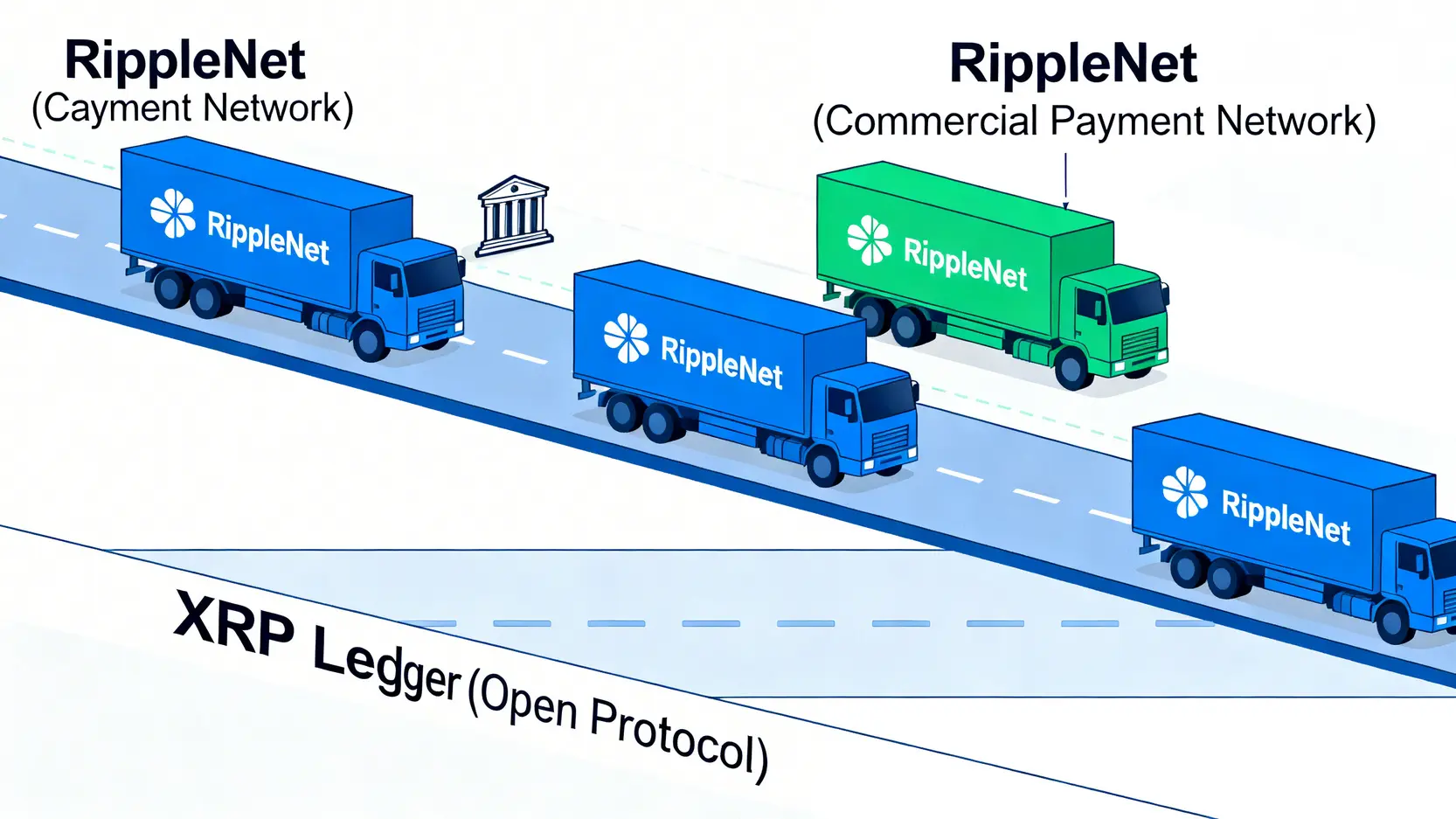
- RippleNet: This is a global payment network developed and operated by Ripple Labs, Inc., (a private company). Financial institutions (such as banks) can join RippleNet and use its software to process cross-border payments. RippleNet can use XRP as a “bridge currency” to provide liquidity, but not all RippleNet transactions are required to use XRP.
Simply put, XRPL is the highway, while RippleNet is a specific fleet of branded vehicles traveling on that highway. The highway is open, while the fleet is a commercial service.

What Are the Fundamental Differences Compared With Bitcoin and Ethereum?
Ripple technology differs fundamentally from Bitcoin and Ethereum in both core design philosophy and operational model:
| Characteristic | Ripple (XRP Ledger) | Bitcoin | Ethereum |
| Consensus Mechanism | Ripple Protocol Consensus Algorithm (RPCA) | Proof of Work (PoW) | Proof of Stake (PoS) |
| Transaction Speed | 3-5 Seconds | Approximately 10-60 Minutes | Approximately 12-15 Seconds (Layer 2 Solutions Are Faster) |
| Transaction Cost | Extremely Low (Approximately $0.0002) | Relatively High, Highly Volatile | Moderate, Depending on Network Congestion |
| Mining Requirement | No Mining Required | Requires Large Amounts of Computational Power for Mining | No Mining Required, but ETH Staking Is Needed |
| Primary Use Case | Payments, Cross-Border Settlement | Store of Value, Peer-to-Peer Payments | Smart Contracts, Decentralized Applications (DApps) |
These fundamental differences give Ripple a unique advantage in specific application scenarios, (particularly in financial payments). It has therefore become a blockchain-based cross-border payment solution focused on addressing real pain points within the financial industry.
Further Reading (Highly Recommended)
What Are Decentralized Exchanges, Gas Fees, and CoinMarketCap? A Complete Beginner Guide!
In-Depth Analysis: The Core Operating Principles of the XRP Ledger (XRPL)
To understand why Ripple can achieve such high transaction efficiency, it is necessary to examine its core infrastructure, the XRP Ledger (XRPL). Unlike traditional blockchains that rely on energy-intensive mining, XRPL adopts a lighter and faster consensus mechanism.
A Decentralized Ledger: How Transactions Are Recorded and Verified
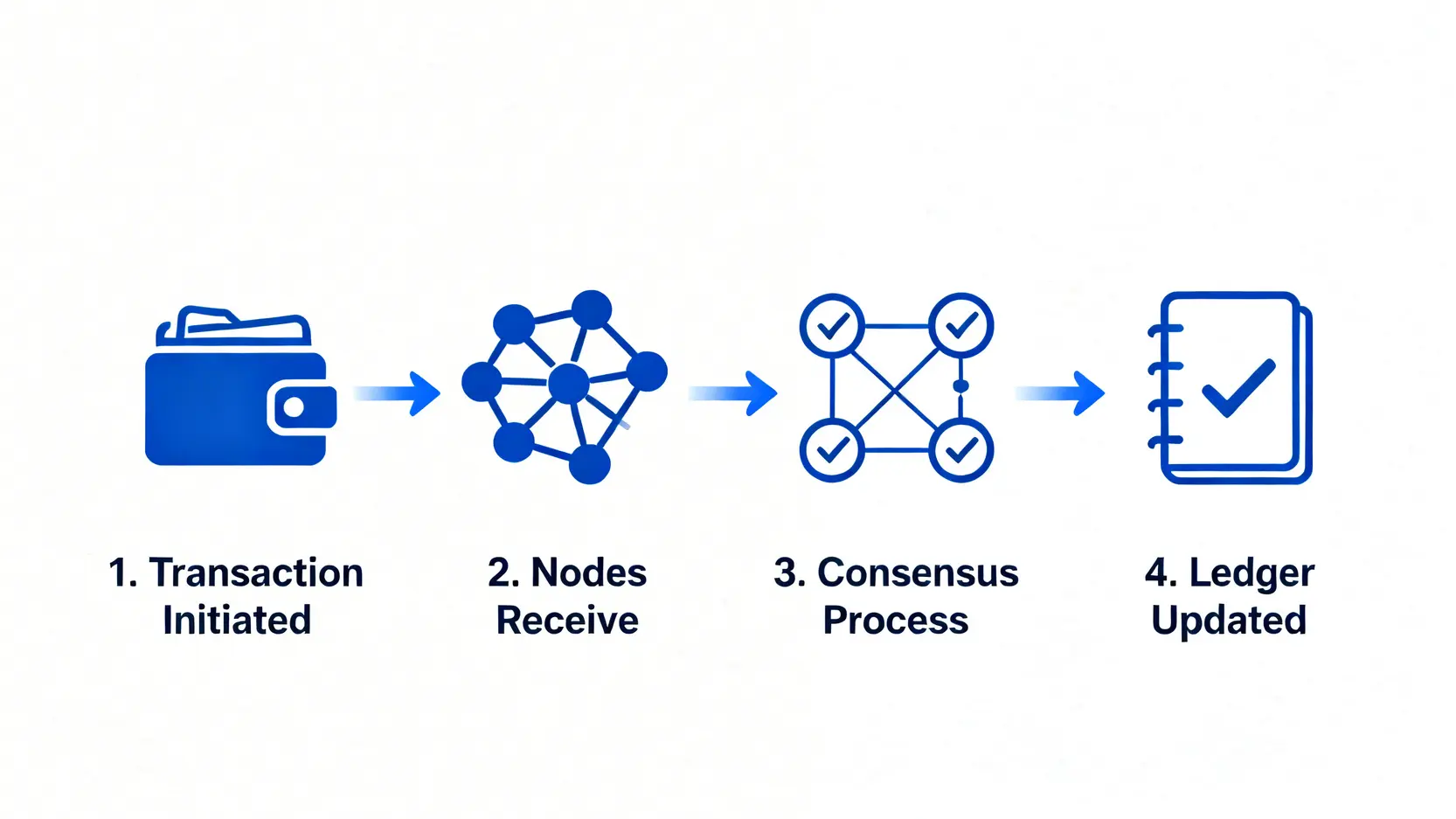
The XRP Ledger is essentially a distributed digital ledger maintained by hundreds or even thousands of servers worldwide known as “validators”. When a transaction occurs (for example when A sends 10 XRP to B), the process generally works as follows:
- Transaction Initiation: A’s wallet creates a transaction, signs it digitally using its private key, and broadcasts it to the XRP Ledger network.
- Node Reception: Validator nodes across the network receive the unconfirmed transaction.
- Consensus Process: The nodes begin using Ripple’s consensus mechanism (RPCA) to reach agreement on the transaction’s validity and order. This process happens extremely quickly and will be explained in detail in the next section.
- Ledger Update: Once more than 80 percent of trusted validators reach agreement on a batch of transactions, those transactions are written into a new “ledger version” and permanently recorded. Each ledger version links to the previous one, forming an immutable chain.
This process ensures that all participants in the network share the same and most up-to-date ledger state, guaranteeing transaction security and consistency.

The Key to Speed: Why XRPL Transactions Take Only 3–5 Seconds?
The impressive speed of XRPL comes primarily from its consensus mechanism. Unlike Bitcoin, which requires miners to perform complex mathematical calculations to create a new block, a process (that typically takes about 10 minutes), XRPL validator nodes complete a round of voting and verification within seconds. They do not engage in resource-intensive mining but instead confirm transactions through efficient communication and voting. This model of “consensus rather than competition” is the fundamental reason XRPL can finalize transactions in just 3–5 seconds. For more detailed information about the XRP Ledger, readers can refer to its official learning portal.
Low Cost and High Scalability: Energy Efficiency of XRPL
Because the XRP Ledger does not rely on mining, its energy consumption is extremely low. This allows transaction fees to remain minimal (often less than one cent per transaction), while also making the network more environmentally sustainable. According to official data, the energy required for a single XRPL transaction is far lower than that of most mainstream credit card networks. Compared with Proof of Work blockchains such as Bitcoin, the difference is even more dramatic. This energy efficiency and low operating cost give XRPL remarkable scalability, theoretically enabling it to process up to 1500 transactions per second, a capacity sufficient for global payment networks.
The Unique Engine: Understanding Ripple’s Consensus Mechanism (RPCA)
If the XRP Ledger is a high-performance vehicle, then the Ripple Protocol Consensus Algorithm (RPCA) is the engine that powers it. It is a non-traditional consensus mechanism designed specifically for speed and efficiency, completely eliminating the need for mining.
No Mining Required: How RPCA Reaches Consensus?
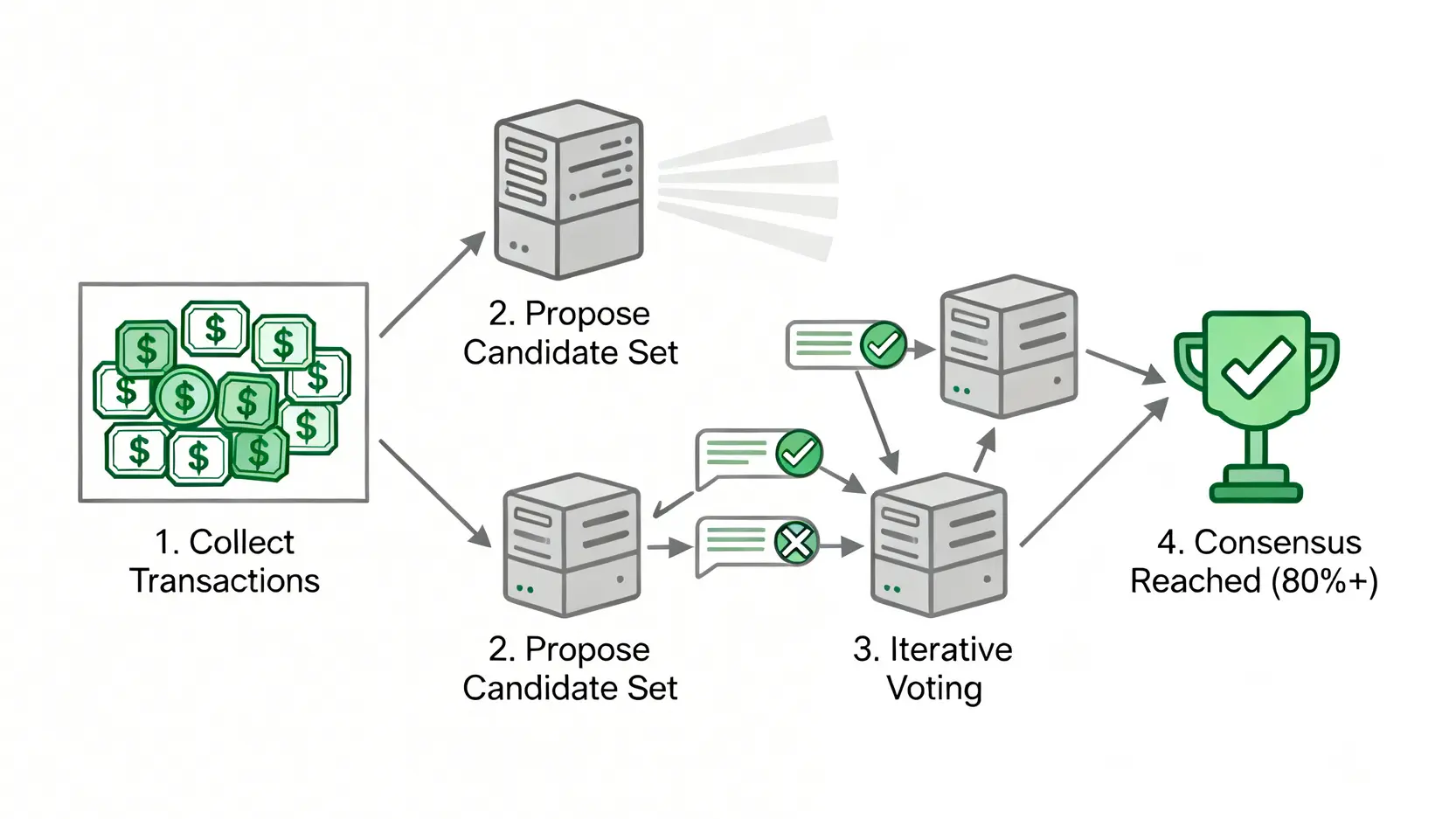
The core concept of RPCA is “collective trust”. Instead of relying on computational competition, it uses a rapid iterative process that allows validators in the network to agree on transaction validity. The process works as follows:
- Transaction Collection: Each validator collects pending transactions from the network and forms an initial “candidate set”.
- Proposal Submission: Validators share their candidate sets with other validators as proposals.
- Multiple Voting Rounds: In the next few seconds, validators continuously compare each other’s proposals. Based on the proposals from other validators they trust (namely members on their UNL list), they modify their own candidate sets, gradually removing disputed transactions and adding transactions that the majority agrees on.
- Consensus Achieved: When at least 80 percent of validators agree on the same transaction set, consensus is reached. The finalized transaction set is then applied to the ledger, completing the transaction confirmation.
The entire process resembles an efficient committee meeting where members communicate, vote, and reach a final decision within seconds.

Validators and the Role of the Unique Node List (UNL)
- Validators: These are servers running XRP Ledger software that participate in the consensus process, verify transactions, and maintain the ledger. In theory, anyone can operate a validator node.
- Unique Node List (UNL): This is one of the most distinctive and debated aspects of RPCA. Each validator maintains its own list of trusted validators, known as its UNL. During the consensus process, a validator primarily considers the proposals of validators included in its UNL. Ripple provides a recommended UNL, but node operators are free to modify or replace it.
Advantages and the Centralization Debate Around RPCA
RPCA offers several clear advantages:
- Extremely fast transaction: Confirmation within 3–5 seconds.
- Very low cost: Due to minimal energy consumption.
- High scalability: Capable of supporting large transaction volumes.
However, its design has also sparked debate regarding “what is decentralization”. The controversy mainly centers on the UNL structure. Critics argue that because Ripple’s recommended UNL carries significant influence in the network, Ripple may exert too much control, meaning the XRP Ledger may not be as decentralized as Bitcoin. Supporters counter that as more independent validators join the network and customize their own UNLs, the level of decentralization continues to improve. They view the system as a pragmatic balance between efficiency and decentralization.
Further Reading (Highly Recommended)
FAQ Frequently Asked Questions
Q: Does the XRP Ledger require “mining”?
A: Not at all. The XRP Ledger uses the Ripple Protocol Consensus Algorithm (RPCA), a consensus mechanism based on validator voting rather than the energy-intensive “mining” process used by Bitcoin. This is also the main reason XRPL transactions are fast, low-cost, and energy efficient.
Q: Is the transaction speed of XRP really that fast?
A: Yes. A transaction on the XRP Ledger typically takes only 3–5 seconds from initiation to full confirmation. This means funds can be settled almost instantly, which provides a major advantage for use cases such as cross-border payments and financial settlements that require high efficiency.
Q: Does Ripple control the XRP Ledger? Is it decentralized?
A: This question is relatively complex. The XRP Ledger itself is open source and is not controlled by any single entity. However, Ripple, as one of the main developers and contributors, does have significant influence within the ecosystem. The debate around decentralization mainly focuses on the Unique Node List (UNL). While the network is gradually moving toward greater decentralization, its level of decentralization continues to be actively discussed within the community, especially when compared with projects such as Bitcoin.
Q: What are the main use cases of the XRP Ledger?
A: The core application of XRPL is as a high-efficiency and low-cost value transfer network, particularly suitable for:
1. Cross-border payments and remittances: Providing banks and payment providers with an alternative to the traditional correspondent banking system.
2. Central Bank Digital Currencies (CBDCs): Its technical architecture is suitable for issuing and managing national digital currencies.
3. Tokenized assets: Various digital assets such as stablecoins and security tokens can be issued on XRPL.
4. Micropayments: Extremely low transaction fees make it ideal for handling frequent small-value transactions.
Conclusion
In summary, Ripple’s blockchain technology, powered by the innovative XRP Ledger architecture and the efficient Ripple Protocol Consensus Algorithm (RPCA), successfully addresses the core pain points of traditional financial payments, including slow speed, high costs, and low efficiency. Its mining-free design not only enables extremely fast transactions and minimal fees but also makes it a more sustainable blockchain solution. Although discussions about its level of decentralization continue, its enormous potential within the global payments ecosystem remains undeniable. For those interested in the future of financial technology, studying Ripple technology is an important step toward understanding the evolution of global digital finance.
Related Articles
-
Complete Guide to Virtual Asset Trading Platform (VASP) License Applications: A 2026 Hong Kong Web3 Compliance Practical Guide At the pivotal moment of 2026, as global financial digitization accelerates at an unprecedented pace, Hong Kong has firmly established itself as a leading Web3 compliance hub in Asia and around the...2026 年 6 月 3 日
-
2026 Offshore Renminbi Range-Bound Arbitrage Trading Guide: Mastering the CNH-CNY Spread and a Profit Guide to Hedging Through Two-Way Volatility Against the combined influence of global macroeconomic developments and international trade policies, the foreign exchange market in 2026 has become increasingly complex. The Renminbi exchange rate often exhibits a pattern...2026 年 6 月 3 日
-
Friday Taiwan Index Options Buyer Strategies: Precisely Capturing Explosive Market Moves From Non-Farm Payroll Data Many investors often complain that options buyers have low win rates, frequently predicting the direction correctly but ultimately losing to time decay. However, under the new dual-settlement system, short-term volatility and event-driven trading have created...2026 年 6 月 3 日