How Many XRP Are There? 2026 Supply & Tokenomics

Updated: 2026/03/18  |  CashbackIsland

xrp-supply-tokenomics

Interested in investing in XRP (Ripple) but confused about its supply? What does the widely mentioned “total supply of 100 billion XRP” actually mean? Why does Ripple hold a large portion of the tokens, and how does this affect XRP’s tokenomics? Many investors evaluating XRP’s potential are curious about its supply mechanism and circulating quantity. This article provides an in-depth analysis of XRP’s total supply, actual circulating supply, and its unique tokenomics model, helping you clearly understand the key factors that influence its value. For investors new to cryptocurrency, it is recommended to first read a beginner’s guide to cryptocurrency to build a solid foundation.


What Is the Total and Maximum Supply of Ripple (XRP)?

When evaluating the value of any cryptocurrency, the design of its supply mechanism is a fundamental factor that cannot be ignored. In this regard, Ripple (XRP) has taken a path that is completely different from Bitcoin (BTC). Understanding XRP’s total supply and its distribution structure is the first step in assessing its long-term investment potential.


The Origin of the Fixed 100 Billion Supply: Why Was XRP Fully “Pre-mined” from the Start?

The maximum supply of XRP was fixed at 100 billion tokens from the very beginning and will never increase. This is fundamentally different from Bitcoin, which gradually releases new coins into the market through “mining”. When the developers created the XRP Ledger in 2012, all XRP tokens were generated at once. This approach is known as “pre-mining”.

The developers chose pre-mining mainly for several reasons:

  • Efficiency and Speed: The consensus mechanism of the XRP Ledger (XRPL Consensus Protocol) does not rely on Proof-of-Work, meaning it does not require mining to validate transactions or generate new tokens. As a result, transaction confirmations are extremely fast (around 3–5 seconds) and energy consumption is significantly lower.
  • Certainty and Predictability: By fixing the total supply from the beginning, the market is provided with clear expectations regarding token supply. No new XRP will ever be created, eliminating uncertainty that could arise from changes in mining rewards or algorithm adjustments.
  • Focus on Real-World Applications: The founding team allocated the majority of XRP (approximately 80 billion tokens) to Ripple, with the expectation that the company would develop applications around the XRP ecosystem, particularly in cross-border payments and financial services, thereby driving adoption and long-term value.


Total Supply vs. Circulating Supply: Which Number Should Investors Pay Attention To?

When discussing the circulating supply of XRP, it is important to distinguish between two key concepts: total supply and circulating supply.

  • Total Supply: This refers to the total number of tokens that have been created, minus any that have been permanently destroyed. For XRP, the initial total supply was 100 billion tokens. However, since transaction fees are burned during network operations, this number gradually decreases over time.
  • Circulating Supply: This refers to the number of tokens that are currently available for public trading and use in the market. It excludes tokens that are locked, held in escrow, or controlled by project teams or governments that cannot be immediately sold.

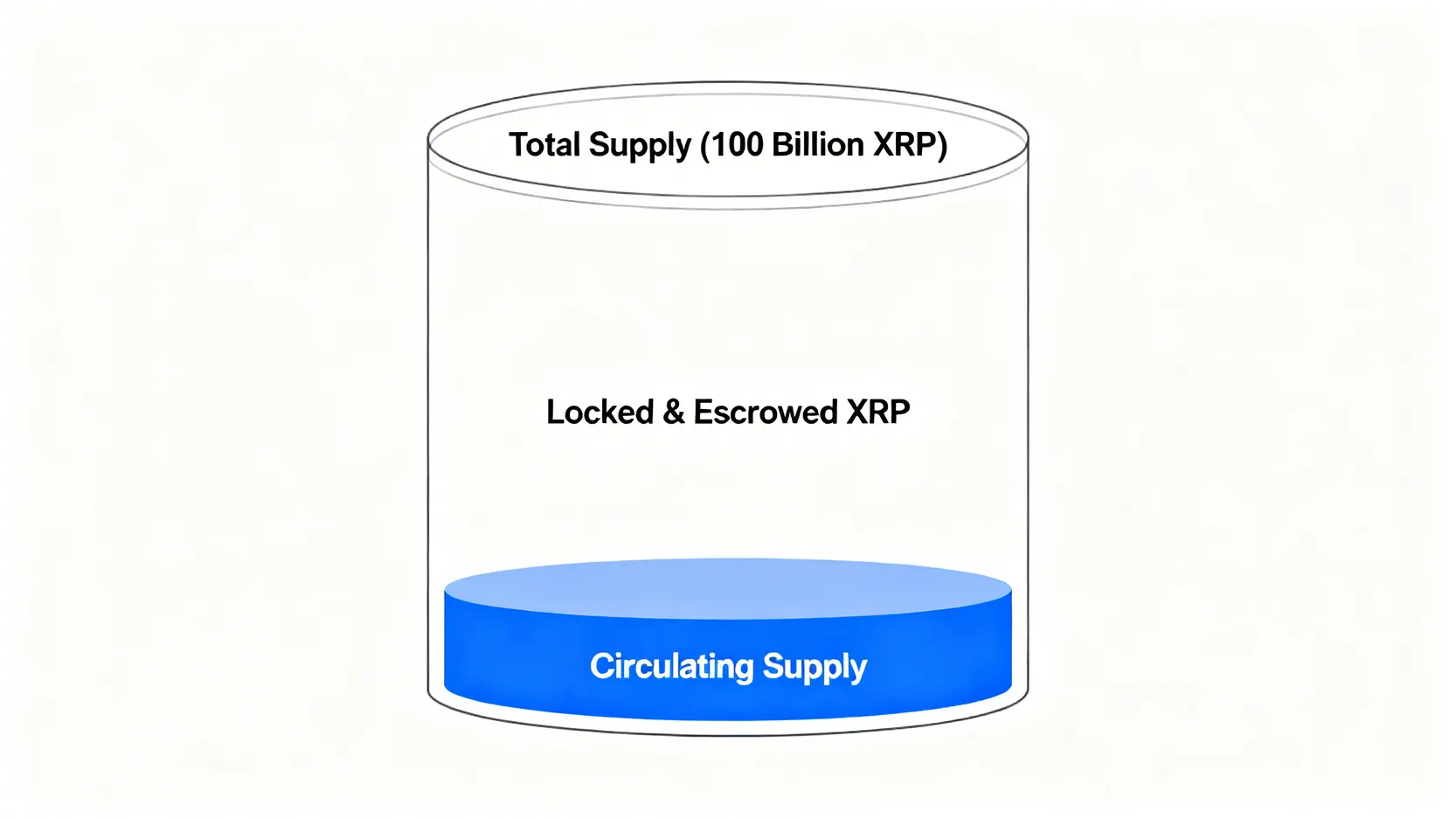
For investors, circulating supply is the more relevant real-time indicator. It directly reflects the supply-demand balance in the market and therefore has a more immediate impact on price movements. If a large number of previously locked tokens (such as those held in Ripple’s escrow accounts) were suddenly released into the market, it could theoretically increase selling pressure and affect the price. For this reason, understanding how XRP’s circulating supply is managed and released is crucial for evaluating its market dynamics.一張圖表解釋瑞波幣的總供應量與流通供應量的區別,顯示流通量是總量的一部分。

Relationship Between XRP Total Supply and Circulating Supply: Circulating supply represents the portion that is actually available for trading in the market.


Further Reading (Highly Recommended)

[2025 XRP Guide] What Is XRP? A Complete Explanation of Ripple and Its Use Cases

XRP Circulating Supply Explained: Who Controls Most of the XRP?

After understanding the difference between total supply and circulating supply, the next key question is: who actually holds the 100 billion XRP? Why is the portion held by Ripple not fully counted as circulating supply? The answer lies in its unique official escrow mechanism, which is a core design influencing XRP’s circulating supply and market expectations.


The Official Escrow Mechanism: How Ripple Gradually Releases XRP?

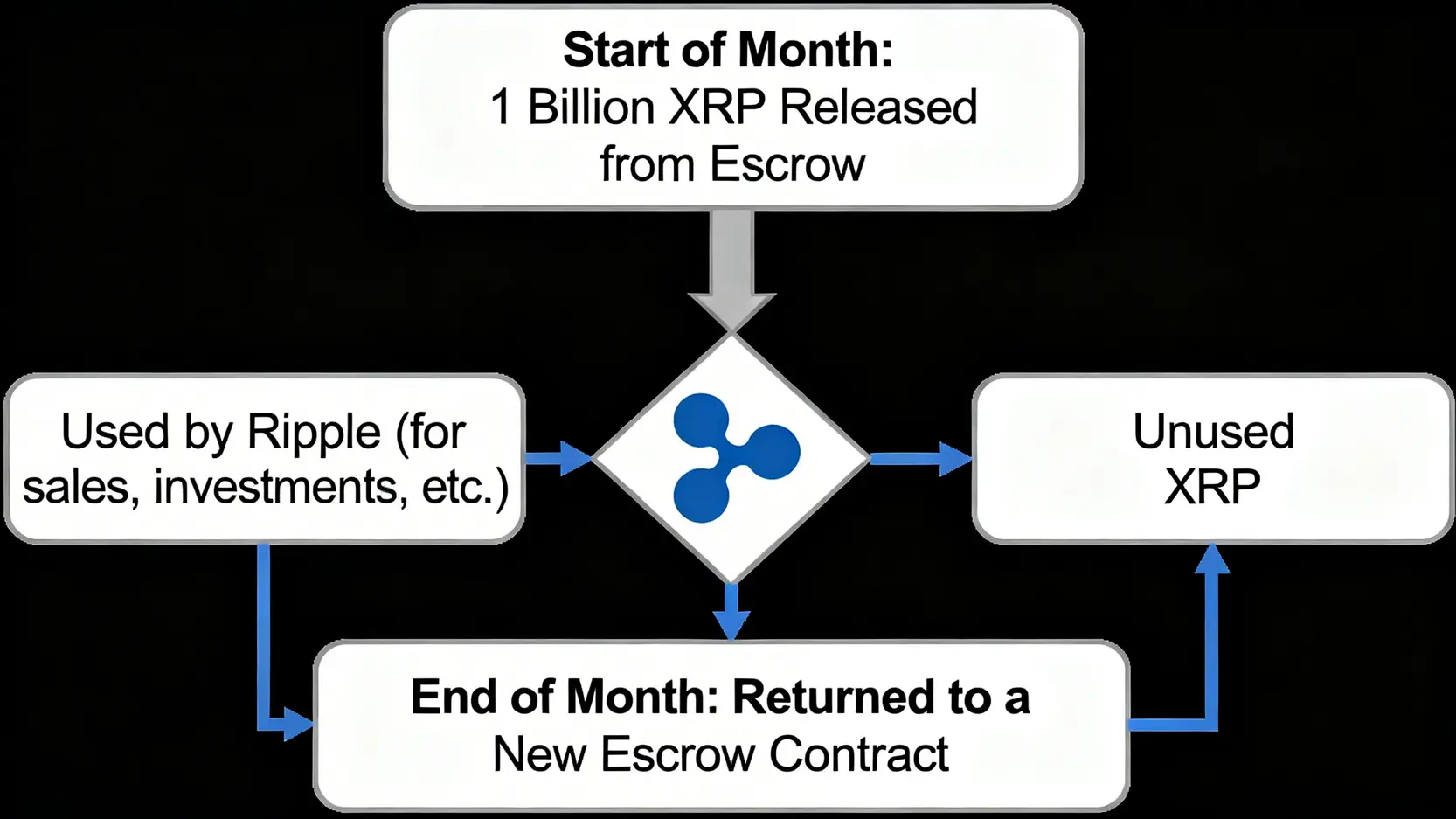
To address market concerns that “Ripple could potentially sell a large amount of XRP” at any time, the company placed most of its holdings (around 55 billion XRP) into a series of time-locked escrow smart contracts in 2017. This mechanism operates as follows:

  • Monthly Release: Starting in January 2018, one escrow contract expires on the first day of each month, releasing 1 billion XRP.
  • Clear Usage Purpose: Ripple can use the released XRP to fund operations, invest in ecosystem partners, or sell to institutional buyers in order to increase liquidity within the XRP payment network.
  • Unused Tokens Returned: At the end of the month, any XRP that has not been used is returned to a new escrow contract and placed at the end of the escrow queue. This means the tokens will not immediately enter the market but will instead be released again several years later.

瑞波幣官方託管機制運作流程圖,展示每月釋放 10 億 XRP 並將未用部分返還託管的循環過程。

Illustration of Ripple’s Escrow Mechanism: Monthly releases with unused portions returned to escrow ensure predictable supply.

The purpose of this design is to provide predictable XRP supply. Market participants can clearly understand the maximum amount of XRP that may enter circulation each month from Ripple, thereby reducing uncertainty. This level of transparency helps build confidence among institutional investors and ecosystem partners.


How to Check Real-Time XRP Circulating Supply and Market Data?

For investors who want to track the latest XRP circulating supply, there are many reliable third-party data platforms available. These platforms aggregate data from the blockchain and major exchanges to provide real-time market indicators. Some of the most popular and authoritative sources include:

  • CoinMarketCap: One of the most well-known cryptocurrency data websites globally, offering detailed information on XRP price, market capitalization, circulating supply, total supply, and historical data.
  • CoinGecko: Another widely used data platform that provides comprehensive market indicators and analytical tools.
  • Official Reports: Ripple regularly publishes market reports detailing its XRP sales activity and changes within its escrow accounts.

To obtain the most up-to-date and authoritative data, investors can directly refer to the XRP page on CoinMarketCap, which provides the latest circulating supply and market capitalization information.

The Core of XRP Tokenomics: Burning Mechanism and Future Potential

In addition to the escrow mechanism on the supply side, another key pillar of XRP’s tokenomics is its built-in burning mechanism. This mechanism not only helps ensure network security but also introduces a deflationary element into XRP’s long-term value model, while directly supporting its use in cross-border payments.


Transaction Fee Burning: Is XRP a Deflationary Currency?

Every transaction conducted on the XRP Ledger, whether a transfer or a trading order, requires the payment of a very small transaction fee (currently as low as approximately 0.00001 XRP). Unlike Bitcoin or Ethereum, where transaction fees are rewarded to miners or validators, XRP transaction fees are permanently burned and removed from the total supply.

This design serves two primary purposes:

  1. Preventing Network Spam: Although the fee is extremely small, it is sufficient to prevent malicious actors from overwhelming the network with large volumes of meaningless transactions.
  2. Creating Deflationary Pressure: As transaction activity increases, more XRP is burned. This means the total supply of XRP gradually decreases over time, making it a deflationary digital asset.

Although the current rate of token burning is relatively slow, if transaction activity on the XRP Ledger grows significantly in the future (such as through widespread adoption by global banks for daily settlement), the cumulative burning effect could become substantial, strengthening XRP’s scarcity and potentially supporting its value.


How Tokenomics Supports XRP’s Role in Cross-Border Payments?

The entire tokenomics structure of XRP, from its fixed total supply and predictable release schedule to its low and deflationary transaction fees, is designed to serve its core objective: becoming a bridge currency for global cross-border payments. For those who want to understand how to get started in practice, you may refer to guides on how to buy XRP.

  • Low Cost: The micro-fee burning model enables cross-border settlements using XRP at a cost far lower than traditional systems such as SWIFT.
  • High Speed: The pre-mined structure combined with an efficient consensus algorithm allows payments to settle within seconds rather than days.
  • Scalability: The XRP Ledger can process more than 1,500 transactions per second, providing the capacity to support large-scale global adoption.
  • Neutrality: As a neutral digital asset, XRP does not belong to any specific country and can function as a seamless value transfer medium between different fiat currencies.

Overall, XRP’s tokenomics model, particularly its supply management and burning mechanism, provides a solid foundation for its potential applications in the financial sector.


Further Reading (Highly Recommended)

[2025 XRP Guide] What Is XRP? A Complete Explanation of Ripple and Its Use Cases


FAQ About XRP Total Supply and Distribution

Q: Is the total supply of XRP fixed?

A: Yes. The total supply of XRP was fixed at 100 billion tokens at the time of its creation and will never increase. In addition, because a small amount of XRP is burned as a transaction fee for every transaction, the total supply is actually decreasing slowly and continuously over time, giving XRP a deflationary characteristic.

Q: How much XRP does Ripple hold? Could it sell and affect the price?

A: Ripple initially received about 80 billion XRP. To maintain market stability, 55 billion XRP were later placed into escrow accounts. These accounts release 1 billion XRP each month, and any unused portion is locked back into escrow. This mechanism makes supply releases transparent and predictable, aiming to reduce the direct market impact of large-scale selling. Investors should still monitor Ripple’s monthly reports to evaluate potential market effects.

Q: How is XRP’s supply different from Bitcoin’s?

A: The two are fundamentally different. XRP was “pre-mined”, meaning the entire 100 billion supply was created at genesis. On the other hand, Bitcoin is produced gradually through “mining”, where miners solve mathematical problems to generate new coins, with a maximum supply of about 21 million BTC. This process is expected to continue until around 2140. Therefore, XRP’s supply release is managed through Ripple’s escrow system, while Bitcoin’s supply is determined by its algorithm and mining difficulty.

Q: How fast is XRP being burned?

A: The burning rate of XRP depends on transaction activity on the XRP Ledger. Each transaction burns only a very small fee (around 0.00001 XRP), so under current transaction volumes the burn rate is relatively slow. For the burn mechanism to have a significant impact on total supply, network transaction volume would need to remain very high over a long period. It is therefore a long-term deflationary mechanism rather than a short-term price catalyst.


Conclusion

In summary, understanding the total supply of XRP, its circulating supply, and the overall XRP tokenomics model is fundamental when evaluating its long-term value. The fixed maximum supply of 100 billion XRP, the monthly release mechanism from escrow accounts, and the transaction fee burning model together create a unique supply and demand dynamic. This design aims to provide a stable, efficient, and predictable environment for XRP’s use in cross-border payment applications. Before making investment decisions, investors should carefully consider how these supply-side factors interact with market demand, macroeconomic conditions, and ongoing regulatory developments.

编者
Evan Lin

Evan Lin

我是Evan Lin,从大学时期开始接触外汇交易,至今已有多年实战经验,熟悉技术分析与EA策略,热衷于研究市场脉动与风险管控,喜欢分享实战经验和交易技巧,和大家一起学习、一起进步!

If you liked this article, please share it!

Related Articles

  • Hong Kong VASP License Guide 2026 for Web3 Firms
    Complete Guide to Virtual Asset Trading Platform (VASP) License Applications: A 2026 Hong Kong Web3 Compliance Practical Guide At the pivotal moment of 2026, as global financial digitization accelerates at an unprecedented pace, Hong Kong has firmly established itself as a leading Web3 compliance hub in Asia and around the...
    2026 年 6 月 3 日
  • CNH-CNY Arbitrage Guide 2026: Spread & Hedging
    2026 Offshore Renminbi Range-Bound Arbitrage Trading Guide: Mastering the CNH-CNY Spread and a Profit Guide to Hedging Through Two-Way Volatility Against the combined influence of global macroeconomic developments and international trade policies, the foreign exchange market in 2026 has become increasingly complex. The Renminbi exchange rate often exhibits a pattern...
    2026 年 6 月 3 日
  • Friday Taiwan Index Options: NFP Trading Strategy
    Friday Taiwan Index Options Buyer Strategies: Precisely Capturing Explosive Market Moves From Non-Farm Payroll Data Many investors often complain that options buyers have low win rates, frequently predicting the direction correctly but ultimately losing to time decay. However, under the new dual-settlement system, short-term volatility and event-driven trading have created...
    2026 年 6 月 3 日
返回顶部