Hong Kong Hedge Fund Rankings 2026: Top 5 Guide

The world of hedge funds has always carried an air of mystery, regarded as the arena for elite investors. Have you ever wondered which top Hong Kong hedge funds operate in Asia’s financial center? How do they differ from the hedge fund giants of Wall Street in the US? This article reveals the latest Hong Kong hedge fund rankings, provides an in-depth analysis of leading firms’ investment strategies, and compares the unique characteristics of the Hong Kong and US markets, offering a comprehensive insight guide for aspiring investors and job seekers.
What Is a Hedge Fund? Why Is It Favored by Elite Investors?
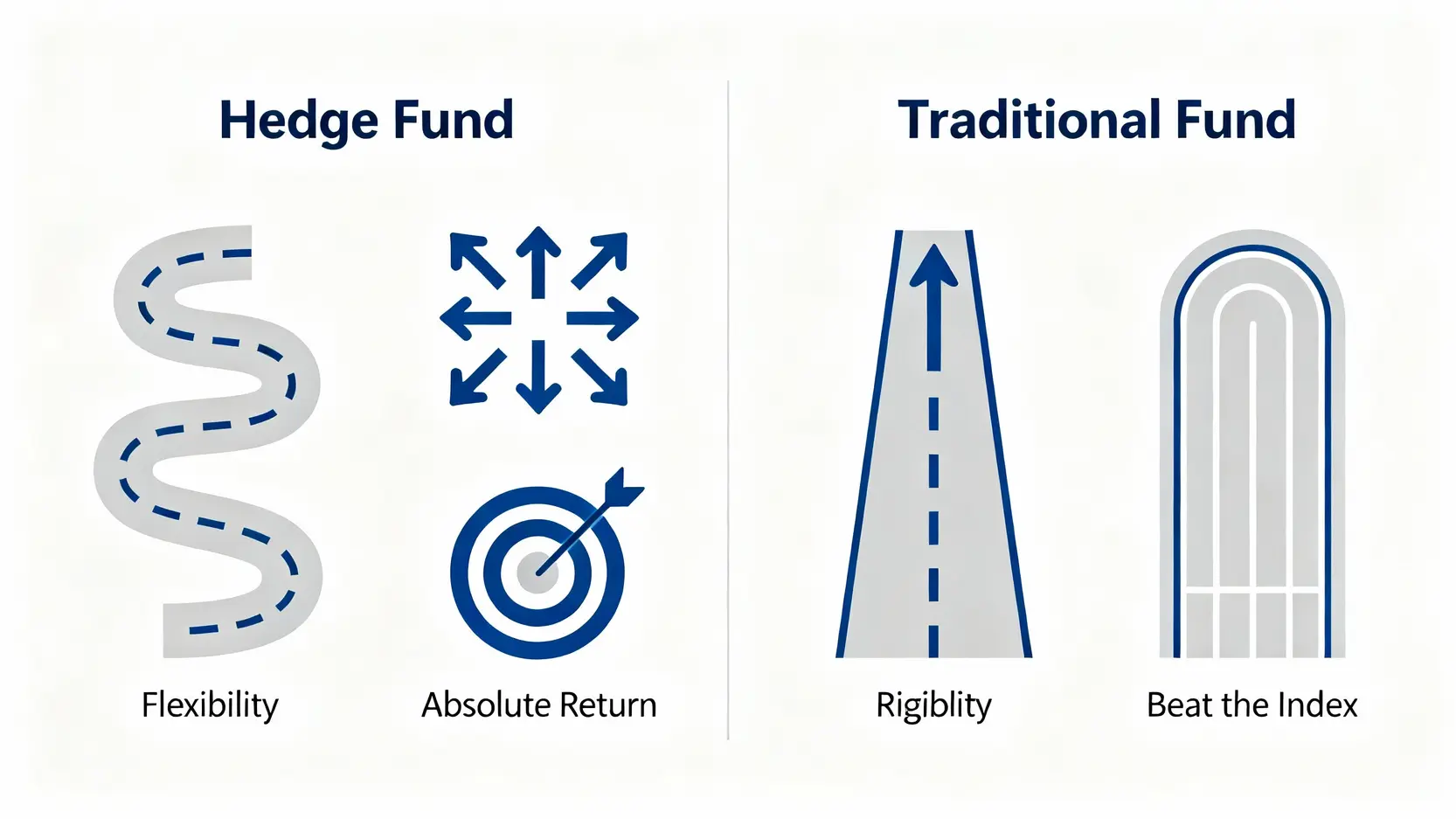
A hedge fund is often misunderstood as merely a fund that “hedges risk”, but its scope extends far beyond that. It is a private investment partnership primarily serving professional investors (such as high net worth individuals or institutions) with extremely high operational flexibility, aiming to achieve absolute returns regardless of whether the market is bullish or bearish.
The Core Definition and Operating Model of Hedge Funds
The term “hedge” in hedge funds originates from the strategy adopted by its founder, Alfred Winslow Jones, in 1949. He hedged overall market volatility risk by simultaneously buying, (long), undervalued stocks and short selling (short) overvalued stocks, thereby focusing on generating excess returns through stock selection. Modern hedge funds have evolved far beyond this model. They employ leverage, derivative financial instruments, short selling, quantitative models, and various other complex tools and strategies to invest in stocks, bonds, foreign exchange, commodities, and other global asset classes.
Three Major Advantages Over Traditional Funds: Absolute Return, Flexible Strategies, and Risk Hedging
Hedge funds have secured a place in the financial world largely due to their significant advantages over traditional mutual funds:
- Pursuit of Absolute Return: Traditional funds aim to outperform a benchmark index (which represents relative return). Even if the market declines by 30 percent and the fund declines by 20 percent, it may still be considered successful. In contrast, hedge funds seek to generate positive returns for investors in all market conditions.
- Highly Flexible Investment Strategies: Traditional funds are usually limited to long positions and face strict restrictions on investment targets and leverage usage. However, hedge funds employ diverse strategies, can go long or short, use high leverage, invest globally, and even allocate to illiquid assets.
- Sophisticated Risk Hedging: Through short selling and derivatives, hedge funds can more effectively manage and hedge specific risks, isolating the manager’s true alpha advantage and providing downside protection to the portfolio.

Top 5 Hong Kong Hedge Fund Companies in 2026
As Asia’s international financial center, Hong Kong is home to numerous leading hedge fund firms. Although specific assets under management (AUM) are highly confidential, based on industry reputation, strategy uniqueness, and market influence, the following five Hong Kong hedge fund firms are currently among the most prominent representatives.
First Place: Hillhouse Capital Group, The Asian Model of Value Investing
Although Hillhouse Capital is often categorized as a long-term private equity investor, its public market funds also adopt flexible hedge fund strategies. Its core philosophy is “fundamentals-driven value investing”, focusing on identifying and holding companies with significant long-term potential in Asia, particularly in China. Through in-depth research on industry trends and corporate moats, it combines long positions in core assets with short positions to hedge market risk, representing a leading integration of macro vision and micro stock selection.
Second Place: Pinpoint Asset Management, Expert in Equity Long Short Strategies
Pinpoint is one of the most renowned hedge funds in Asia, known for its refined equity long short strategy. Its portfolio management team conducts rigorous fundamental research to identify companies with growth potential for long positions while shorting companies with weak fundamentals or overvaluation. This strategy aims to reduce market beta risk and focus on generating alpha from stock selection, enabling stable performance in volatile Asian markets.
Third Place: BFAM Partners, Focused on Asia Event Driven and Credit Strategies
BFAM Partners is a multi-strategy platform focused on the Asian market, particularly strong in credit and event driven strategies. The firm specializes in identifying opportunities from corporate mergers and acquisitions, restructurings, distressed debt, and other special situations. This requires deep financial analytical expertise and precise understanding of legal and regulatory environments across Asian jurisdictions, making it a representative of opportunistic investing.
Fourth Place: PAG (Pacific Alliance Group), A Giant in Asian Credit and Real Estate
Similar to Hillhouse, PAG is a large alternative asset management firm whose hedge fund operations hold a significant position in Asian credit markets, particularly in distressed assets. Leveraging its scale and local network, PAG identifies undervalued credit assets arising from market dislocations or liquidity constraints. Its strategies are complex and specialized, offering institutional investors unique access to high yield opportunities.
Fifth Place: Value Partners, A Hong Kong Based Greater China Value Investor
As a long established asset management firm in Hong Kong, Value Partners is known for its Greater China value investing strategy. Its funds serve not only institutional investors but also retail investors. Its hedge fund strategies similarly revolve around value investing, conducting in-depth research on listed companies in mainland China and Hong Kong to identify investment targets trading significantly below intrinsic value. Its deep understanding of Chinese policy and economic cycles forms one of its core competitive advantages.
US Hedge Fund Giants: Three Firms That Influence Global Markets
When discussing hedge funds, Wall Street legends cannot be ignored. These US hedge fund giants are not only massive in scale, but their investment strategies and founders have profoundly shaped the operation of global financial markets.
Bridgewater Associates, The Model of Global Macro Strategy
Founded by legendary investor Ray Dalio, Bridgewater is the largest hedge fund firm in the world. The foundation of its success lies in its “Global Macro” strategy, which involves in-depth analysis of global macroeconomic trends, including interest rates, exchange rates, inflation, and other indicators, to assess the future direction of major asset classes and allocate investments globally. Its renowned “All Weather” strategy aims to build a resilient portfolio capable of withstanding various economic environments.
Renaissance Technologies, The Mysterious King of Quantitative Investing
Founded by mathematician James Simons, this firm represents the pinnacle of quantitative trading. Renaissance Technologies employs very few traditional financial analysts and instead consists primarily of top mathematicians, physicists, and computer scientists. They use complex mathematical models and algorithms to identify profitable statistical arbitrage opportunities within massive volumes of market data. Its flagship “Medallion Fund” is regarded as one of the most successful hedge funds in history, but it is only open to internal employees.
Citadel, The Successful Model of a Multi Strategy Platform
Founded by Ken Griffin, Citadel exemplifies the multi strategy platform model. The firm contains multiple independent investment teams, each focusing on a specific strategy, such as quantitative trading, equity long short, or global macro. The company provides infrastructure and risk management support while allocating capital to the best performing teams. This model combines diversification with internal competition, enabling consistent returns across different market environments. Citadel is also one of the largest market makers globally, with operations spanning both investment management and trade execution.
Further Reading (Highly Recommended)
Hong Kong vs US: Comparison of the Two Hedge Fund Markets
Although both are world class financial centers, the hedge fund markets in Hong Kong and the US differ significantly in regulation, strategy, and talent, shaping distinct industry ecosystems in each region.

Regulatory Environment and Licensing Requirements
Both regions impose strict regulation on the hedge fund industry, but with different emphases.
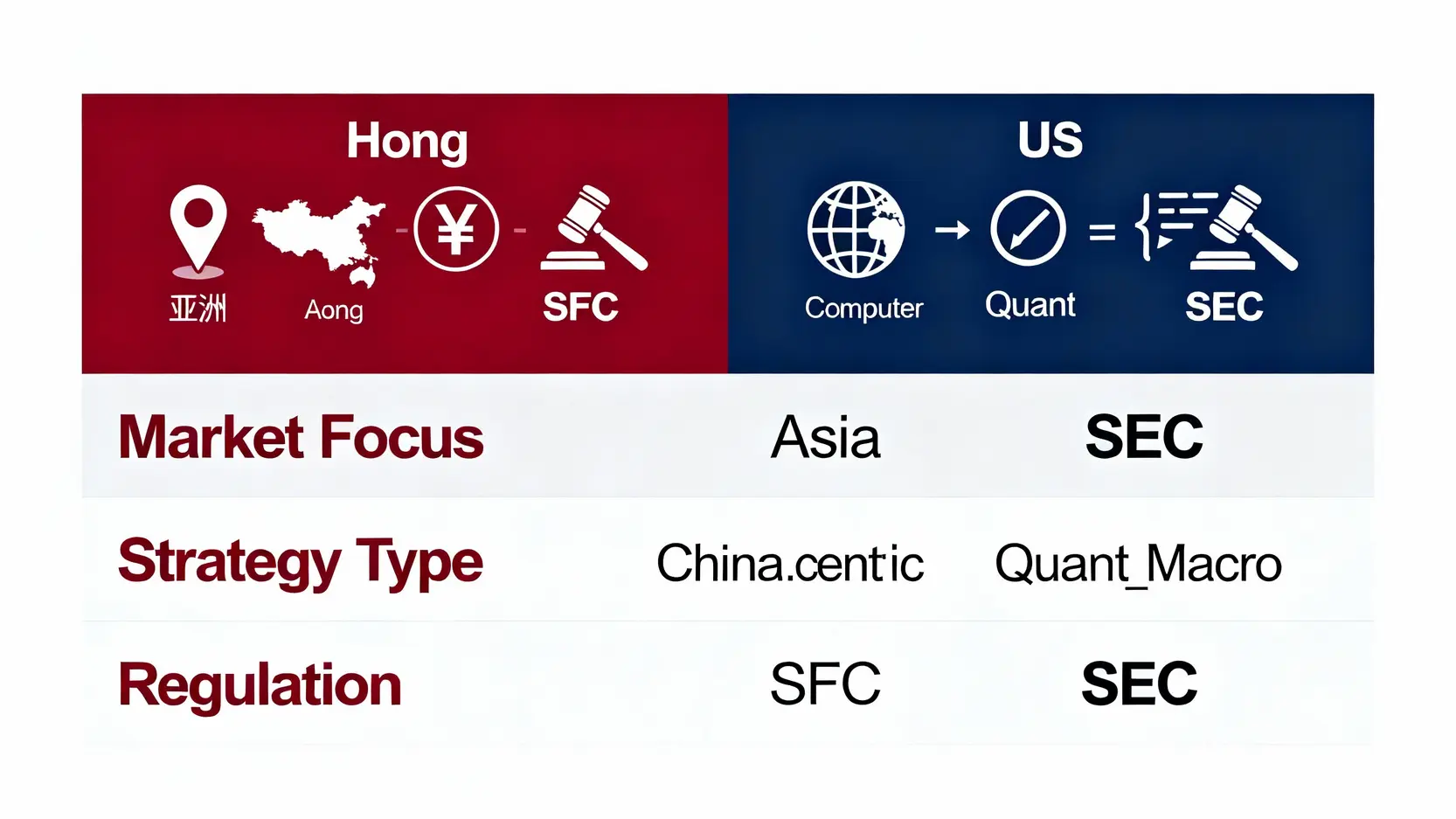
- Hong Kong: Regulated by the Securities and Futures Commission. Hedge fund management companies established in Hong Kong must apply for the appropriate license according to their business activities, with the most essential being “the Type 9 license (for asset management)”. The SFC imposes strict capital, risk management, and compliance requirements on licensed corporations to protect investor interests.
- US: Primarily regulated by the Securities and Exchange Commission. Larger hedge fund managers must register as investment advisers and comply with regulations such as the “Dodd Frank Act” including regular reporting of holdings and risk exposure. The US regulatory framework is broader and more complex.
Mainstream Investment Strategies and Market Focus
The geographic location and market structure determine the strategic preferences of funds.
- Hong Kong: Benefiting from its unique position backed by mainland China and facing Asia, Hong Kong hedge funds focus more on capturing “Asian alpha”. Mainstream strategies include equity long short, Greater China value investing, Asia event driven, and credit strategies. Fund managers must possess deep insight into China’s policy direction, industrial transformation, and emerging Asian markets.
- US: As the largest capital market in the world, US hedge funds adopt more diversified and globalized strategies. From global macro and systematic quantitative strategies to various complex derivatives arbitrage approaches, the depth and breadth of strategies are more extensive. Many top quantitative funds and multi strategy platforms are concentrated in the US.
Talent Recruitment and Compensation Structure
The talent pool and compensation culture in the two regions also differ slightly.
- Hong Kong: Recruitment emphasizes candidates’ understanding of Asian markets, particularly Mandarin proficiency and a China background. Investment analysts are often required to travel to mainland China for field research. The compensation structure typically consists of “base salary plus performance bonus”, with bonuses highly linked to fund performance.
- US: Talent competition is extremely intense, especially in the quantitative field, where hedge funds compete with Silicon Valley technology giants for top mathematicians and computer scientists. Overall compensation levels may be higher, particularly for top fund managers and quantitative researchers, with performance bonuses forming a substantial portion of total compensation.
Frequently Asked Questions About Hong Kong Hedge Funds (FAQ)
Q: What is the minimum investment threshold for hedge funds?
A: Hedge funds are private in nature and not open to the general public. Investors must qualify as “Professional Investors”. According to the definition of the Hong Kong SFC, individuals must possess an investment portfolio of no less than HKD 8 million. The threshold for institutional investors is even higher. The minimum subscription amount for a single fund is typically USD 1 million or above, representing a very high barrier to entry.
Q: What license must Hong Kong hedge funds obtain from the Securities and Futures Commission?
A: To engage in asset management business in Hong Kong, it is necessary to apply to the SFC for a Type 9 license (Asset Management) regulated activity. If the business also involves providing advice on securities or futures contracts, a Type 4 and Type 5 license may also be required. The company’s Responsible Officers must meet specific industry experience and qualification requirements. You may refer to the SFC compliance guide for more information on licensing.
Q: Which is the largest hedge fund company in the world?
A: At present, Bridgewater Associates, founded by Ray Dalio, remains the hedge fund company with the largest assets under management globally. Its AUM has long remained at the level of hundreds of billions of US dollars, far exceeding its peers.
Q: What does the hedge fund “2/20” fee structure mean?
A: “2/20” refers to the traditional hedge fund fee model. The “2” represents a 2 percent annual management fee based on assets under management, charged regardless of fund performance, to cover daily operating costs. The “20” represents a 20 percent performance fee on profits, which can only be charged when the fund generates gains and exceeds a specified threshold (such as a high water mark). In recent years, as industry competition has intensified, fee structures have become more diversified.
Conclusion
Whether focusing on Asia based Hong Kong hedge funds or globally influential US hedge funds, understanding their rankings, core strategies, and market environments is the essential first step toward successful investment or career planning. With its unique geographic and institutional advantages, Hong Kong plays an indispensable role in capturing Asian growth opportunities, while the US continues to lead in global financial innovation and strategic depth. The rankings and strategic analysis of leading firms provided in this article aim to unveil the mystery of hedge funds and help you find clear direction in the complex financial world.
Related Articles
-
How to Get Started with Bitcoin? The Complete 2026 Bitcoin Buying Guide for Beginners After watching Bitcoin repeatedly reach new highs in recent years and successfully pass spot ETF reviews in the US and Hong Kong in 2024, officially entering mainstream financial markets, many investors have turned their attention to...2026 年 7 月 20 日
-
Is Gold’s V-Shaped Rebound a Bottom-Fishing Signal? A Complete Guide to Trading Strategies Amid “$100 Price Swings” What Is a Gold V-Shaped Rebound? More Than Just a Technical Pattern The gold market has recently experienced sharp rises and falls, with prices frequently displaying dramatic “gold V-shaped rebounds”. Single-day “$100 price...2026 年 7 月 20 日
-
What Is PPI Data? 2026 Latest Analysis: Understand the Differences from CPI and How It Affects Stock Market Trends With market information constantly changing, do you always hold your breath while waiting for CPI data to be released? But did you know that a more forward-looking inflation indicator, PPI data...2026 年 7 月 20 日