What Is the Sintra Central Bank Forum? Understand How the European Central Bank Forum Influences Monetary Policy and Stock and FX Markets in One Read
Every summer, global markets focus on a seemingly low-key but highly influential event that can trigger volatility across stocks, FX, and bonds: the Sintra Central Bank Forum (also often referred to as the European Central Bank Forum). For investors, this is not just a seminar attended by central bank officials, but a “public examination” used to interpret the direction of monetary policy: will rate cuts come earlier? Is inflation stickiness still difficult to deal with? Will policy communication turn more hawkish? These signals often cause markets to reprice in advance based on just a few short remarks.
If you usually follow Federal Reserve meetings and nonfarm payrolls data, the Sintra Forum belongs to the same tier: it can push the macro narrative to the next page. Especially for readers in Taiwan and Malaysia, such international central bank signals are often reflected through US dollar trends, capital flows, and risk appetite, affecting technology stocks, Taiwan index heavyweights, Malaysian financial stocks, and even mortgage rates and FX hedging costs.
The Origin of the Sintra Central Bank Forum and Why Its Influence Is Seen as a Monetary Policy Barometer
The Sintra Central Bank Forum (ECB Forum on Central Banking) is hosted by the European Central Bank (ECB) and is regularly held in Sintra, Portugal. It brings together central bank governors, academics, financial market representatives, and the media from various countries to discuss current policy issues and medium- to long-term macro trends. For the ECB’s official introduction to the forum and past information, refer to: ECB Forum on Central Banking (Sintra Forum) official page.
The reason this forum is closely watched by the market is not “whether there is a post-forum decision”, but that it provides a stage for central bank officials to explain clearly (or deliberately not explain clearly), their thinking to the market between policy decisions. For price-sensitive bond yields, FX, and major stock indices, this kind of “verbal forward guidance” is often traded faster than formal statements.
Taking 2026 as an example, the European Central Bank has announced the theme and schedule of this year’s forum: ECB Forum on Central Banking 2026 (29 June to 1 July 2026, Sintra). For event-driven traders, the intensity of speeches over these three days can often influence global risk asset sentiment for the week.
Comparison with the US Jackson Hole Symposium: Two Major Stages for Central Bank Communication
Markets often compare the Sintra Forum with the “Jackson Hole Symposium”, for a straightforward reason: neither is a regular interest rate decision meeting, yet both may produce key turning-point language, such as “inflation risks remain tilted to the upside”, “policy will remain restrictive for longer”, and “ready to adjust if necessary”.
Jackson Hole leans more toward US policy narratives and the anchoring of global US dollar liquidity.
The Sintra Central Bank Forum more often reflects the differences among “multiple central banks on the same stage”: whether the ECB, Fed, BoE, BoJ, and others are aligned in their judgments on inflation, growth, and financial stability.
For investors in Taiwan and Malaysia, Sintra’s value lies in this: when major central bank narratives begin to “move in sync”, market volatility tends to increase. Conversely, if divergences appear, opportunities in FX and interest rate differential trades may open up.
The Impact of Past Forums on Stock and FX Markets: Why One Sentence Can Make Markets Reprice Instantly
The “impact” of the Sintra Forum usually comes from three scenarios:
The policy path is repriced: for example, if the market was originally betting on faster rate cuts, but officials’ remarks imply greater caution, bond yields may rise and stock market valuations may come under pressure.
The inflation narrative shifts: if the narrative changes from “inflation is falling smoothly” to “services inflation remains sticky”, the market will immediately raise the probability that restrictive rates will be maintained for longer.
Financial stability/geopolitical risks are highlighted: for example, secondary inflation pressure caused by energy, shipping, supply chains, or regional conflicts can affect risk appetite and FX hedging demand.
The key point is: the forum does not provide “answers”. It provides insight into how central banks are thinking and what they may say next. What markets trade is the gap in expectations.
Core Economic Issues and Long-Tail Monetary Policy Interpretations at This Year’s Sintra Central Bank Forum
When investors follow the Sintra Central Bank Forum, the goal is not to copy every word, but to identify three main themes: inflation stickiness, growth resilience/soft landing, and policy communication and market expectation management. These three themes will determine whether the interest rate peak has passed, whether the pace of rate cuts will be delayed, and whether risk asset valuations can be spared by “rate discounting”.
Inflation Stickiness and Exit Strategy: Why the Rate Cut Path Is Often Swayed by Sintra Remarks
In the 2026 market environment, “rate cuts” remain a popular topic, but what central banks fear most is inflation not falling cleanly enough, especially slower-moving items such as services inflation, wage growth, and rents. Once officials repeatedly mention “inflation remains sticky” and “more confidence is needed” at the forum, markets will push back the timing of the first rate cut.
Keywords to watch here (which are also the most common trading triggers), include:
restrictive / sufficiently restrictive: whether policy is restrictive enough.
data-dependent: whether policy depends on data rather than prior commitments.
higher for longer: an indication that rates may stay elevated for longer.
Once these terms appear, the bond market usually moves first, FX follows, and stocks only later reflect valuation compression. For Taiwan and Malaysian stocks, changes in the US dollar and US Treasury yields are often transmitted more quickly than “local European data”.
Soft-Landing Risks and Geopolitical Challenges: Why Central Banks Are Actually Talking About Risk Premiums
“Soft landing” sounds like an economic term, but in market language, it means one thing: whether corporate earnings can hold up in a high-interest-rate environment. If central bank officials at the Sintra Forum focus risks on geopolitics, energy prices, shipping bottlenecks, or supply chain disruptions, markets usually reflect this in two ways:
Risk premiums rise: stock valuations are revised lower, and credit spreads widen.
Safe-haven preference increases: the US dollar, Japanese yen (or Swiss franc) strengthens, while emerging market currency volatility intensifies.
Therefore, the focus of the Sintra Central Bank Forum is not only “whether rate cuts will happen”, but whether central banks are hinting that even if they cut rates, they will not do so very quickly, and may even pause if inflation rises again. This kind of “uncertainty” directly becomes market volatility.
Nonfarm Payrolls Data and Sintra Central Bank Forum Remarks in Resonance: A Long-Tail Perspective on Market Prepricing
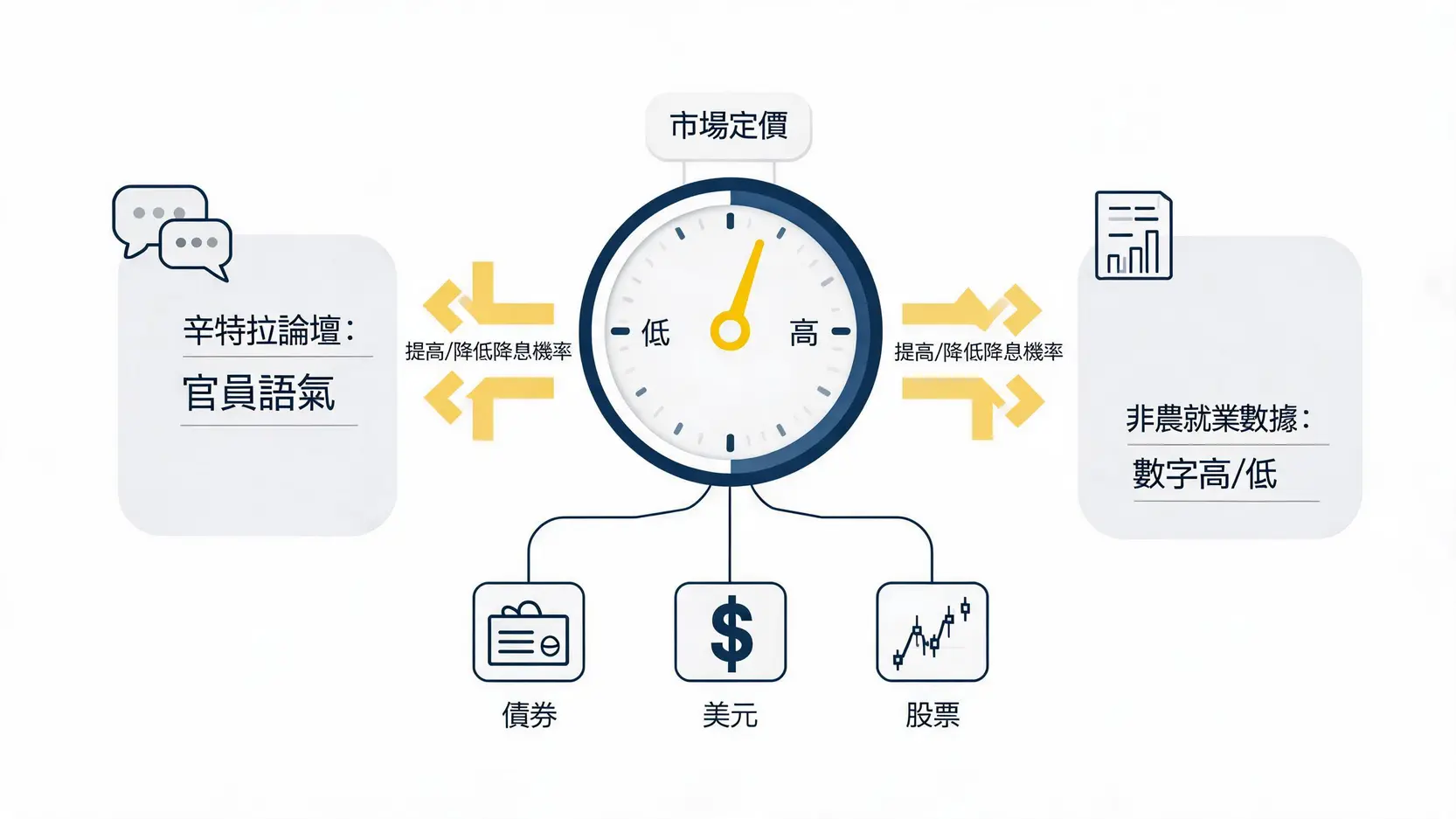
The Sintra Central Bank Forum often falls during the summer period, while another fixed market radar is US nonfarm payrolls data. When the two are close in timing, a typical “dual-event” effect can occur: central bank language affects rate cut probabilities, while nonfarm payrolls data affects the supporting evidence. When the two validate or contradict each other, markets can easily experience sharp rallies and sudden sell-offs.
Dual-Event Resonance: Central Bank Tone + Nonfarm Payrolls Data, and How They Amplify “Prepricing” and Volatility
Risk-Off Sentiment and Prepricing Ahead of Nonfarm Payrolls: Why Volatility Often Happens Before the Data Is Released
Many investors wonder: nonfarm payrolls have not been released yet, so why do exchange rates or stock indices move first? The reason is that institutions adjust position risk in advance (especially in rate-sensitive bonds and technology stocks). If remarks at the Sintra Forum lean hawkish, the market will first raise the probability of the “strong nonfarm payrolls = later rate cuts” scenario.
For Taiwan readers, this kind of prepricing is often reflected in:
Taiwan index heavyweights and growth stocks being more sensitive to changes in yields.
The New Taiwan dollar/Malaysian ringgit being driven by short-term US dollar trends, while corporate hedging demand may amplify volatility.
At this point, the indicators to watch can focus on the US 2-year Treasury yield, the US Dollar Index, and changes in implied volatility in major stock index futures. These often reflect what the market is “afraid of” earlier than news headlines.
Policy Communication Boundaries: How Central Bank Officials Manage Market Expectations at the Forum
Central bank speeches at the Sintra Forum usually deliberately remain “flexible”: they neither commit to a rate cut timetable nor lock themselves into a single scenario. This is what is known as the boundary of policy communication. If they speak too clearly, the market may overprice it; if they speak too vaguely, the market may speculate wildly.
In practice, a simple framework can be used to interpret it:
If inflation risks are emphasized: hawkish, and the interest rate path may be revised higher.
If slowing growth and tight financial conditions are emphasized: dovish, and the market will increase the probability of rate cuts.
If data dependency and uncertainty are emphasized: neutral, but volatility will rise, because each piece of data may “change the script”.
For investors, this is not just macro understanding, but also a basis for deciding whether to adjust position leverage and holding periods. The greater the gap between the signals released by the Sintra Central Bank Forum and the market’s original expectations, the easier it is for short-term volatility to amplify.
FAQ
When is the Sintra Central Bank Forum usually held?
A: It mostly falls between late June and early July each year and is an important summer central bank communication event. The official announcement should prevail. In 2026, it will be held from June 29 to July 1 in Sintra, Portugal. You can refer to the event page published by the European Central Bank.
Why do central bank governors from different countries attend the European Central Bank Forum?
A: As the Sintra Central Bank Forum provides an opportunity for dialogue among central banks, academia, and market participants on the same stage. It allows discussions on policy frameworks and structural changes in inflation and growth, and also helps “calibrate” market expectations through public remarks. This communication itself is part of the monetary policy toolkit.
Will the forum outcome directly cause the stock market to plunge the next day?
A: Not necessarily. The market reaction depends on whether “the remarks exceed original pricing”. If officials’ comments are in line with market expectations, volatility may be limited; if there is a clearly hawkish or dovish surprise, stocks, FX, and bonds may reprice within a short period of time, and it does not necessarily have to wait until the next day.
What practical impact does the Sintra Central Bank Forum have on investors in Taiwan and Malaysia?
A: It is mainly transmitted through the US dollar, global interest rates, and risk appetite. If the forum causes the market to revise higher the probability of “higher interest rates for longer”, growth stock valuations may come under pressure, the US dollar may strengthen, and capital flows in emerging markets may become volatile. Conversely, if the market increases rate cut expectations, risk assets are usually more favorable.
What should investors focus on to keep up with signals from the Sintra Central Bank Forum?
A: You can focus on three things: first, officials’ attitudes toward inflation (especially services inflation and wages); second, their descriptions of growth and financial conditions (such as whether they mention “tight” or “dragging on demand”); third, whether they emphasize data dependency and uncertainty. Combined with US Treasury yields and US dollar trends, this usually helps interpret market direction more quickly.
Conclusion
The reason the Sintra Central Bank Forum is important is that it allows investors to capture, outside formal interest rate meetings, the “real concerns” of major central banks about inflation, growth, and financial conditions in advance. For markets such as Taiwan and Malaysia, which are highly connected to international capital and the US dollar cycle, monetary policy signals released by the Sintra Forum often affect stock market valuations and asset allocation rhythms through interest rate and exchange rate channels.
What investors should truly focus on is not whether the forum “made big statements”, but whether the tone of officials requires the market to reprice. If the forum period coincides with key data such as nonfarm payrolls, volatility is more likely to amplify. If positions involve leverage or are concentrated in a single risk factor, investors should pay closer attention to liquidity and stop-loss rhythm under event risk. Treating the Sintra Central Bank Forum as a fixed focus on the financial calendar allows investors to respond more systematically to global monetary policy turning points.
Planning to travel abroad, study overseas, or invest in foreign currencies? Faced with the complex mix of bank exchange fees and constantly fluctuating rates, it’s easy to feel overwhelmed. Among major banks such as CTBC, Fubon, and TCB, each has its own unique rules for exchange rate discounts and handling...
Asset Allocation and FX Investment Strategies amid Central Bank Policy Divergence: Mastering Rate Cut Expectations, Interest Rate Differentials, and Safe-Haven Positioning As central bank policy divergence becomes the main market theme in 2026, what investors most often struggle with is not “whether they can understand the news”, but how to...
Are Continued Bank of Japan Rate Hikes a Foregone Conclusion? A Full Analysis of Kazuo Ueda’s Hawkish Signals, the Yen’s 160 Defense Battle, and Investment Strategies Investors who have been closely following news about continued Bank of Japan rate hikes over the past two years probably share one feeling: yen...