ROI Guide: Accurate Calculation & Annualized Return

Updated: 2026/03/31  |  CashbackIsland

roi-annualized-return-calculation

How to Calculate Return on Investment Most Accurately? A Complete Guide to ROI Meaning and Annualized Return Calculation (With Excel Tutorial)

Do you often hear terms like ROI and return rate, but are not entirely sure what Return on Investment actually means? Or when evaluating your own investment performance, are you unsure whether to look at total return or annualized return? In reality, miscalculations can lead to serious misjudgment of your investment results. This article will explain in the simplest way the definition and formula of “ROI” (Return on Investment), and guide you step by step on how to calculate annualized return, so you can accurately measure the true performance of every investment and eliminate common misconceptions. 


What Is Return on Investment (ROI)?

Before learning more complex calculations, we must first build a solid foundation and understand the core concept: what is Return on Investment?


ROI Meaning and Definition (Return on Investment)

ROI, short for Return on Investment, is a key metric used to measure investment performance. It shows the percentage of profit (or loss) relative to the cost of investment. Simply put, it tells you how much you earn for every dollar invested. Whether it is stocks, funds, real estate, or even running a business, ROI is the universal language for evaluating whether an investment is “worthwhile”. The English term for return rate is Return on Investment, and in financial news or analysis reports, you will most commonly see the abbreviation ROI. 


Why Is Calculating ROI Important?

Calculating ROI may seem basic, but its importance goes far beyond what you might expect. It offers at least three major benefits:

  • Objective performance evaluation: ROI provides a standardized figure that quantifies investment success. Instead of just looking at how much you earn, it shows how much you earn relative to cost, making it more objective.
  • Comparison of different investments: If you have multiple investment opportunities, such as Stock A earning 5,000 in a year and Property B earning 50,000, which is better? Profit alone is not enough to decide. If A costs 20,000 (ROI 25%) and B costs 500,000 (ROI 10%), the answer becomes clear.
  • Improved decision-making: Regularly calculating and reviewing your portfolio’s ROI helps identify underperforming assets and reallocate capital to higher-return opportunities, leading to better financial decisions.


ROI Calculation Formula and Simple Example

The ROI formula is straightforward:

ROI (%) = (Final Investment Value – Initial Investment Cost) / Initial Investment Cost × 100%

Or:

ROI (%) = Net Profit / Initial Investment Cost × 100%

Example:

Suppose you bought a stock one year ago for 50,000 yuan and sold it today for 60,000. During the holding period, you also received 2,000 in dividends. How do you calculate ROI?

  • Initial Investment Cost: 50,000 yuan 
  • Final Investment Value: 60,000 yuan (selling price) + 2,000 yuan (dividends) = 62,000 yuan 
  • Net Profit: 62,000 – 50,000 = 12,000 yuan 

Applying the formula:

ROI = (12,000 / 50,000) × 100% = 24%

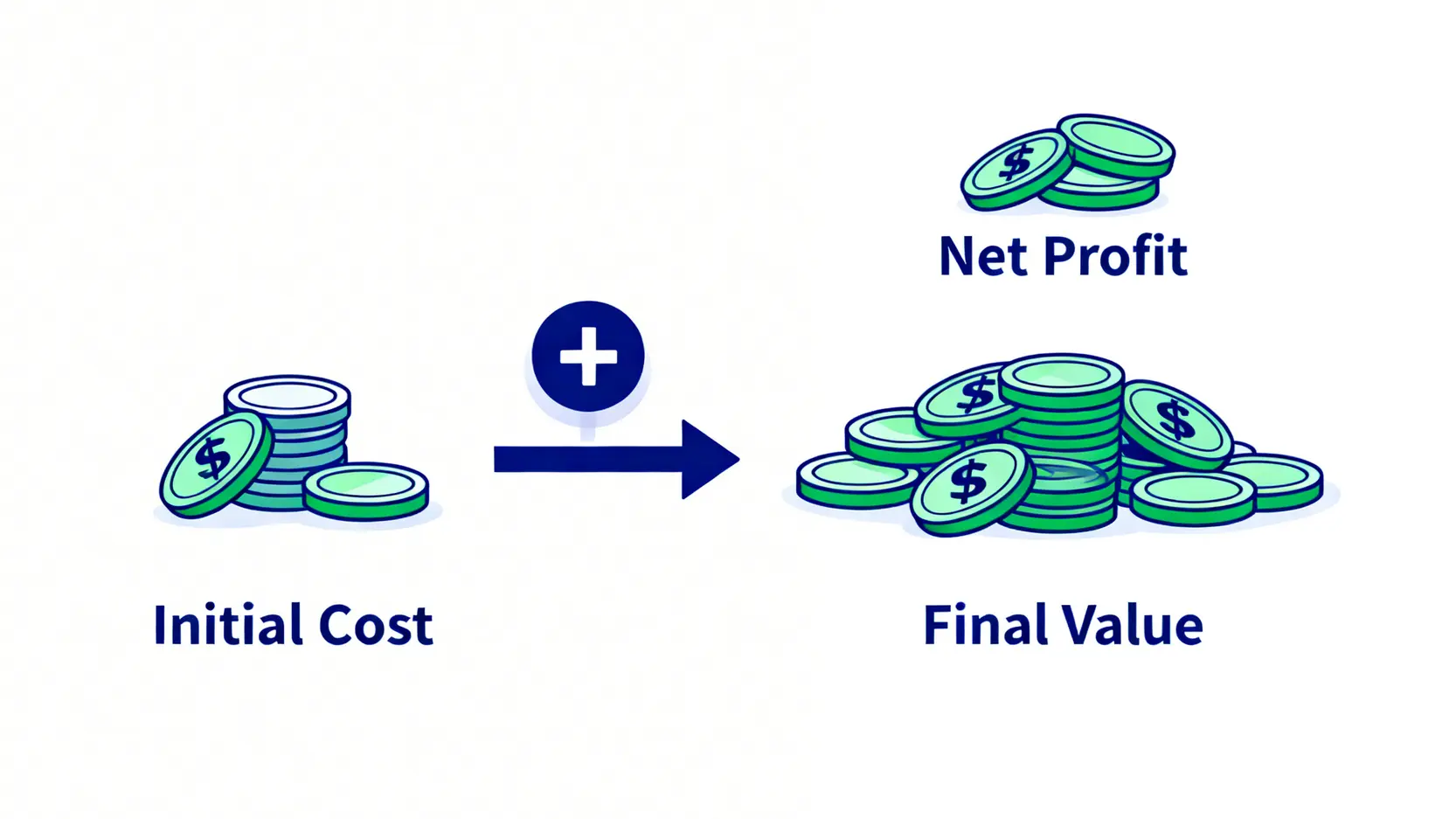
投資回報率(ROI)概念圖,展示了從初始成本到最終價值的增長過程,並標示出淨利潤。

Core concept of ROI: measuring net profit relative to initial cost.

This means your stock investment generated a total return of 24%.


How to Calculate Total Return and Annualized Return? Why Annualized Return Matters More?

The 24% calculated above is the “total return”. While useful, it has a critical limitation, which is why we need to understand the more advanced concept of “annualized return”.


Limitation of Total Return (ROI): Ignoring Time

The biggest issue with total return is that it completely ignores the factor of “time”. Consider the following scenarios:

  • Scenario 1: You invest in Project A and earn 20% return in 1 year.
  • Scenario 2: You invest in Project B and earn 20% return in 5 years.

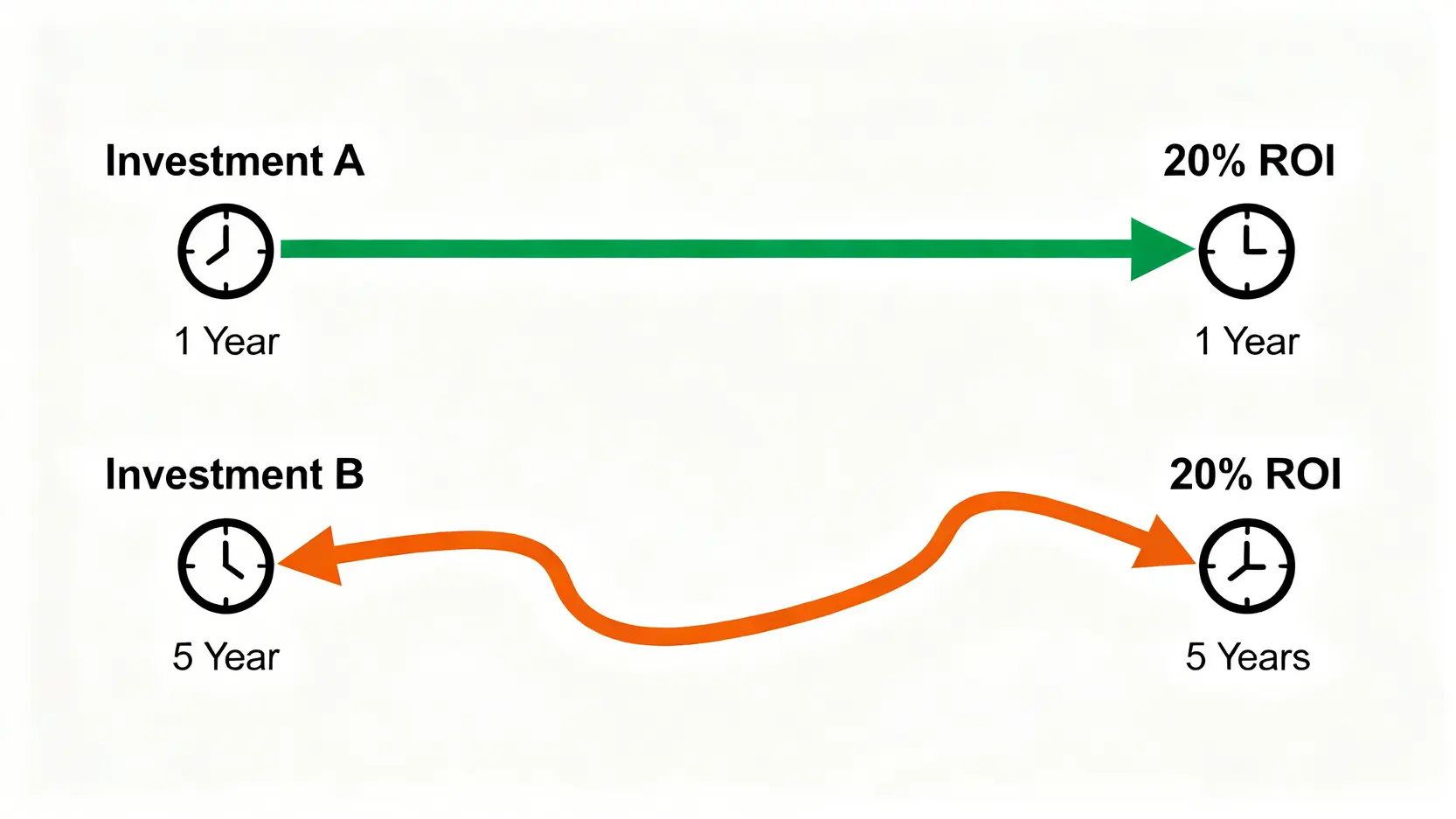
對比圖,顯示兩種投資雖然總回報率同為 20%,但一個耗時 1 年,另一個耗時 5 年,突顯時間成本的重要性。

Although both returns are 20%, the time taken is very different, leading to vastly different investment efficiency.

If you only look at total return, both appear equal. However, Project A is clearly more efficient than Project B. Your capital is tied up for five years in Project B to achieve the same return, implying a significant time and opportunity cost. ROI alone cannot reflect this difference, which is where “annualized return” becomes essential.


Definition of Annualized Return: A Fair Comparison Standard

Annualized Rate of Return converts the total return over an investment period into an average yearly return. It standardizes different investment durations into a common basis (one-year), allowing fair comparison.

In simple terms, it answers this question: “If the return were consistent each year, what annual rate would be required to achieve the total return over the given period?” Through annualization, you can clearly see the efficiency of capital growth.


Further Reading (Highly Recommended)

What Is a Hedge Fund? 2026 Investment Strategies, Principles, and Risk Analysis

Gold Investment Beginner’s Guide: 5 Channels Explained with Pros and Cons


How to Calculate Annualized Return Step by Step?

The formula for calculating annualized return is slightly more complex than ROI, but do not worry. Once you understand the logic and combine it with Excel tools, anyone can easily get started.


Detailed Explanation of the Annualized Return Formula

The formula for annualized return is as follows:

Annualized Return = ((1 + Total Return)^(1 / Investment Period)) – 1

Or by directly using values:

Annualized Return = ((Final Investment Value / Initial Investment Cost)^(1 / Investment Period)) – 1

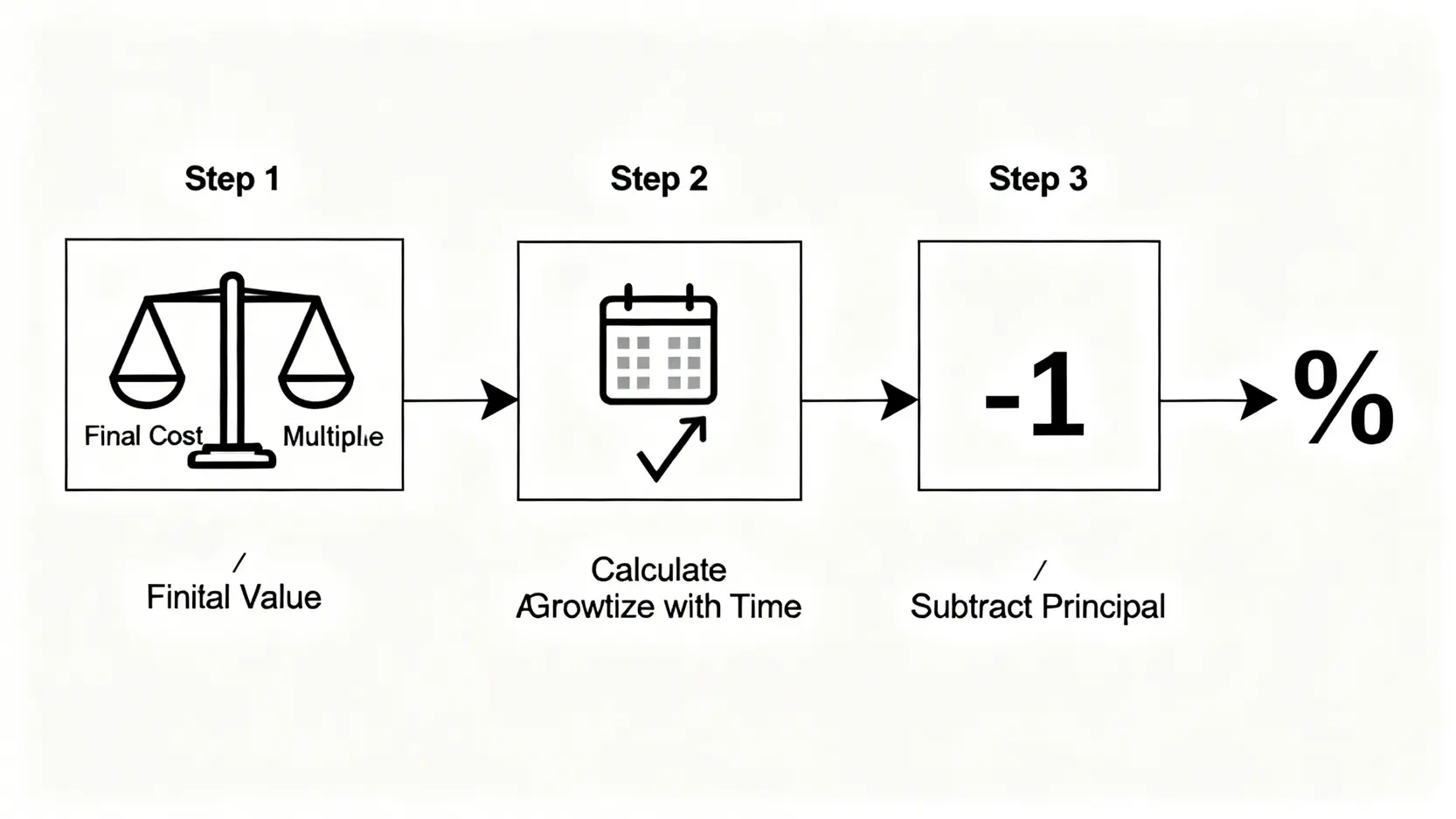
年化回報率計算公式的步驟分解圖,包含計算增長倍數、根據時間年化、以及扣除本金三個步驟。

The logic behind annualized return: distributing total return evenly across each year.

The ^ symbol represents “exponentiation”. Let’s break it down:

  • (Final Investment Value / Initial Investment Cost): This calculates the total growth multiple including principal.
  • ^(1 / Investment Period): This is the core of the formula. It takes the root of the total growth multiple to convert it into an average annual growth multiple. For example, for a 3-year investment, it takes the cube root.
  • -1: Finally subtract 1 to remove the principal portion and isolate the return rate.


Practical Guide: How to Use Excel to Calculate Annualized Return Quickly?

Manual exponentiation can be a bit tedious, but fortunately we have powerful spreadsheet tools like Excel (or Google Sheets). You only need to input a simple formula to complete the calculation.

You can use the POWER function or directly use the ^ symbol.

Assume your data is as follows:

  • Cell A1: Initial Investment Cost (e.g., 50000)
  • Cell B1: Final Investment Value (e.g., 62000)
  • Cell C1: Investment Period (e.g., 3)

You can enter one of the following formulas in cell D1:

Method 1 (using ^ symbol):

=((B1/A1)^(1/C1))-1

Method 2 (using POWER function):

=POWER(B1/A1, 1/C1) – 1

After pressing Enter, set the cell format to “Percentage” and you will instantly obtain the annualized return!


Case Study: Calculating Annualized Return for Stocks and Funds

Let us use two practical examples to reinforce the concept.

Case 1: Stock Investment

Three years ago, Xiao Ming invested 100,000 yuan to buy a stock mentioned in the beginner’s guide to stock investment. Today, he sold it entirely for 150,000 yuan, without receiving any dividends. What is the annualized return?

  • Initial Cost: 100,000
  • Final Value: 150,000
  • Investment Period: 3

Annualized Return = ((150000 / 100000)^(1/3)) – 1 ≈ 14.47%

Although the total return is as high as 50%, when distributed annually, the annualized return is approximately 14.47%.

Case 2: Fund Investment

Five years ago, Xiao Hua subscribed to Fund B, introduced in What Is a Fund? How to Invest in Funds?, with an initial investment of 200,000 yuan. To date, the total value of the fund (including reinvested dividends) has grown to 300,000 yuan. What is the annualized return?

  • Initial Cost: 200,000
  • Final Value: 300,000
  • Investment Period: 5

Annualized Return = ((300000 / 200000)^(1/5)) – 1 ≈ 8.45%

This 8.45% annualized return is a more meaningful indicator of long-term performance.


Frequently Asked Questions (FAQ)

Q: Is there a “good” standard for Return on Investment (ROI)?

A: There is no single standard answer. A “good” ROI depends on various factors, including the type of investment, risk level, overall market conditions, and your personal goals. Generally, you can refer to market benchmarks. For example, ETFs that track major indices (such as the S&P 500) have a long-term annualized return of around 8-10%. If your portfolio can consistently outperform the market under similar risk conditions, it can be considered a good performance.

Q: What is the difference between Internal Rate of Return (IRR) and annualized return?

A: Annualized return mainly applies to scenarios with a single investment and a single withdrawal. In contrast, the Internal Rate of Return (IRR) is more powerful, as it can handle multiple and irregular cash inflows (such as dividends) and outflows (such as additional investments) during the investment period. For investments with irregular cash flows, such as dollar-cost averaging or savings insurance, IRR is a more accurate measurement tool.

Q: Should inflation be considered when calculating returns?

A: Absolutely. The ROI or annualized return we usually calculate is the “nominal return” .However, what truly affects your purchasing power is the “real return”, which accounts for inflation. For example, if your annualized return is 7% and inflation is 3%, your real return is approximately 4%. Inflation must be considered in long-term financial planning.

Q: How are ROI and annualized return calculated if the investment incurs a loss?

A: The formula remains exactly the same, but the result will be negative. For example, if you invest 10,000 and it becomes 8,000 after one year, then ROI = ((8000 – 10000) / 10000) × 100% = -20%. This negative value directly reflects the proportion of your loss, and the calculation logic is universally applicable.


Conclusion

Accurately calculating return on investment is the foundation of successful investing. This article starts from the basic meaning of ROI, explains the core differences between total return and annualized return, and provides a detailed guide on how to calculate annualized return. Understanding and applying annualized return allows you to move beyond focusing only on total profit and instead evaluate your investments in stocks, funds, and other assets from a more balanced and long-term perspective. Start applying what you have learned today to reassess your portfolio and make more precise financial decisions!

If you liked this article, please share it!

Related Articles

  • Volatility Surface Guide: Skew Trading Strategies
    Practical Applications of Volatility Surfaces: From Options Modeling to Advanced Skew Trading Strategies In options markets, implied volatility is never a flat line. Instead, it forms complex "smile" or "skew" surfaces. For advanced traders, mastering the practical applications of volatility surfaces is equivalent to possessing a lens that reveals market...
    2026 年 6 月 3 日
  • Foreign Capital Flow Model: Track Institutional Money
    Building a Foreign Capital Flow Copy Trading Model: A Stock Market Indicator for Accurately Tracking Institutional Positioning In Asia-Pacific stock markets, foreign capital inflows and outflows often determine the direction of the index. However, simply looking at daily net buy and sell data is no longer enough. Only by building...
    2026 年 6 月 3 日
  • Options Buying Strategies for Extreme Market Risks
    Options Buyer Strategies During Extreme Market Conditions: Black Swan Hedging and Cross-Market Arbitrage During Volatility Surges The most terrifying aspect of financial markets is not a gradual decline, but overnight flash crashes and cross-market capital withdrawals accompanied by volatility surges. In the highly unpredictable global macroeconomic environment of 2026, geopolitical...
    2026 年 6 月 3 日
返回顶部