Hedge Fund Guide 2026: Strategies, Principles & Risks

What Is a Hedge Fund? 2026 Investment Strategies, Principles, and Full Risk Analysis
Hedge funds (Hedge Fund) often carry an aura of mystery. In the eyes of many, they seem like an exclusive game for Wall Street giants, far removed from ordinary investors. But how do they actually operate? Why are they able to profit in both bull and bear markets? This article will provide a complete explanation of hedge fund principles, explore core hedge fund investment strategies in depth, and reveal the underlying hedge fund risks, helping you fully understand this complex yet fascinating top-tier investment tool.
What Exactly Is a Hedge Fund? Understanding Its Operating Model from Core Principles
A hedge fund, also known as a private investment fund, is a private investment partnership that pools capital from multiple investors. It has a high degree of flexibility in its operations and can utilize a wide range of financial instruments and complex trading strategies, with the goal of generating “absolute return” for investors. In other words, it aims to achieve positive returns regardless of whether the overall market is rising or falling.
The True Meaning of “Hedging”: Not Just Risk Avoidance, but Absolute Return
Many people, upon seeing the term “hedge” or “risk hedging”, assume that the primary purpose of a hedge fund is simply to “avoid risk”. This is only partially correct. The essence of hedge funds lies in using “hedging” as a tool to control and manage risk, rather than completely eliminate it.
A simple example:
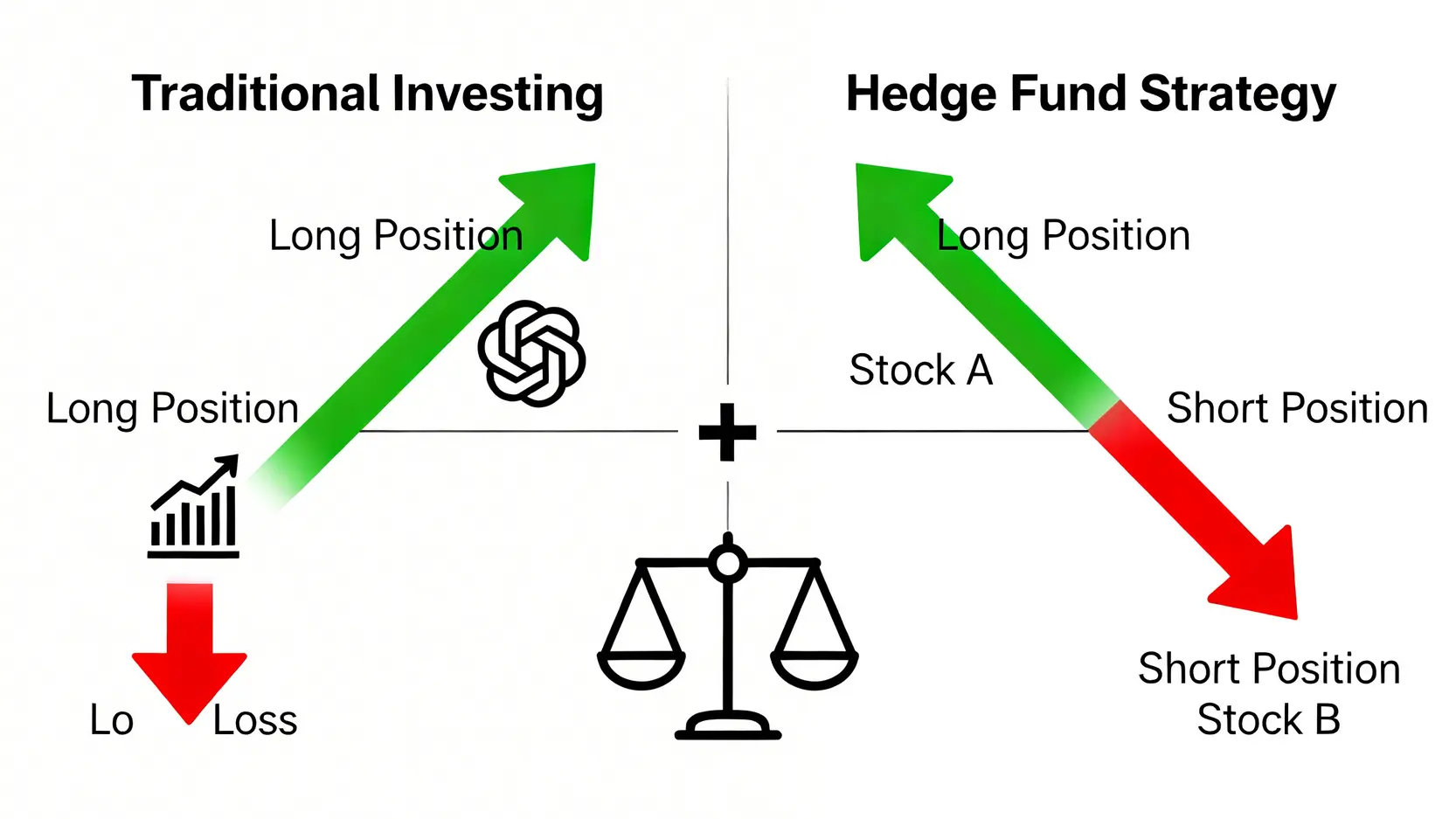
- Traditional investing: If you are optimistic about stock A, you would buy (go long) stock A. If the price rises, you profit; if it falls, you incur a loss. Your gains and losses depend entirely on the market moving in a single direction.
- Hedging approach: A hedge fund manager may simultaneously buy (go long) stock A, which they believe will rise, and sell (go short) stock B, which they believe will fall. In this way, even if the overall market declines, as long as stock A falls less than stock B, the portfolio can still generate a profit.

The Core Principle of Hedge Funds: Using long and short positions simultaneously to reduce reliance on a single market direction.
Through this long-short approach, fund managers can reduce dependence on the overall market direction (Beta) and focus on capturing the relative value of individual assets (Alpha), which is the core operating principle behind hedge funds’ pursuit of absolute return.
Significant Differences from Mutual Funds: Investment Threshold, Flexibility, and Regulation
Hedge funds differ greatly from the more familiar mutual funds (Mutual Fund) in many aspects. For investors who want to understand hedge fund investment strategies, clearly distinguishing between the two is essential.
| Comparison Items | Hedge Fund |
Mutual Fund |
| Investment Objectives | Pursues absolute return regardless of market direction | Typically seeks relative returns that outperform market benchmarks (such as the S&P 500) |
| Investment Strategies | Flexible and diverse, can use leverage, derivatives, and short selling | Strategies are relatively simple, usually focused on going long in equities or bonds, with more restrictions |
| Investment Threshold | Very high, limited to “qualified investors” or “professional investors” | Low threshold, generally accessible to the public |
| Regulatory Oversight | Less regulated, with lower information transparency | Strictly regulated, with requirements for regular disclosure of holdings and financial status |
| Fee Structure | “2/20” rule: 2% management fee + 20% performance fee | Primarily management fees, usually between 1% – 2% |
| Liquidity | Relatively low, with lock-up period and redemption restrictions | High liquidity, typically allowing daily subscription and redemption |
Simply put, mutual funds are like public transportation, with clear rules, fixed routes, and accessible to everyone; whereas hedge funds are like Formula One racing cars, powerful and complex to operate, only allowing professional drivers (qualified investors) to drive on specific tracks (private markets).
Further Reading (Highly Recommended)
Breaking Down 5 Major Mainstream Hedge Fund Investment Strategies
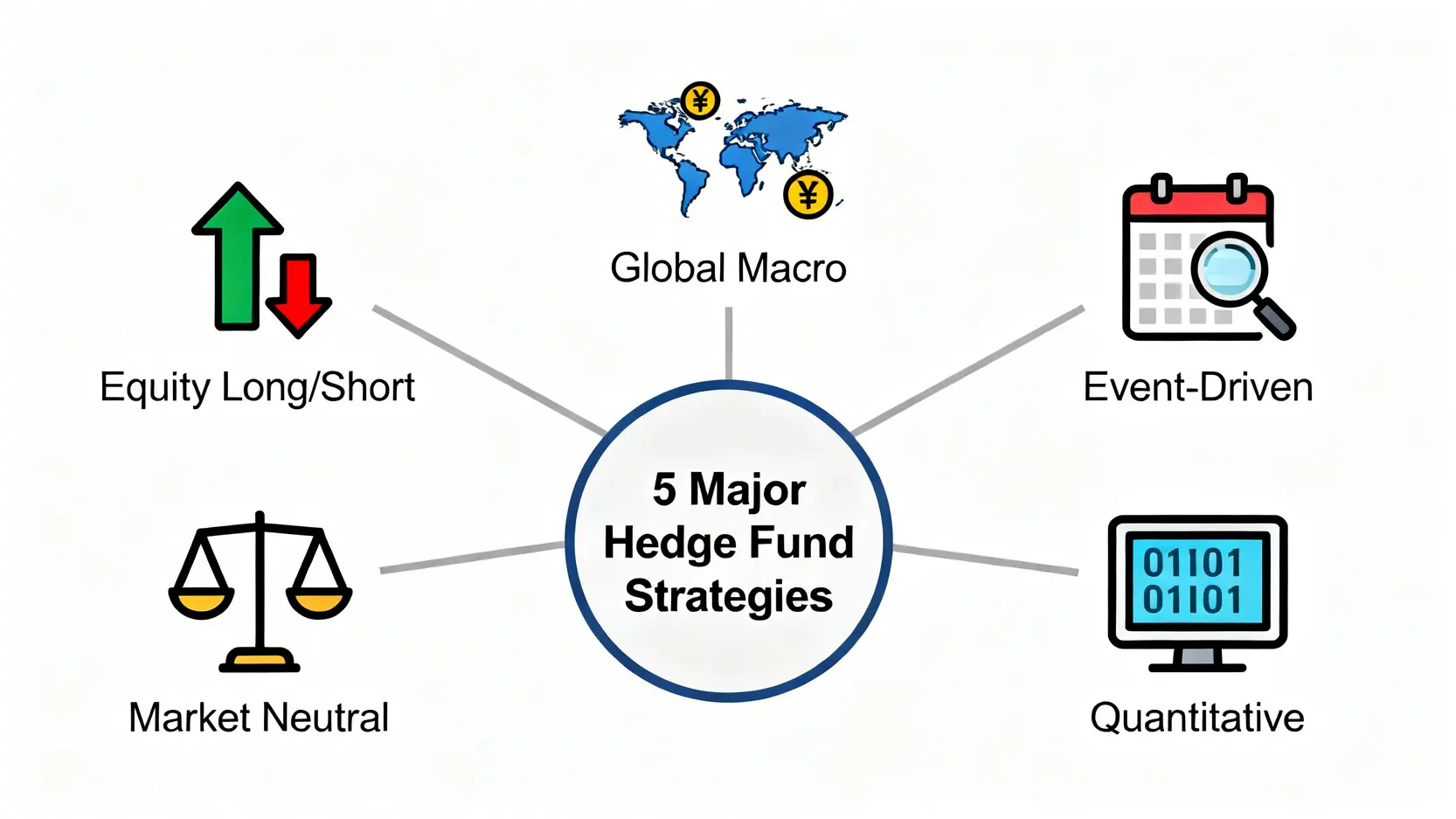
The profitability of hedge funds comes from their diverse range of investment strategies. Understanding these mainstream strategies is key to grasping hedge fund principles. Below is a breakdown of five of the most common hedge fund investment strategies:

The five major mainstream hedge fund strategies each have different market entry points and profit models.
Equity Long/Short: The Most Classic Hedging Strategy
This is the oldest and most widely used strategy. Fund managers construct a portfolio consisting of “long positions” (buying stocks expected to rise) and “short positions” (selling stocks expected to fall).
- Core operation: The core lies in stock selection ability. The goal is for the gains of long positions to exceed those of short positions (or in a bear market, for long positions to decline less than short positions).
- Advantage: Through hedging with short positions, it can significantly reduce the impact of overall market downturns, allowing the fund’s performance to focus more on the manager’s stock-picking skills.
- Example: A fund manager may go long (buy) promising technology stocks while going short (sell) traditional retail stocks that are considered overvalued.
Global Macro: Targeting Opportunities from Global Political and Economic Changes
Fund managers using this strategy act as “global hunters”, focusing on macroeconomic trends worldwide, such as interest rate changes, monetary policy, and geopolitical events, to identify investment opportunities. George Soros’s Quantum Fund is a representative example of this strategy.
- Core operation: Deep understanding and forward-looking judgment of the global economy.
- Investment instruments: Not limited to equities, but widely used foreign exchange, bonds, commodity futures, and index derivatives.
- Example: If a manager expects a country to implement monetary easing leading to currency depreciation, they may establish a short position in that currency in advance to profit.
Event-Driven: Profiting from Corporate Mergers and Restructuring
This strategy focuses on identifying profit opportunities from specific corporate events. These events often have a significant impact on stock prices, such as mergers and acquisitions, business spin-offs, bankruptcy restructuring, and legal disputes.
- Core operation: Accurately predicting the outcome of events and their impact on stock prices.
- Sub-strategy: The most common is “merger arbitrage”. When Company A announces an acquisition of Company B at $50 per share, if Company B is currently trading at $45, the fund will buy shares of Company B and earn the $5 spread per share once the deal is completed.
- Risk: The main risk lies in the possibility that the event does not occur as expected (such as a failed acquisition).
Market Neutral: Eliminating Market Fluctuations to Generate Stable Returns
The market neutral strategy is an extreme version of the equity long/short strategy. Its goal is to reduce market risk (Beta) to near zero, creating a portfolio that is almost unaffected by overall market movements. This may sound remarkable, but the underlying hedge fund principle is clear.
- Core operation: Build a portfolio with equal value in long and short positions. For example, buying $10 million of stocks expected to rise while simultaneously shorting $10 million of stocks expected to fall.
- Source of profit: Purely from the excess return (Alpha) where the long portfolio outperforms the short portfolio.
- Characteristics: Since market fluctuations are removed, this strategy tends to perform relatively steadily in volatile markets, but expected returns are usually lower.
Quantitative Strategies: Algorithm-Driven High-Frequency Trading
These funds are also known as “quant funds”, relying on complex mathematical models and powerful computer algorithms to make trading decisions, minimizing human subjective judgment. Renaissance Technologies is a leading example in this field.
- Core operation: Through data analysis, identify small but high-probability pricing inefficiencies or trading patterns, and accumulate profits through high-frequency and large-volume trading.
- Advantage: Eliminates emotional interference and enforces strong trading discipline.
- Challenge: Models may fail when market structures change, and it requires top-tier talent in mathematics and computer science.
Must-Read Before Investing: Three Major Potential Risks of Hedge Funds
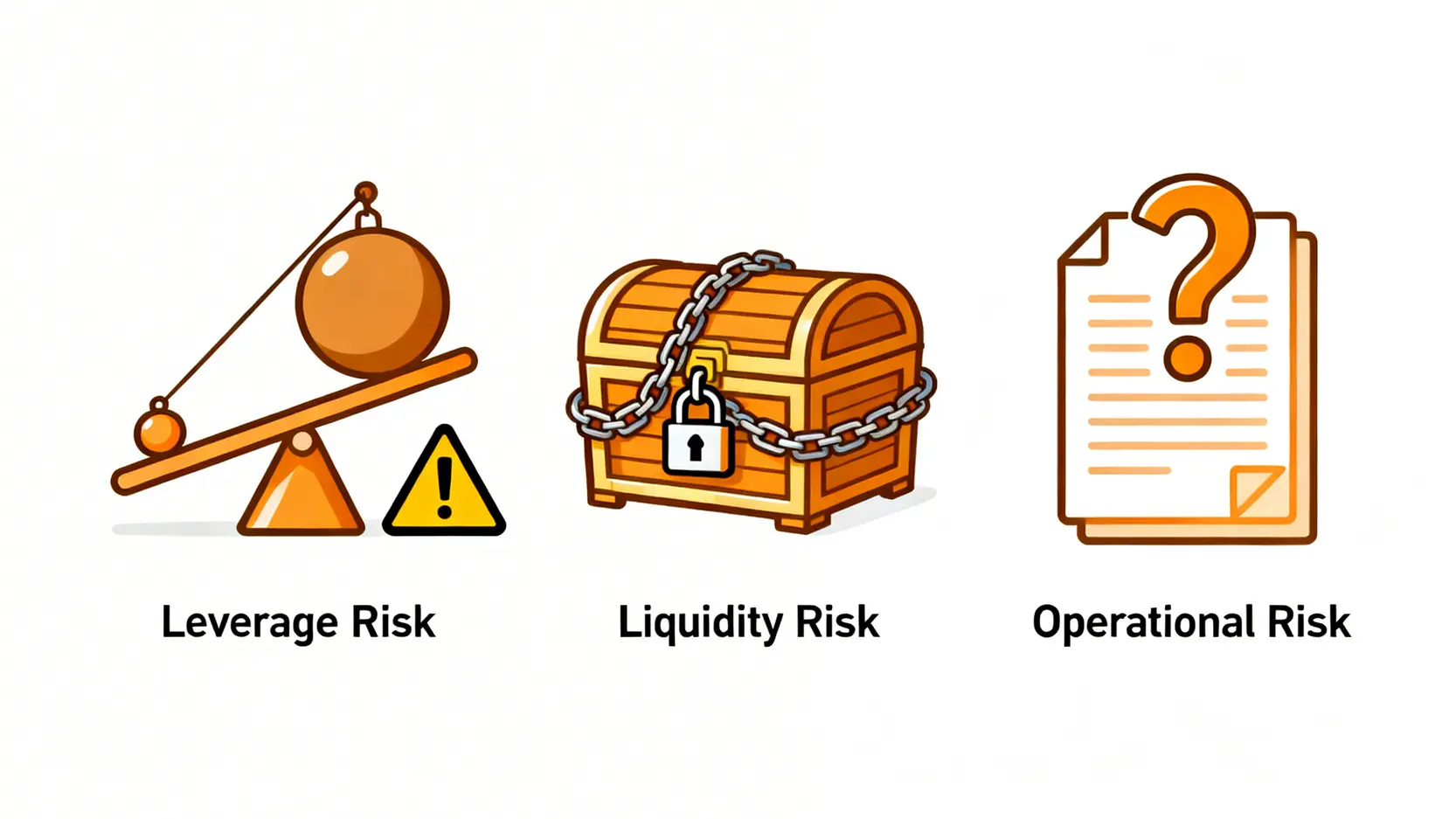
Although hedge funds offer attractive return potential, the investment risks behind them should not be underestimated. Before considering any related investment, it is essential to clearly understand the following three major hedge fund risks:

Before investing in hedge funds, it is necessary to carefully evaluate the three core risks.
Leverage Risk: A Double-Edged Sword That Can Both Create and Destroy Wealth
Leverage is a key tool for many hedge funds to amplify returns, often using borrowed funds to expand investment scale. While leverage can turn small market movements into substantial profits, the reverse is also true. If the market moves against expectations, leverage will magnify losses, potentially causing the fund’s net asset value to evaporate rapidly and resulting in total loss of capital. The collapse of Long-Term Capital Management (LTCM) in 1998 is a painful example of leverage risk.
Liquidity Risk: The Difficulty of Converting Assets into Cash
To execute complex strategies, hedge funds often invest in less liquid assets, such as private equity, specialized bonds, or complex structured derivatives. In addition, to prevent large-scale capital outflows from affecting operations, funds generally impose a “lock-up period”, during which investors are not allowed to redeem their investments. This means that when you urgently need funds or want to adjust your investments, your capital may be “locked” and cannot be liquidated in time.
Operational and Transparency Risk: High Fees and Information Asymmetry
The relatively loose regulation of hedge funds means they are not required to frequently disclose holdings and strategy details like mutual funds. Investors find it difficult to fully understand the fund’s actual operations and risk exposure. At the same time, the high “2/20” fee structure may erode your investment returns. Even if the fund performs poorly, you are still required to pay a 2% management fee. This information asymmetry and high fee structure constitute a certain level of operational risk for investors.
FAQ Frequently Asked Questions
Q: Can individual investors buy and sell hedge funds?
A: Generally speaking, the threshold for directly investing in hedge funds is very high. Regulations in various countries usually require investors to be “accredited investors” or “professional investors” which means meeting certain asset or income requirements (for example, a net worth exceeding one million US dollars). This is to ensure that investors have sufficient financial strength and knowledge to bear the high risks of hedge funds. However, in recent years, there have been funds of hedge funds or certain liquid alternative investment ETFs, allowing ordinary investors to participate indirectly with a lower threshold.
Q: What is the fee structure of hedge funds? (2/20 rule)
A: The most classic fee structure of hedge funds is known as “2 and 20”. This includes two components:
- Management fee: Regardless of profit or loss, 2% of the total fund assets is charged annually as a management fee.
- Performance fee: 20% of the fund’s profits is taken as a performance incentive. It is usually accompanied by a “high-water mark” clause, ensuring that the fund must reach a new high before performance fees can be charged, preventing managers from earning bonuses after losses. This fee structure is designed to incentivize fund managers to generate better returns.
Q: Is investing in hedge funds guaranteed to make a profit?
A: Absolutely not. This is a very common misconception. Although hedge funds aim to generate returns in any market environment, this does not mean they are risk-free or guarantee profits. There have been many cases in history where well-known hedge funds collapsed due to strategy failures, black swan events, or excessive use of leverage. Their complexity and high-risk nature mean that losses are also possible, and may even be substantial. It is essential to conduct thorough due diligence before investing.
Q: What is a high-water mark (High-Water Mark)?
A: A high-water mark is an important clause for hedge funds in charging performance fees. It means that the fund’s net asset value must exceed its historical peak (the “water mark”) before the manager can charge performance fees on new profits. For example, if a fund’s NAV falls from $100 to $80 and later recovers to $100, the manager cannot charge any performance fees during this period. Only when the NAV exceeds $100, such as reaching $110, can the manager charge a 20% performance fee on the $10 profit. This mechanism protects investors by preventing them from paying performance fees for merely “recovering previous losses”.
Conclusion
In conclusion, hedge funds, with their flexible and diverse investment strategies and goal of achieving absolute return, provide professional investors with the potential to outperform traditional markets. From classic equity long-short strategies to complex quantitative models, these strategies demonstrate the depth and breadth of financial markets. However, their characteristics of high leverage, complexity, and high entry thresholds are also accompanied by significant leverage risk, liquidity risk, and operational risk. Before considering including hedge funds in an investment portfolio, it is essential to fully understand their operating principles and various potential investment risks, and to seek advice from professional financial advisors.
Related Articles
-
Practical Applications of Volatility Surfaces: From Options Modeling to Advanced Skew Trading Strategies In options markets, implied volatility is never a flat line. Instead, it forms complex "smile" or "skew" surfaces. For advanced traders, mastering the practical applications of volatility surfaces is equivalent to possessing a lens that reveals market...2026 年 6 月 3 日
-
Building a Foreign Capital Flow Copy Trading Model: A Stock Market Indicator for Accurately Tracking Institutional Positioning In Asia-Pacific stock markets, foreign capital inflows and outflows often determine the direction of the index. However, simply looking at daily net buy and sell data is no longer enough. Only by building...2026 年 6 月 3 日
-
Options Buyer Strategies During Extreme Market Conditions: Black Swan Hedging and Cross-Market Arbitrage During Volatility Surges The most terrifying aspect of financial markets is not a gradual decline, but overnight flash crashes and cross-market capital withdrawals accompanied by volatility surges. In the highly unpredictable global macroeconomic environment of 2026, geopolitical...2026 年 6 月 3 日