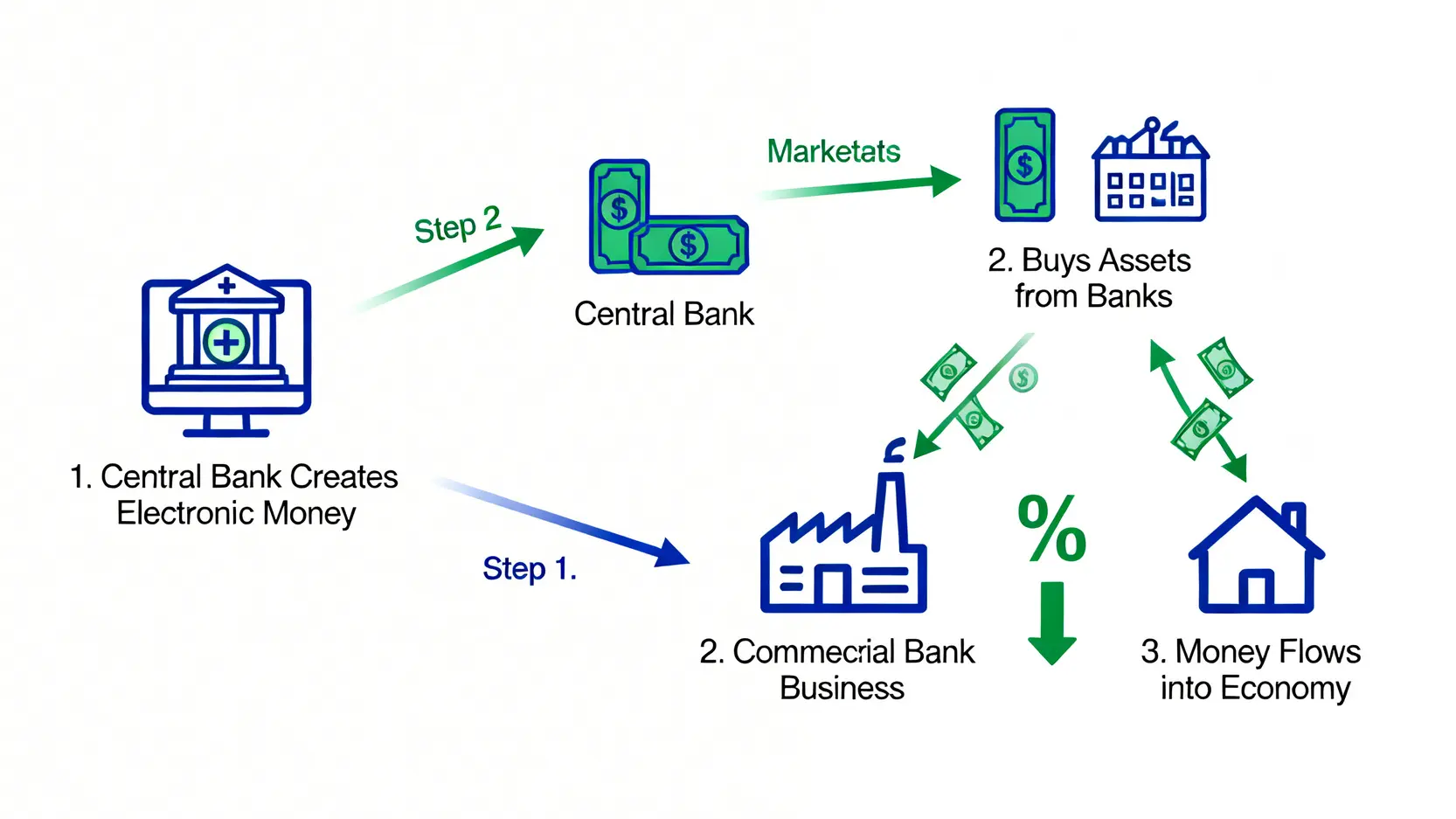
Illustration: The Three-Step Transmission Mechanism of Quantitative Easing (QE)
The 5 Core Effects of Quantitative Easing (QE) on the Economy and Markets
Although QE is intended as a powerful remedy to save the market, its effects are broad and far-reaching. It brings both benefits and side effects that cannot be ignored. Understanding these effects of quantitative easing is essential for every investor who wants to navigate the market wisely and avoid risk.
Positive Effect: Stimulating the Stock Market and Asset Prices
When QE begins, liquidity floods the market, while interest rates on traditional fixed-income products such as savings deposits and bonds are pushed to extremely low levels. In search of higher returns, capital flows heavily into risk assets, especially the stock market. This is what is often called a “liquidity-driven market”.
- Abundant liquidity: More money chasing a limited supply of stocks naturally pushes up stock prices.
- Lower borrowing costs: Companies can raise funds more easily at low cost, helping to improve earnings expectations and support stock prices.
- Wealth effect: Rising stock prices and property prices make asset holders feel wealthier, encouraging them to spend more and further stimulate the economy.
For investors who want to participate in the market, understanding the basics in Hong Kong Stock Investment Guide for Beginners: Learn How Stocks Make Money From Scratch (With 2026 Popular Hong Kong Account Recommendations) is the first step to seizing opportunities in the QE era.
Negative Effect: The Risk of Inflation and Widening Wealth Inequality
The most direct potential risk of QE is inflation. When the amount of money circulating in the market far exceeds the growth rate of actual goods and services, money becomes “less valuable”, and prices rise across the board. This is what we commonly call “inflation”. If wage growth fails to keep pace with rising prices, the purchasing power of ordinary people will be eroded.
In addition, QE is often criticized for worsening wealth inequality. This is because wealthy people usually hold more assets such as stocks and real estate, allowing them to benefit greatly from rising asset prices. Ordinary people or renters who mainly rely on wage income, on the other hand, not only fail to enjoy the gains from asset appreciation, but must also bear the pressure of higher living costs, leading to the phenomenon where “the rich get richer, and the poor get poorer”.
Impact on the Property Market: Does a Low-Interest-Rate Environment Drive Up Housing Prices?
QE has a very direct effect on the property market. When central banks push down long-term interest rates, mortgage rates offered by commercial banks also tend to remain at historic lows. This significantly reduces borrowing costs and monthly repayment pressure for homebuyers, stimulating housing demand. When supply remains relatively unchanged, a surge in demand naturally drives up housing prices. As a result, during QE periods, we often see significant rises in real estate markets across major global cities.
Impact on Exchange Rates: Why Does QE Cause a Currency to Depreciate?
From a supply-and-demand perspective, when a country implements QE, it is effectively increasing the supply of its currency substantially. According to the law of supply and demand, the value of that currency (meaning its exchange rate) will decline, causing it to depreciate against foreign currencies. A weaker currency benefits exports because domestic goods become cheaper in international markets, but it also makes imported goods more expensive, which may trigger imported inflation.
Investor Response Strategies: 3 Asset Allocation Suggestions for the QE Era
In response to market changes brought by QE, investors need to adjust their strategies flexibly:
- 1. Go with the trend and embrace risk assets: As the saying goes, “Do not fight the central bank”. In the early and middle stages of monetary easing, risk assets such as stocks usually perform well. Moderately allocating to high-quality stocks or equity funds is one of the main ways to benefit from QE.
- 2. Allocate to inflation-resistant assets: To hedge against currency depreciation and inflation risk, investors may consider adding a certain proportion of inflation-resistant assets to their portfolios, such as gold, commodities, and real estate investment trusts (REITs).
- 3. Stay alert to bubbles and exit risks: Asset prices inflated by QE may carry bubble risks. Investors need to remain vigilant at all times and closely watch for “exit” (tapering) signals from the central bank. Once the market expects liquidity to tighten, asset prices may experience sharp corrections.
Common Questions About Quantitative Easing (FAQ)
Does QE Equal Direct “Money Printing”?
Not exactly. Although the effect is similar to injecting liquidity into the market, QE creates “electronic money” that mainly exists in reserve accounts within the banking system, rather than being physically printed and distributed to the public. These funds must flow into the real economy through channels such as bank lending, making the transmission process more indirect and complex than direct “money printing”.
When Will Quantitative Easing End (Taper)?
When the central bank determines that the economy has stabilized and recovered, for example when unemployment continues to decline and inflation reaches or approaches the target level, (usually 2%), it will consider gradually reducing the scale of its asset purchases. This process is known as “Tapering”. Taper is the first step in exiting QE and is usually seen by the market as a signal that monetary policy is shifting from easing to tightening.
What Is the Difference Between QE and QT (Quantitative Tightening)?
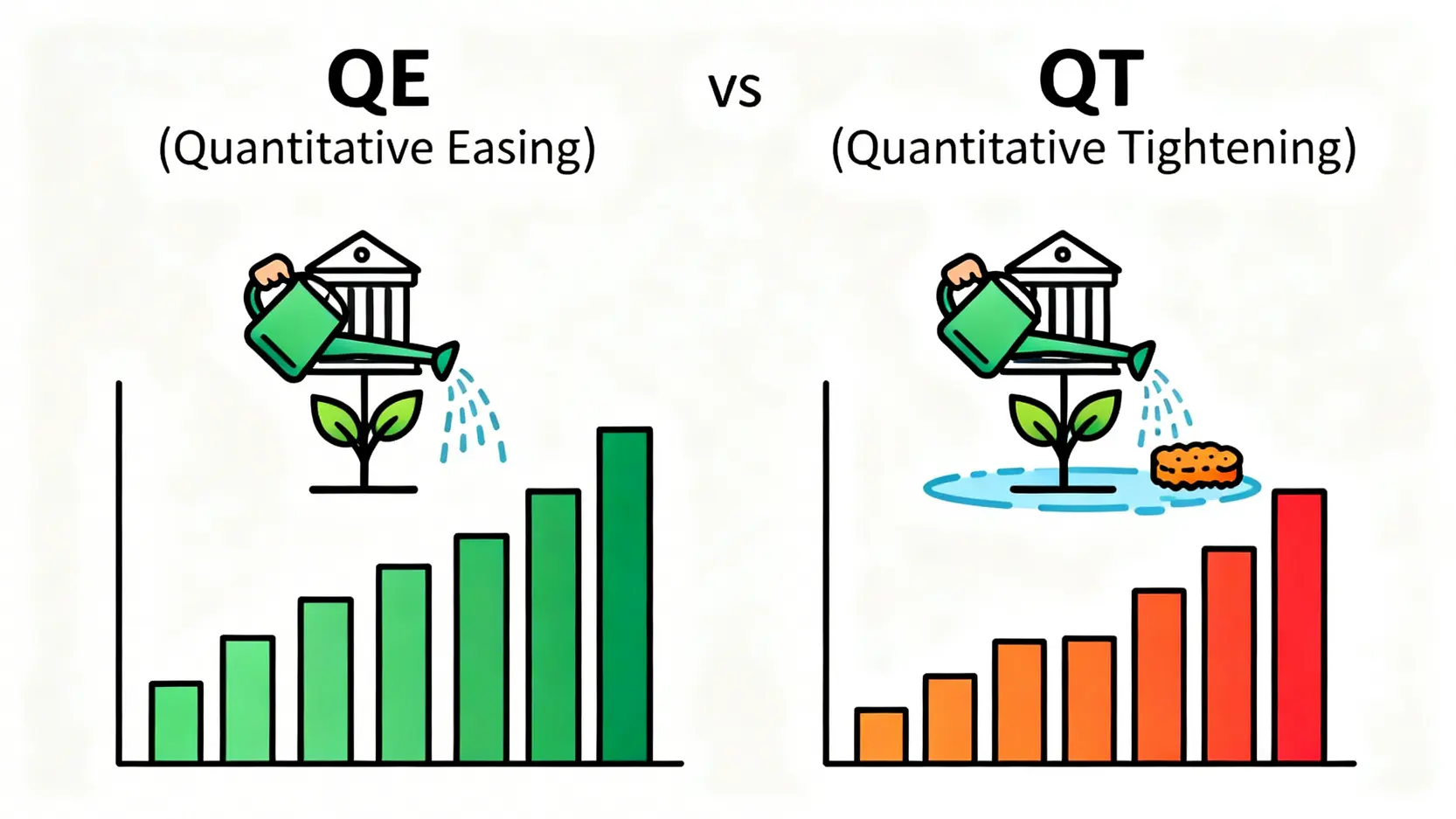
QE (Quantitative Easing) and QT (Quantitative Tightening) are completely opposite operations. QE involves the central bank “expanding” its balance sheet and “injecting liquidity” into the market, while QT involves the central bank “shrinking” its balance sheet and “withdrawing liquidity” from the market. QT is implemented by stopping the reinvestment of principal from maturing bonds or directly selling held bonds, with the aim of reducing the money supply in the market and curbing an overheating economy and high inflation.