Oil Price Crash: Causes, Market Impact & Investments

Updated: 2026/07/08  |  CashbackIsland

oil-price-crash

Oil Price Crash: Causes, Market Impact, and Top Investments

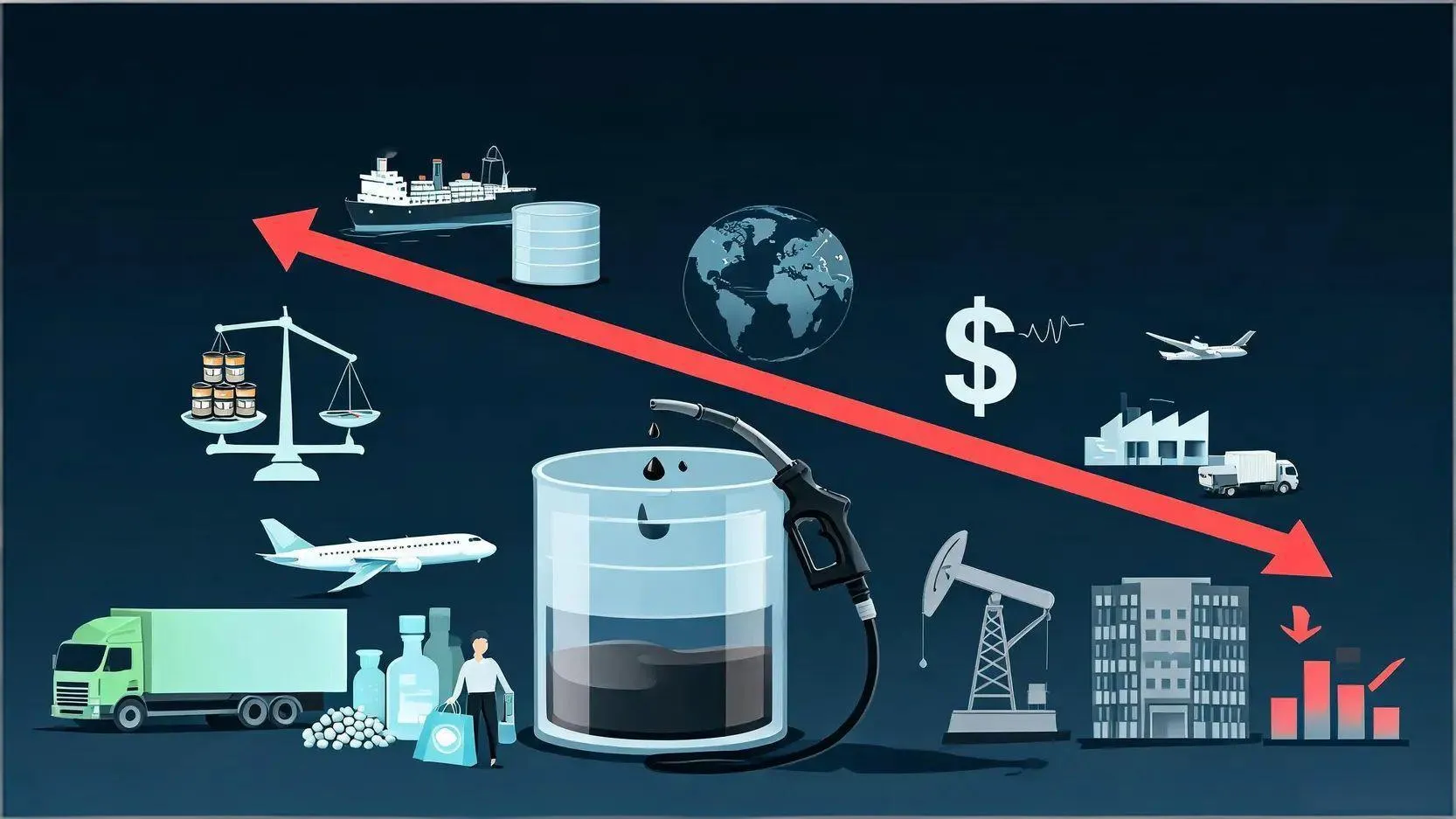
The discussion around oil prices being cut in half is heating up again. From news reports to market research, everyone is watching the same question: will the sharp drop in international oil prices continue to a level that shocks the market? For investors, instead of focusing on emotions, the more important task is to break down the reasons behind falling oil prices, understand the impact of lower oil prices, and convert the “possible oil price forecast path” into an actionable asset allocation plan. You may not feel the impact clearly when refueling in Taiwan or Malaysia, but in global financial markets, once crude oil prices fall, inflation, interest rates, exchange rates, and industry profits will all be repriced.

To put it plainly, falling oil prices are not necessarily purely positive. For consumers, it means saving money. For some industries, it means lower costs. But if oil prices fall because demand is weakening, this is often accompanied by an “economic slowdown”. This article will explain, from an investor’s perspective, the three main reasons behind oil prices being cut in half, historical lessons, a list of benefiting and affected industries, and why “international oil prices can fall sharply, yet domestic fuel prices often rise more than they fall”.


Why International Oil Prices Are Facing a Halving Crisis: Three Key Reasons Behind Falling Oil Prices

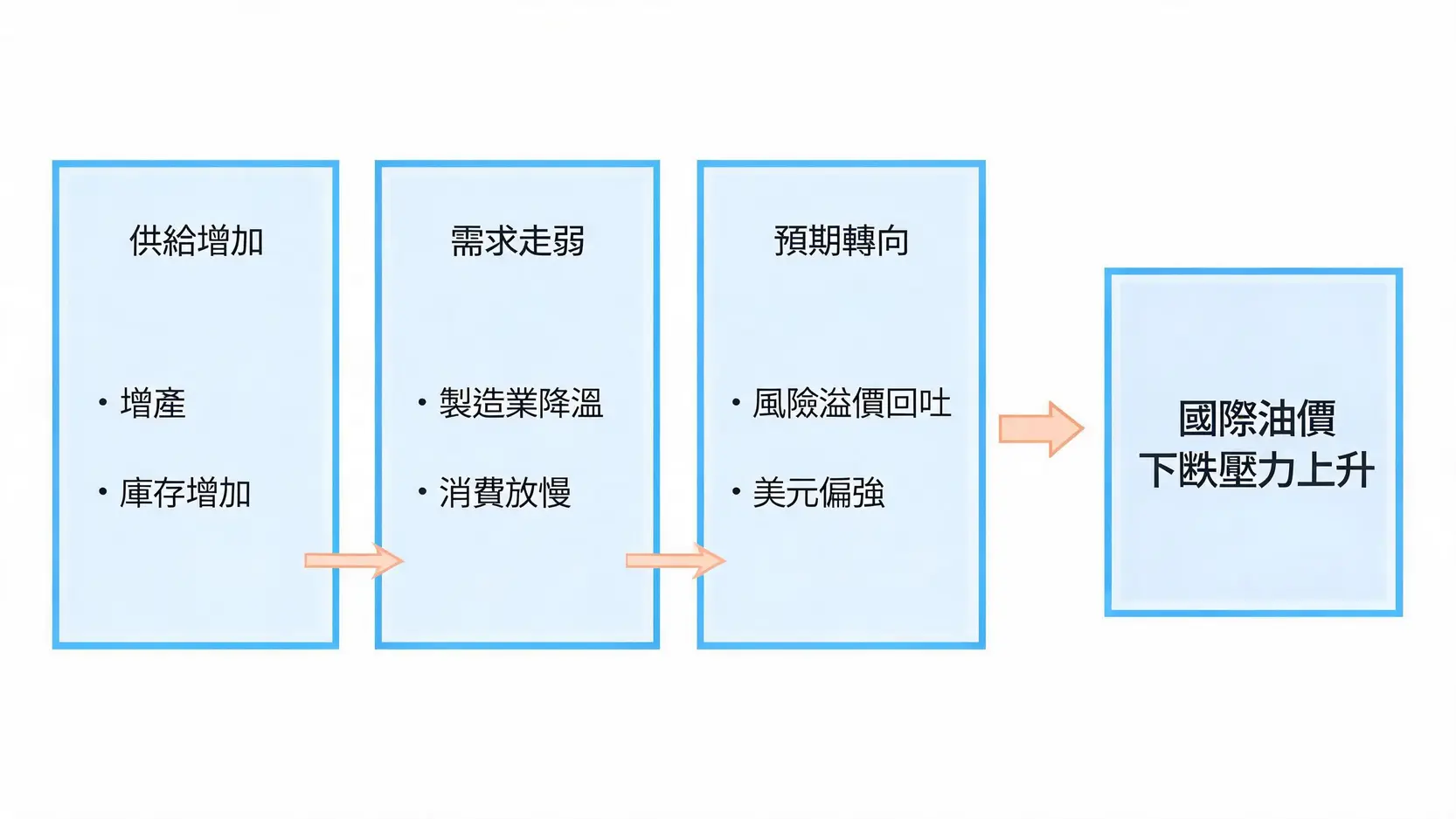
When the market talks about oil prices being cut in half, it is usually not based on feelings, but on the simultaneous overlap of three forces: “rising supply, weakening demand, and shifting expectations”. When these three things happen at the same time, a sharp drop in international oil prices is not surprising.

三大油價下跌原因流程圖:供給增加、需求走弱與預期轉向匯聚成油價下跌壓力

Three Forces Overlap: Supply, Demand, and Market Expectations Jointly Drive Oil Prices Lower.


Worsening Supply-Demand Imbalance: Rising Supply From Oil-Producing Countries vs Slower Global Demand Growth

Crude oil is ultimately a commodity, and its price moves around supply and demand over the long term. When excess supply emerges (such as increased production by oil-producing countries, higher non-OPEC supply, or slower inventory replenishment) while demand cools due to the global manufacturing cycle and weaker consumption, it can easily form a downward trend of “oversupply”.

The demand outlook for 2026 is especially worth close attention from investors. Taking the International Energy Agency’s IEA monthly report as an example, the report takes a relatively conservative tone on global demand trends, so the market naturally prices in “weaker-than-expected demand” first. You may refer to this authoritative source: IEA Oil Market Report – June 2026. When demand expectations are revised downward, the central range of oil price forecasts will also move lower. This is one of the typical reasons behind falling oil prices.

Geopolitical Shifts: Fading War Risk Premium and Expectations of Peace Agreements

Many people instinctively believe that “war means oil prices must rise”. However, trading markets focus on the probability of supply disruptions and risk premiums, not the news headlines themselves. When the market believes that a conflict is controllable, that there has been no genuine large-scale disruption to shipping or production areas, or that the likelihood of peace talks has increased, the previously elevated risk premium will be priced out, creating downward pressure on international oil prices.

In addition, if major consuming countries release strategic reserves, or major oil-producing countries use “verbal intervention” to stabilize market expectations, short-term prices may first fall before stabilizing. This type of scenario is the easiest for investors to misjudge: they may assume that falling oil prices represent a permanent trend, only for prices to surge again when an unexpected supply-side event occurs.

Energy Transition Trends: The Long-Term Displacement of Traditional Fuel by Electric Vehicles and Green Alternative Energy

The energy transition will not make oil prices fall every day, but it will change “how much valuation the market is willing to assign to crude oil”. As electric vehicle penetration rises, countries raise fuel efficiency standards, and the costs of renewable energy and energy storage decline, the long-term demand curve will be pushed downward. This structural pressure will make oil price declines deeper each time the economy slows, while keeping rebounds more restrained.

In other words: oil prices may not be halving every day, but a market structure where they are “more likely to fall sharply” is indeed taking shape.


Historical Lessons: How the Impact of a Halving in Oil Prices Shakes the Global Economy

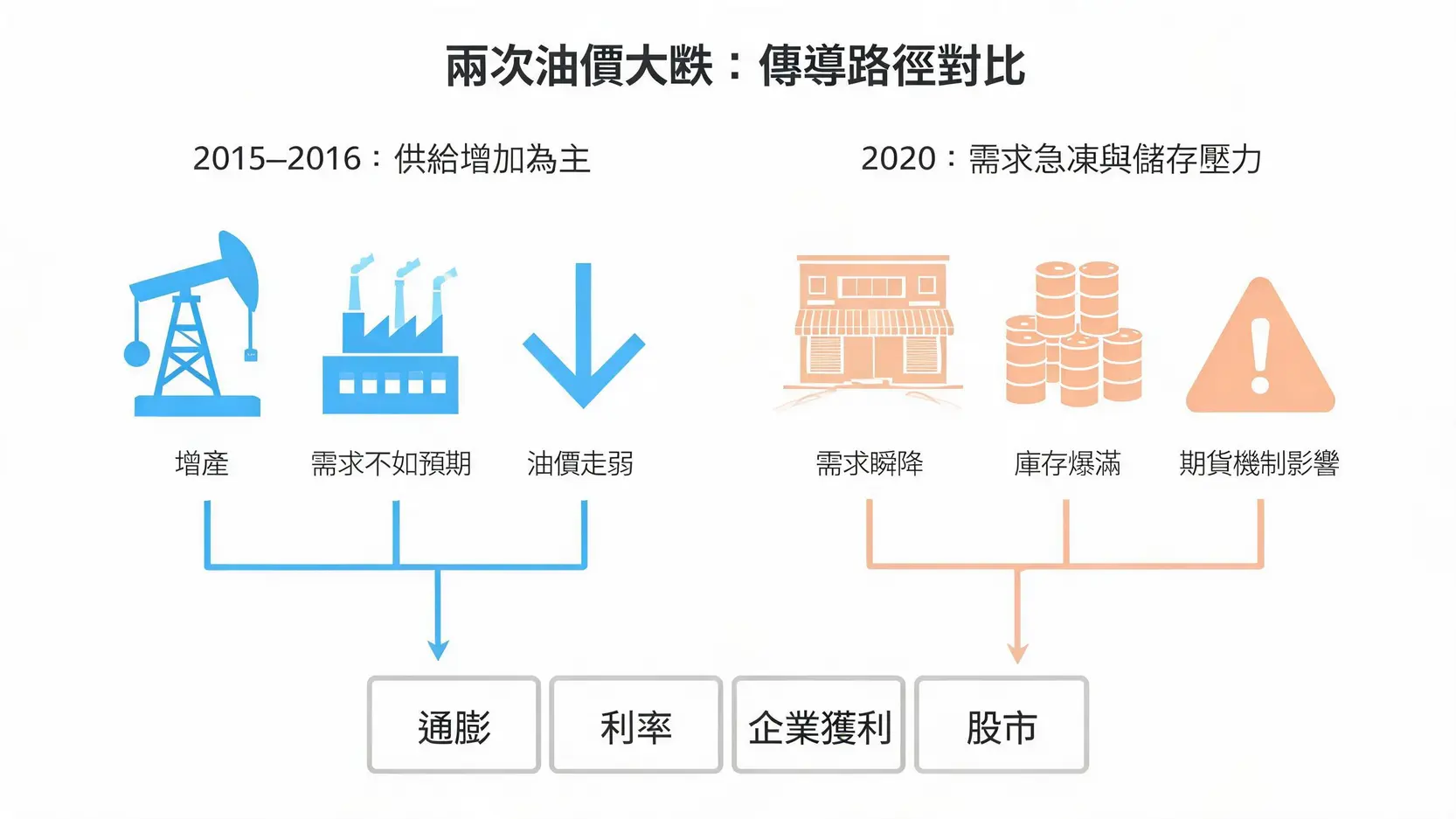
When looking at oil price forecasts, the biggest risk is focusing on only one line. Looking back at two representative major declines (2015-2016 and 2020) allows for a more comprehensive understanding of the channels through which the impact of falling oil prices transmits to the stock market and the economy.

2015-2016與2020兩次油價大跌原因與影響路徑對比圖

Even when oil prices fall sharply, different causes lead to different transmission rhythms across inflation, interest rates, and the stock market.


2015-2016 Oil Price Collapse: Economic Cycle and a Reshuffling of Industry Profits

In the 2015-2016 decline, the core factors were a rapid increase in supply and weaker-than-expected demand, with oil prices weakening all the way. Several typical patterns emerged in the market at the time:

  • Energy-related companies cut capital expenditure: the profitability and cash flow of oilfield services, drilling, and upstream exploration and production companies deteriorated rapidly.
  • Lower raw material costs widened spreads for some midstream and downstream players: if end demand remained acceptable, or product prices fell more slowly than raw materials, midstream sectors such as petrochemicals could benefit.
  • Cooling inflation and lower yields: falling oil prices affected inflation expectations, which in turn influenced central bank policy and funding costs.

This is also why, even when oil prices fall sharply, some companies revise their earnings forecasts downward, while others see gross margins improve. The key has never been whether oil prices rise or fall, but whether the asset you buy is affected on the “cost side” or the “revenue side”.


The 2020 Pandemic Black Swan: The Historic Moment When Crude Oil Futures Fell Below Zero and the Subsequent Rebound

The 2020 episode was even more extreme: demand evaporated instantly, inventories were full, and delivery and storage pressures drove futures prices into negative territory. This told investors two things:

  • Crude oil is not a stock: futures/ETFs involve rollover costs, delivery mechanisms, and futures-spot structure issues, so investors cannot force a bottom-fishing strategy based on the idea that “if it has fallen deeply enough, it will return”.
  • A rebound does not mean breaking even: if the structure of the investment instrument is wrong, you may still fail to profit even when the underlying asset rises, and may even lose more the longer you hold it.

Therefore, whenever the market discusses another halving in oil prices, investors’ first reaction should not be “should I buy crude oil”, but to ask first: Is this decline driven by supply-side competition? Demand-side recession? Or financial market deleveraging? Different causes of oil price declines require completely different strategies.


A Must-Watch Industry and Stock Market List for Investors Under the Impact of Falling Oil Prices When Oil Prices Halve

The impact of falling oil prices transmits along the chain of “costs → gross margins → cash flow → valuations”. Below, the beneficiaries and victims are separated in the most practical way to help you quickly focus.


Beneficiary Industries Receiving a Major Profit Boost: Aviation, Shipping, Automobiles, and Some Petrochemical Sectors

The beneficiary side of a sharp drop in oil prices is usually industries where fuel accounts for a high proportion of costs, or where lower raw material costs can widen spreads:

  • Aviation: jet fuel costs decline, and if ticket prices do not fall sharply at the same time, profit elasticity can be significant (but exchange rates and travel demand still need to be considered).
  • Shipping and logistics: lower fuel and transportation costs may help improve the profit structure.
  • Automobiles and transportation-related sectors: lower logistics costs and higher disposable income for consumers provide support for some domestic demand.
  • Some midstream petrochemical/chemical sectors: if end demand remains acceptable, falling raw material prices may widen spreads; however, if the decline is driven by weakening demand, it may also lead to “lower prices and shrinking volume”.

Small reminder: being a beneficiary does not guarantee a rise. If oil prices fall because the economy is weakening, aviation and shipping may also face deteriorating demand, and stock prices may not necessarily respond positively.


Victim Industries Facing Shrinking Profits: Traditional Energy Stocks and Emerging Market Assets in Oil-Producing Countries

The victim side is more straightforward: companies or countries whose revenue is highly dependent on oil prices will be hit first.

  • Upstream exploration and production, oilfield services, and drilling: when oil prices fall below break-even levels, cash flow weakens and capital expenditure is cut back.
  • High-dividend energy stocks: the market often questions dividend stability, and valuations are usually cut first.
  • Assets related to oil-producing countries (stock markets, currencies, and bonds): fiscal revenue declines, risk premiums rise, and capital may flow out.

If you hold energy stocks or have exposure to oil-producing markets, the first action to take when you see signs of oil prices halving is usually stress testing: for every 10% drop in oil prices, how much will corporate free cash flow and dividend-paying capacity change? This is more important than guessing oil price forecasts. 

Macroeconomic Effects: How Falling Oil Prices Affect Inflation and Central Bank Rate-Cut Decisions

Falling oil prices have the most direct impact on inflation, especially transportation and energy-related items. When inflation falls, the market will price in “rate cuts” or “looser financial conditions” earlier, and interest rate-sensitive groups in the stock market (such as some growth stocks) may benefit as a result.

However, one reverse risk should be noted: if oil prices fall sharply because global demand freezes, inflation may fall, but corporate revenue may also decline, causing the stock market to instead move in a pattern of “falling first before rate cuts are discussed”. Therefore, when looking at oil price forecasts, it is best to also observe PMI, shipping freight rates, consumption, and the inventory cycle to avoid focusing on a single variable.


Why Domestic Oil Prices Rise More Than They Fall Even When International Oil Prices Halve: Key Analysis of the Difference

People in Taiwan and Malaysia often have a common question: when international oil prices fall sharply, why does it seem like there is “not much difference” at petrol stations? The reason is usually not that operators “do not cut prices”, but that pricing mechanisms and cost structures absorb the decline.

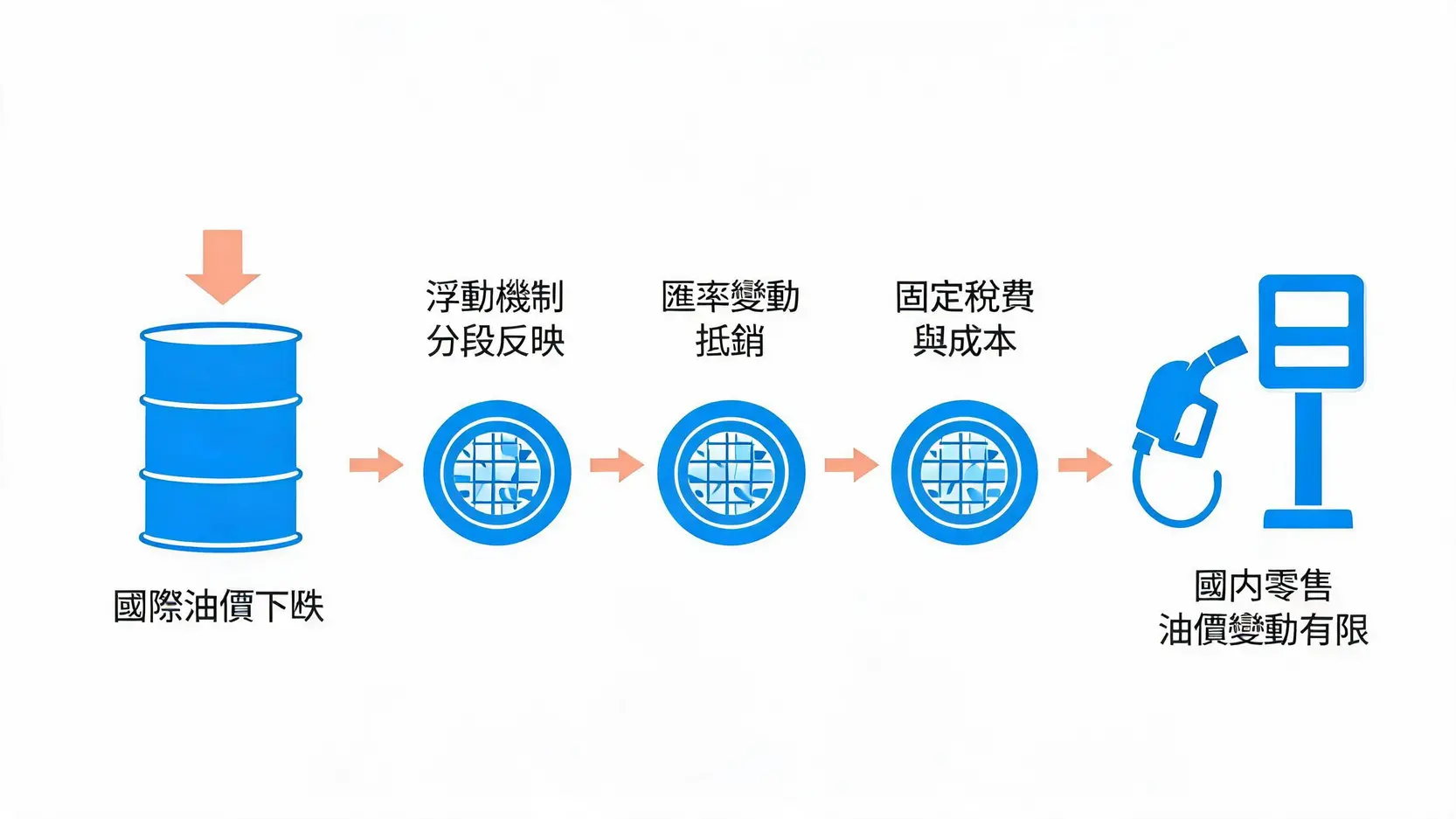
國際油價下跌但國內油價漲多跌少的三道關卡示意圖

Between international oil prices and petrol station prices, there are still three barriers: mechanisms, exchange rates, and taxes and fees.


Uncovering the Operating Logic of the Domestic Floating Oil Price Mechanism and Stabilization Fund

Taking Taiwan as an example, domestic oil prices refer to the floating oil price mechanism and use stabilization measures to reduce short-term volatility. Simply put: if international oil prices fall very quickly, domestic prices may reflect it in stages; if international oil prices rise very quickly, domestic prices may also absorb it in stages, but not necessarily symmetrically.

In addition, oil products also involve inventory costs (previous high-priced inventory), transportation insurance, refining costs, and other factors, so they may not fully keep up with international quotations in the short term. 

How Exchange Rate Fluctuations and Fixed Tax and Fee Structures Eat Into Oil Price Declines

Another key factor is exchange rates and taxes and fees. International crude oil is mostly priced in US dollars, so if the local currency depreciates, part of the benefit of falling oil prices will be offset by exchange losses. In addition, oil product retail prices in many regions include fixed taxes and fees, so even if crude oil itself falls by 30%, the “room for decline” at the retail end will be smaller than you might think.

Therefore, when making investment judgments, do not infer international oil price trends solely from “whether petrol has become cheaper”. They are two separate systems.


FAQ

Will International Oil Prices Continue to Fall in the Future? Which Indicators Should Be Watched for Oil Price Forecasts

The most effective way to forecast oil prices is to break them down into “supply, demand, inventories, and financial conditions”. On the supply side, OPEC+ policy and non-OPEC production can be tracked; on the demand side, monthly reports from authoritative institutions such as the IEA and economic indicators of major economies can be monitored; on the inventory side, commercial inventories and floating storage changes should be watched; for financial conditions, the US dollar and interest rates should be observed. When demand is revised downward, inventories rise, and the US dollar strengthens at the same time, the probability of a sharp decline in international oil prices increases.

Does War Always Lead to Higher Oil Prices? Why Do Prices Sometimes Fall Instead?

Not necessarily. What the market trades is the “possibility of actual supply disruption” and the “risk premium”. If the conflict does not affect major production areas or key shipping routes, or if the market expects the situation to remain controllable, the risk premium may be priced out, causing oil prices to fall instead. In addition, if the war triggers concerns over global growth and lowers demand expectations, this may also outweigh supply risks and become one of the reasons oil prices fall.

Should Ordinary Investors Buy Crude Oil ETFs When Oil Prices Fall?

You must first confirm what type of crude oil ETF you are buying: whether it tracks spot prices, front-month futures, or uses a different futures rollover strategy can lead to significant performance differences. If the market is in a futures “contango” structure (where longer-dated contracts are more expensive than near-month contracts), holding a front-month futures ETF over the long term may be eroded by rollover costs. When oil prices halve, violent volatility is more likely to occur. Without an understanding of the instrument structure and risk control, investors should not enter the market simply because prices have “fallen deeply”.

Which Groups in Taiwan Stocks and Malaysian Stocks Are More Sensitive to a Halving in Oil Prices?

Generally speaking, the impact of falling oil prices will first be reflected in cost-side groups such as transportation, aviation, and some chemical and petrochemical sectors. In contrast, if the market is worried about weakening demand, energy and resource-related stocks, as well as targets with higher correlation to the economic conditions of oil-producing countries, will face more pressure. For Taiwan stocks, the New Taiwan dollar exchange rate and export cycle should also be observed; for Malaysian stocks, attention should be paid to energy weighting and exchange rate changes.

Is a Sharp Drop in Oil Prices a Tonic for Cooling Inflation or a Poison for Economic Recession?

Both scenarios are possible. If oil prices fall due to increased supply, it cools inflation and supports consumption, making it more of a “tonic”; however, if a collapse in demand causes international oil prices to fall sharply, inflation may decline, but corporate revenue and employment may also come under pressure, making it more of a “poison”. The key judgment lies in whether demand data and corporate earnings expectations are weakening at the same time.


Conclusion

A halving in oil prices is not simply commodity price news, but a “macro switch” that affects inflation, interest rates, exchange rates, and industry profits. When breaking down the reasons oil prices fall, the three most common main lines are: supply-demand imbalance, changes in geopolitical risk premiums, and long-term demand pressure under the energy transition. When facing a sharp decline in international oil prices, instead of rushing to guess the bottom, it is better to first place your holdings into the beneficiary/victim list for stress testing, then use instrument structure (whether the ETF has rollover losses) and risk control (scaling in, stop-losses, and position limits) to keep the uncertainty of oil price forecasts contained.

编者
Evan Lin

Evan Lin

我是Evan Lin,从大学时期开始接触外汇交易,至今已有多年实战经验,熟悉技术分析与EA策略,热衷于研究市场脉动与风险管控,喜欢分享实战经验和交易技巧,和大家一起学习、一起进步!

If you liked this article, please share it!

Related Articles

  • Bank Currency Exchange Fees: CTBC, Fubon & TCB
    Planning to travel abroad, study overseas, or invest in foreign currencies? Faced with the complex mix of bank exchange fees and constantly fluctuating rates, it’s easy to feel overwhelmed. Among major banks such as CTBC, Fubon, and TCB, each has its own unique rules for exchange rate discounts and handling...
    2026 年 7 月 8 日
  • Asset Allocation & FX Strategies Amid Policy Divergence
    Asset Allocation and FX Investment Strategies amid Central Bank Policy Divergence: Mastering Rate Cut Expectations, Interest Rate Differentials, and Safe-Haven Positioning As central bank policy divergence becomes the main market theme in 2026, what investors most often struggle with is not “whether they can understand the news”, but how to...
    2026 年 7 月 8 日
  • BOJ Rate Hikes: Yen Outlook & Investment Strategy
    Are Continued Bank of Japan Rate Hikes a Foregone Conclusion? A Full Analysis of Kazuo Ueda’s Hawkish Signals, the Yen’s 160 Defense Battle, and Investment Strategies Investors who have been closely following news about continued Bank of Japan rate hikes over the past two years probably share one feeling: yen...
    2026 年 7 月 8 日
返回顶部