China Bull Market Guide: A-Shares & CSI 300

Mainland Bull Market Strategy: 3 Essential Methods to Invest in A-Shares and How to Position With the CSI 300 Index
Recently, sentiment in the mainland stock market has been heating up, and the “mainland bull market” has become a hot topic. Many investors are eager to position themselves in anticipation of a potential rally. However, many investors in Hong Kong or overseas remain unfamiliar with the operating model and historical trends of the A-share market, and are unsure where to begin. In reality, capturing opportunities in A-shares is not as difficult as it may seem. This article will comprehensively analyze the historical characteristics of A-share bull markets, explain the core A-share market indicator “CSI 300 Index” in a clear and accessible way, and present three of the most practical methods for investing in A-shares. This will help you seize early opportunities in a potential bull market and achieve wealth growth. Whether you are a beginner or an experienced investor, this guide provides a clear roadmap.
What Is a Mainland Bull Market? A Review of the Historical Characteristics of A-Share Bull Markets
A “bull market” refers to a period in which the stock market experiences sustained and widespread price increases. Investor sentiment is optimistic, and market participants expect prices to continue rising, which encourages widespread buying. Bull markets in the mainland A-share market often display distinctive characteristics of a “policy-driven market” and a “liquidity-driven market”. Historical fluctuations are also more volatile than in mature markets, making it essential to understand these features when determining entry timing.
Analysis of the Causes and Duration of Past A-Share Bull Markets
Looking back, the A-share market has experienced several spectacular bull markets. Each had different causes and durations, but in general they were mainly driven by the following factors:
- Policy support: This is the most common catalyst for A-share bull markets. When the government introduces major economic reforms, monetary easing policies (such as interest rate cuts or reserve requirement reductions) or industrial support initiatives, it often injects strong confidence into the market and triggers a bull run. For example, the 2014–2015 bull market was closely linked to macro policies at the time, including state-owned enterprise reform and the “Belt and Road” initiative.
- Abundant liquidity: The level of capital available in the market directly affects stock market performance. Whether through domestic monetary easing or inflows of global capital, ample liquidity pushes up asset prices and provides the “fuel” for a bull market.
- Market sentiment and retail participation: Retail investors account for a high proportion of the A-share market. Their sentiment is easily influenced by media coverage and market atmosphere, forming a “herd effect”. Once bullish sentiment forms, a large amount of capital quickly floods into the market, further driving up indices and creating a “fast bull” market. However, this often leads to irrational exuberance in the later stages and sharp corrections.

In terms of duration, A-share bull markets are generally short and are often described as “short bulls and long bears”. A complete bull cycle may last only one to two years, with rapid gains followed by equally intense corrections. This reminds investors that trading in the A-share market requires greater flexibility and close attention to changes in policy direction and market trends.
Potential Signals for a 2026 Bull Market and Interpretation of Expert Views
Looking ahead to 2026, expectations for a mainland bull market are gradually increasing, mainly based on several potential signals:
- Improving economic fundamentals: As structural adjustments in the mainland economy gradually take effect, continued improvement in consumption, exports, and manufacturing data would provide the strongest fundamental support for the stock market.
- Historically low valuations: After a period of adjustment, major A-share indices, including the CSI 300 Index, are now at relatively low valuation levels. This provides long-term investment value and significantly increases their attractiveness.
- Stronger policy support: To boost economic confidence, the mainland government is expected to continue introducing fiscal and monetary policies aimed at stabilizing growth and stimulating domestic demand. These measures could become the spark that ignites a bull market.
Many experts believe that the next bull market may no longer follow the previous pattern of “everything rising and falling together”, but instead evolve into a more quality-focused structural bull market. Sectors such as technological innovation, green energy, advanced manufacturing, and domestic consumption are expected to become the main drivers of the market.
Further Reading (Highly Recommended)
Mastering the Core Indicator of A-Shares: Understanding the CSI 300 Index in Seconds
For investors encountering A-shares for the first time, recognizing the highly representative CSI 300 Index is the first step to quickly grasping the overall market. It is not only a key benchmark for measuring the performance of the A-share market, but also the underlying index tracked by many financial products.
Constituents and Sector Distribution of the CSI 300 Index
The CSI 300 Index consists of the 300 largest and most liquid A-share stocks listed on the Shanghai and Shenzhen stock exchanges. It can be understood as the representative “blue-chip” team of the A-share market. Its core characteristics include:
- Strong representativeness: The combined market capitalization of these 300 companies accounts for more than 60 percent of the total market value of the A-share market, enabling the index to accurately reflect the overall trend of the A-share market.
- Balanced sector distribution: The index covers a wide range of industries, mainly including finance, industrials, consumer staples, information technology, and materials. Among them, financial and real estate sectors have the highest weighting, although the proportion of technology and consumer stocks has steadily increased in recent years, reflecting the transformation of China’s economic structure.
- Regular adjustments: To maintain representativeness, the index constituents are reviewed and adjusted periodically. Companies that no longer meet the criteria are removed and replaced by more dynamic new entrants.
Why Is the CSI 300 Index the Key Indicator of A-Share Market Temperature?
The CSI 300 Index is important because it plays multiple roles:
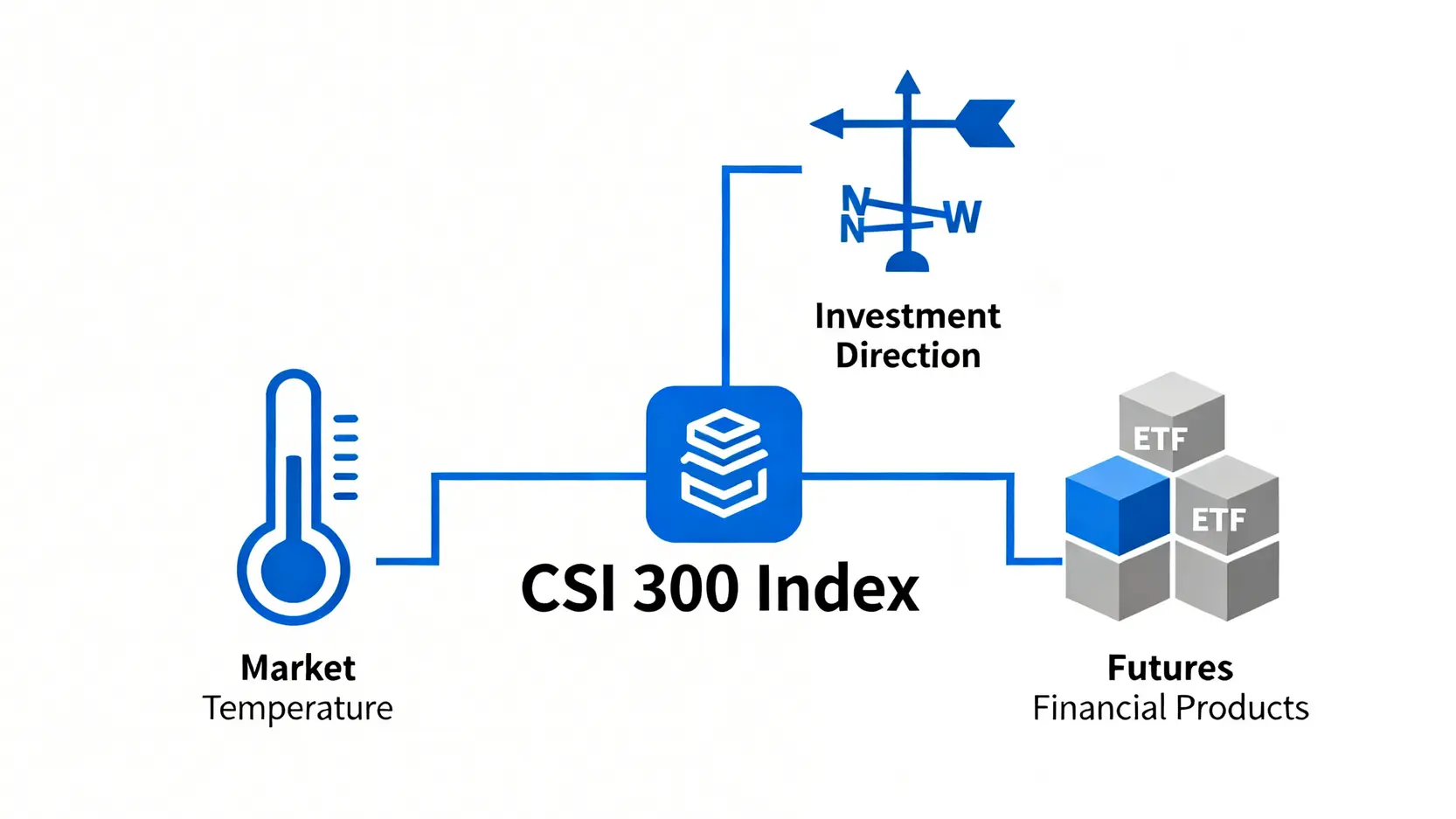
- Market thermometer: The rise and fall of the index is the most direct and core indicator for determining whether the entire A-share market is in a “bull” or “bear” phase. When the CSI 300 Index continues to rise, it usually indicates that the overall market is on an upward trajectory.
- Investment benchmark: Institutional investors, whether domestic mutual funds or overseas QFII investors, treat the CSI 300 Index as an important reference for asset allocation. Industries and individual stocks with larger weights in the index often become the focus of market capital.
- Foundation for financial derivatives: Numerous financial derivatives such as ETFs, index futures, and options are developed based on the CSI 300 Index. This provides investors with a wide range of tools for investment and risk hedging.

Simply put, understanding the trend and composition of the CSI 300 Index means capturing the pulse of the A-share market. For investors who wish to simplify investment decisions, directly investing in products that track the index is an efficient way to participate in a mainland bull market.
[Lazyman Guide] 3 Practical Ways for Hong Kong Investors to Invest in A-Shares
After understanding the market background and core indicators, the next practical question is: from Hong Kong, how can investors conveniently and safely invest in A-shares? At present, there are three main channels, each with its own advantages and disadvantages.
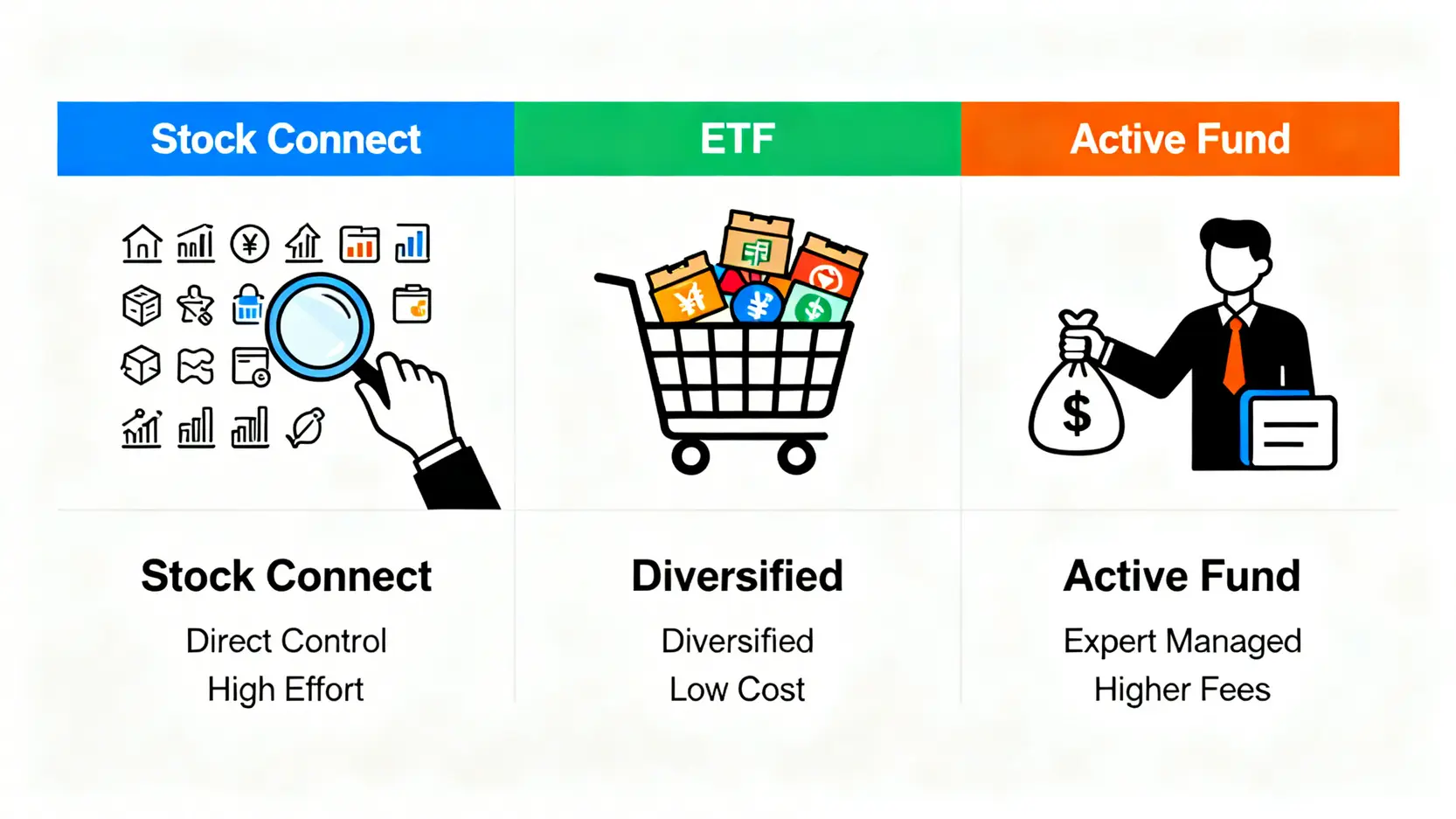
Method 1: Directly Trade A-Shares Through a Local Brokerage Account (Shanghai-Hong Kong Stock Connect / Shenzhen-Hong Kong Stock Connect)
This is the most direct and convenient method. The “Shanghai-Hong Kong Stock Connect” and “Shenzhen-Hong Kong Stock Connect” mechanisms (collectively known as “Stock Connect”) allow Hong Kong investors to directly trade designated A-share stocks listed on the Shanghai and Shenzhen stock exchanges through local brokerage accounts, without the need to open an account in mainland China.
- Advantages: Easy operation, as orders can be placed through a familiar brokerage app; funds do not need to be converted into RMB and transferred out of Hong Kong, as settlement and currency conversion are handled by the exchange, making the process relatively secure.
- Disadvantages: Investment targets are restricted, as only A-shares included in the designated stock list can be traded; there are also daily quota limits.
Method 2: Invest in A-Share ETFs (Such as ETFs Tracking the CSI 300 Index)
If you do not want to spend time researching individual stocks, or if you want to diversify risk, investing in A-share ETFs (exchange-traded funds) is an excellent option. These ETFs are listed on the Hong Kong Exchange and are traded in exactly the same way as ordinary stocks.
- Advantages: A single lot of an ETF includes a basket of A-shares (such as all constituent stocks of the CSI 300 Index), achieving excellent diversification; management fees are low and trading costs are relatively low; liquidity is strong and trading is convenient.
- Disadvantages: It is not possible to achieve excess returns beyond the market, as performance closely tracks the corresponding index; when selecting ETFs, investors still need to examine details such as tracking error and management fees.
Method 3: Purchase Actively Managed Funds Related to A-Shares
For investors who wish to rely on professional analysis to pursue higher returns, actively managed funds operated by fund management companies may be considered. These funds are managed by fund managers who select promising A-shares and construct the investment portfolio.
- Advantages: Managed by a professional team, saving time and effort; there is an opportunity to achieve Alpha returns beyond the broader market through the fund manager’s stock selection.
- Disadvantages: Management fees and subscription or redemption fees are relatively high; the performance of the fund manager directly affects the fund’s returns, creating uncertainty.
Table Comparison: Advantages, Disadvantages, and Suitable Investors for the Three A-Share Investment Methods

| Investment Method |
Advantages |
Disadvantages | Suitable Investors |
| Shanghai-Hong Kong Stock Connect / Shenzhen-Hong Kong Stock Connect | Direct operation, ability to select individual stocks, funds settled in Hong Kong | Investment targets are restricted, individual stocks require self-research | Experienced investors with in-depth research on A-shares who wish to actively select stocks |
| A-Share ETFs | Highly diversified risk, low cost, convenient trading | Returns closely track the index, unable to obtain excess returns | Beginners or long-term investors seeking stability and hoping to follow overall market performance |
| Actively Managed Funds | Expert management, time-saving and effortless, potential excess returns, | Management fees are relatively high, performance depends on the fund manager | Investors with larger capital who trust professional management and are willing to pay higher fees |
Common Questions About Investing in A-Shares (FAQ)
Q: Do I need to open a mainland bank account to invest in A-shares?
A: No. If you invest through “Shanghai-Hong Kong Stock Connect” or “Shenzhen-Hong Kong Stock Connect”, you can directly use your Hong Kong securities account and bank account for trading and fund settlement. Likewise, when purchasing A-share ETFs or funds in Hong Kong, transactions are conducted using Hong Kong dollar or US dollar accounts, making the process very convenient.
Q: What taxes and fees are involved when trading A-shares?
A: The main costs include: 1) Commission: Charged by your broker, which varies by firm; 2) Stamp duty: Payable when selling A-shares, currently at a rate of 0.05% of the transaction value; 3) Transfer fee: Charged both ways at a certain proportion of the transaction amount; 4) Dividend tax: Investors holding H-shares who receive dividends distributed by A-share companies must pay a 10% dividend tax.
Q: How do RMB exchange rate fluctuations affect investing in A-shares?
A: There is a direct impact. Since A-shares are assets denominated in RMB, even if you invest using Hong Kong dollars, your final return will still be affected by fluctuations in the RMB to Hong Kong dollar exchange rate. If the RMB appreciates, your return in Hong Kong dollars will increase. Conversely, if the RMB depreciates, even if the share price rises, the return converted into Hong Kong dollars may be reduced. Therefore, exchange rate risk should be taken into consideration when investing in A-shares.
Q: What are the trading hours for A-shares?
A: A-share trading hours are divided into two sessions: the morning session runs from 9:30 to 11:30 Beijing time, and the afternoon session runs from 13:00 to 15:00. There is a 1.5-hour market break at midday. This differs from the trading hours and continuous trading model of the Hong Kong stock market, and investors should take note.
Conclusion
In summary, capturing potential investment opportunities in a mainland bull market requires proper preparation and choosing the A-share investment method that best suits you. First, understanding the historical characteristics of A-share bull markets, such as the “policy-driven market” and “fast bull” pattern, helps establish reasonable expectations. Second, using the CSI 300 Index as a market benchmark enables you to grasp overall market trends more effectively. Finally, whether choosing the most direct Shanghai-Hong Kong Stock Connect, the stable ETF approach, or professionally managed active funds, each method has its own suitable application. By establishing a clear investment strategy and making decisions based on your risk tolerance and investment objectives, you can move forward steadily in the A-share market and capture your own wealth opportunities.
Related Articles
-
Practical Applications of Volatility Surfaces: From Options Modeling to Advanced Skew Trading Strategies In options markets, implied volatility is never a flat line. Instead, it forms complex "smile" or "skew" surfaces. For advanced traders, mastering the practical applications of volatility surfaces is equivalent to possessing a lens that reveals market...2026 年 6 月 3 日
-
Building a Foreign Capital Flow Copy Trading Model: A Stock Market Indicator for Accurately Tracking Institutional Positioning In Asia-Pacific stock markets, foreign capital inflows and outflows often determine the direction of the index. However, simply looking at daily net buy and sell data is no longer enough. Only by building...2026 年 6 月 3 日
-
Options Buyer Strategies During Extreme Market Conditions: Black Swan Hedging and Cross-Market Arbitrage During Volatility Surges The most terrifying aspect of financial markets is not a gradual decline, but overnight flash crashes and cross-market capital withdrawals accompanied by volatility surges. In the highly unpredictable global macroeconomic environment of 2026, geopolitical...2026 年 6 月 3 日