What Is a Fund? Beginner Guide & 5 Steps to Invest

Updated: 2026/03/17  |  CashbackIsland

fund-investment-beginners-guide

[Fund Beginner’s Guide] What Is a Fund? Understand Fund Types, Definition, and Five Investment Steps in One Article

Want to increase passive income but feel unsure where to begin with the fast changing stock market? A “fund” may be your ideal starting point for investing. Many people have heard of funds, but basic concepts such as what a fund is and the definition of a fund remain unclear. In fact, fund investing is far simpler than many imagine. This article provides a comprehensive beginner’s guide to funds, explaining the concept step by step and introducing the major types of funds so you can easily grasp the core ideas and take the first step toward sound financial planning. 


What Is a Fund? Understand the Definition and Operating Principles in One Article

To learn how to invest in funds, you must first clearly understand “what a fund is”. Simply put, a fund is a “collective investment scheme”. It pools money from a large group of investors and entrusts it to a professional fund management team, which invests in a basket of assets such as stocks, bonds, and real estate with the goal of generating returns for investors.


Official Definition of a Fund: Professional Investment Through Pooled Capital

According to the official definition, a fund is a collective securities investment trust (Mutual Fund). By issuing fund units, it pools capital from numerous investors to form a separate pool of assets. These assets are professionally managed and utilized by a fund manager (meaning a fund management company) and invested in a diversified portfolio of financial instruments. Investors share the investment returns according to the proportion of capital they contribute, while also sharing the corresponding risks.


How Does a Fund Work? Let a Fund Manager Manage Assets for You

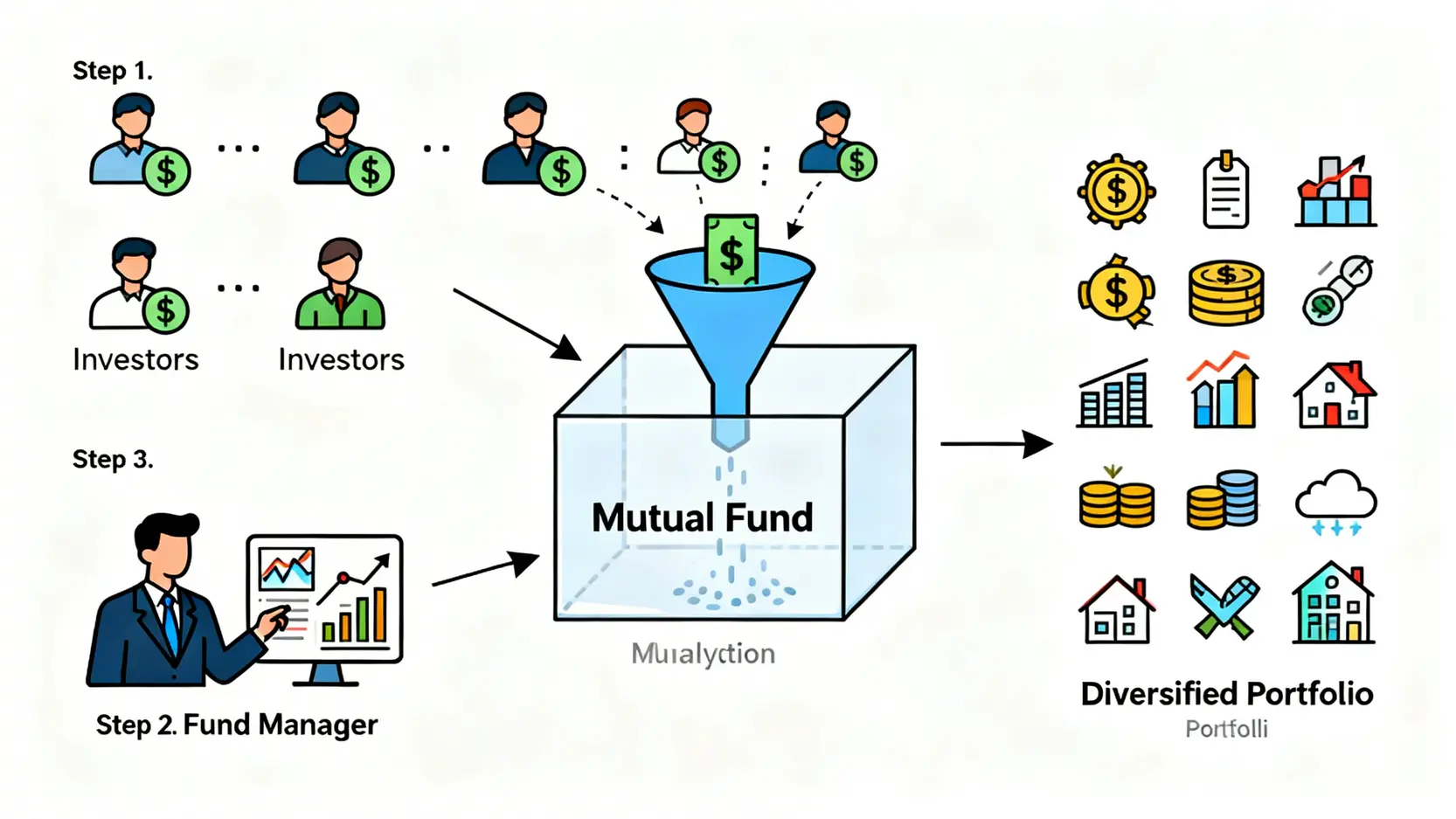
The operation of a fund is similar to pooling money to hire a professional driver to drive for you. You (the investor) place money into the fund, and the fund manager uses this large pool of capital, according to the fund’s predefined investment objectives and strategies, to purchase dozens or even hundreds of different assets and build a diversified investment portfolio. The profit or loss of the fund depends on the overall market performance of the assets within this portfolio. As an investor, you share the gains or bear the losses according to the number of fund units you hold.

基金運作原理示意圖,展示投資者將資金交給基金經理,再由經理投資於股票和債券等多元化資產的流程。

Fund Operating Principle: Pooling Investors’ Capital and Diversifying Investments Managed by Professionals.


Three Advantages and Potential Risks of Investing in Funds

After understanding how funds operate, let us examine their key attractions and the points investors should pay attention to:

  • Diversification: One of the greatest advantages of funds. Because a fund invests in multiple assets at the same time, even if one or two stocks or bonds perform poorly, the overall portfolio impact is relatively limited, effectively reducing the risk of “putting all your eggs in one basket”.
  • Professional management: Investing requires extensive research and analysis, and ordinary investors may not have sufficient time or expertise. Funds employ professional teams to research markets, select assets, and continuously monitor performance, saving investors significant effort.
  • Low entry barrier: Purchasing dozens of blue chip stocks at once requires substantial capital. Through funds, however, you may only need several hundred or one thousand dollars to indirectly hold these high quality assets, making funds particularly suitable for small investors or beginners.
  • Potential risks: Of course, every investment carries risk. Fund values fluctuate with market movements, and losses are possible. In addition, funds charge management fees, subscription fees, and other expenses, which reduce your investment returns.


Fund Types Explained: How to Choose Between Equity, Bond, and Mixed Funds?

There are many different funds available in the market. To choose one that “suits” you, you must first understand the different types of funds. Generally speaking, funds can be categorized from three perspectives.


Classification by Investment Target: Equity Funds vs Bond Funds vs Money Market Funds

This is the most basic classification, based on where the fund mainly invests your capital:

  • Equity funds: At least 80% of capital is invested in the stock market. They offer higher potential returns but also carry the highest risk. Suitable for investors seeking capital appreciation and able to tolerate higher risk.
  • Bond funds: Primarily invest in bonds issued by governments or corporations, aiming to generate stable interest income. They carry relatively lower risk and suit investors seeking stable cash flow and a more conservative approach.
  • Money market funds: Invest in highly liquid and low risk instruments such as short term treasury bills and commercial paper. Risk is extremely low and returns are relatively limited, mainly used for short term capital parking or defensive purposes.

基金風險與回報光譜圖,從左至右依次為低風險低回報的貨幣市場基金、中等風險的債券基金,以及高風險高回報的股票基金。

Risk and Return Spectrum of Different Fund Types.


Classification by Risk Level: Growth vs Balanced vs Conservative Funds

This classification is directly linked to an investor’s risk preference:

  • Growth funds: Primarily invest in equities, particularly companies with high growth potential, with the objective of maximizing capital appreciation.
  • Balanced funds / Mixed asset funds: Invest simultaneously in stocks and bonds, for example 60% stocks and 40% bonds, balancing growth potential with risk control.
  • Conservative funds: Most capital is invested in bonds and money market instruments, with only a small portion allocated to stocks, focusing on capital preservation and stable income.


Classification by Management Style: Active Funds vs Passive Funds (Index Funds)

This classification relates to the role of the fund manager:

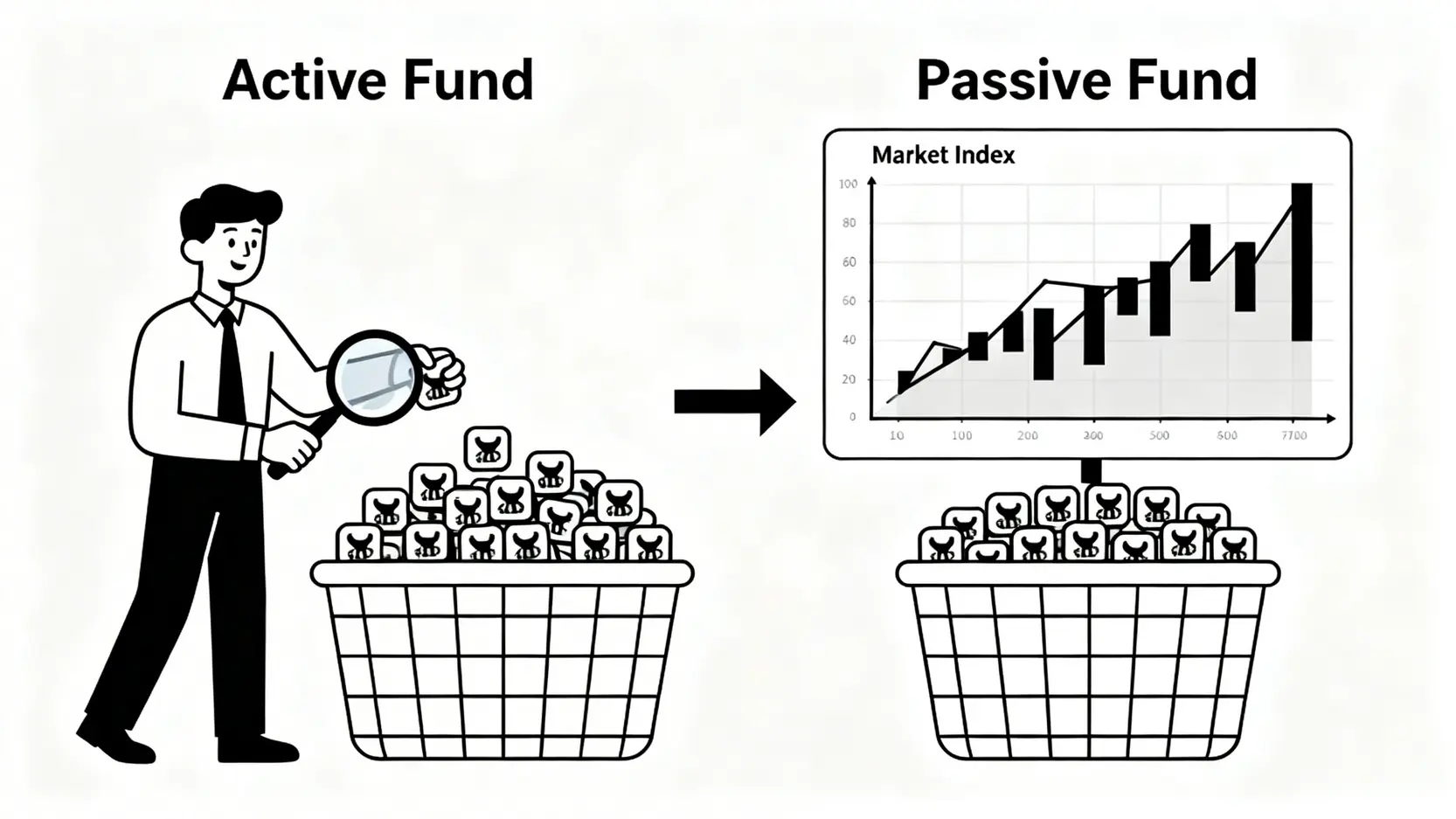
  • Actively managed funds: Fund managers actively analyze markets and select stocks or assets they believe can outperform the market. The goal is to generate returns above the market benchmark, known as alpha. Management fees are usually higher.
  • Passively managed funds: Typically refer to index funds or exchange traded funds (ETF). These funds do not actively select stocks but instead replicate the performance of a market index (such as the Hang Seng Index or the S&P 500 Index). As management is simpler, their management fees are usually much lower.

主動型基金與被動型基金的對比圖。左邊顯示基金經理主動挑選股票,右邊顯示基金被動地複製市場指數的表現。

Active vs Passive Funds: The Difference Between Expert Stock Selection and Tracking the Market.


Further Reading (Highly Recommended)

What Is the S&P 500? Beginner’s Investment Guide: Understanding Constituents, ETF, and How to Buy


Five Steps to Getting Started With Fund Investing

After understanding the basic concepts and types, it is time to take action! By following these five steps, beginners can easily start their first fund investment.

  1. Assess your personal risk tolerance:
    This is the most important first step! Ask yourself: if your investment portfolio falls by 20% in the short term, would it cause significant stress? Is your investment intended for buying a house in a few years, or retirement decades later? Honestly evaluating your risk tolerance helps you select the most suitable fund type. Generally speaking, younger investors have higher risk tolerance than those approaching retirement.
  2. Set clear investment goals and time horizons:
    Why are you investing? Is it for a travel fund in three years, an education fund in ten years, or retirement thirty years from now? Different goals and time horizons determine whether you should choose growth, balanced, or conservative funds. The longer the time horizon, the greater risk you can accept in pursuit of higher returns.
  3. Choose the appropriate type of fund:
    Based on your risk assessment and investment goals, select from the fund types mentioned above. For example, a young investor who can tolerate high risk and plans to retire in twenty years may choose a global equity growth fund. Someone who needs funds within five years and has low risk tolerance may choose a balanced fund or a bond fund.
  4. Compare fees and services across banks or investment platforms:
    There are many channels for purchasing funds, including traditional banks, brokerage firms, and online fund platforms. You should compare:

    • Whether the range of funds available is broad
    • Whether subscription fees and platform fees are high
    • Whether the platform interface is user friendly
    • Whether research reports or customer service are provided
  5. Choosing a reliable platform with reasonable fees is very important.
  6. Understand subscription fees, management fees, and other common expenses:
    The details matter. Before investing in a fund, carefully review the fee structure, which mainly includes:

    • Initial charge: A one time fee charged when purchasing the fund, usually 1% to 5% of the investment amount. Many platforms offer discounts.
    • Management fee: Charged annually and deducted from the fund’s assets to pay for fund manager salaries and operational expenses. Actively managed funds usually charge higher fees (around 1% to 2%) while passive funds are lower, (around 0.1% to 0.5%).
    • Switching fee: The fee charged when transferring funds from Fund A to Fund B within the same fund company.
  7. Over the long term, fee levels have a significant impact on your final returns. To learn more about investor protection information, you can refer to the official resources provided by the Investor and Financial Education Council (IFEC).


Common Questions About Fund Investing (FAQ)

Q: What is the difference between funds and stocks?

A: The biggest difference lies in “concentration”. Buying stocks means directly investing in “one” company, where the risk is highly concentrated. If the company performs well, you earn more, and if it performs poorly, the opposite happens. Buying funds means indirectly investing in “a basket” of stocks, bonds, or other assets, where the risk is already diversified. For beginners, funds generally carry lower risk than individual stocks and serve as a more stable starting point.

Q: What is the minimum investment amount to buy a fund?

A: It varies depending on the investor. Many funds offered by banks or platforms have a minimum subscription amount as low as HKD $1,000 or $5,000 per purchase. If it is a monthly investment plan, the entry threshold is even lower. You may only need HKD $500 or $1,000 per month to begin investing, which is very suitable for small investors.

Q: What is a “monthly fund investment plan”? Is it suitable for beginners?

A: A monthly fund investment plan, also known as regular investment, means setting a fixed date each month to invest a fixed amount into a selected fund. This method is very suitable for beginners because it creates the effect of “dollar cost averaging”. When the fund price is high, you purchase fewer units. When the price is low, you purchase more units. Over the long term, this helps average out the cost of entering the market, and it also encourages disciplined saving and investing habits.

Q: How should fund performance be evaluated? What indicators should be considered?

A: You can find a document called the “Factsheet” on the website of a fund company or sales platform. It contains the information you need, including the fund’s historical performance, returns over the past one year, three years, and five years, asset allocation, top ten holdings, risk rating, and various fees. Beginners should focus more on the long term performance of the fund (for example three years or longer), rather than only paying attention to short term price fluctuations.


Conclusion

In summary, as a collective investment tool, funds significantly reduce the barriers and complexity of individual investing. Through the detailed explanation of “what a fund is”, the introduction of different types of funds, and the step by step beginner guide provided in this article, you should now have a clearer understanding of this flexible investment instrument. Investing should not remain only theoretical. Start planning your financial goals now, assess your risk tolerance, choose suitable funds, and take the first confident step toward growing your wealth.

If you liked this article, please share it!

Related Articles

  • Volatility Surface Guide: Skew Trading Strategies
    Practical Applications of Volatility Surfaces: From Options Modeling to Advanced Skew Trading Strategies In options markets, implied volatility is never a flat line. Instead, it forms complex "smile" or "skew" surfaces. For advanced traders, mastering the practical applications of volatility surfaces is equivalent to possessing a lens that reveals market...
    2026 年 6 月 3 日
  • Foreign Capital Flow Model: Track Institutional Money
    Building a Foreign Capital Flow Copy Trading Model: A Stock Market Indicator for Accurately Tracking Institutional Positioning In Asia-Pacific stock markets, foreign capital inflows and outflows often determine the direction of the index. However, simply looking at daily net buy and sell data is no longer enough. Only by building...
    2026 年 6 月 3 日
  • Options Buying Strategies for Extreme Market Risks
    Options Buyer Strategies During Extreme Market Conditions: Black Swan Hedging and Cross-Market Arbitrage During Volatility Surges The most terrifying aspect of financial markets is not a gradual decline, but overnight flash crashes and cross-market capital withdrawals accompanied by volatility surges. In the highly unpredictable global macroeconomic environment of 2026, geopolitical...
    2026 年 6 月 3 日
返回顶部