Hong Kong Fund Guide: Popular LIHKG Funds & Tips

Updated: 2026/03/12  |  CashbackIsland

香港基金推薦:LIHKG熱門基金點揀?基金經理教你避開3大伏位

Hong Kong Fund Recommendations: How to Choose Popular LIHKG Funds? A Fund Manager Teaches You to Avoid 3 Major Traps

Want to grow your wealth through fund investing, but feel overwhelmed by the wide variety of options in the market and worry about being misled when buying funds through banks? Many Hong Kong investors, when searching for Hong Kong fund recommendations, first visit fund discussion forums such as LIHKG to learn from the real experiences of fellow investors. This article combines popular discussions across major forums with analysis from professional fund managers to provide a practical 2026 Hong Kong fund recommendation list and risk avoidance guide. Whether you want to invest through monthly contributions or pursue stable income, it will help you make smarter decisions. 


Why Refer to Fund Discussion Forums? Understanding the Investment Insights of LIHKG Users

In an age of information overload, platforms such as LIHKG and the Hong Kong Discussion Forum have become important channels for retail investors to exchange insights. For fund investing, what value do these “grassroots experts” discussion forums actually offer, and how should the information within them be interpreted?


Advantages: Real User Experiences and Risk Warnings

The greatest value of fund discussion forums lies in their authenticity and practical insights. Unlike the polished data published by fund companies, user discussions are often closer to reality:

  • Customer service experience: Which banks or platforms have the most complicated procedures for opening accounts? Which customer services are difficult to reach? These firsthand experiences are details that official documents rarely reveal.
  • Hidden fee exposure: Have bank RMs (relationship managers) recommended high-commission funds with poor performance? Details such as subscription fees, platform fees, and switching fees are often highlighted through real user experiences.
  • Actual return sharing: After deducting all fees, what is the real return received? How well did the fund perform during major market downturns? These real results often provide more practical reference than historical data shown in fund factsheets.


Disadvantages: Fragmented Information and Potential Bias, How to Filter Key Insights

Although discussion forums contain valuable information, their drawbacks are also obvious. The information is often fragmented and lacks structure, and users may express strong personal biases (for example promoting a fund they heavily invested in). To effectively filter key insights, consider the following principles:

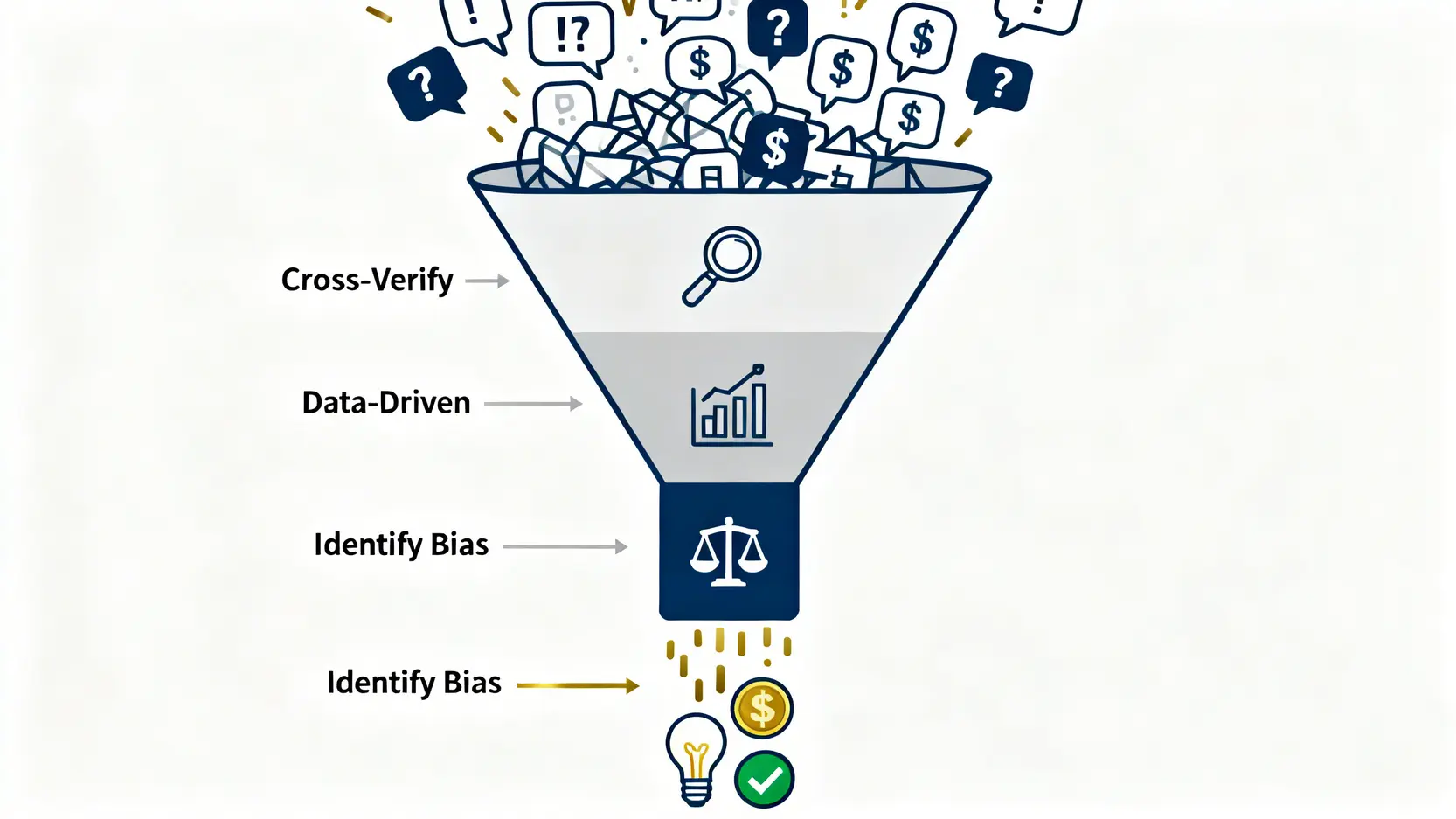
  • Cross verification: Do not trust a single post or comment. Observe whether multiple users at different times mention similar viewpoints or experiences.
  • Data first: Discussions about fund performance should ultimately return to official data. Use forum opinions as references and then verify the fund’s official documents and third-party ratings.
  • Recognizing interests: Some comments may come from industry insiders or online promoters. If a comment excessively praises or criticizes a fund without solid reasoning, extra caution is required. Learning how to filter investment information is the first step in protecting your assets.

一個資訊過濾漏斗,展示如何將混亂的論壇資訊轉化為有價值的投資見解。

Apply filtering principles to transform forum noise into valuable information.


The Role of Professional Fund Managers: Not Only Stock Selection but Also Risk Gatekeepers

While the collective insights of forum users are valuable, the role of professional fund managers should not be overlooked. An outstanding fund manager and their team are often the key to whether a fund can outperform the market over the long term. Their responsibilities go far beyond simple stock selection.


How to Evaluate a Fund Manager’s Strategy and Track Record Through Fund Documents

To understand a fund manager’s capability, you must carefully review the fund’s official documents, particularly the “Fact Sheet” and “Key Facts Statement (KFS)”. These documents serve as an essential reference for investors.

  • Investment objectives and strategy: Does the fund pursue high growth or stable income? Which regions and sectors does it invest in? These basic details help determine whether the fund matches your financial goals.
  • Fund manager background: Who is the fund manager? How many years of investment experience do they have? When did they start managing the fund? Frequent changes in fund managers are usually not a positive sign.
  • Historical performance: In addition to overall returns, examine how the fund performed under different market conditions. For example, what was the maximum drawdown during the 2008 financial crisis or the 2020 pandemic? This reflects the fund manager’s risk control ability.
  • Portfolio allocation: What are the fund’s top ten holdings? Are sectors and regions sufficiently diversified? This helps you understand the sources of returns and potential risks. For authorized funds publicly offered in Hong Kong, relevant documents can be found on the Hong Kong Securities and Futures Commission (SFC) website, which is the most authoritative information source.


How Important Is the Fund Manager’s Team Background to Fund Performance?

A successful fund is never the result of the fund manager alone. A strong research team, a robust risk management system, and the overall investment philosophy of the fund company all play crucial roles. Large asset management firms (such as BlackRock and Fidelity), typically have global research networks that provide fund managers with deeper market insights and data support, which is a significant advantage that smaller firms often cannot match.


Further Reading (Strongly Recommended)

Hong Kong Hedge Fund Rankings Complete Guide: 5 Top Firms and the Strategies of US Giants

2026 US Dividend Stock Recommendations: Selected Portfolio of 10 High Dividend Stocks With Dividend Calendar and Tax Guide

5 Popular Hong Kong Fund Recommendations for 2026 (Based on LIHKG Discussions and Expert Ratings)

Based on the popularity within LIHKG fund discussion forums and data from professional rating agencies, we have selected the following five funds that are widely discussed in the Hong Kong market. They cover different investment objectives and may help you find a suitable option.


Stable Income Choice: PIMCO GIS Income Fund

This fund is often referred to on LIHKG as an “income generator” and is a popular choice for investors seeking stable cash flow. It primarily invests in a diversified global bond portfolio and is managed by bond giant PIMCO, with a relatively stable track record. Suitable for: Investors approaching retirement or those seeking steady monthly passive income.


Growth Potential Choice: Allianz Income and Growth Fund

If you are not satisfied with the stability of pure bond returns and want both income and asset growth potential, this fund is worth considering. It adopts a “hybrid asset” strategy by investing in US high-yield bonds and convertible bonds, aiming to capture equity market upside while managing risk.


Monthly Investment Choice for Beginners: Global Technology Theme Funds

For young professionals or beginner investors, monthly fund investment is an effective way to develop saving habits and benefit from compound growth. Global technology theme funds (such as Fidelity Global Technology Fund and BlackRock World Technology Fund), focus on leading global technology companies such as Apple, Microsoft, and NVIDIA. Although short-term volatility may be higher, the long-term growth potential is significant, making them suitable for long-term investment through dollar cost averaging.


Focus on the Hong Kong Market: First Sentier Hong Kong Growth Fund

If you are optimistic about the long-term development of the Hong Kong market and want to focus on quality local companies, this fund is a strong candidate. Managed by an experienced team, it focuses on identifying Hong Kong listed companies with sustainable growth potential. Its historical performance stands out among similar funds and it is often considered a core holding for local investors.


ESG Trend Choice: BlackRock Global Sustainable Energy Fund

ESG investing (focusing on environmental, social, and governance principles) has gained strong momentum in recent years. It allows investors to pursue returns while supporting sustainable development. This fund invests in companies involved in clean energy, renewable energy, and energy efficiency, capturing the long-term trend of global energy transition. Suitable for: Investors who believe in ESG principles and the long-term prospects of the green economy.


Essential Reading for Fund Investors: 3 Common “Investment Traps” Discussed by LIHKG Users

Within fund discussion forums, users often share experiences not only about good funds but also about mistakes they have encountered. Understanding these common traps is often more valuable than simply obtaining a fund code.


Trap One: High Management Fees Eroding Your Long-Term Returns

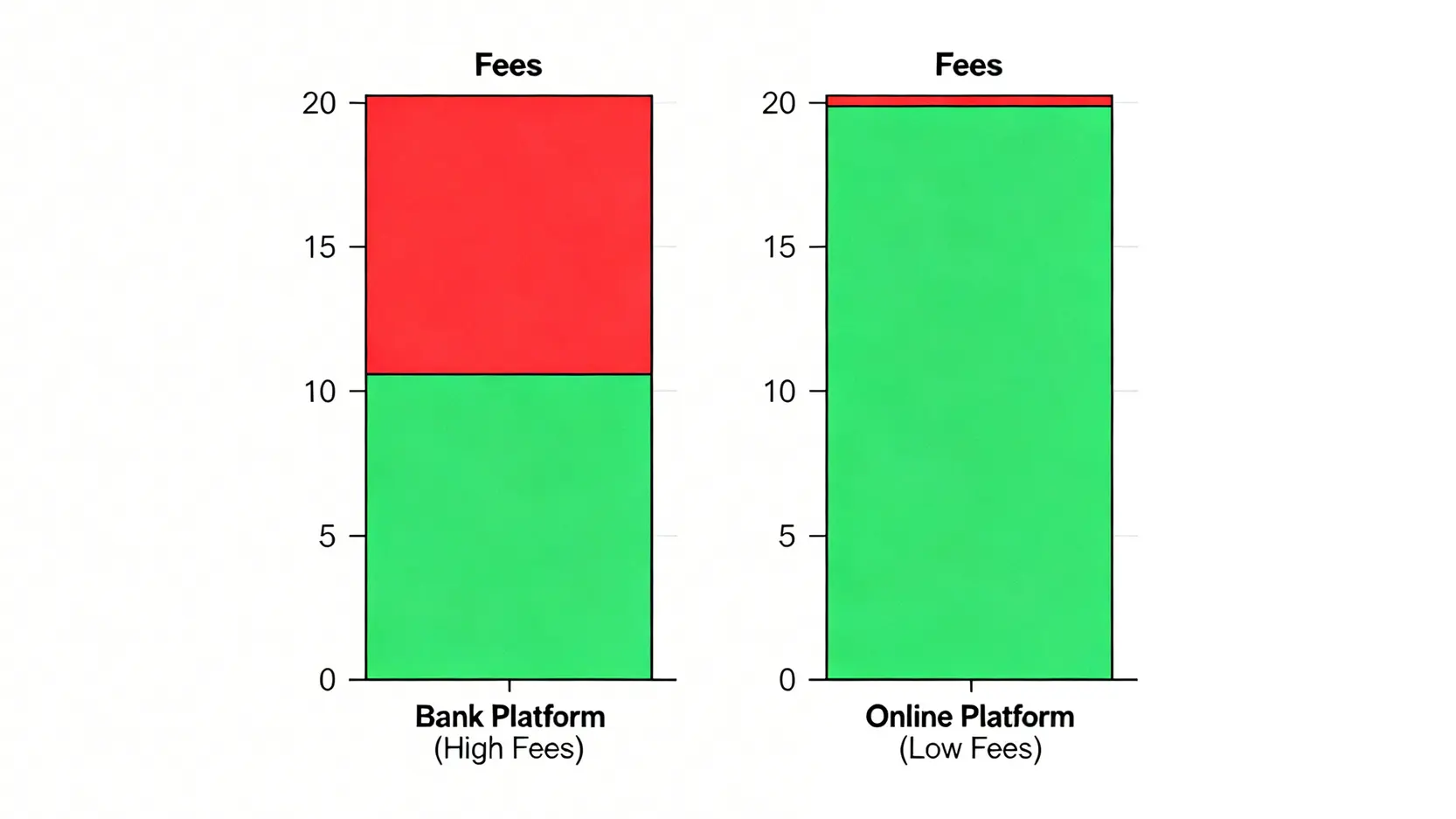
Statements such as “buy through iFast or FSM if you know what you are doing” and “banks charge higher fees” are common remarks on LIHKG. These comments highlight the impact of costs on investment returns. The total expense ratio (TER) of funds often ranges from 1.5 percent to 2.5 percent per year. Although it appears small, it significantly erodes long-term compound returns. Purchasing funds through banks may also involve initial subscription fees ranging from 2 percent to 5 percent. In contrast, many online fund platforms waive subscription fees, which alone can significantly improve your starting return.

兩張並列的條形圖,比較在銀行平台和網上平台投資基金20年後,高昂收費對最終回報的侵蝕效果。

Over the long term, even small differences in fees can have a significant impact on your investment returns.


Trap Two: Focusing Only on Dividend Yield While Ignoring Capital Loss Risk

High dividend funds are a favorite among many Hong Kong investors, but high yields may conceal hidden risks. Some funds maintain attractive dividend yields by distributing capital, meaning your own principal is paid back as dividends, which creates a situation where income is received but capital value declines. Smart investors should not only focus on dividend yield but also examine “total return” (which includes price appreciation or depreciation plus dividend income). Understanding the fund’s distribution policy helps avoid falling into high dividend traps

Trap Three: Buying Funds Through Bank RMs With Hidden Fees and Service Considerations

The role of bank relationship managers (RMs) is another frequently discussed topic. While RMs can provide convenient one-stop services, they often have sales targets to meet (KPI). As a result, the funds they recommend may not necessarily be the best-performing or most suitable options for you, but rather those that generate higher commissions for the bank. In addition, buying or switching funds through banks may involve additional charges. Before investing, always clarify all fee structures and treat RM recommendations as references while conducting your own research.


FAQ: Common Questions About Fund Investing in Hong Kong

Q: Is a monthly fund investment plan good? What type of investor is it suitable for?

A: A monthly fund investment plan is a strategy that suits most people, especially young people who are just starting out or investors with limited capital. It applies the principle of “dollar cost averaging”, buying fewer units when prices are high and more units when prices are low, which can effectively smooth out costs and reduce the risk of entering the market at a high point with a lump sum. As long as you stay consistent, you can accumulate considerable wealth over time.

Q: Should I buy funds through a bank, brokerage, or online platform?

A: Each has its own advantages and disadvantages. Banks: offer one-stop services, which are convenient but also the most expensive in terms of fees. Brokerages: charge lower fees than banks, but the fund selection may be more limited. Online fund platforms (such as FSM and iFast): offer the lowest fees and the widest selection, but require investors to have a certain level of self-management ability. For savvy investors, online platforms are undoubtedly the most cost-effective choice.

Q: What is the difference between money market funds, bond funds, and equity funds?

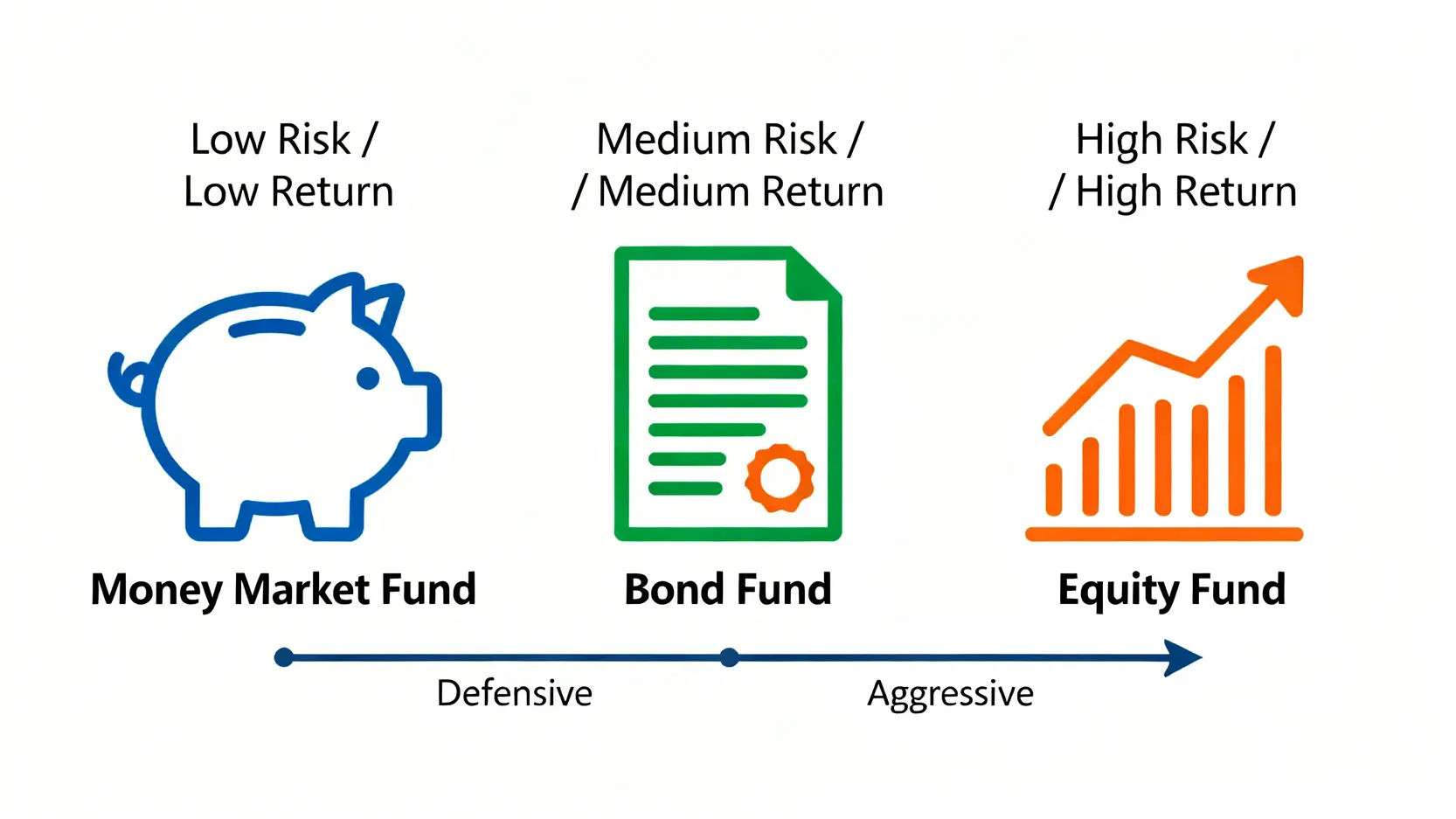
A: The main differences lie in their investment targets, risk levels, and expected returns.

一張圖表解釋貨幣基金、債券基金和股票基金在風險與回報上的區別。

Fund Risk Spectrum: From Defensive Stability to Aggressive Growth.

Money market funds: invest in short-term deposits, commercial paper, and similar instruments. They carry very low risk, with returns similar to bank savings deposit rates, and are mainly used to park idle funds.
Bond funds: invest in bonds issued by governments or corporations. They carry relatively low risk and provide stable interest income, making them the “defensive” part of an asset allocation.
Equity funds: invest in shares of listed companies. They offer the highest potential returns, but also the highest risk and volatility, making them the “offensive” core of an investment portfolio.

Q: What does a fund’s “Net Asset Value (NAV)” mean?

A: Net Asset Value (NAV) refers to the value of each fund unit. It is calculated by taking the total market value of all assets held by the fund (such as stocks and bonds), subtracting all liabilities, and then dividing by the total number of fund units issued. The buying and selling price of a fund is based on the NAV calculated after the market closes each day.

Q: After buying a fund, how often should I review its performance?

A: Funds are long-term investment tools and are not suitable for frequent trading. In general, it is recommended to review them every six months or once a year. When reviewing, you should focus on: 1) whether the fund’s performance is in line with similar funds or market indices; 2) whether there have been any major changes to the fund’s investment strategy; 3) whether your personal financial goals or risk tolerance have changed. Avoid making irrational decisions because of short-term market fluctuations.


Conclusion

In short, to invest successfully in funds, you cannot rely solely on the track record of professional fund managers. You should also make good use of the collective wisdom found in fund discussion forums such as LIHKG to avoid common traps. This 2026 Hong Kong fund recommendation list is the result of balancing both perspectives. Before making any investment decision, be sure to conduct careful research, compare the fees and services of different platforms, and ultimately choose the fund that best matches your personal risk tolerance and financial goals. Only then can you go further and more steadily on your investment journey.

编者
Evan Lin

Evan Lin

我是Evan Lin,从大学时期开始接触外汇交易,至今已有多年实战经验,熟悉技术分析与EA策略,热衷于研究市场脉动与风险管控,喜欢分享实战经验和交易技巧,和大家一起学习、一起进步!

If you liked this article, please share it!

Related Articles

  • Order Flow Analysis Tools: Track Institutional Activity
    In-Depth Review of Intelligent Order Flow Detection Tools: Understanding Institutional Activity and Identifying Real Market Buying and Selling Pressure What Is Order Flow, and Why Is It a “Leading Indicator” for Price Prediction? Candlestick charts and technical indicators can be misleading, but the real-money "Order Flow" within the market cannot....
    2026 年 6 月 4 日
  • Social Sentiment Indicators: Predicting Stock Trends
    Social Sentiment Quantitative Indicators: Mining PTT and Dcard Discussions to Predict Stock Prices What Are Social Sentiment Quantitative Indicators, and Why Are They Becoming Increasingly Important? In an era of information overload, financial markets are no longer driven solely by cold financial statements and macroeconomic data. The "Shipping King" phenomenon...
    2026 年 6 月 4 日
  • Taiwan FSC Futures Broker Verification Guide
    Avoid Fraudulent Platforms! A Visual Guide to Taiwan FSC Licensed Futures Merchant Verification and Scam Prevention In recent years, driven by heightened volatility in global financial markets and the impact of monetary easing policies worldwide, more investors have begun seeking diversified investment instruments. However, underground futures operators and overseas fraudulent...
    2026 年 6 月 4 日
返回顶部