Cold Wallet Risks: 5 Security Tips to Protect Crypto

Cold Wallet Risks Revealed: 5 Critical Security Precautions You Must Know to Avoid the Trap of Losing Everything
When investing in cryptocurrency, asset security is always the first line of defense. Many people believe that storing cryptocurrency in a cold wallet guarantees complete safety, but this is actually a dangerous misconception. In reality, improper usage and potential cold wallet risks may cause your assets to disappear overnight. This article will thoroughly analyze several key cold wallet security precautions you must be aware of, helping you enhance your cryptocurrency wallet security from the source. It ensures that your digital wealth receives real protection and helps you avoid irreversible losses caused by a moment of negligence.
Clarifying the Concept: Why Are Cold Wallets Considered the Most Secure Cryptocurrency Wallet?
Before discussing the potential risks of cold wallets in depth, it is important to understand why they are so highly regarded. A cold wallet, also known as a hardware wallet has a core advantage rooted in its design principle, which significantly enhances cryptocurrency wallet security.
The Core Principle of Cold Wallets: Private Keys Never Touch the Internet
Ownership of cryptocurrency is essentially proven by the “private key”. Whoever controls the private key controls all the assets associated with the corresponding address. The most critical design of a cold wallet is that it stores your private key in a completely offline physical device. This means:
- Offline generation and storage: The private key is generated inside the device when the cold wallet is first activated, and it never leaves the device.
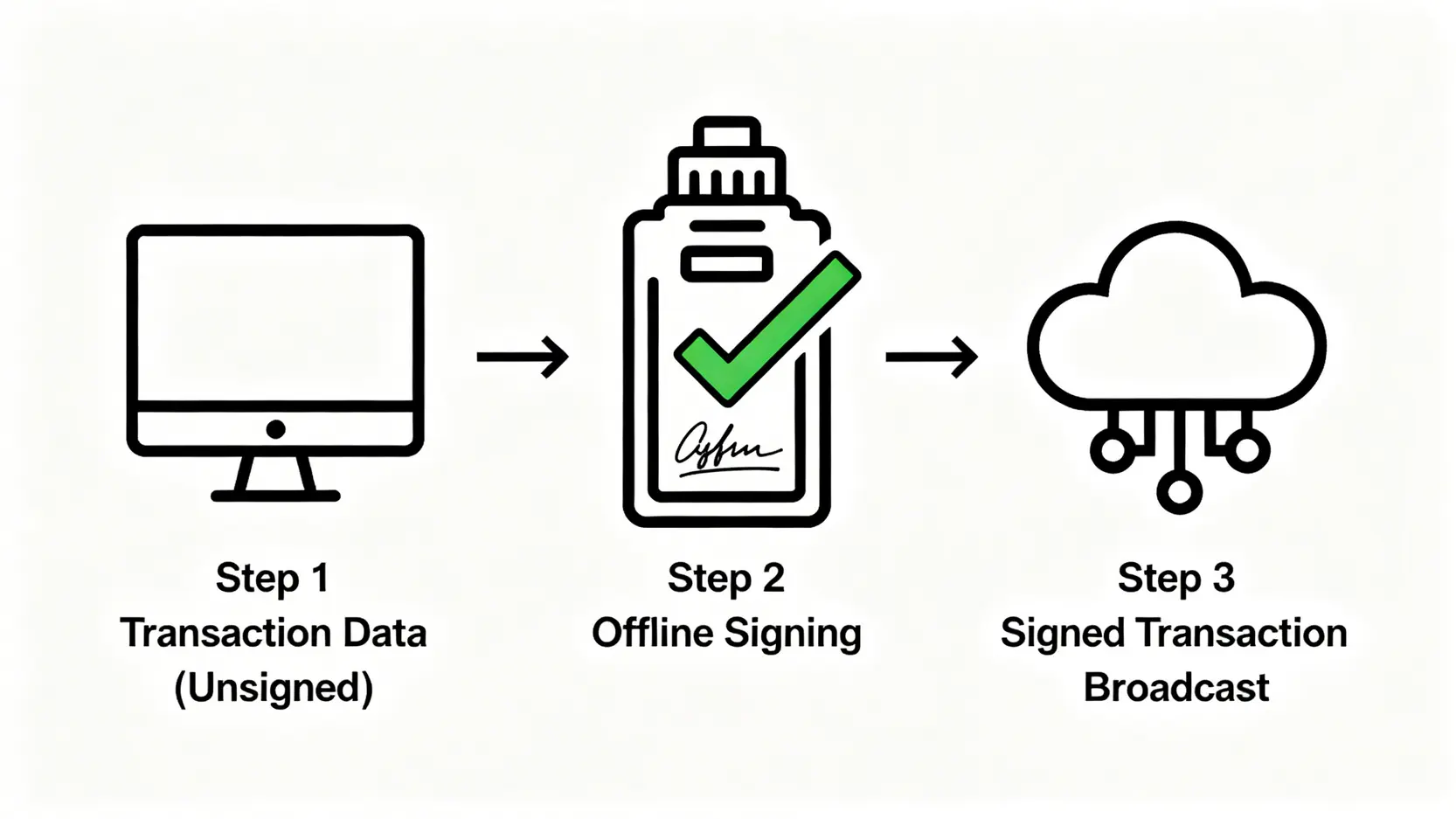
- Isolated transaction signing: When you need to send a transaction, the transaction request is transmitted from an internet-connected computer or mobile phone to the cold wallet. After you confirm the transaction details on the cold wallet screen (such as the amount and address), the device uses the private key stored inside to authorize the transaction through “signing”. The entire signing process is completed in an offline environment. Only the signed transaction data is returned to the computer and broadcast to the blockchain network.
- Immunity to viruses and hackers: Because the private key never touches the internet, even if your computer or mobile phone is infected with malware, hackers cannot steal your most important asset, the private key.

It is precisely this characteristic of “physical isolation” that allows cold wallets to effectively defend against the vast majority of online attacks, making them the preferred solution for storing large amounts of crypto assets or holding them long term.
Security Comparison: Cold Wallet vs. Hot Wallet vs. Exchange Wallet
To better understand the position of cold wallets, we can compare them with two other common types of wallets. Understanding their differences helps you develop a more comprehensive cryptocurrency wallet security strategy based on your own needs.
| Wallet Type |
Private Key Storage Method |
Security | Convenience | Applicable Scenarios |
| Cold Wallet (Hardware Wallet) | Stored offline in a dedicated hardware device | Extremely High | Relatively Low | Long-term storage, large-value assets (HODL) |
| Hot Wallet | Stored online in a mobile app or browser extension | Medium | High | Daily transactions, small payments, interaction with DApps |
| Exchange Wallet | Custodied centrally by the exchange, users do not directly hold the private keys |
Relatively Low |
Extremely High | Frequent trading, quantitative trading, staking for yield |
In summary, there is no perfect wallet, only the option that best suits your needs. Most experienced investors adopt a hybrid strategy: storing the majority of long-term holdings in a cold wallet, while keeping a smaller amount of funds that need to be used frequently in a hot wallet or exchange. This approach balances security and convenience.
Further Reading (Strongly Recommended)
Core Risk: Cold Wallets Are Not 100% Safe! 3 Hidden Cold Wallet Risks You Must Watch Out For
Although cold wallets are technically very secure, their biggest weakness often comes from the user. Understanding these potential cold wallet risks is the first step in building an effective protection strategy.
Risk One: Physical Risks (Loss, Damage, Theft)
This is the most intuitive risk. A cold wallet is a physical device, and it can face various physical threats just like your phone or keys:
- Loss: It may be accidentally lost during a move, while traveling, or in daily life. Without a proper seed phrase backup, this is equivalent to permanently losing all assets.
- Damage: It may be affected by fire, flooding, or accidental crushing or dropping of the device, resulting in the inability to access the data.
- Theft: The device may be directly stolen by a thief or someone nearby. Although a thief still needs your PIN code to operate it, it remains a direct threat.
Core Prevention: The key solution to physical risk lies in “backup”. Your assets are not stored in the hardware itself but recorded on the blockchain. As long as you have the correctly backed-up “seed phrase”, you can fully restore all assets on a new wallet even if the device is lost or damaged.
Risk Two: Human Error (Improper Seed Phrase Storage, Phishing)
This is the most common and also the most fatal source of cold wallet risks. Many users lose their assets not because the cold wallet itself is hacked, but due to operational mistakes.
- Improper storage of the seed phrase: The seed phrase is the only key to restore your wallet and typically consists of 12, 18, or 24 words. Anyone who obtains your seed phrase can replicate your wallet anywhere and steal all assets. Common mistakes include:
- Taking screenshots of the seed phrase or storing it as a text file on a computer, mobile phone, or cloud drive.
- Leaving the paper containing the seed phrase carelessly or storing it in the same place as the cold wallet.
- Sending the seed phrase via email or messaging software.

- Phishing: This is the most widespread attack method targeting cold wallet users. Scammers impersonate official personnel or applications to trick you into entering your seed phrase. Common forms of cryptocurrency phishing scams include:
- Fake technical support: When you ask for help on social media, scammers may send you a private message providing a fake “official verification” or “wallet synchronization” website and ask you to enter your seed phrase to “resolve the issue”.
- Malicious airdrops or DApps: These lure you to connect your wallet to a malicious website, authorize asset transfers, or display a fake wallet interface asking you to enter your seed phrase to “claim rewards”.
Core Prevention: Establish a strict rule that the seed phrase never touches the internet and is never entered into any website or online form. The seed phrase should only be entered directly into the cold wallet device itself during wallet initialization or wallet recovery.
Risk Three: Supply Chain Attacks (Purchasing a Tampered Malicious Device)
This is a relatively rare but highly dangerous attack method. Attackers intercept and tamper with the device during the process between the factory and delivery to the user. For example:
- Pre-configuring the wallet and retaining the seed phrase. Once you transfer assets into this “new wallet”, the attacker can immediately steal them.
- Embedding malicious firmware in the device that may leak your private key under certain conditions.
Core Prevention: Only purchase cold wallets from official websites or their authorized distributors. Do not try to save money by buying from auction sites, second-hand platforms, or unknown sellers.
Practical Guide: 5 Cold Wallet Security Precautions to Protect Your Assets
After understanding the risks, the next step is to establish a robust security process. Following the five cold wallet security precautions below can significantly enhance your cryptocurrency wallet security.
Precaution One: Always Purchase From Official Authorized Channels
This is the first and most important line of defense against supply chain attacks. Purchase directly from the brand’s official website (such as the official websites of Ledger or Trezor) or from their officially listed authorized distributors. When receiving the product, carefully check whether the packaging is intact and whether there are any signs of tampering.
Precaution Two: Physically Back Up and Store the Seed Phrase Offline
The seed phrase is the ultimate insurance for your assets and must be stored in the most primitive and reliable way.
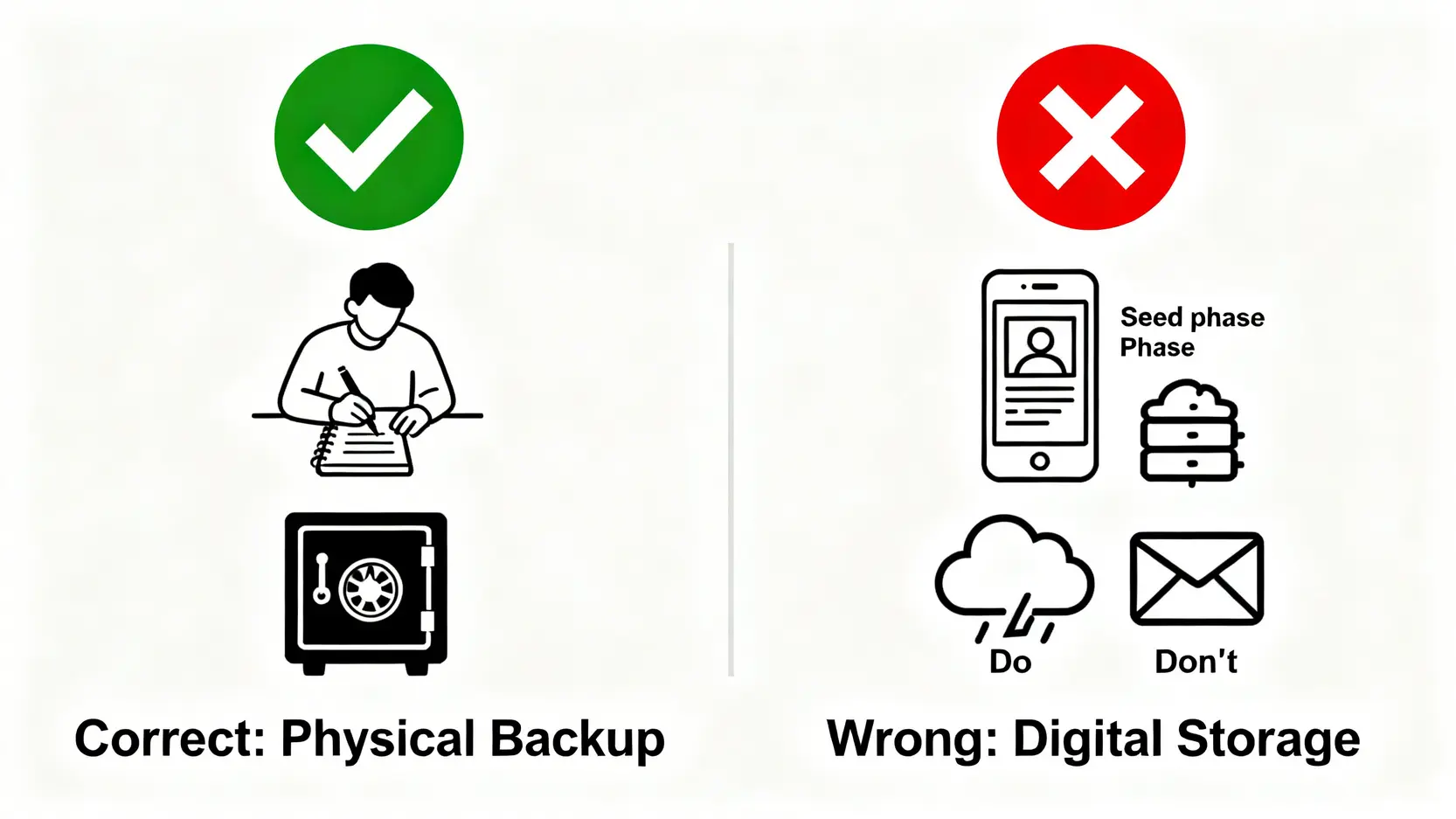
- Physical writing: Use the seed phrase card included in the package and write it down by hand. Check it two to three times to ensure accuracy.
- Reject digitization: Never photograph, screenshot, or store the seed phrase as any digital file.
- Distributed storage and fireproof protection: Store the written seed phrase in a secure, concealed, fireproof, and waterproof place. A more advanced method is to purchase a steel seed phrase backup tool and engrave it onto metal to prevent paper damage due to accidents. You may also consider storing backups in two different secure locations (such as a home safe and a bank safe deposit box).
Precaution Three: Perform the Initialization Process Yourself and Never Use a Pre-Configured Wallet
After receiving a new cold wallet, the entire setup process must be completed by you personally.
- Reset the device: Even for a brand-new device, develop the habit of performing a “factory reset” first to ensure that no default program exists.
- Generate a new seed phrase: Allow the device to randomly generate a brand-new seed phrase in front of you and immediately write it down for backup.
- Beware of preset seed phrases: If the package contains a seed phrase card that has already been “printed” or “scratched open”, this is definitely a trap! Stop using it immediately and contact the manufacturer. This is a typical supply chain attack method.
Precaution Four: Carefully Verify Wallet Addresses and Screen Information Before Transactions
This is the most easily overlooked step in daily operations. When transferring funds or interacting with smart contracts, hackers may use malware to alter the recipient address displayed on your computer screen.

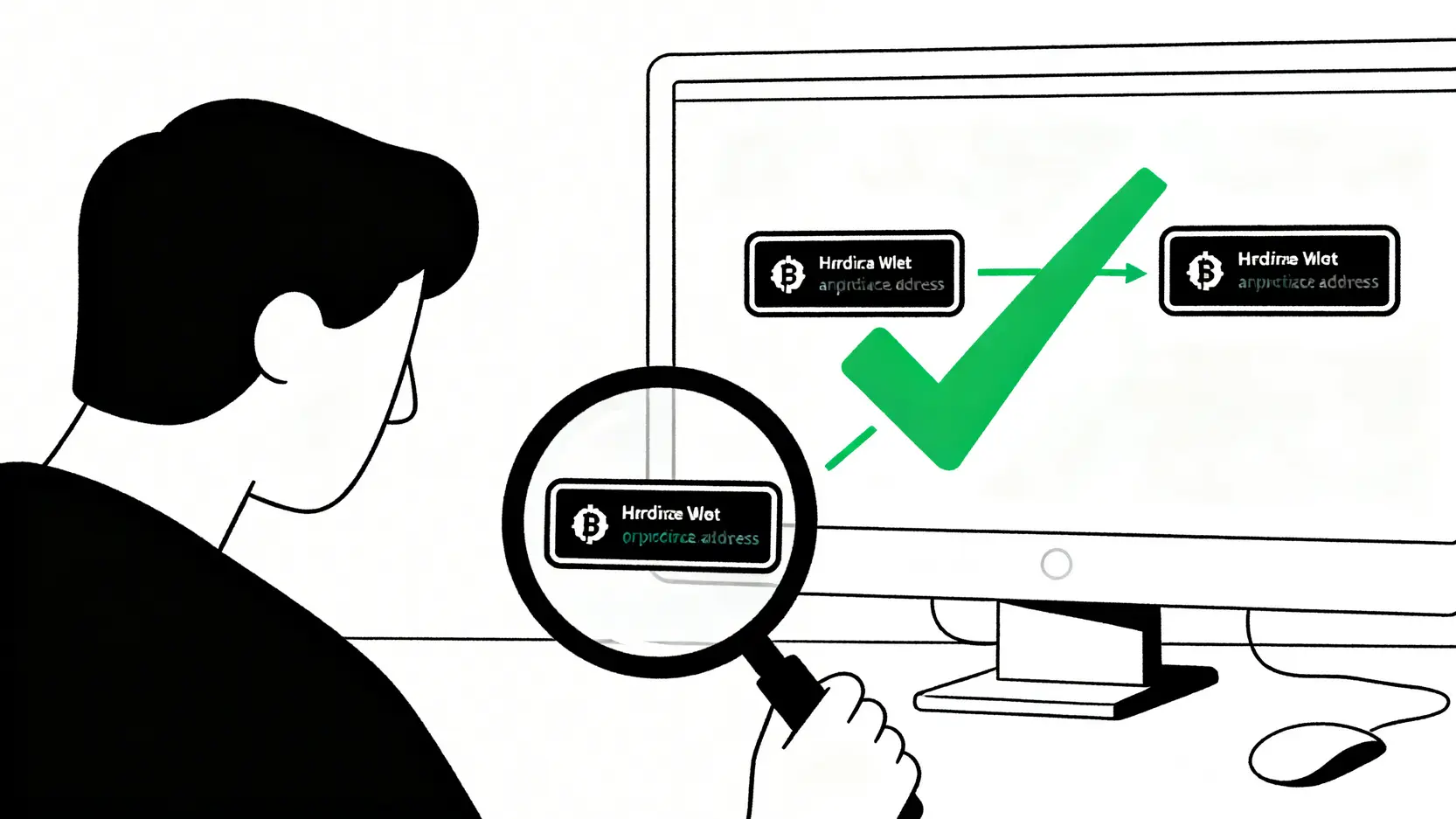
- Trust your device screen: The screen of the cold wallet is independent and secure. The information displayed there is the most reliable.
- Cross verification: Before pressing the confirmation button, carefully verify that the address and amount displayed on the cold wallet screen match exactly with what you expect. For addresses, at least verify the first six and last six characters.
Precaution Five: Perform Regular Small Test Transactions to Ensure Wallet and Backup Function Properly
For assets stored long term, regular checks are necessary. This prevents situations where you need to use the assets years later only to discover device failure or an incorrectly recorded seed phrase.
- Function testing: Every six months or once a year, try sending a very small transaction to confirm that the device functions properly.
- Backup verification: This is the highest level security practice. Prepare a spare or new cold wallet and restore it using your backed-up seed phrase to check whether the assets can be successfully recovered. This confirms with absolute certainty that your backup is accurate and valid. After completion, make sure to completely wipe the spare device.
Cold Wallet Risks and Security Precautions FAQ
Q: If my cold wallet breaks or goes missing, will my assets disappear?
A: No. As long as you properly keep the correct seed phrase, your crypto assets remain completely safe. You can purchase a new cold wallet from the same brand or a different brand (that supports the same crypto standards) and use your seed phrase to restore the wallet. All assets will appear fully in the new wallet. Assets are recorded on the blockchain, not inside the hardware device.
Q: Can one cold wallet store multiple different cryptocurrencies?
A: Yes. Most mainstream cold wallets today, such as Ledger and Trezor, support thousands of cryptocurrencies and tokens, including Bitcoin (BTC), Ethereum (ETH) and its ecosystem ERC-20 tokens, BNB Chain, Solana, and others. You only need to install the application for the corresponding coin within the management software (such as Ledger Live) and you can manage multi-chain assets using the same cold wallet and the same seed phrase.
Q: What are the main security differences between different cold wallet brands (such as Ledger and Trezor)?
A: Both are top-tier choices in the industry with very high security levels. The main difference lies in the secure chip and open-source software strategy. Ledger uses a bank-grade Secure Element chip that provides additional physical protection, but some of its firmware is not open source. Trezor follows a fully open-source principle where the source code is publicly available for review, offering greater transparency but slightly less physical protection. For ordinary users, as long as correct security practices are followed, both can provide sufficient protection.
Q: Can a cold wallet be remotely hacked?
A: Basically impossible. The core design of a cold wallet ensures that the private key never connects to the internet. Hackers cannot remotely steal the private key stored inside the device through the internet. Nearly all known cases of stolen cold wallet assets result from users leaking their seed phrase or being tricked by phishing attacks into authorizing malicious transactions, rather than the cold wallet itself being compromised.
Conclusion
In summary, a cold wallet is a powerful tool for improving cryptocurrency wallet security, but it is not a universal solution. Real security comes from the user’s own knowledge and vigilance. Ultimately, you are the guardian of your assets, and the hardware wallet is merely your shield. By thoroughly understanding potential cold wallet risks and strictly following the five cold wallet security precautions mentioned in this article, purchasing from official channels, physically backing up the seed phrase, performing initialization personally, carefully verifying transactions, and conducting regular tests, you can maximize the protection of your crypto assets and navigate the Web3 world with confidence.
Related Articles
-
Practical Applications of Volatility Surfaces: From Options Modeling to Advanced Skew Trading Strategies In options markets, implied volatility is never a flat line. Instead, it forms complex "smile" or "skew" surfaces. For advanced traders, mastering the practical applications of volatility surfaces is equivalent to possessing a lens that reveals market...2026 年 6 月 3 日
-
Building a Foreign Capital Flow Copy Trading Model: A Stock Market Indicator for Accurately Tracking Institutional Positioning In Asia-Pacific stock markets, foreign capital inflows and outflows often determine the direction of the index. However, simply looking at daily net buy and sell data is no longer enough. Only by building...2026 年 6 月 3 日
-
Options Buyer Strategies During Extreme Market Conditions: Black Swan Hedging and Cross-Market Arbitrage During Volatility Surges The most terrifying aspect of financial markets is not a gradual decline, but overnight flash crashes and cross-market capital withdrawals accompanied by volatility surges. In the highly unpredictable global macroeconomic environment of 2026, geopolitical...2026 年 6 月 3 日