FX Swap vs Currency Swap: Key Differences & Risks

Updated: 2026/04/24  |  CashbackIsland

fx-swap-vs-currency-swap

Foreign Exchange Swap vs Currency Swap: Definition, Examples, and Risk Analysis

When dealing with cross-border business or overseas investment, fluctuations in exchange rates and interest rates pose a major challenge for corporate financial management. Many people have heard of “swap transactions” but often have only a superficial understanding of foreign exchange swaps and currency swaps, and are even less clear about what cross-currency swaps are, as well as the hidden risks involved in swap trading. Although these financial instruments are complex, they are powerful tools used by multinational corporations to hedge risks and reduce financing costs. This article will provide a thorough analysis of the core differences between the two, help you understand their operating mechanisms through practical foreign exchange swap examples, and offer effective risk management strategies. Whether you are a corporate finance manager or an active investor, understanding these concepts will be highly beneficial. 


What is a Swap Transaction? Understanding the Two Core Tools

A swap transaction is a type of financial derivative in which two parties agree to exchange different types or currencies of cash flows over a future period. Its essence is an “exchange” with the purpose of managing risk, reducing costs, or obtaining access to specific market financing opportunities. The most common swap transactions fall into two main categories: foreign exchange swaps and currency swaps.


Definition and Mechanism of Foreign Exchange Swap (FX Swap)

A foreign exchange swap (FX Swap) is a contract that combines “spot” and “forward” foreign exchange transactions. At the time of signing, both parties agree to exchange principal in two currencies at the spot exchange rate, and then reverse the exchange at a pre-agreed forward exchange rate on a specified future date.

In simple terms, it is like a “short-term currency exchange arrangement” with a bank:

  • Step 1 (Spot Transaction): You need US dollars now, so you exchange New Taiwan dollars with the bank for a certain amount of US dollars.
  • Step 2 (Forward Transaction): At the same time, you agree with the bank that, for example, three months later, regardless of how the market exchange rate has changed, you will exchange the US dollars back into New Taiwan dollars at a rate agreed upon today.

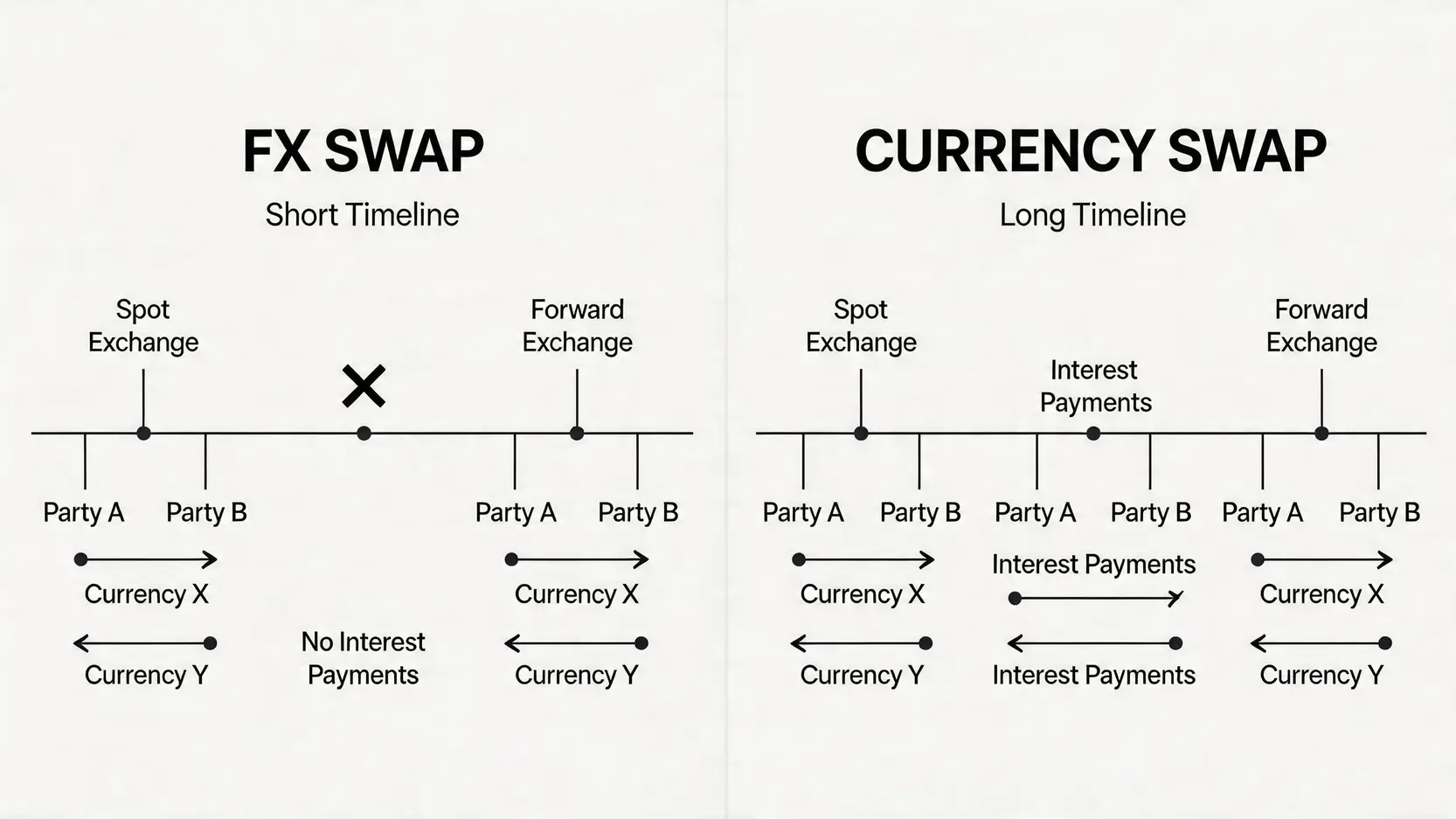
The core purpose of an FX swap is short-term liquidity management. It does not involve interest exchange and is mainly used to meet short-term foreign currency funding needs while locking in exchange costs. It is an efficient foreign exchange hedging tool. 


Definition and Mechanism of Currency Swap

A currency swap, more precisely referred to as a cross-currency swap, is a longer-term contract. It not only involves the exchange of principal at the beginning and end of the agreement but also requires both parties to periodically exchange interest payments denominated in their respective currencies during the contract period.

According to the Bank for International Settlements (BIS), swap transactions are an important component of the over-the-counter (OTC) market. The mechanism of a currency swap is as follows:

  • At initiation: Two companies (or financial institutions) exchange equivalent principal amounts in different currencies at the prevailing exchange rate.
  • During the term: Throughout the contract period (typically more than one year), both parties periodically pay interest to each other based on the agreed notional principal and interest rate, which may be fixed or floating.
  • At maturity: The original principal amounts are exchanged back at the end of the contract.

The main purpose of a currency swap is to manage long-term exchange rate and interest rate risks, as well as to reduce overseas financing costs. For example, a company may be able to borrow at a lower interest rate in a local currency market, while needing US dollars for investment in the US. Through a currency swap, it can leverage its local financing advantage to indirectly obtain lower-cost US dollar funding. 


Core Differences: FX Swap, Currency Swap, and Cross-Currency Swap Comparison

After understanding the basic definitions, we now take a deeper look at the differences between FX swaps and currency swaps, and explain what a cross-currency swap is. Although the names are similar, they differ significantly in structure, duration, and usage. Incorrect application may lead to serious swap trading risks.


A Clear Comparison of the Three: Principal, Interest, and Usage

To help you understand at a glance, we have summarized the core differences among the three in the table below:

Comparison Items FX Swap Currency / Cross-Currency Swap
Principal Exchange ✅ Principal is exchanged at both the start and the end of the contract ✅ Principal is exchanged at both the start and the end of the contract (but there are also structures where principal is not exchanged, only interest is exchanged)
Interest Exchange No interest is exchanged; the cost is embedded in the difference between the forward exchange rate and the spot exchange rate (swap points) Periodic interest payments are exchanged, which is its core feature
Contract Tenor Short-term tenor (usually within one year) Long-term tenor (usually more than one year, and can extend to ten years or even longer)
Main Purpose Short-term funding, cash flow management, short-term foreign exchange hedging Long-term interest rate and foreign exchange risk management, reducing overseas financing costs, and accessing foreign capital markets

外匯掉期與貨幣掉期現金流對比圖,展示了兩者在利息交換上的核心區別。

FX Swap vs Currency Swap: Core Differences at a Glance


What Is a Cross-Currency Swap? Why Is It So Important?

In practice, “currency swap” and “cross-currency swap” are often used interchangeably, but “cross-currency swap” is a more precise term, specifically referring to swap contracts involving two different currencies and including interest exchange. Its importance lies in providing global corporations and investors with a powerful tool to optimize their balance sheets.

Its importance is reflected in:

  • Avoiding financing barriers: Companies can leverage their strong credit reputation and low interest rate advantages in their home market to indirectly obtain foreign currency funding that is otherwise difficult to access directly or comes at a high cost.
  • Hedging long-term foreign currency assets/liabilities: When multinational corporations hold large amounts of foreign currency assets or liabilities, long-term fluctuations in exchange rates and interest rates create significant risks. Cross-currency swaps can convert these uncertain foreign currency cash flows into predictable domestic currency cash flows, achieving effective hedging.
  • Creating arbitrage opportunities: When interest rate markets in different countries diverge, financial institutions can structure cross-currency swap products to profit from these spreads while offering clients more attractive financing solutions. This is similar to the concept of an interest rate swap, but applied across different currencies.


Practical Applications of Swap Transactions: Learning How They Work Through Examples

After covering the theory, let us look at two common business scenarios to see how FX swap examples and cross-currency swap examples operate in the real world.


FX Swap Example: How an Import and Export Company Locks in a 3-Month Exchange Cost

Assume a Malaysian furniture exporter (Company A) receives an order from a US client and will receive USD 1 million in payment in three months. However, Company A currently needs MYR 500,000 to purchase raw materials. At the same time, the company’s finance team expects the USD/MYR exchange rate may decline over the next three months, which would reduce the value of the incoming USD payment.

To manage cash flow and hedge exchange rate risk, Company A enters into an FX swap transaction with a bank:

  1. Spot leg: Company A immediately sells approximately USD 106,000 (assuming spot rate USD/MYR = 4.70) to the bank using part of its future USD receivables as collateral, receiving MYR 500,000 in return.
  2. Forward leg: At the same time, both parties agree on a 3-month forward contract, in which Company A will repurchase the USD 106,000 from the bank at a pre-agreed forward rate (for example, 4.72) after three months.

Result: Through this transaction, Company A not only resolves its immediate MYR liquidity needs but, more importantly, locks in the exchange cost of part of its USD exposure. No matter how the market rate fluctuates in three months, its operations will not be affected. This is a typical FX swap example used to manage short-term liquidity and hedge exchange rate risk.


Further Reading (Highly Recommended)

What Does “USD Hedging” Mean in Funds? Essential Safe-Haven Currencies and AUD Hedging Strategies for Investors


Cross-Currency Swap Example: How Multinational Corporations Reduce Financing Costs Through Interest Rate Differentials

Assume a US technology giant (Company B) plans to build a factory in Japan and needs a 5-year loan of JPY 10 billion. At the same time, a Japanese automobile manufacturer (Company C) plans to expand into the US market and needs an equivalent 5-year loan of USD 80 million.

Their respective financing conditions are:

  • Company B has strong credit in the US and can borrow USD at a fixed annual rate of 3%, but borrowing JPY directly in Japan may cost as high as 1.5%.
  • Company C is a leading firm in Japan and can borrow JPY at a very low fixed annual rate of 0.5%, but borrowing USD directly in the US may cost as high as 5%.

Direct financing is not optimal for either party. Therefore, they arrange a cross-currency swap through an investment bank:

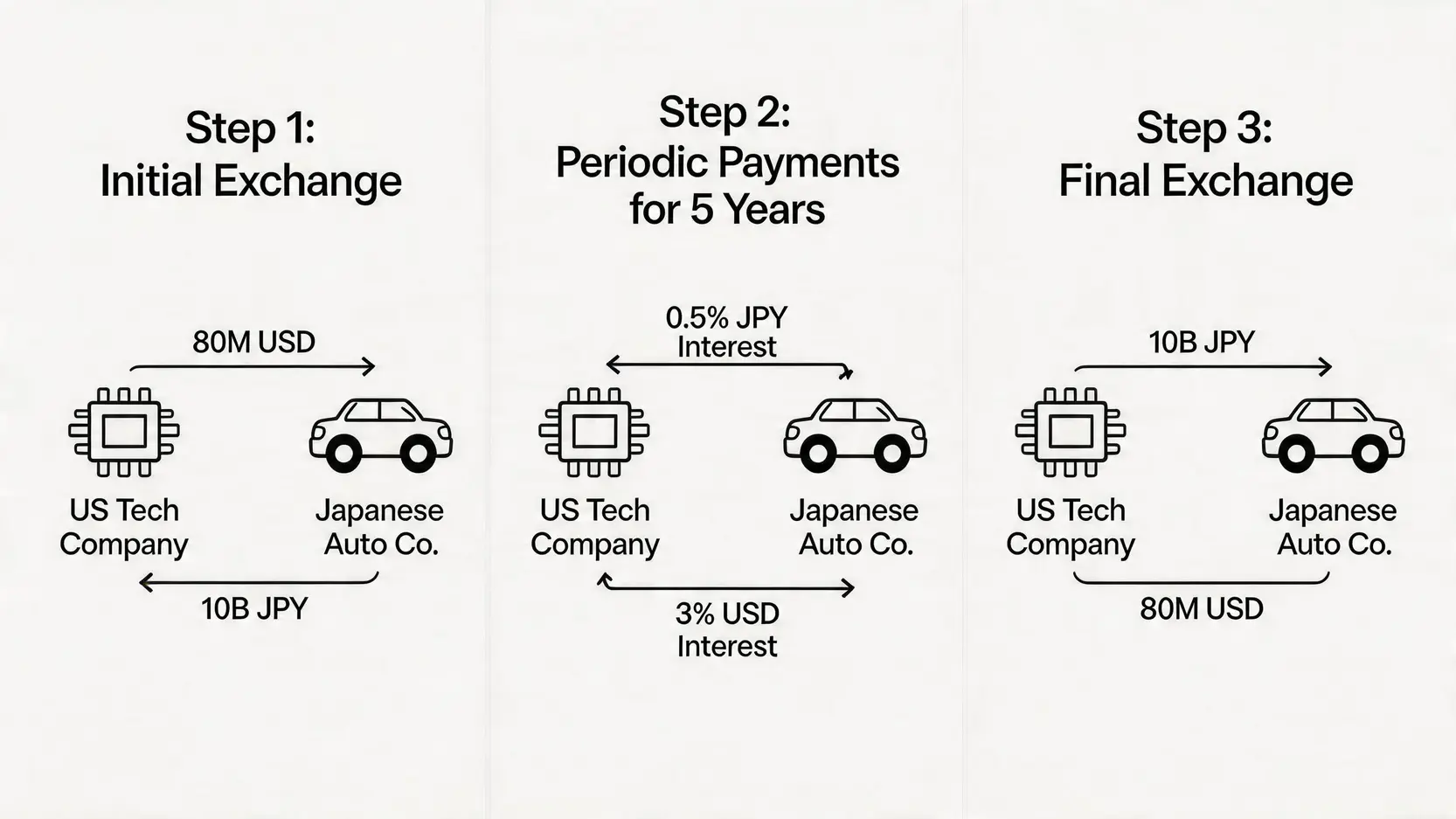
  1. Initial principal exchange: Company B transfers USD 80 million to Company C, and Company C transfers JPY 10 billion to Company B.
  2. Periodic interest payments: Over the next 5 years, annually:
    • Company B pays Company C JPY interest at 0.5% based on the JPY principal (10 billion × 0.5% = JPY 50 million).
    • Company C pays Company B USD interest at 3% based on the USD principal (80 million × 3% = USD 2.4 million).
  3. Final principal repayment: After 5 years, Company B returns JPY 10 billion to Company C, and Company C returns USD 80 million to Company B.

交叉貨幣掉期操作流程圖,展示美國與日本公司如何交換本金與利息以降低融資成本。

Cross-Currency Swap Process: Reducing Financing Costs Through Comparative Advantage

Result: Company B successfully obtains JPY funding at 0.5%, significantly lower than the 1.5% it would pay by borrowing directly in Japan; Company C obtains USD funding at 3%, also significantly lower than the 5% cost of borrowing directly in the US. Both parties leverage their home market financing advantages to reduce funding costs, perfectly demonstrating the powerful function of cross-currency swaps.


Must-Read! 4 Major Swap Trading Risks and Management Strategies

Although swap transactions are powerful, they are not without risks. Before enjoying their benefits, it is essential to fully understand the potential risks of swap trading and establish corresponding management strategies. The following are the four main types of risk.


Counterparty Risk: What if the Counterparty Defaults?

This is one of the most critical risks. Since swap contracts are privately negotiated between two parties (over-the-counter), if one party is unable to fulfill its contractual obligations due to financial difficulties or other reasons (for example, failing to pay interest or return principal), the other party will incur losses. The longer the contract tenor, the greater this risk.

  • Management strategies:
  • Transact with reputable large financial institutions.
  • Sign an ISDA Master Agreement to clearly define default handling terms.
  • Require the counterparty to provide collateral or margin.
  • Clear transactions through a central counterparty (CCP) to reduce bilateral credit risk.


Interest Rate and Exchange Rate Risk (Market Risk): The Direct Impact of Market Fluctuations

Market risk refers to situations where movements in interest rates or exchange rates go against expectations, causing the value of the swap contract to move unfavorably. For example, in a cross-currency swap, if you are the party paying a fixed rate and receiving a floating rate, a sharp decline in market interest rates will reduce the interest you receive while the interest you pay remains unchanged, resulting in a loss.

  • Management strategies:
  • Conduct thorough market analysis and stress testing before entering into contracts.
  • Treat swap transactions as hedging tools rather than speculative instruments, ensuring alignment with actual business risks.
  • Consider incorporating option structures into swap contracts to increase flexibility.


Liquidity Risk: Difficulty in Exiting the Contract

Swap contracts are usually customized for specific needs and are not highly standardized. This means that if you want to terminate or transfer the contract before maturity, it may be difficult to find a willing third party in the market, or it may require paying a high termination cost.

  • Management strategies:
  • Use more standardized contract structures whenever possible.
  • Clearly define early termination terms and calculation methods with the counterparty before signing.
  • Ensure sufficient internal cash flow so that positions do not need to be closed under unfavorable market conditions.


Basis Risk

Basis risk exists in floating-for-floating cross-currency swaps. It refers to the risk that two different floating rate benchmarks (for example, SOFR for USD and ESTR for EUR) do not move in perfect alignment, leading to deviations in hedging effectiveness. Even though both are floating rates, differences in reference benchmarks may result in slight discrepancies in movement pace and magnitude, which can accumulate into significant losses over time.

  • Management strategies:
  • When designing hedging strategies, choose swap rate benchmarks that are as closely aligned as possible with the interest rate benchmarks of the hedged assets or liabilities.
  • Regularly monitor basis movements, assess hedging effectiveness, and make adjustments when necessary.


Frequently Asked Questions (FAQ)

Q: Is principal exchange always required in swap transactions?

A: Not necessarily. In an FX swap, principal is exchanged at both the beginning and the end. Standard cross-currency swaps also involve principal exchange. However, there are also “interest-only currency swaps” where principal is not exchanged and only interest payments based on a notional principal are exchanged. This can be useful in certain hedging scenarios. In addition, the most common interest rate swaps typically do not involve principal exchange.

Q: Can individual investors participate in FX swap transactions?

A: Generally, it is very difficult. Both FX swaps and currency swaps are over-the-counter (OTC) products with large contract sizes, and the counterparties are mainly banks, large multinational corporations, and institutional investors. Individual investors are more likely to encounter “rollover” or “swap” in margin forex trading, where the calculation is related to swap points, but this is not an actual swap contract.

Q: How are swap points calculated?

A: Swap points represent the difference between the forward exchange rate and the spot exchange rate in an FX swap, mainly reflecting the interest rate differential between the two currencies over the contract period. A simplified formula is: swap points ≈ spot exchange rate × (quote currency interest rate – base currency interest rate) × (days/360). If one currency has a higher interest rate than the other, its forward rate is typically at a discount (lower rate), and vice versa at a premium (higher rate), to offset the interest advantage of holding the higher-yielding currency.

Q: What is the difference between a cross-currency swap and an interest rate swap?

A: The main difference lies in the currencies involved. An interest rate swap involves only a “single currency”, where both parties exchange interest cash flows of the same currency but with different rate structures (such as fixed vs floating). A cross-currency swap involves “two different currencies”, where both principal and interest cash flows are exchanged in different currencies. Therefore, cross-currency swaps are exposed to both interest rate risk and exchange rate risk. 

Conclusion

In summary, FX swaps and currency swaps (also known as cross-currency swaps) are key tools for managing exchange rate and interest rate risks, but they serve fundamentally different purposes. An FX swap is a short-term liquidity management tool, while a currency swap is a long-term strategic financial arrangement. Clearly understanding the differences between FX swaps and currency swaps allows you to choose the most suitable financial instrument based on your company’s cash flow needs, hedging horizon, and risk tolerance. Although swap trading risks do exist, through prudent counterparty assessment, well-structured contract design, and continuous market monitoring, their powerful functions in stabilizing corporate finances and optimizing financing structures can be effectively realized. 

If you liked this article, please share it!

Related Articles

  • US-Japan Rate Gap: The Real Cause of Yen Weakness
    US-Japan Interest Rate Differential Out of Control? Uncovering the Root Causes of Yen Depreciation and the Bank of Japan's Policy Dilemma Recently, even though Japan's Ministry of Finance has repeatedly deployed large-scale intervention measures, the yen has only enjoyed brief periods of relief before returning to its depreciation trend. This...
    2026 年 6 月 9 日
  • Yen Carry Trade Unwinding: Global Market Impact
    The Ultimate Guide to Yen Carry Trade Unwinding: The Chain Reaction That Triggers Global Market Turmoil Recent violent fluctuations in the Japanese yen exchange rate, including the frequent intraday "flash crashes" and "surges", all point to one key term: the "carry trade unwinding chain reaction". This seemingly technical concept is...
    2026 年 6 月 9 日
  • Yen Futures Surge: Smart Money Positioning Guide
    Japanese Yen Futures Trading Volume Surges! Is Smart Money Flowing In? A Complete Guide to Positioning for the Opportunity Fundamentals: What Are Japanese Yen Futures? To understand the significance behind a surge in Japanese yen futures trading volume, we first need to answer a basic question: "What are Japanese yen...
    2026 年 6 月 5 日
返回顶部