Spot Gold Breaks Above US$4,100: Three Key Drivers and the Outlook for US$4,500
Market Update! After several weeks of intense volatility, spot gold price finally achieved a decisive breakout in July 2026. It not only surged past the key psychological level of $4,100, but also held firmly above it, drawing significant attention from global investment markets. This rally has left many investors wondering: Has the gold bull market truly returned? How long can this rally continue? What mysterious forces are driving gold above $4,100? For investors still on the sidelines, is it wise to chase prices higher now? This article provides an in-depth analysis of the current gold trend, comprehensively examining the core drivers behind this gold rally and future positioning strategies.
Bulls and Bears Clash: Why Has $4,100 Become the Market’s Key Battleground?
Every breakout above a key price level happens for a reason. The intense battle between bulls and bears around $4,100 reflects profound market psychology and important technical significance.
Reviewing Recent Gold Price Volatility: From Breaking Below Support to a Strong Rebound
Before this breakout, gold prices went through a prolonged and frustrating consolidation period. The market briefly declined amid concerns over the Federal Reserve’s (Fed) hawkish stance, with gold repeatedly testing support at $4,000 and even temporarily falling below it as pessimism spread. However, whenever the market expected gold to weaken further, strong buying emerged to absorb the selling pressure. This tug-of-war reflected the market’s conflicting expectations between “monetary tightening” and “economic recession concerns”. Ultimately, as a series of macroeconomic data was released, market sentiment gradually shifted toward safe-haven demand, paving the way for a strong rebound in gold prices.
The Dual Psychological and Technical Significance of $4,100
From a technical analysis perspective, $4,100 was not only a previous resistance zone, but also an important round-number threshold. Successfully breaking through and holding above this level indicates that bullish forces have secured a temporary victory, creating a more favorable upward technical structure. Psychologically, this level is regarded as a “touchstone” of market confidence. Once gold holds firmly above it, more capital that had previously remained on the sidelines may enter the market, creating a positive cycle that pushes prices even higher. Therefore, whether gold can hold $4,100 is directly related to its short-term direction and the stability of market sentiment.
Three Core Engines Igniting the Gold Bull Market
What forces pulled gold prices out of the consolidation mire within such a short period and propelled them to new heights? The answer lies in the combined strength of the following three core engines.
Engine One: Global Central Banks Continue Buying as Safe-Haven Demand Remains Strong
Data from the World Gold Council (WGC) shows that central banks worldwide remained committed buyers of gold in the first half of 2026. Led by emerging-market countries, (particularly in Asia), central banks continued to use gold as an important tool for diversifying their foreign exchange reserves. The objective is clear: to reduce dependence on a single currency (especially the US dollar) and provide their domestic financial systems with a “stabilizing anchor” that can preserve value during turbulent periods. Continued central bank purchases have provided highly solid long-term support for gold prices.
Engine Two: Persistent Inflation Data and Growing Recession Concerns
Although core inflation has slowed in major economies, overall inflation remains stubborn and continues to fluctuate. This has sustained market doubts over “whether inflation has truly been brought under effective control”. At the same time, several leading indicators, including the Manufacturing PMI and consumer confidence, have signaled weakening economic momentum, while concerns over a recession are gradually intensifying. Amid expectations of a “stagflation-like” environment, gold has become significantly more attractive as a traditional inflation hedge and safe-haven asset.
Engine Three: Escalating Geopolitical Risks Drive Demand for Stable Assets
From ongoing regional conflicts to political uncertainty in key regions, the geopolitical landscape in 2026 remains complex and volatile. Whenever international tensions rise or unexpected events occur, capital markets instinctively seek safe havens. Gold, the “ultimate currency” that does not belong to the sovereignty of any country, naturally becomes the preferred choice for global capital. The recent resurgence in geopolitical risks has undoubtedly been one of the direct catalysts igniting this gold price rally.
Gold Price Outlook: A Challenge of $4,500 or a Retest of $4,000?
Breaking above $4,100 is only the first step. Will gold prices build on their momentum and challenge $4,500 or even higher, or lose steam and retest support at $4,000? This requires a comprehensive assessment from three perspectives: technical analysis, expert views, and investment strategies.
Technical Analysis: Where Are the Current Key Support and Resistance Levels?
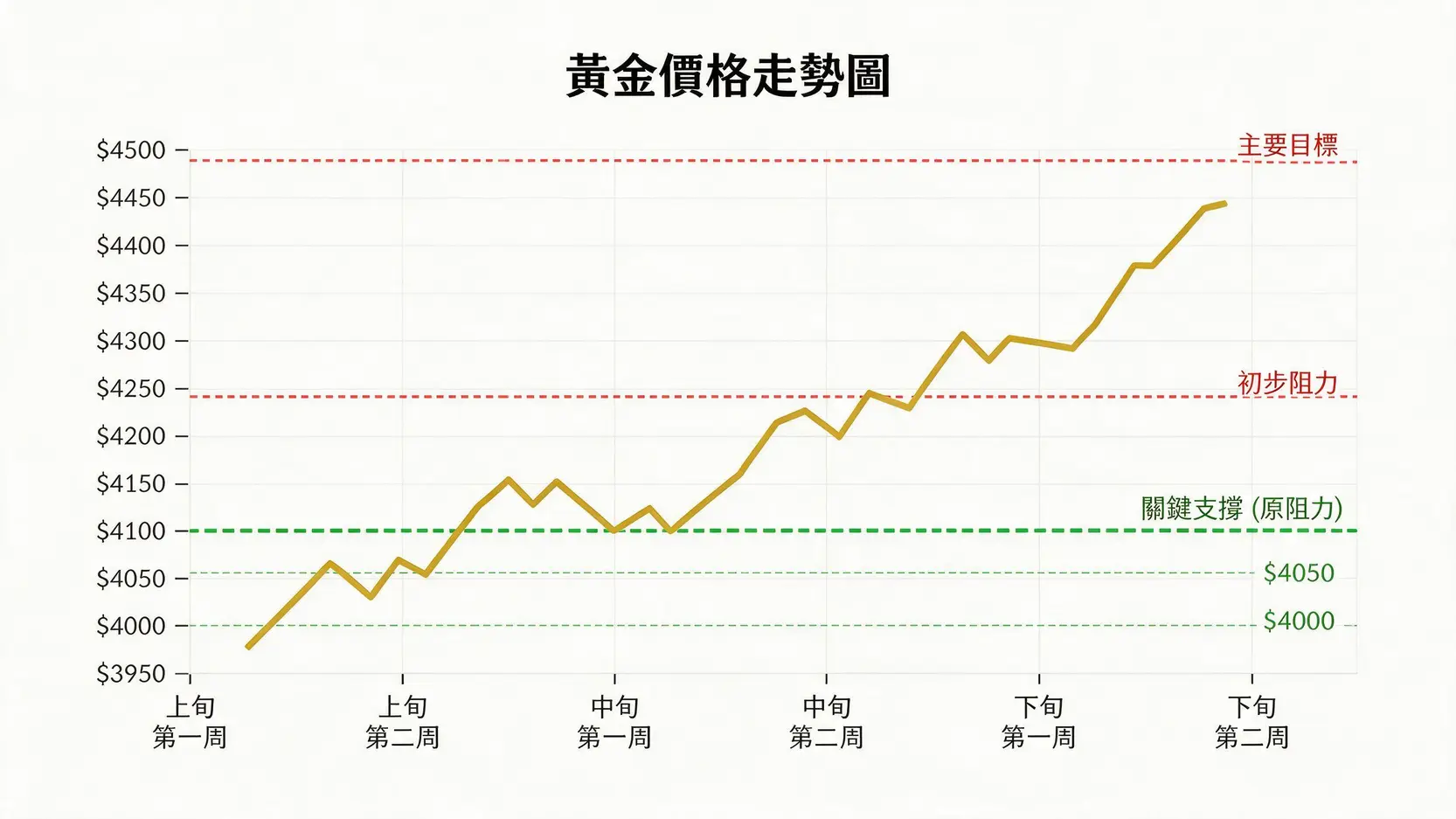
From the daily chart, after gold broke above $4,100, this level shifted from previous resistance to a key support level. As long as gold remains firmly above it, the upward trend is expected to continue.
Illustration of Key Gold Price Support and Resistance Levels
Lower Support: The primary short-term support is at $4,100. If this level is unexpectedly breached, attention should shift to $4,050 and the round-number threshold of $4,000.
Upper Resistance: Initial resistance is expected near $4,250. If gold successfully breaks above this level, the next major target will be the $4,400 to $4,500 range.
Investors can closely monitor movements around these levels as a basis for assessing market strength.
Expert Views: Latest Target Price Forecasts From Major Institutions (Such as Goldman Sachs)
Major Wall Street investment banks have also revised their outlook for gold prices. Goldman Sachs, for example, recently adjusted its gold price forecast. According to reports from authoritative financial media, Goldman Sachs has set a year-end 2026 gold price target of $4,900, while also warning that gold prices could face downside risks if the Fed unexpectedly raises interest rates. This indicates that although the long-term outlook remains bullish, investors should remain alert to short-term volatility. Most analysts believe that against the current macroeconomic backdrop, the floor for gold prices is gradually rising, making the trend of further gains more likely than declines increasingly evident.
Investor Strategies: Approaches for Long-Term Holding vs. Short-Term Trading
Given the current gold price trend, different types of investors should adopt different strategies:
Long-Term Investors: If you are optimistic about gold’s long-term value preservation and safe-haven functions, price pullbacks at current levels may still be viewed as opportunities to build positions in stages. There is no need to focus excessively on short-term fluctuations. The priority is to establish a core allocation to gold assets.
Short-Term Traders: Traders seeking swing-trading profits need to remain more flexible. The $4,100 level can be used as the dividing line between bullish and bearish conditions. If gold holds firmly above it, traders may follow the trend and go long, targeting the resistance levels ahead. If it falls below this level, caution is warranted, and short positions may even be considered. Stop-loss orders must be set, and risk must be strictly controlled.
Frequently Asked Questions About Gold Investment (FAQ)
Q: Is It Still Not Too Late to Buy Gold After the Recent Rally?
A: This depends on your investment horizon. If you are a long-term investor aiming to hedge against inflation and diversify risk, it is never too late to begin buying in stages. However, if you are a short-term trader, chasing prices higher carries relatively greater risk. It may be advisable to wait for the price to pull back to a key support level (such as around $4,100) before looking for an entry opportunity, or to test the market with a smaller position while setting a strict stop-loss level.
Q: Besides Spot Gold, What Other Gold Investment Methods Are More Suitable for Ordinary Investors?
A: For ordinary investors who do not want to trade spot gold or futures directly, many more accessible options are available. For example, a gold savings account is a highly convenient choice that allows you to purchase gold regularly through a bank, much like saving money. There are also gold ETFs that track gold price performance (such as GLD in the US stock market). These can be traded as conveniently as stocks through the securities market, with relatively low transaction costs. These are excellent tools for investors with limited capital to participate in gold investment.
Q: What Potential Risks Could Cause Gold Prices to Fall Again in the Future?
A: Although current market sentiment is bullish, several potential risks should not be overlooked. First, tighter-than-expected monetary policy. If inflation data suddenly surges and forces central banks (particularly the Fed) to adopt more aggressive interest rate hikes, the opportunity cost of holding gold will increase, placing pressure on gold prices. Second, a significant easing of geopolitical risks. If the international situation stabilizes, safe-haven sentiment may fade, and capital could flow from gold into risk assets. Third, an unexpected sharp strengthening of the US dollar could also weigh on US dollar-denominated gold prices in the short term.
Conclusion
In summary, spot gold’s breakout above the $4,100 mark was jointly driven by three major engines: global central bank purchases, concerns over inflation and recession, and geopolitical risks. It was not simply the result of market speculation. This breakout has established a technical foundation for a bullish medium- to long-term gold outlook and reinforced gold’s position as an indispensable safe-haven asset in investment portfolios. Looking ahead, although the path toward $4,500 may involve volatility, the overall upward trend has become clear. Conservative investors are advised to adopt a strategy of buying in stages during pullbacks and include gold in their long-term asset allocation. More active investors may follow the trend and engage in swing trading, but must remain focused on risk management at all times. Closely monitoring macroeconomic data and central bank policy developments will be the key to strategizing effectively in the gold market during the second half of 2026.
Bullish Oil Prices Mean You Should Short USD/CAD? A Complete 2026 Trader’s Guide to the Correlation Between the Canadian Dollar and Crude Oil Introduction When international oil prices surge and the market is filled with “bullish oil price” news, many traders instinctively react by shorting USD/CAD. But does this strategy...
Turn Crisis Into Opportunity: Four Core Strategies for High-Probability Trading Setups Amid Geopolitical Wars Global geopolitical risks have continued to intensify in 2026, from tense confrontations in Eastern Europe to sporadic conflicts in the Middle East. Any geopolitical war could instantly trigger extreme volatility in financial markets. Many investors feel...
【Strategic Allocation Fund Comparison】Fuh Hwa vs. UBS: Understand the Differences, Performance, and Risks of Popular Funds at a Glance! Faced with complex and ever-changing financial markets, are you still struggling with how to build an investment portfolio that can effectively diversify risk and achieve steady growth? A “Global Strategic Allocation...