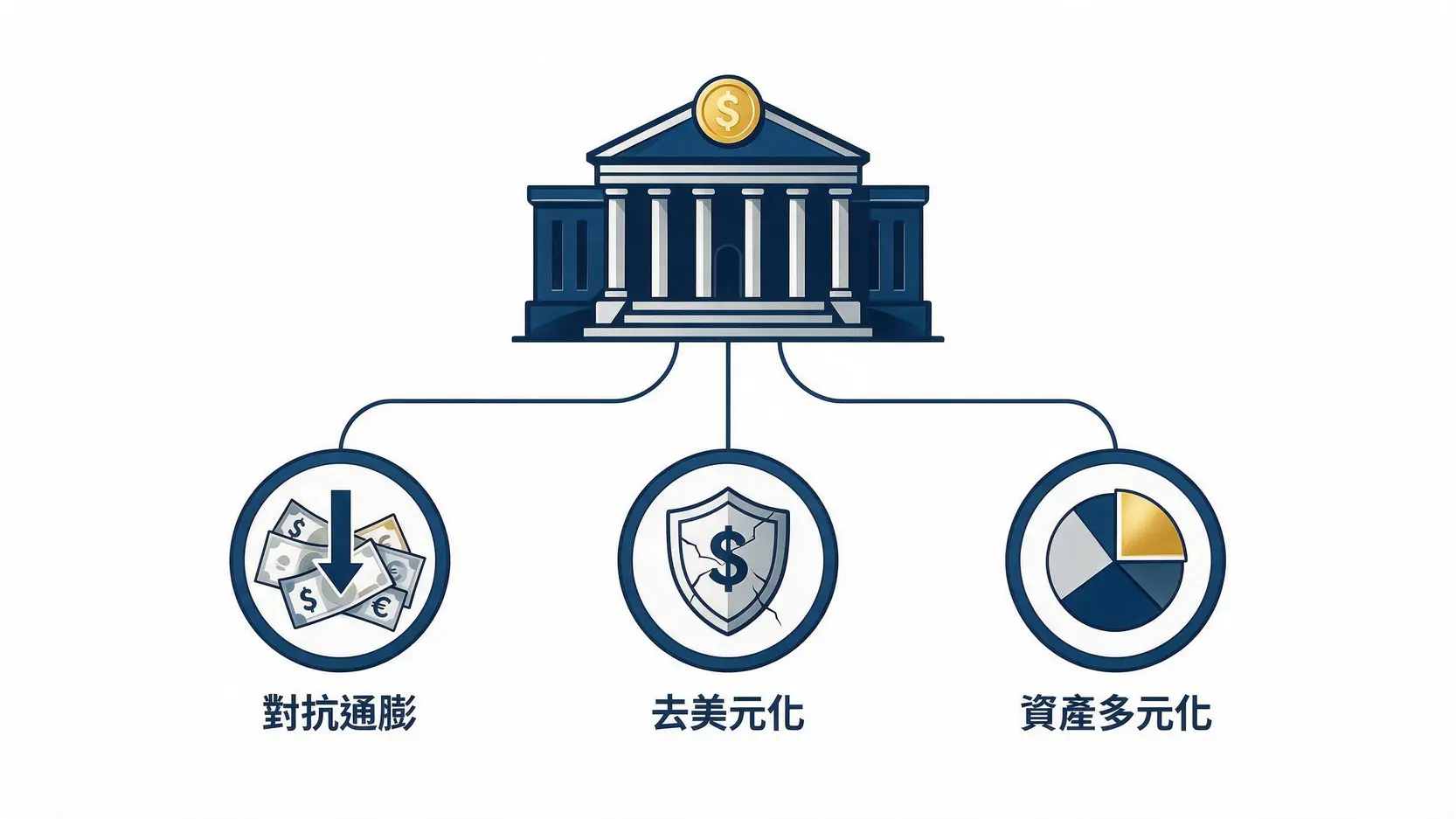
Three Main Reasons for Central Bank Gold Purchases: Safe-Haven Protection, Independence, and Diversification
Reason One: Hedging Against Inflation and Sovereign Currency Depreciation
In recent years, countries have generally adopted large-scale monetary easing policies to address economic challenges, leading to a sharp increase in the amount of money in circulation and placing depreciation pressure on the purchasing power of sovereign fiat currencies (such as the US dollar and the euro). Against this backdrop, gold, as a “hard asset” that does not depend on the credit of any government, has regained favor because of its ability to hedge against inflation and preserve value. Increasing gold holdings has become an effective way for central banks to hedge against the long-term depreciation risk of their domestic currencies.
Reason Two: The “De-Dollarization” Wave Amid Geopolitical Risks
International geopolitical conflicts have intensified in recent years. In particular, the US has “weaponized” the US dollar by imposing financial sanctions on specific countries and freezing their US dollar assets. This has made many countries aware of the potential risks of excessive dependence on the US dollar system. To safeguard their financial security and independence, a quiet wave of “de-dollarization” is unfolding worldwide. Central banks are reducing their holdings of US dollar assets (such as US Treasuries) and redirecting the proceeds toward increasing their gold reserves. Gold’s anonymity and universal acceptance make it the best choice for reducing dependence on US dollar dominance and diversifying reserve assets.
Reason Three: Asset Diversification to Reduce Dependence on a Single Currency System
“Do not put all your eggs in one basket” is a fundamental investment principle, and it applies equally to the management of national reserve assets. In the past, the US dollar was the preferred foreign reserve asset for countries because of its liquidity and stability. However, as the global economic structure becomes increasingly multipolar and the US faces worsening debt problems, the risks of relying solely on the US dollar continue to rise. Therefore, central banks are actively diversifying their reserve assets by including gold, the euro, the renminbi, and other assets in their reserve portfolios to spread risk and strengthen overall asset stability.
Further Reading (Highly Recommended)
Practical Guide After a Sharp Gold Price Decline: Five Gold Investment Strategies and Safe-Haven Asset Allocation
Central Banks Are Buying Gold, but Should Retail Investors Follow? Strategic Gold Allocation Recommendations for Individual Investors
As central banks around the world continue to “stockpile gold”, many individual investors may wonder: Should I also buy gold? The answer is that you need to make a rational judgment rather than blindly follow the trend. Central bank gold purchases are based on national-level macroeconomic strategies, which differ from the objectives of individual investors. However, we can learn from their approach and include gold as part of our personal asset allocation.
Gold’s Safe-Haven Role in Personal Asset Allocation
For individuals, gold’s greatest value lies in its “safe-haven” function. When stock markets become volatile, the economy enters a recession, or an unpredictable “black swan” event occurs, gold prices often rise against the broader market trend, effectively offsetting losses from other risky assets in your portfolio, such as stocks. In a balanced investment portfolio, allocating 5% to 15% to gold can help reduce overall volatility and improve asset stability.
Comparison and Selection of Physical Gold, Gold Passbook Accounts, and Gold ETFs
Retail investors who wish to invest in gold have many available channels. Understanding the characteristics of different gold investment instruments is essential. The following compares three mainstream options:
| Investment Instruments |
Advantages |
Disadvantages |
Suitable for |
| Physical Gold (Gold Bars/Gold Coins) |
✓ Physical ownership with no credit risk
✓ Can be passed down as an inheritance |
✗ Difficult to store and carries a risk of theft
✗ Wide bid-ask spread and lower liquidity |
Extremely Risk-Averse Investors, Large-Scale Long-Term Holders |
| Gold Passbook Account |
✓ Convenient trading with online access
✓ Low investment threshold (starting from 1 gram) |
✗ Trading hours are limited to bank business hours
✗ Physical gold cannot be withdrawn |
Investors Who Prefer the Banking System and Small Regular Investments |
| Gold ETFs (Such as GLD, IAU) |
✓ Low transaction costs and excellent liquidity
✓ Can be traded at any time like stocks |
✗ Management fees apply
✗ Prices may trade at a slight premium or discount |
Active Stock Investors Seeking Low Costs and High Liquidity |
For most retail investors, gold ETFs are the best choice for combining cost-effectiveness and flexibility. To learn more about the various instruments, refer to this 2026 Gold Investment Instruments Comparison.
Practical Tools and Authoritative Sources for Tracking Central Bank Gold Purchase Trends
To make your investment decisions more forward-looking, you can regularly monitor the following authoritative sources:
- World Gold Council (WGC): Publishes the most authoritative central bank gold reserve data and market analysis reports.
- International Monetary Fund (IMF): Also provides official reserve data for various countries through its “International Financial Statistics (IFS)” database.
- Official Central Bank Websites: Some central banks proactively publish their balance sheets, which can be used to identify changes in their gold reserves.
FAQ
Q: Which countries’ central banks are the main gold buyers?
A: According to the latest data from the World Gold Council, the largest gold buyers in recent years have mainly been emerging-market countries. The People’s Bank of China has been the world’s largest official gold buyer in recent years and has increased its gold holdings for more than ten consecutive months. Other active gold-buying countries include Poland, Turkey, India, Singapore, and the Czech Republic.
Q: Do central bank gold purchases directly affect international gold prices?
A: Yes, and the impact is twofold. First, central bank gold purchases directly increase physical gold demand in the market. With supply remaining relatively stable, this creates direct upward pressure on gold prices. Second, the more important impact comes from the “signaling effect”. As the most credible market participants, central banks send a strong signal of confidence in gold and risk aversion through large-scale gold purchases. This attracts more institutional and individual investors to follow, further pushing up gold prices. This impact is known as the “central bank gold purchase floor effect”.
Q: How does Taiwan’s central bank rank globally in terms of gold reserves?
A: As of early 2026, the Central Bank of Taiwan held approximately 423.63 metric tonnes of gold reserves, consistently ranking among the world’s top 15 central banks. Although Taiwan’s central bank has not significantly increased or reduced its gold reserves in recent years, the substantial reserve holdings themselves remain an important foundation for maintaining the stability of the New Taiwan dollar and national financial security.
Q: What is the direct relationship between central bank gold purchases and “de-dollarization”?
A: The two are closely related. Central bank gold purchases are one of the key methods for implementing a “de-dollarization” strategy. When a country seeks to reduce its dependence on the US dollar, it sells its US dollar assets (mainly US Treasuries) and uses the proceeds to purchase neutral assets that do not belong to any sovereign country. Gold is the best choice. Therefore, trends in global central bank gold purchases can be regarded as an important indicator for measuring the progress of global “de-dollarization”.
Conclusion
In summary, the central bank gold-buying wave in 2026 is an inevitable result of global economic uncertainty. It deeply reflects countries’ concerns about risks in the traditional financial system and their pursuit of asset security and independence. This trend is not merely a short-term safe-haven operation. It may also signal a structural shift in the global reserve asset landscape over the coming years. As an individual investor, you do not need to blindly follow every move made by central banks. However, understanding the strategic intentions behind central bank gold purchases will help you plan your asset allocation more comprehensively and make effective use of gold, an ancient and time-tested investment instrument, to navigate future market changes with greater confidence.