US Fractional Shares Guide: 5 Brokers & Fees

Updated: 2026/03/10  |  CashbackIsland

us-stock-fractional-shares-platform

[US Fractional Share Trading Platforms] How to Buy One Share of US Stocks? Comparison of 5 Major Brokers’ Minimum Entry Requirements and Fees

What Is US Fractional Share Trading? Why Does It Solve the Problem of High Entry Costs?

Want to invest in top global technology stocks such as Tesla (TSLA) and NVIDIA (NVDA), but hesitate because a single share can cost hundreds or even thousands of US dollars and the entry cost of buying US stocks feels too high? Do not worry. Through major US fractional share trading platforms, you can become a shareholder of these leading companies with as little as 1 US dollar. This innovative trading method has completely changed the game. This article will explain in detail how to buy one share of US stocks and compare the advantages and disadvantages of popular brokers, helping you take your first step into US stock investing with ease. 


Definition of Fractional Shares: Buying and Selling Less Than One Full Share

“Fractional shares”, also known as odd lots or decimal shares, refer to portions of a stock that are less than one full share. Traditionally, the basic unit of stock trading is “one share”. However, for high-priced stocks such as Apple (AAPL) and Amazon (AMZN), the capital required to purchase a full share can be substantial. The introduction of fractional share trading allows investors to purchase stocks by amount. For example, by investing 100 US dollars in NVIDIA, you will receive the corresponding fraction of shares (such as 0.1 share), instantly making you a shareholder. Brokers aggregate all investors’ fractional share orders, execute whole-share transactions in the market, and then allocate shares proportionally to clients. According to the US Securities and Exchange Commission (SEC), fractional share investing makes small-scale market participation possible.

一張完整的股票被分割成多個碎股,展示給不同投資者購買的概念圖。

Fractional share trading allows you to use a small amount of capital to purchase a portion of high-priced stocks.


Three Major Advantages of Fractional Share Trading: Low Threshold, Risk Diversification, and Cost Averaging

For small investors and beginners, fractional share trading brings a transformative change, mainly reflected in the following three advantages:

  • Low investment threshold: This is the most direct benefit. Stocks that previously required hundreds of US dollars to purchase one share may now require only 1 to 5 US dollars to start investing. This significantly lowers the capital threshold for entering the US stock market, allowing anyone to participate in market growth.
  • Easy risk diversification: When funds are limited, it is difficult to build a diversified investment portfolio. Through fractional shares, you can allocate a small amount of capital (such as 500 US dollars) across 10 or even 20 different companies, covering sectors such as technology, finance, and consumer goods, effectively reducing the risk caused by fluctuations in a single stock.

一張對比圖,顯示用相同資金,碎股交易比整股交易能買入更多樣化的股票組合,有效分散風險。

With the same capital, fractional shares allow you to build a more diversified portfolio.

  • Implementing Dollar-Cost Averaging (DCA): Regular fixed-amount investing is a key strategy for long-term financial planning. Fractional share trading makes it easy to execute the “Dollar-Cost Averaging strategy”. You can set a fixed monthly investment amount, such as 100 US dollars, to continuously purchase your preferred stock portfolio. Regardless of whether prices are high or low, you continue buying, which helps smooth out costs and mitigate market volatility over the long term.


Comparison of Popular US Fractional Share Trading Platforms

An increasing number of brokers now offer US fractional share trading services, but their fee structures, features, and account opening promotions differ. Understanding these differences helps you find the investment partner that best suits you. Choosing a reliable US stock broker is the first step toward successful investing.


Comparison Criteria: Account Opening Promotions, Trading Commissions and Platform Fees, Supported Fractional Share Quantity, Minimum Trade Amount

For ease of comparison, we have compiled the following table covering the key dimensions that investors care about most:

Broker Platform

Trading Commission

Platform Fee Minimum Trade Amount Supported Fractional Share Quantity
Futu (moomoo) 0 Commission US$1 per Order US$5 Over 5,000 Stocks and ETFs
Tiger Brokers 0 Commission US$1 per Order US$1 Over 4,000 Stocks and ETFs
uSMART Securities 0 Commission US$1.5 per Order US$1 Selected Popular US Stocks
SoFi 0 Commission 0 Platform Fee US$1 Most US Stocks
Interactive Brokers (IBKR) Fixed: US$0.005 per Share (Minimum US$1) None US$1 Over 6,000 Stocks

*Note: The above fees and promotional information are accurate as of early 2026. For the latest details, please refer to the official websites of the respective brokers.


Analysis of Each Platform’s Features

  • Futu (moomoo): Powerful and feature-rich, offering extensive market data and analytical tools, with an active community function, making it suitable for investors who enjoy research and discussion. It supports a very wide range of fractional shares, covering the vast majority of popular securities.
  • Tiger Brokers: A clean and user-friendly interface that is easy to get started with, making it highly suitable for beginners. Trading starts from as little as US$1, with an extremely low entry threshold, and frequent account opening promotions, offering high cost-effectiveness.
  • uSMART Securities: Focuses on smart investing features, providing quantitative strategies and portfolio recommendations, suitable for users who wish to leverage technology to assist decision-making. Although its fractional share selection is relatively limited, it covers mainstream large-cap stocks.
  • SoFi: Promotes a zero-fee model, offering not only commission-free trading but also no platform fees, resulting in very low trading costs and making it highly friendly to small-amount and frequent traders. The interface is simple and straightforward, focusing on core trading functions.
  • Interactive Brokers (IBKR): A globally renowned professional-grade broker, offering the broadest selection of fractional shares and access to global markets. Its fee structure is more suitable for professional investors with larger capital or frequent trading needs and may be relatively complex for beginners.


Further Reading (Highly Recommended)

【2025 Broker Recommendations】Five Key Selection Criteria for Beginners and Comparison of Popular Brokers


Illustrated Guide: How to Buy One Share of US Stocks? Complete Your Order in Three Steps

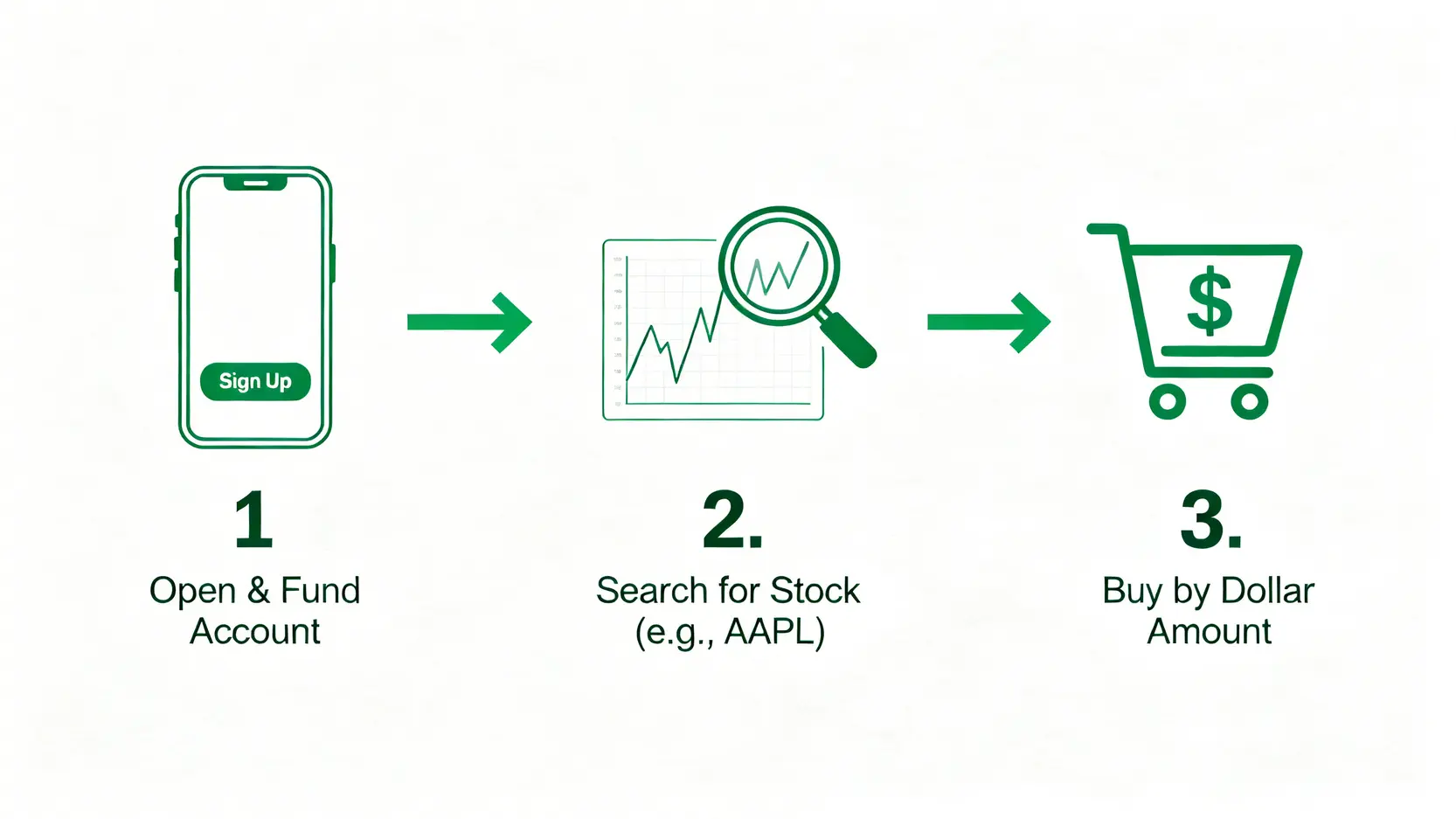
After understanding the platforms, the next step is actual execution. Regardless of which platform you choose, the process of buying fractional shares is largely similar. In general, it can be completed in three simple steps, with no need to worry about complexity!

購買美股碎股的三個步驟流程圖:開戶入金、搜尋股票、按金額買入。

Three Simple Steps to Complete Your First Fractional Share Trade with Ease.

  1. Step One: Choose your preferred platform, complete account opening and fund deposit based on the comparison in the previous section, select the platform that best suits your needs and follow the in-app instructions to complete the online account opening process. You will usually need to prepare identification documents and proof of address. Once your account is successfully opened, deposit funds into your securities account.
  2. Step Two: Search for the stock ticker (e.g., AAPL) In the trading app’s search bar, enter the ticker symbol of your desired company. For example, if you want to buy shares of Apple Inc., enter “AAPL”. Click to access the detailed quotation page of the stock.
  3. Step Three: Select “Buy by Amount” or “Fractional Share” to place your order. On the trading interface, you will see the “Buy” button. After clicking it, the platform will usually provide two order methods: “By Quantity” or “By Amount”. At this point, select “By Amount” and enter the amount you wish to invest, for example, US$100. The system will automatically calculate the corresponding fractional share quantity. After confirming the details, submit the order! It is that simple!


Frequently Asked Questions (FAQ) About US Fractional Share Trading

Q: Are there additional fees for buying and selling US fractional shares?

A: For most platforms that offer fractional share trading, the fee structure is the same as for whole-share trading. For example, if the platform promotes zero commission, then buying and selling fractional shares is also commission-free. However, you should pay attention to platform fees or minimum charges. For instance, Futu and Tiger Brokers charge a platform fee of approximately US$1 per order. SoFi is one of the few brokers that also waives platform fees, resulting in relatively lower trading costs.

Q: Can fractional shares receive dividends?

A: Yes. Holding fractional shares is equivalent to becoming a shareholder of the company on a proportional basis, and you are therefore entitled to receive dividends. Dividends are calculated precisely based on the proportion of shares you hold and are credited to your securities account. For example, if you hold 0.5 shares and the company declares a dividend of US$1 per share, you will receive US$0.5 in dividends.

Q: Are all US stocks eligible for fractional share trading?

A: Not necessarily. Although mainstream brokers support an increasingly wide range of fractional shares, not all stocks listed in the US are eligible for fractional share trading. Generally, large-cap blue-chip stocks, popular technology stocks, and major ETFs (Exchange Traded Funds) are widely supported. Some smaller-cap, less liquid stocks may not be available for fractional trading. Before placing an order, you can check in the broker’s app whether the stock supports the fractional share function.

Q: Do fractional shares have voting rights?

A: This depends on the broker’s policy. Technically, fractional shareholders are entitled to voting rights in proportion to their holdings. However, to simplify administration, most brokers may not pass on shareholder meeting voting rights to fractional shareholders. If shareholder voting rights are important to you, it is advisable to consult the broker directly regarding its specific policy.


Conclusion

In summary, the emergence of US fractional share trading has completely broken the high “entry cost of buying US stocks”, enabling retail investors to easily invest in the world’s leading companies and serving as a powerful tool for wealth growth. From Futu and Tiger Brokers to SoFi and IBKR, each platform has its own unique advantages. When choosing the most suitable US fractional share trading platform, you should comprehensively consider its fees, features, range of supported stocks, and your own investment habits. It is hoped that this guide helps clarify all your questions about “how to buy one share of US stocks”, allowing you to find the most suitable tools and start your US stock investment journey immediately.

If you liked this article, please share it!

Related Articles

  • How to Buy Bitcoin in 2026: A Beginner’s Guide
    How to Get Started with Bitcoin? The Complete 2026 Bitcoin Buying Guide for Beginners After watching Bitcoin repeatedly reach new highs in recent years and successfully pass spot ETF reviews in the US and Hong Kong in 2024, officially entering mainstream financial markets, many investors have turned their attention to...
    2026 年 7 月 20 日
  • Gold V-Shaped Rebound: Bottom Signal or Bull Trap?
    Is Gold’s V-Shaped Rebound a Bottom-Fishing Signal? A Complete Guide to Trading Strategies Amid “$100 Price Swings” What Is a Gold V-Shaped Rebound? More Than Just a Technical Pattern The gold market has recently experienced sharp rises and falls, with prices frequently displaying dramatic “gold V-shaped rebounds”. Single-day “$100 price...
    2026 年 7 月 20 日
  • 2026 PPI Guide: PPI vs CPI and Stock Market Impact
    What Is PPI Data? 2026 Latest Analysis: Understand the Differences from CPI and How It Affects Stock Market Trends With market information constantly changing, do you always hold your breath while waiting for CPI data to be released? But did you know that a more forward-looking inflation indicator, PPI data...
    2026 年 7 月 20 日
返回顶部