Futures Money Management: 5 Pro Position Techniques

Ultimate Guide to Futures Money Management: 5 Position Control Techniques Used by Professional Traders
Have you ever suffered a major loss or even faced liquidation in the futures market due to a single oversized position? Many traders focus all their energy on predicting market direction while ignoring a more fundamental key to success: “money management”. Successful traders understand that long-term consistent profitability does not come from perfect predictions, but from strict futures position management and futures position sizing control. This article reveals five futures money management techniques used by professional traders, teaching you how to control risk from the source and make your trading journey more stable and sustainable.
Why Money Management Is Your Survival Tool in Futures Trading
Before diving into specific techniques, we must first establish a core concept: in futures trading, staying in the game is far more important than catching a big move once. Money management is the only insurance that ensures long-term survival in the market.
Understanding Leverage as a Double-Edged Sword: The Gap Between Sudden Wealth and Sudden Loss
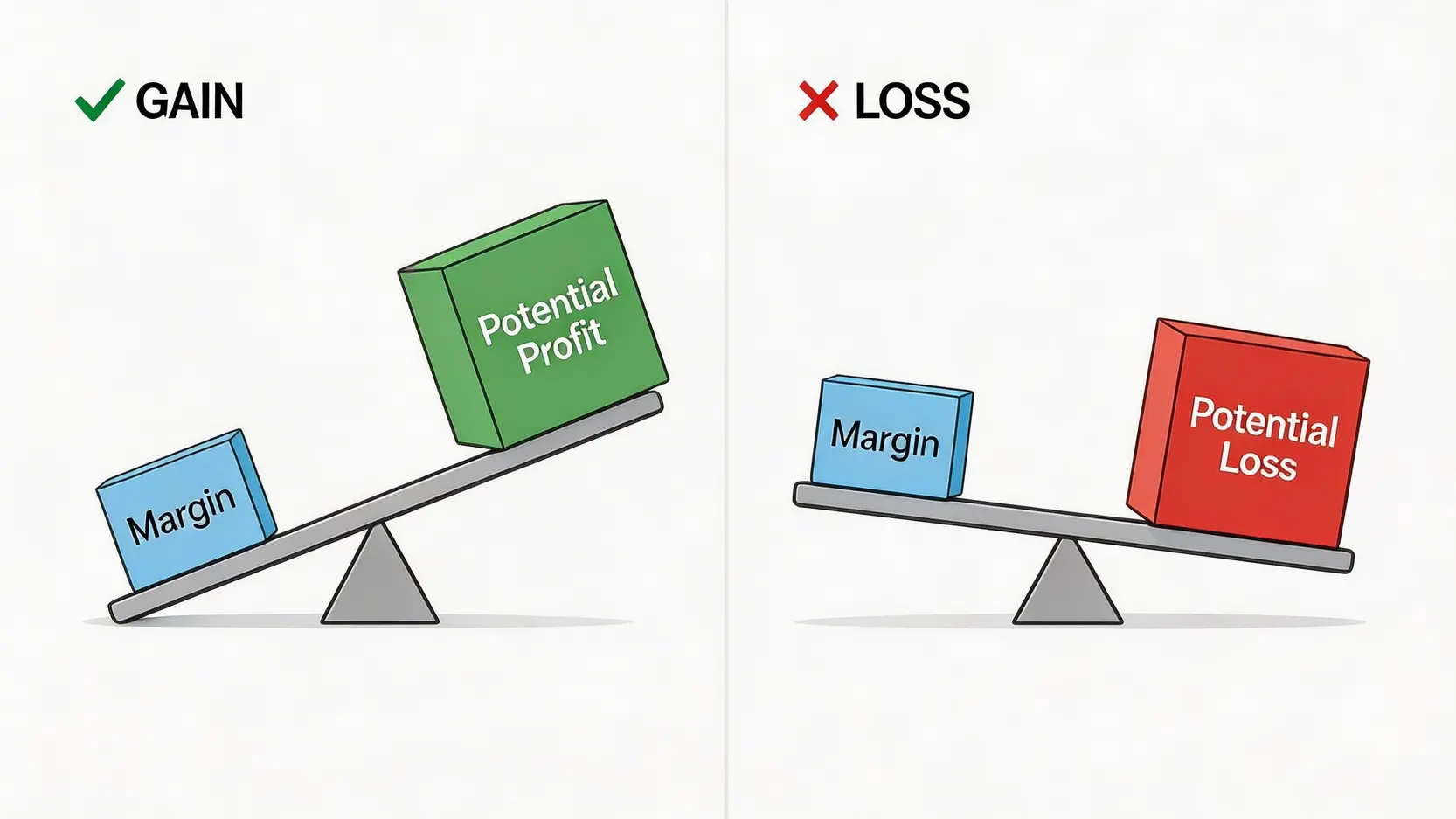
The most attractive feature of futures is leverage. With a relatively small margin, you can control contracts worth dozens or even hundreds of times more, significantly amplifying potential profits. However, risk and reward are two sides of the same coin. Leverage also magnifies losses. Without proper position planning, a single wrong trade with oversized exposure can trigger a margin call or even wipe out your account entirely, known as “liquidation”. Many beginners only see the profit potential of leverage while ignoring its destructive side.

Leverage is a double-edged sword that can amplify gains as well as losses.
From Gambling Mindset to Professional Trading: The Importance of Futures Position Sizing Control
“Feels like it will surge, go all in!” This is a typical gambler’s mindset, not professional trading. Professional traders never rely on intuition. They rely on a validated trading system, and futures position sizing control is the core of that system. It ensures that every trade remains within a controllable risk range, so even consecutive losses will not cause catastrophic damage. Trading is a probability game, and strict position sizing allows you to survive unfavorable periods and wait for your edge to appear.
5 Step-by-Step Futures Money Management Techniques Every Beginner Must Learn
After understanding the importance of money management, the next step is turning theory into practice. The following five techniques range from basic to advanced and will help you build your own position management system.
Technique 1: The 2% Risk Rule — Calculating Maximum Loss Per Trade
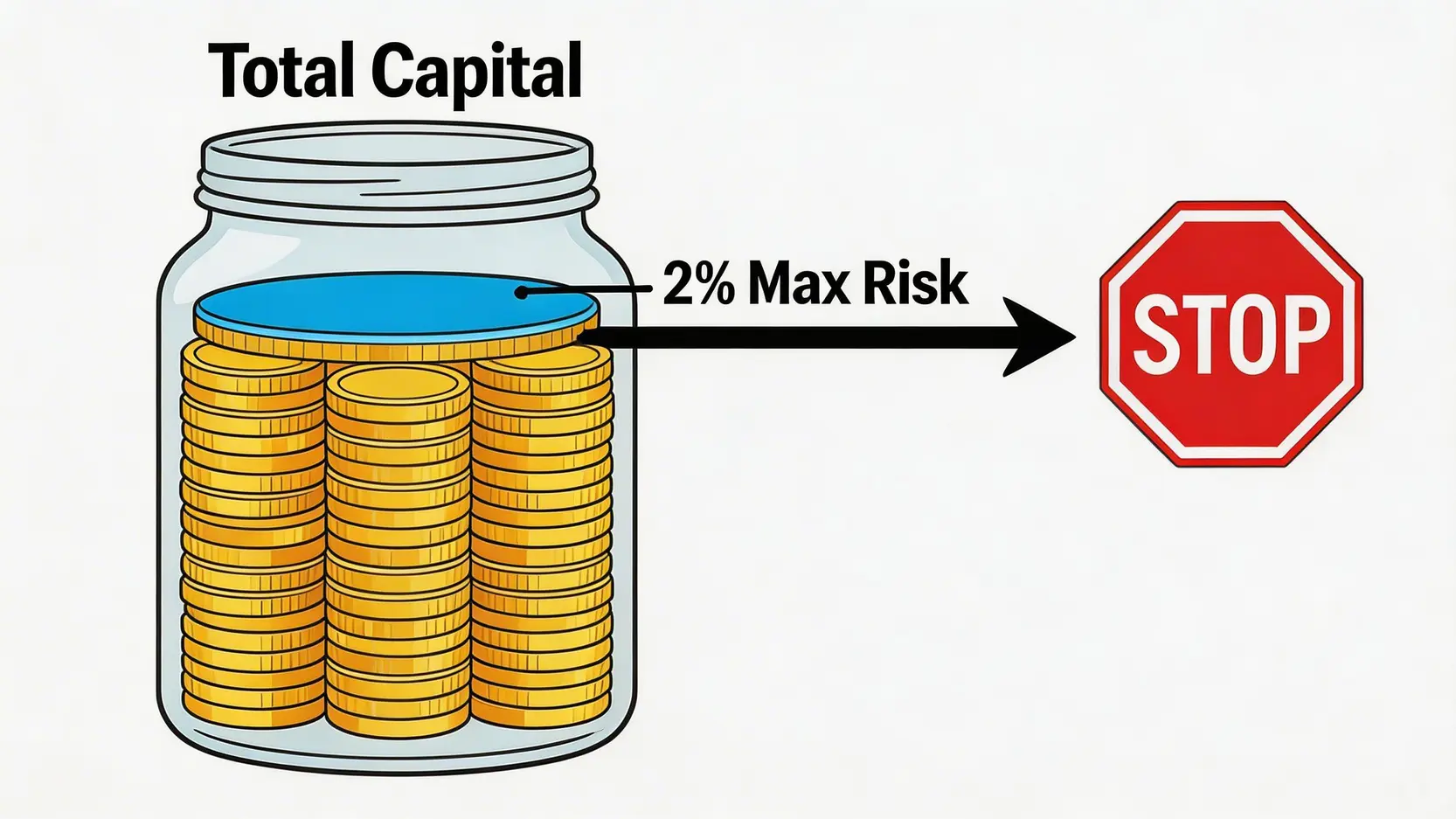
This is the most classic and fundamental principle of money management. The 2% risk rule means that no matter how confident you are, the maximum risk on any single trade should not exceed 2% of your total capital. For example, if your futures account has 10,000 US dollars, the maximum stop loss for any trade should be 200 US dollars (10,000 × 2%).
- Advantages: It effectively prevents single-trade damage. Even after five consecutive losses, total capital would only decrease by about 10%, preserving your ability to recover.
- Practical method: Before entering a trade, calculate the distance between entry and stop loss, then determine position size so that “(stop loss price − entry price) × contract size × number of contracts” is less than 2% of total capital.
This rule forces you to shift from “how much can I make” thinking to “how much can I lose” risk control thinking.

2% Risk Rule: Limit the maximum loss of a single trade to a small percentage of total capital.
Technique 2: Fixed Percentage Position Method — Automating Position Size
This method extends the 2% rule by dynamically adjusting position size based on account equity. The core idea is to allocate a fixed percentage of total capital as margin each time, for example 10%.
- When capital increases after profits, 10% becomes larger, allowing position size to increase and enabling a natural “scale-up with trend” effect.
- When you incur losses and your total capital decreases, the amount corresponding to 10% will also decrease, and your position size will automatically shrink, achieving a protective effect of “reducing exposure against the trend”.
This approach prevents traders from overleveraging after losses or being overly conservative after gains.
Technique 3: ATR Position Sizing Method — Adjusting Exposure Based on Volatility
This is a more advanced futures position sizing control model. ATR (Average True Range) measures the average market volatility. When volatility increases, ATR rises; when markets consolidate, ATR falls. Core logic:
- High volatility (high ATR): Price swings are large, stop loss must be wider, so position size must be reduced to stay within the same 2% risk limit.
- Low volatility (low ATR): Price movement is stable, stop loss can be tighter, allowing larger position size under the same risk constraint.
This method allows your position size to adapt dynamically to market “behavior,” staying cautious in volatile conditions while maximizing capital efficiency in stable markets.
Technique 4: Pyramid Scaling Strategy — Expanding Gains While Profitable
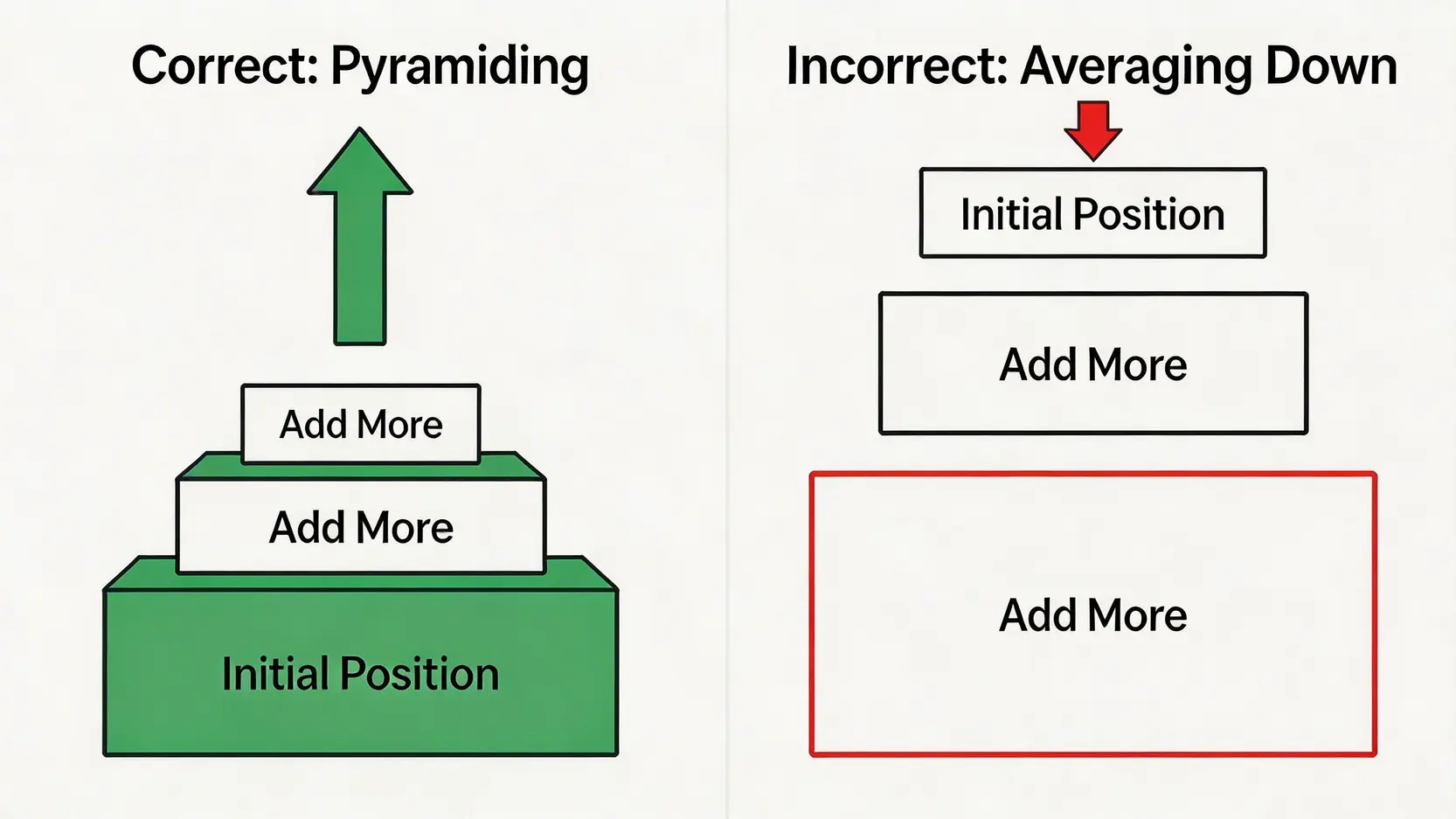
Most retail traders tend to “average down”, continuously adding to losing positions, which causes position sizes to grow larger and risk spiraling out of control. In contrast, professional position-building strategies do the opposite by using a “pyramiding” approach, adding only to positions that are already profitable.

Correct scaling resembles a normal pyramid (left), where positions are increased during profitable moves; incorrect averaging down resembles an inverted pyramid (right), where risk becomes uncontrollable.
- Pyramid structure: The initial position is the largest, and each subsequent add-on position becomes smaller. For example, open with 4 contracts, then add 2 contracts as the market moves as expected, and finally add 1 contract.
- Execution requirement: After each add-on, the overall stop loss for the entire position must be moved upward, ensuring that even if the market reverses, the trade remains profitable or at least breaks even.
This strategy allows you to “let profits run” and safely expand gains when you are correct in direction, achieving the goal of small losses and large wins.
Technique 5: Setting Capital Water-Level Warning Lines — Preventing Uncontrolled Losses
This is a psychological risk control method. You set several drawdown warning levels for your total capital, and once they are reached, predefined actions must be taken.
- Yellow warning (e.g. 10% total capital loss): Review the past 10 trades, identify issues, and reduce trading size by half for one week.
- Red warning (e.g. 20% total capital loss): Immediately stop all live trading and return to demo trading for at least two weeks until a stable trading rhythm and confidence are re-established.
This safeguard prevents the destructive cycle of “loss → frustration → oversized positions → even larger losses”, forcing you to pause and regain clarity before damage becomes irreversible.
Practical Exercise: How to Build Your Personal Futures Trading Plan
Understanding theory is not enough; practice is essential. A complete trading plan should integrate the above money management techniques.
Step 1: Assess Your Total Risk Capital and Risk Tolerance
First, the capital allocated to futures trading must be “risk capital”, meaning money you can afford to lose entirely without affecting your normal life. Next, honestly assess yourself. Are you an aggressive trader willing to accept higher volatility for higher returns, or a conservative trader prioritizing stability? This will determine whether your 2% risk rule should be adjusted to 1% or 1.5%.
Step 2: Choose a Suitable Position Management Model
For beginners, starting with the combination of the “2% risk rule” and “fixed percentage position method” is a good choice. This setup is simple and effective in avoiding catastrophic mistakes. As you gain a deeper understanding of market volatility, you can upgrade to the “ATR position sizing method” for more flexibility. “Pyramid scaling” should only be introduced later, once you have established a stable and consistent profit system.
Step 3: Maintain a Trading Journal for Continuous Tracking and Optimization
Your trading plan should never be static. Every trade entry and exit, position size, stop loss and take profit settings, as well as your emotional state, should be recorded in detail in a trading journal. Regularly reviewing this journal (whether weekly or monthly), helps identify patterns in losing trades and evaluate whether your money management rules are being strictly followed. This is one of the most valuable tools for improving your trading system. Many authoritative institutions, such as CME Group, emphasize the importance of post-trade analysis in risk management.
FAQ: Common Questions About Futures Money Management
Q: How much capital should be kept in a futures account to be considered safe?
A: There is no fixed answer, as it depends on your risk tolerance and the contracts you trade. A basic principle is that account capital should be significantly higher than the “minimum margin” required for the contract you intend to trade. It is recommended to have at least 5–10 times the minimum margin, which provides enough buffer to handle normal market fluctuations and avoid margin calls from small losses. The key is that this money must be “risk capital” that you can afford to lose.
Q: During consecutive losses, should position size be reduced or maintained?
A: Position size should absolutely be reduced. Consecutive losses not only erode capital but also severely damage trading psychology, leading to irrational decisions. At this stage, reducing position size or even pausing trading is necessary to protect both capital and mindset. The previously mentioned “fixed percentage position method” can automatically enforce this discipline.
Q: How is money management different for day trading?
A: The core principles remain the same, but execution is stricter. Because trading frequency is higher, the risk per trade is often reduced from 2% to 0.5% or 1%. Stop losses are tighter, and positions are never held overnight to avoid gap risk. For day traders, discipline and execution are more important than anything else.
Q: What is the biggest trap in future position management?
A: The biggest traps are “averaging down into losses” and “taking profits too early”. Retail traders tend to add to losing positions to lower average cost, which is a gambling behavior that often leads to catastrophic losses. At the same time, they tend to close profitable positions too early out of fear of giving back gains. Proper money management follows the principle of “cut losses short and let profits run” which is the core philosophy behind the pyramid scaling strategy.
Conclusion
In summary, mastering futures position management and futures position sizing control is the key to surviving and succeeding in high-risk markets. Instead of chasing short-term explosive gains, it is far more important to build a money management system that allows long-term survival. These seemingly simple rules are the true dividing line between winners and losers. Starting today, apply the “2% risk rule” in every trade and integrate these futures money management techniques into your decision-making process. You will find that consistent performance will follow naturally.
Related Articles
-
Practical Applications of Volatility Surfaces: From Options Modeling to Advanced Skew Trading Strategies In options markets, implied volatility is never a flat line. Instead, it forms complex "smile" or "skew" surfaces. For advanced traders, mastering the practical applications of volatility surfaces is equivalent to possessing a lens that reveals market...2026 年 6 月 3 日
-
Building a Foreign Capital Flow Copy Trading Model: A Stock Market Indicator for Accurately Tracking Institutional Positioning In Asia-Pacific stock markets, foreign capital inflows and outflows often determine the direction of the index. However, simply looking at daily net buy and sell data is no longer enough. Only by building...2026 年 6 月 3 日
-
Options Buyer Strategies During Extreme Market Conditions: Black Swan Hedging and Cross-Market Arbitrage During Volatility Surges The most terrifying aspect of financial markets is not a gradual decline, but overnight flash crashes and cross-market capital withdrawals accompanied by volatility surges. In the highly unpredictable global macroeconomic environment of 2026, geopolitical...2026 年 6 月 3 日