Funding Rate Arbitrage: Perpetual Futures Guide

How Is Perpetual Futures Funding Rate Calculated? A Complete Guide to Negative Funding Rate Arbitrage, Achieving Low-Risk Returns in 5 Steps!
Want to find a relatively stable profit opportunity amid the turbulence of the cryptocurrency market? You may have heard of “negative funding rate arbitrage”, but still feel confused about how it works, the risks involved, and how to execute it precisely. While it sounds complex, the concept is actually quite straightforward. This article provides a clear and practical perpetual futures funding rate guide, breaking down the fundamentals of how Funding Rate is calculated and offering a step-by-step strategy to help you utilize this powerful tool for potential returns even in bearish or sideways markets.
What Are Perpetual Futures and Funding Rate?
To understand negative funding rate arbitrage, you first need to grasp two core concepts: perpetual futures and funding rate. They form the foundation of crypto derivatives markets and enable arbitrage opportunities.
Introduction to Perpetual Futures: Why Do They Have No Expiry Date?
Traditional futures contracts always have a “fixed expiration date”. On that date, all positions must be settled regardless of profit or loss. Perpetual futures break this limitation. They have no expiry date, meaning you can theoretically hold a position indefinitely. This gives traders great flexibility, but also raises a question: without a settlement deadline, how does the contract price stay aligned with the “spot price”? The answer lies in the funding rate mechanism.
The Core Role of Funding Rate: The Key Mechanism for Price Alignment Between Futures and Spot
Funding Rate is a unique mechanism in perpetual futures markets. It acts like an invisible rubber band that constantly pulls the futures price back toward the spot price. Importantly, this fee is not charged by the exchange itself but is exchanged directly between long (buy) and short (sell) traders.
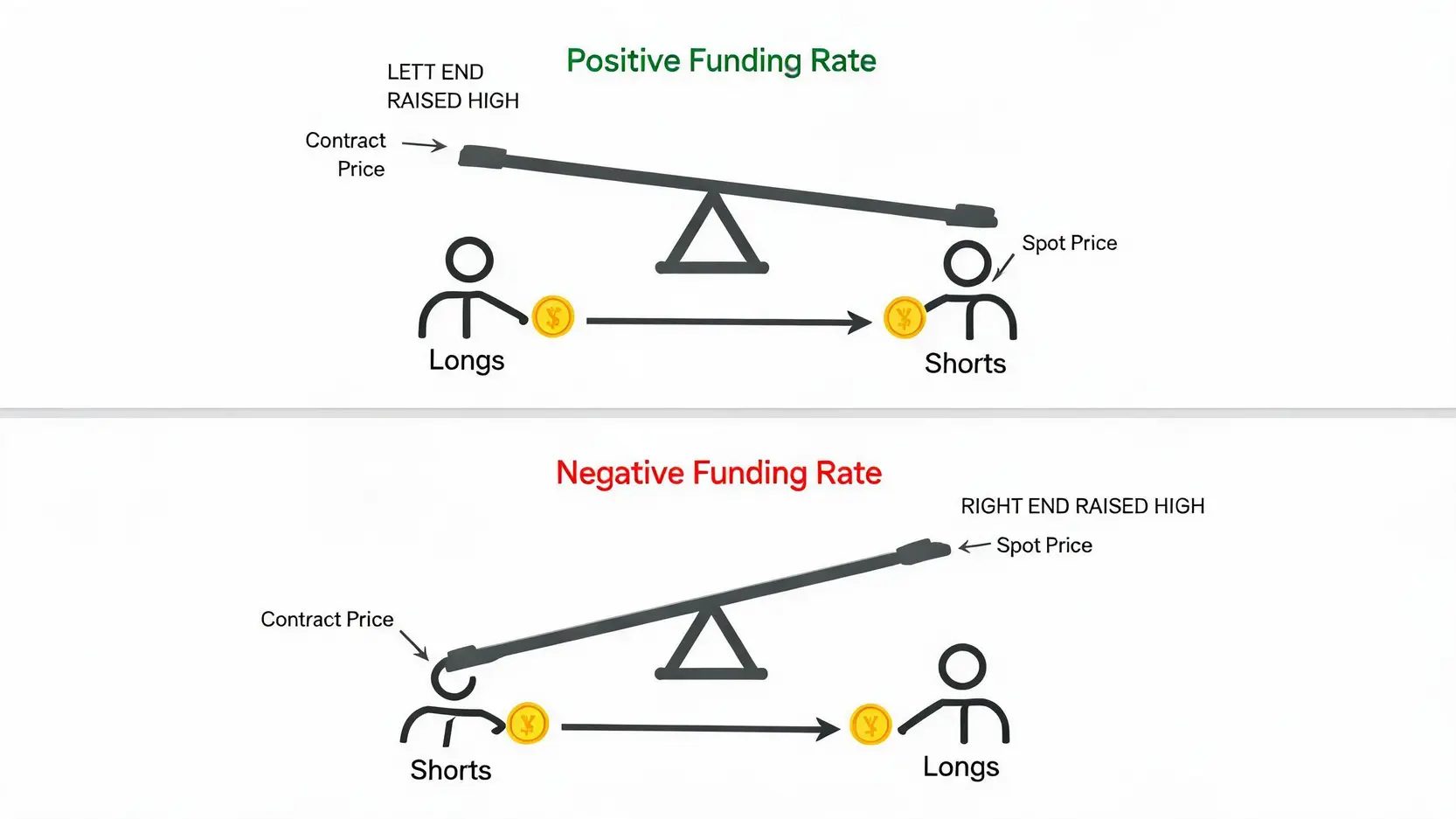
- When contract price > spot price: Market sentiment is bullish. Long traders pay funding fees to short traders. This increases the cost of holding long positions, encouraging position reduction or shorting, which helps push the price back toward spot.
When contract price < spot price: Market sentiment is bearish. Short traders pay funding fees to long traders. This increases the cost of short positions, encouraging short covering or long positions, again helping realign the price.

This mechanism is exactly what makes negative funding rate arbitrage possible.
How Is Funding Rate Calculated? Full Breakdown of Positive and Negative Funding Rates
Understanding how Funding Rate is calculated, and what its positive or negative values represent, is essential for executing arbitrage strategies. It determines whether you are paying or receiving funding fees.
Funding Rate Formula Breakdown (Interest Rate and Premium Index)
Although exact formulas vary slightly across exchanges, funding rate generally consists of two main components:
- Interest Rate: A relatively fixed value reflecting the interest rate difference between holding the underlying asset (e.g., Bitcoin) and the quoted currency (e.g., USDT). For example, an exchange may set a daily rate of 0.03%.
- Premium Index: This is the key variable determining whether the funding rate is positive or negative. It measures the price difference between the perpetual contract and the spot index price. If the contract price is higher than spot, the premium index is positive; if lower, it is negative.
Simplified formula: Funding Rate = Premium Index + clamp(Interest Rate – Premium Index, -0.05%, 0.05%)
For most investors, there is no need to manually calculate this complex formula. You only need to understand how to read the “funding rate” and “predicted funding rate” displayed on exchanges.
Positive vs Negative Funding Rate: What Do They Indicate About Market Sentiment?
Funding rate direction is one of the clearest indicators of market sentiment. It shows whether bullish or bearish traders dominate the market.
| Status | Market Sentiment | Fee Flow | Meaning |
| Positive Funding Rate | Bullish | Longs pay shorts | The market is generally optimistic, with strong long positioning. The contract price is usually higher than the spot price. |
| Negative Funding Rate | Bearish | Shorts pay longs | The market is generally pessimistic or panicked, with strong short positioning. The contract price is usually lower than the spot price. This is where the arbitrage opportunity lies! |
Extended Reading (Highly Recommended)
【2025 Hong Kong Virtual Asset Exchange Recommendations】SFC-Compliant Exchange Guide for Beginners
Negative Funding Rate Arbitrage Guide: 5 Steps to Achieve Low-Risk Returns
When the market shows a negative funding rate, it means short traders are paying long traders. Our arbitrage strategy aims to exploit this mechanism to earn stable “funding fee” income while hedging price volatility risk. Below are the five practical steps:
Step 1: How to Identify Coins with High Negative Funding Rates
Opportunities are not always available, so you need to actively search for them. Negative funding rates are more likely to appear during downtrends or periods of high volatility. You can use the following tools to monitor the market:
- Data analytics platforms: Websites such as Coinglass and CoinMarketCap provide real-time funding rate data across major exchanges and trading pairs, making it easy to compare and filter opportunities.
- Exchange built-in data: Many major exchanges (such as Binance and Bybit) display current and predicted funding rates directly on their futures trading pages.
Screening criteria: Look for coins with negative funding rates, especially those with larger absolute values. For example, -0.1% is more attractive than -0.01%. Also consider liquidity and market capitalization to avoid overly illiquid tokens.
Step 2: Build a Hedged Position (Buy Spot + Short Equal Perpetual Position)
This is the core of the strategy, aiming to achieve a “market neutral” (delta neutral) position so that you are not exposed to price movements.

Execution:
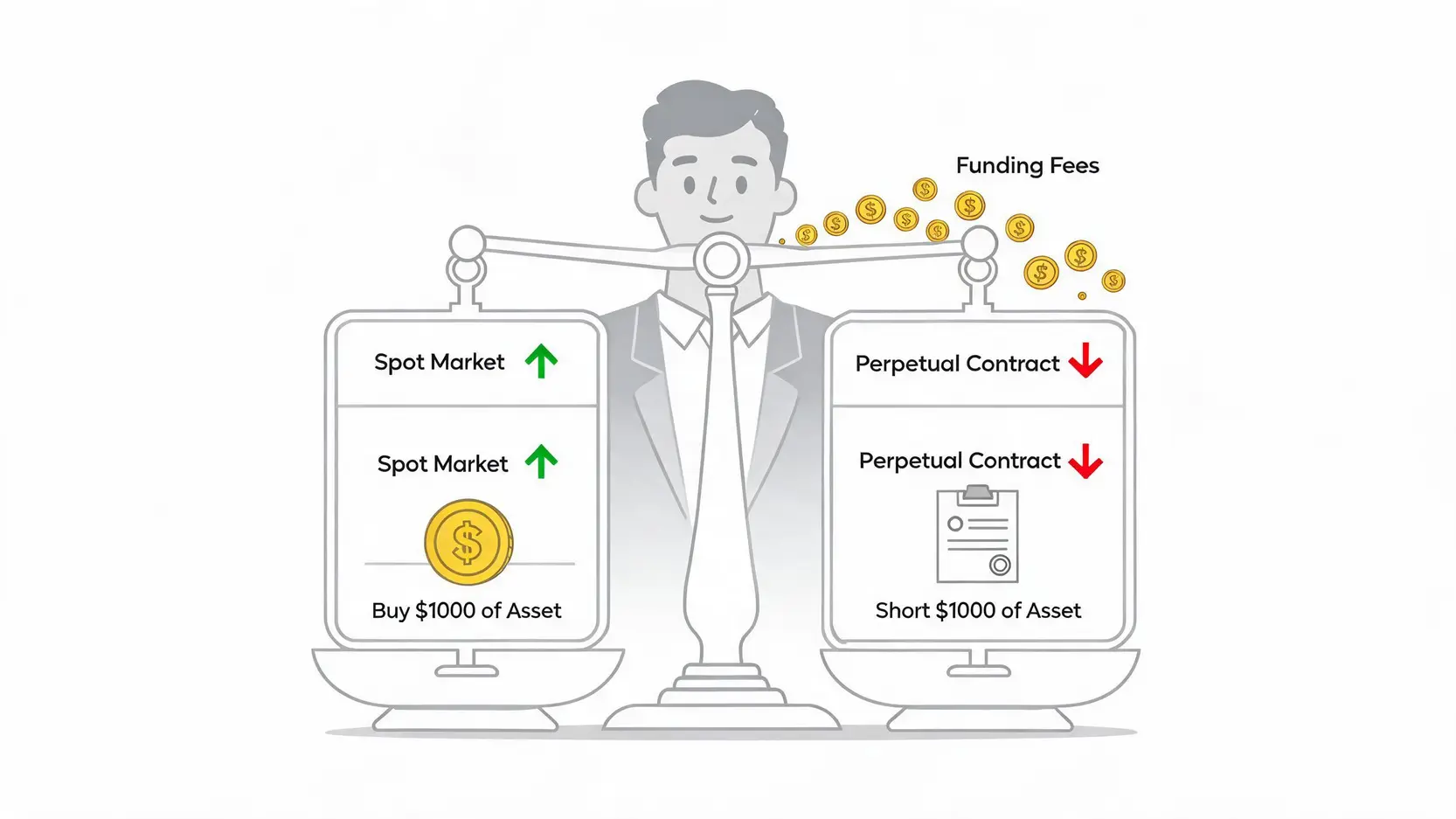
- Buy spot: Purchase $1,000 worth of Bitcoin in the spot market.
- Short futures: Simultaneously open a $1,000 Bitcoin short position in the perpetual futures market.
Hedging effect:
- If Bitcoin rises by 10%, your spot position gains $100, while your futures short loses $100, resulting in a net zero impact.
- If Bitcoin falls by 10%, your spot loses $100, while your futures short gains $100, again offsetting each other.
After this step, your total portfolio value is no longer affected by price fluctuations. Your only profit source becomes the periodic funding payments (usually settled every 8 hours).
Step 3: Accurately Calculate Expected Returns: How Much Profit Remains After Fees?
The key detail lies in costs. Funding rate income is not pure profit and must be calculated after deducting all trading fees.
Main costs include:
- Opening fees: Exchanges charge trading fees (taker or maker) when opening spot and futures positions.
- Closing fees: Fees are also charged when closing both positions.
- Slippage: In volatile markets, actual execution prices may differ from expected prices.
Example calculation:
Assume you use $10,000 for arbitrage with a funding rate of -0.05%, settled every 8 hours. Trading fees for both spot and futures are 0.1%.
- Single funding income: 10,000 × 0.05% = $5
- Daily funding income: $5 × 3 = $15
- Total opening cost: (10,000 × 0.1%) + (10,000 × 0.1%) = $20
- Break-even time: $20 / $15 ≈ 1.33 days
This means you must hold the position for more than 1.33 days before generating net profit. Always calculate carefully before entering a trade to ensure funding income covers all costs.
Step 4: Practical Execution and Risk Management (Slippage and Price Volatility)
In practice, it is recommended to use “limit orders” to reduce slippage. Since you are holding both spot and short futures positions, you must closely monitor “margin levels”. Even though the position is hedged, extreme price movements can still trigger liquidation due to insufficient margin. It is advisable to use low leverage (e.g. 1–3x) and be prepared to add margin when necessary.
Risks and Pitfall Guide for Negative Funding Rate Arbitrage: 3 Major Hidden Risks
Although it is considered a low-risk strategy, negative funding rate arbitrage is by no means “risk-free”. Understanding and avoiding the following three major risks is key to achieving long-term stable returns.
Risk 1: Liquidation Risk Caused by Extreme Price Volatility
This is the primary risk. Even if your position is perfectly hedged 1:1, when the market moves sharply against your futures position (i.e. prices rise), your short futures position will incur significant unrealized losses. If your margin is insufficient to maintain the position, it may be forcibly liquidated. Once the short position is liquidated, your spot holdings will be fully exposed to market risk, and the hedge will no longer be effective.
Avoidance guide:
- Use low leverage or no leverage: This is the most effective risk control method. The lower the leverage, the wider the price range your position can withstand.
- Maintain sufficient margin: Do not use all your capital as margin. Always keep extra funds as a buffer for extreme market conditions.
Risk 2: Profit Erosion from Trading Costs (Fees and Slippage)
As shown in earlier calculations, trading costs are the biggest enemy of arbitrage strategies. When funding rates are not high or holding periods are short, high fees and slippage can easily turn profits into losses.
Avoidance guide:
- Choose exchanges with lower fees: Compare fee structures carefully before opening an account.
- Focus on higher funding rate opportunities: Do not arbitrage for the sake of arbitrage. Target opportunities where expected APR significantly exceeds total trading costs.
- Use limit orders: Reduce additional slippage caused by market orders.
Risk 3: Exchange Stability and Liquidity Risks
All operations depend on the stability of the exchange. If the exchange experiences server downtime, API delays, or extreme market “wicks” (sudden price spikes or drops), your strategy may fail. In addition, if the trading pair has low liquidity, you may face significant slippage when entering or exiting positions.
Avoidance guide:
- Use top-tier exchanges: Prioritize globally ranked, reputable exchanges with strong liquidity and deep order books.
- Diversify funds: For larger capital, consider spreading positions across 2–3 high-quality exchanges to reduce single-platform systemic risk.
FAQ: Frequently Asked Questions About Negative Funding Rate Arbitrage
Q: How often is the funding rate settled?
A: Most cryptocurrency exchanges settle funding rates every 8 hours, specifically at 00:00, 08:00, and 16:00 UTC. However, some exchanges or specific contracts may have different settlement intervals (such as every 4 hours or even every 1 hour). It is essential to confirm the exact rules of the platform you are using before trading.
Q: Is negative funding rate arbitrage risk-free?
A: No. It is a “low-risk” strategy, not a “risk-free” one. As explained above, it still carries risks such as liquidation risk, cost risk, and platform risk. Without proper risk management, investors may still incur losses. The key is to understand the sources of risk and apply appropriate mitigation measures.
Q: Where can I check real-time Funding Rate data?
A: There are many reliable third-party data platforms that help monitor funding rates across the market. Common options include Coinglass, CoinGecko, and CryptoQuant. These platforms typically provide clear charts and sorting functions, allowing you to quickly identify potential arbitrage opportunities.
Q: How much capital is needed for negative funding rate arbitrage?
A: There is no strict minimum requirement in theory, but due to fixed trading fees, very small capital will result in significant profit erosion. Generally, it is recommended to start with at least 1,000 USDT to achieve meaningful returns after covering costs. The larger the capital, the lower the proportion of fixed costs, and the more efficient the strategy becomes.
Q: Is this strategy suitable for beginners?
A: For complete beginners with no experience in spot and futures trading, this strategy may be challenging to execute directly. It is recommended that beginners first understand spot trading, shorting mechanisms in futures, and margin concepts, and then practice with small amounts. For investors with some trading experience, this is a relatively accessible low-risk strategy.
Conclusion
In summary, negative funding rate arbitrage is a relatively stable cryptocurrency investment strategy that leverages the pricing mechanism of perpetual futures to earn returns from the sentiment gap between long and short positions while hedging market price risk. Through this perpetual futures funding rate guide, you should now understand the full process from how Funding Rate is calculated to practical execution. The key to success lies in patiently identifying opportunities, accurately calculating costs and returns, and always prioritizing risk management. You can now begin monitoring market data and looking for your first arbitrage opportunity.
Related Articles
-
Practical Applications of Volatility Surfaces: From Options Modeling to Advanced Skew Trading Strategies In options markets, implied volatility is never a flat line. Instead, it forms complex "smile" or "skew" surfaces. For advanced traders, mastering the practical applications of volatility surfaces is equivalent to possessing a lens that reveals market...2026 年 6 月 3 日
-
Building a Foreign Capital Flow Copy Trading Model: A Stock Market Indicator for Accurately Tracking Institutional Positioning In Asia-Pacific stock markets, foreign capital inflows and outflows often determine the direction of the index. However, simply looking at daily net buy and sell data is no longer enough. Only by building...2026 年 6 月 3 日
-
Options Buyer Strategies During Extreme Market Conditions: Black Swan Hedging and Cross-Market Arbitrage During Volatility Surges The most terrifying aspect of financial markets is not a gradual decline, but overnight flash crashes and cross-market capital withdrawals accompanied by volatility surges. In the highly unpredictable global macroeconomic environment of 2026, geopolitical...2026 年 6 月 3 日