Crypto Risks Guide: 5 Traps & Price Drop Causes

Updated: 2026/04/14  |  CashbackIsland

crypto-investment-risks-guide

Comprehensive Analysis of Cryptocurrency Risks: Avoid the 5 Major Investment Traps and Understand the Causes of Major Market Crashes

Looking to invest in the cryptocurrency market but worried about losing everything? Feeling uneasy as the market soars and plunges unpredictably? You are not alone. Many investors fall into various cryptocurrency investment traps due to a lack of understanding of the underlying risks. The market’s extreme volatility and potential scams not only test human nature but also challenge investors’ wisdom. To establish a foothold in this emerging field, understanding the fundamental causes of market fluctuations essentially, the reasons behind major cryptocurrency crashes is the first line of defense for protecting your assets. This article will provide an in-depth analysis of the root causes of market volatility, expose the most common investment scams, and offer a complete set of risk-avoidance strategies, allowing you to plan your future with confidence. For beginner investors, it is recommended to first read the 2026 Hong Kong Cryptocurrency Beginner’s Guide to build foundational knowledge. 


Why Are Cryptocurrency Risks So High? Understanding the 4 Core Risk Types

The high return potential of cryptocurrencies always attracts attention, but the significant risks behind them are often overlooked. Unlike traditional financial instruments such as stocks and bonds, the sources of risk in digital currencies are more diverse and complex. A thorough understanding of these risks is the foundation for formulating an investment strategy.

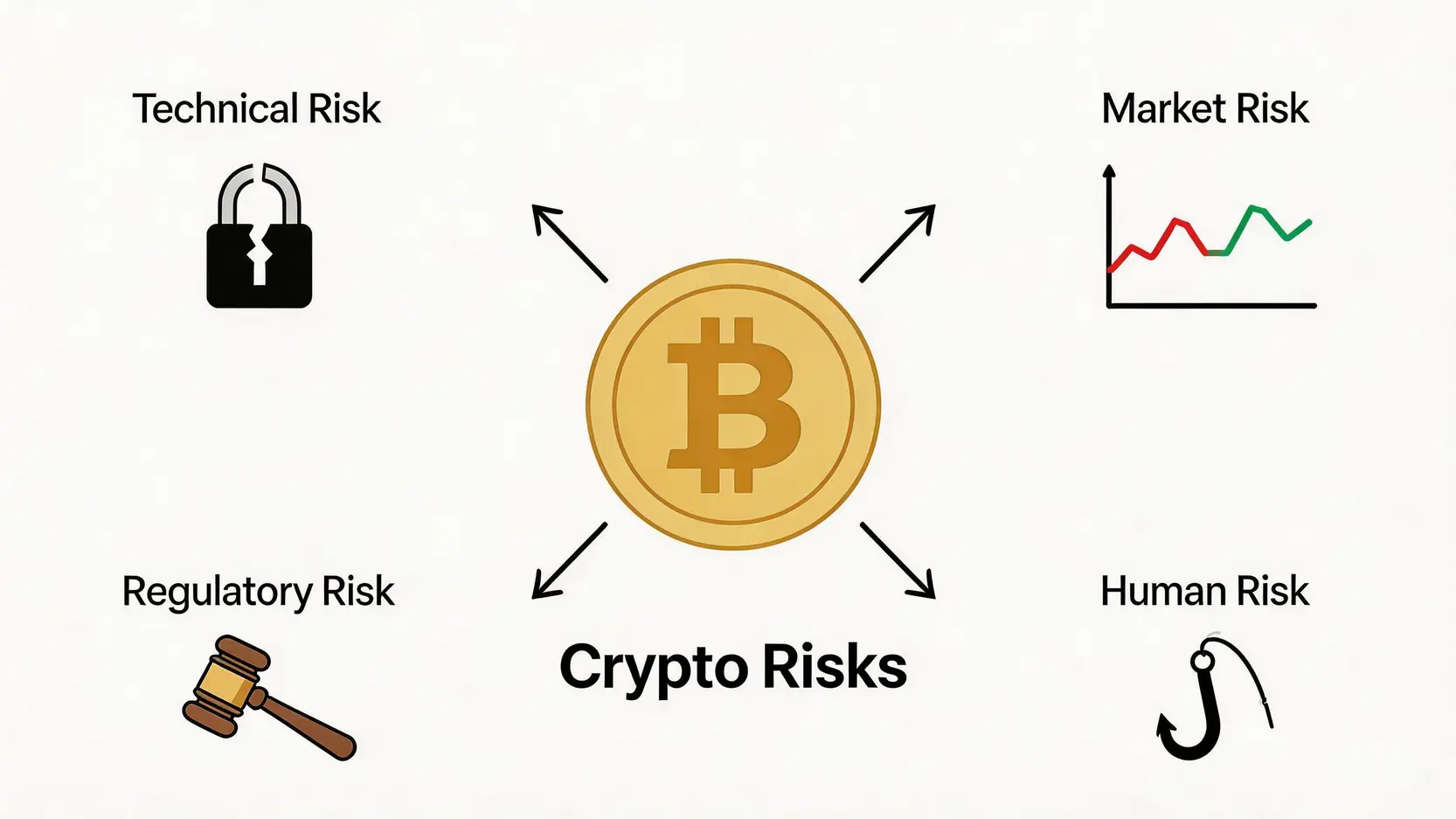
加密貨幣的四大核心風險類型示意圖,包括市場風險、技術風險、監管風險和人為風險。

Overview of the Four Core Cryptocurrency Risks


Market Risk: The Double-Edged Sword of Price Volatility

This is the most widely known cryptocurrency risk. Prices can rise or fall by over 20% in a single day, sometimes even more. This extreme volatility is a double-edged sword, offering both the opportunity for huge profits and the threat of instant asset evaporation. Factors causing price fluctuations include:

  • Market depth insufficiency: Compared with global stock markets, the total market capitalization and trading volume of cryptocurrencies are still relatively small, meaning a single large order can trigger dramatic price swings.
  • News sensitivity: Regulatory policy shifts, a celebrity’s tweet, or even unverified rumors can trigger panic selling or frenzied buying (FOMO).
  • 24/7 trading: Cryptocurrency markets operate year-round with no price limits, meaning risks are constantly present, requiring investors to remain vigilant at all times.


Technical Risk: Hacker Attacks, Platform Failures, and Private Key Management

The underlying technology of cryptocurrencies is blockchain. Although blockchain itself is decentralized and tamper-resistant, technical risks within its ecosystem still exist:

  • Hacker attacks: Exchanges, wallet applications, or DeFi protocols can become targets for hackers. Once a system vulnerability is exploited, users’ assets may be entirely stolen.
  • Platform failures: High-profile exchange collapses (such as FTX) remain fresh in memory. When an exchange fails due to mismanagement, fraud, or hacking, user assets stored on it are often irrecoverable.
  • Private key management: In the crypto world, a private key represents absolute ownership of your assets. If a private key is lost or stolen, the assets can never be recovered. This is the origin of the phrase “Not your keys, not your coins.”


Regulatory Risk: How National Policies Affect Coin Prices

Governments worldwide hold vastly different stances on cryptocurrencies, ranging from active adoption to outright bans. This uncertainty brings significant regulatory risk to the market. For example, the US Securities and Exchange Commission’s (SEC) determination of whether certain coins qualify as “securities,” China’s bans on mining and trading, or licensing requirements for exchanges in various countries—all policy implementations or changes can trigger global market turbulence. Investors need to closely monitor updates from authorities such as the Taiwan Financial Supervisory Commission to assess potential policy impacts. 

Human Risk: Information Asymmetry and Rampant Scams

In a relatively new and under-regulated market, the risks of manipulation and scams are extremely high. Project teams exploit information asymmetry, overhype, and false advertising to lure investors into buying “air coins” and then abscond with the funds (Rug Pulls). Social media is flooded with various “signal teachers” who manipulate the market using retail investors’ greed and fear, conducting “harvesting” operations. These are traps that novice investors are highly susceptible to in cryptocurrency investment.


Recommended Further Reading

2026 Hong Kong Cryptocurrency Exchange Ultimate Rankings: Safest Platforms to Buy Coins with HKD

Cardano (ADA) Wallet Top 5 Recommendations: Ultimate ADA Wallet Guide and Security Settings


Analysis of Major Cryptocurrency Crashes: Understanding the Drivers Behind Bear Markets

Those who have experienced the cryptocurrency market are all wary of “crashes” or “bear markets”. Understanding the causes of major cryptocurrency crashes not only helps maintain calm during market downturns but also reveals future investment opportunities.


Macroeconomic Factors: Impact of Interest Rate Hikes, Inflation, and Global Economic Recession

In recent years, the correlation between cryptocurrencies and the global macroeconomy has grown stronger. When the world faces high inflation, central banks (especially the US Federal Reserve) implement monetary tightening policies such as interest rate hikes to curb inflation. This reduces market liquidity, prompting investors to withdraw from high-risk assets (such as cryptocurrencies and tech stocks) and shift to safer assets (such as the US dollar or government bonds), leading to price declines.


Industry Internal Events: Exchange Collapses, Major Institutional Liquidations, and Chain Reactions

“Black swan” events within the cryptocurrency industry are another major cause of market collapses. For example:

  • Terra (LUNA) Collapse: The de-pegging of the algorithmic stablecoin UST triggered a death spiral for its ecosystem token LUNA, evaporating hundreds of billions of dollars in market value in a short period.
  • FTX Exchange Collapse: The sudden fall of the world’s second-largest exchange not only wiped out user assets but also triggered a crisis of trust and chain liquidations within the industry, plunging the market into a deep bear phase.

These events demonstrate that even industry giants can face enormous operational risks, and their collapse can inflict devastating damage on the entire market.


Market Sentiment and Excessive Leverage: How Panic Selling Happens

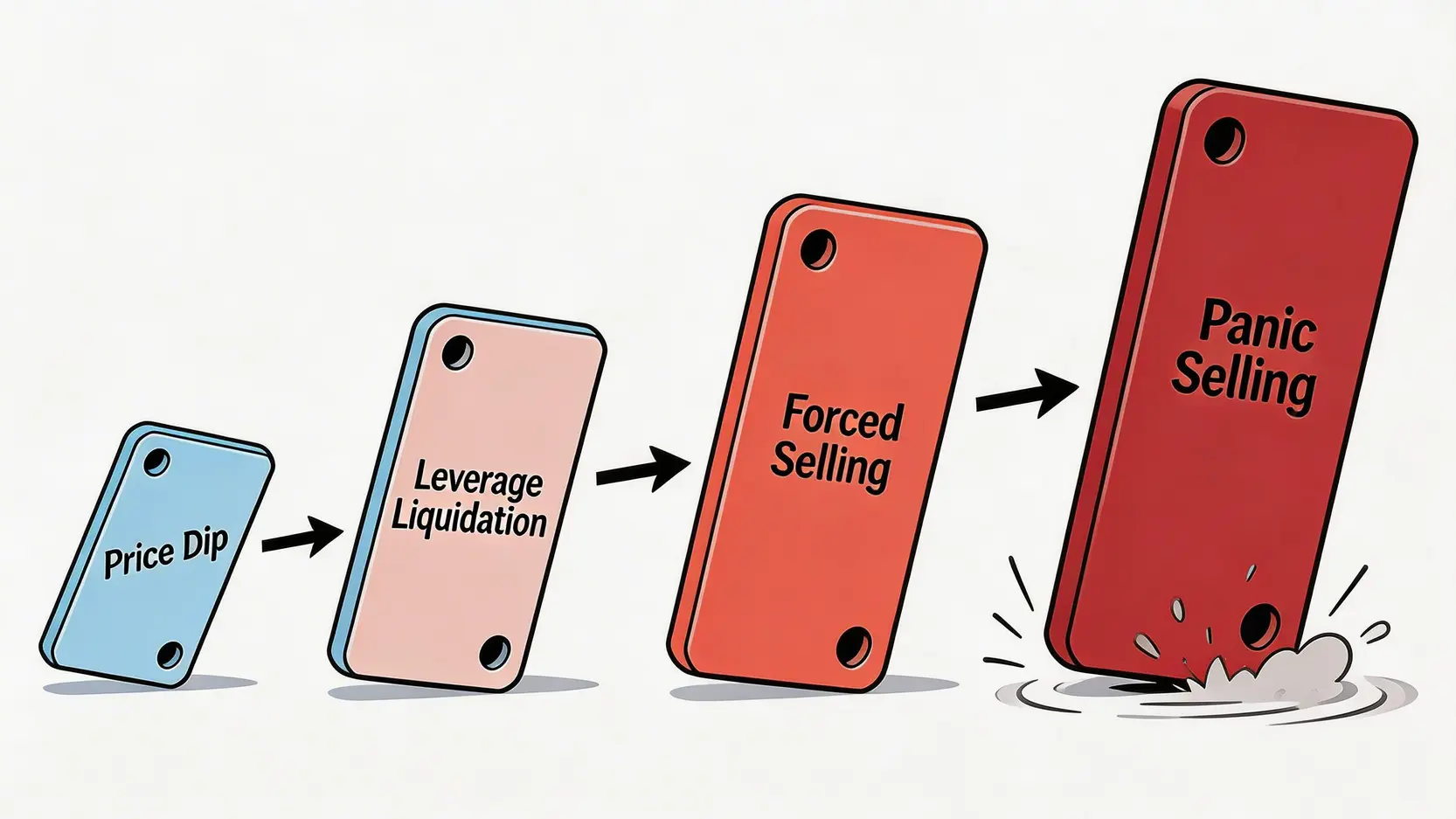
Market sentiment acts as a price amplifier. In a bull market, optimism and FOMO (Fear of Missing Out) drive prices upward, while in a bear market, pessimism and FUD (Fear, Uncertainty, Doubt) accelerate declines. Many investors use leverage to amplify profits, but during market downturns, leverage also magnifies losses. When prices fall below certain key levels, it can trigger massive forced liquidations of leveraged positions (margin calls), which in turn push prices down further, creating a vicious cycle that ultimately leads to cascading panic selling.

加密貨幣市場中因過度槓桿導致恐慌性拋售的流程圖。

How Excessive Leverage Triggers Chain Reactions in the Market


[Fraud Prevention Must-Read] The 5 Most Common Cryptocurrency Investment Traps

The allure of high returns has made the cryptocurrency space a breeding ground for scams. The following are the five most common cryptocurrency investment traps. Learning to identify them is the first step in protecting your hard-earned money.


Trap 1: Fake Exchanges and Phishing Websites

Scammers create fake websites or apps that are identical to well-known exchanges (such as Binance or Coinbase), using ads, social media, or private messages to lure you into clicking. Once you enter your account credentials or private keys on these fake sites, your assets are immediately stolen. Prevention Tip: Always download programs from official websites or app stores, and use bookmarks for frequently used exchanges to avoid logging in via unknown links.


Trap 2: “Signal Teachers” on Social Media and Unrealistic High-Return Promises

On Facebook, LINE, Telegram, or Discord, you may encounter people claiming to be “investment teachers” or “analysis experts”, flaunting luxury lifestyles and claiming insider information while inviting you to join their investment groups. They often promise “guaranteed profits” or “50% monthly returns” which are unrealistic. Once you transfer funds to them or invest in their recommended platforms, withdrawals often fail, resulting in total losses. Prevention Tip: Remember, there are no free lunches. Any guaranteed high-return promise is a scam.


Trap 3: Fake ICOs and Aircoin Projects

ICOs (Initial Coin Offerings) are a method for new projects to raise funds but have become a hotspot for scams. Many “aircoin” projects produce polished whitepapers and websites, claiming revolutionary technology, but in reality have no actual products or development progress. After raising funds, they disappear with the money (Rug Pull), leaving investors with worthless tokens. Prevention Tip: Conduct thorough research on the project team, technical background, and community activity (DYOR – Do Your Own Research) before investing.


Trap 4: Risks of Over-the-Counter (OTC) and In-Person Transactions

To bypass exchange restrictions or seek better rates, some opt for OTC trades with strangers. These transactions are risky; you may receive counterfeit money, stolen funds (leading to frozen bank accounts), or face personal safety threats during in-person exchanges. Prevention Tip: Prefer regulated, reputable large platforms for transactions and avoid private deals with strangers.


Trap 5: Romance Scams Combined with Investment Fraud (Pig Butchering Scam)

The “Pig Butchering Scam” is a malicious scheme that combines emotional manipulation. Scammers build close relationships with victims through dating apps, gain trust with care and attention, and then “casually” reveal they are making big profits from cryptocurrency, enticing the victim to invest. Early on, victims may see small gains and successful withdrawals to lure them into investing larger amounts. Once significant funds are invested, the scammers and money vanish. Prevention Tip: Exercise caution in online relationships. If the other party starts discussing investments and directs you to transfer funds or use unfamiliar platforms, raise your alert level immediately.


5 Practical Tips to Effectively Reduce Cryptocurrency Investment Risks for Beginners

Although cryptocurrencies carry high risks, they can be effectively managed and mitigated with the right strategies and mindset. Here are five practical tips for novice investors:


Manage Your Funds and Never Invest Everything

This is the golden rule of investing. The funds you invest in cryptocurrencies should be disposable money that, even if completely lost, will not affect your daily life. Never borrow money, take loans, or use emergency funds to invest. Beginners are advised to start with 1%–5% of total assets and adjust according to their risk tolerance. 

Choose Reputable, Large Exchanges

A secure and reliable exchange is the first line of defense for asset protection. Consider the following when choosing:

  • Regulatory compliance: Does it hold legal licenses in major countries or regions?
  • Proof of Reserves (PoR): Does it regularly disclose reserve proof, demonstrating the ability to meet user withdrawals?
  • Security record: Has it experienced major hacks or security breaches in the past?
  • Liquidity and trading volume: Larger exchanges typically offer better market depth, reducing price slippage.

Unsure how to choose? Refer to this detailed cryptocurrency exchange ranking and review guide to make an informed decision. 

Learn to Use Cold Wallets to Protect Your Assets

Keeping all assets on an exchange is equivalent to entrusting them to a third party. For long-term holdings not intended for short-term trading, it is strongly recommended to transfer assets to a “cold wallet”. Cold wallets are offline hardware devices that isolate your private keys from the internet, greatly reducing the risk of hacking. For more details, see this cold wallet guide and security setup instructions

Maintain Independent Thinking and Verify Information from Multiple Sources

The cryptocurrency market is full of noise and misinformation. Do not blindly trust “experts” on social media or friends claiming “insider information”. Learn to research independently (DYOR), read project whitepapers, check the development team’s background, analyze tokenomics, and gather information from multiple independent and reputable sources to establish your own investment logic.


Set Stop-Loss Points to Avoid Emotional Trading

Before entering any trade, clearly set your stop-loss and take-profit points. Stop-loss points help automatically sell when the market moves against you, controlling losses and preventing panic or stubbornness from causing larger losses. This disciplined approach effectively mitigates the weaknesses of human greed and fear, allowing for more rational decision-making.


Cryptocurrency Risk Frequently Asked Questions (FAQ)

Q: If I lose money investing in cryptocurrency, will the government intervene?

A: Currently, most countries worldwide, including Taiwan and Malaysia, classify cryptocurrencies as high-risk virtual assets rather than official currency or financial products protected by deposit insurance. Therefore, investment losses are considered personal risk, and governments or financial regulators typically do not intervene or provide compensation. It is essential to understand this before investing and take responsibility for your own decisions.

Q: How can I determine if a cryptocurrency project is a scam?

A: While there is no 100% foolproof method, several warning signs can help identify scams: 1. Promises of unrealistic high returns (e.g., “doubling every month”). 2. Websites or whitepapers that are vague, filled with jargon, but lack substantial technical details. 3. Anonymous founders or unverifiable team backgrounds. 4. Coercively requiring you to recruit friends (similar to pyramid schemes). 5. Project communities (such as Discord or Telegram) that allow only positive discussion, deleting or blocking dissenting voices.

Q: Are the risks higher when investing in smaller coins compared to Bitcoin and Ethereum?

A: Yes, the risks are generally higher. Bitcoin (BTC) and Ethereum (ETH), as the most widely recognized, largest, and longest-standing cryptocurrencies, have relatively more stable prices (though volatility remains significant). Other smaller market-cap coins, commonly referred to as “altcoins”, typically experience more extreme price swings, have shallower market depth, and carry a much higher risk of losing all value. Beginners should focus on Bitcoin and Ethereum primarily and only consider allocating small amounts to other potentially promising projects after gaining deeper understanding.

Q: Can stolen cryptocurrency be recovered?

A: The chances of recovery are very low. Due to the decentralized and anonymous nature of blockchain, once assets are transferred, transactions are almost irreversible. Law enforcement can track on-chain fund flows, but if hackers use mixers or similar technologies, tracing becomes extremely difficult, and cross-border investigations are highly challenging. Therefore, prevention is better than cure, making it crucial to protect your private keys and account security.


Conclusion

In summary, understanding cryptocurrency risks is the first step toward successful investing. The market’s extreme volatility and potential investment traps represent both challenges and opportunities. Through this analysis, you should be able to more clearly identify the causes of major cryptocurrency declines and adopt effective strategies to protect your assets. Remember, careful research and risk management are always your best allies in the crypto world. Start reviewing your investment portfolio now to establish your own safety defenses. 

If you liked this article, please share it!

Related Articles

  • Volatility Surface Guide: Skew Trading Strategies
    Practical Applications of Volatility Surfaces: From Options Modeling to Advanced Skew Trading Strategies In options markets, implied volatility is never a flat line. Instead, it forms complex "smile" or "skew" surfaces. For advanced traders, mastering the practical applications of volatility surfaces is equivalent to possessing a lens that reveals market...
    2026 年 6 月 3 日
  • Foreign Capital Flow Model: Track Institutional Money
    Building a Foreign Capital Flow Copy Trading Model: A Stock Market Indicator for Accurately Tracking Institutional Positioning In Asia-Pacific stock markets, foreign capital inflows and outflows often determine the direction of the index. However, simply looking at daily net buy and sell data is no longer enough. Only by building...
    2026 年 6 月 3 日
  • Options Buying Strategies for Extreme Market Risks
    Options Buyer Strategies During Extreme Market Conditions: Black Swan Hedging and Cross-Market Arbitrage During Volatility Surges The most terrifying aspect of financial markets is not a gradual decline, but overnight flash crashes and cross-market capital withdrawals accompanied by volatility surges. In the highly unpredictable global macroeconomic environment of 2026, geopolitical...
    2026 年 6 月 3 日
返回顶部