Crypto Futures vs Options: Risks & Strategy Guide

Cryptocurrency Futures vs Options: The Ultimate Guide | Risk Comparison, Hedging Strategies, and 5 Key Differences
Confused about cryptocurrency derivatives and struggling to tell the difference between futures and options? Worried about the high risks brought by leverage, but still want to learn how to use derivatives hedging to protect your assets? Understanding the differences between crypto futures and options is essential. This article provides a deep dive into the core distinctions between cryptocurrency futures and options, covering rights and obligations, margin mechanisms, and a comprehensive futures vs options risk comparison, along with practical derivatives hedging guides to help you master these two powerful financial tools and make more informed investment decisions. Whether you are a high-risk trader seeking returns or a cautious investor looking to hedge spot positions, this guide is an essential reference.
What Are Cryptocurrency Futures and Options? Core Concepts Made Simple
Before diving into comparisons, we must first understand the fundamentals of these two derivatives. Although both allow investors to trade assets at a predetermined future time and price, their underlying mechanisms are fundamentally different.
Cryptocurrency Futures: A Future “Obligation” Contract to Buy or Sell
Cryptocurrency futures are standardized legal contracts. Both parties agree to buy or sell a specific amount of cryptocurrency (such as Bitcoin or Ethereum) at a predetermined price on a specified future date (expiration date).
The key concept here is “obligation”. Once the contract is entered into, both parties must fulfill the agreement regardless of future market conditions. For example:
- If you are bullish on Bitcoin and buy a one-month Bitcoin futures contract at $70,000, you are obligated to buy Bitcoin at $70,000 when the contract expires.
- The counterparty (seller) is also obligated to sell Bitcoin at $70,000 at expiration.
This structure makes futures a direct directional trading tool with high leverage and high risk exposure.
Cryptocurrency Options: A Future “Right” to Choose
Cryptocurrency options give the holder the “right”, but not the obligation, to buy or sell cryptocurrency at a predetermined price (strike price) on or before a specific date. In exchange for this right, the buyer pays a fee called a “premium”.
- Call Option: Grants the right to “buy”.
- Put Option: Grants the right to “sell”.
For example, if you expect Bitcoin to rise but are uncertain, you pay a $1,000 premium to purchase a one-month call option with a $70,000 strike price. At expiration:
- If Bitcoin rises to $80,000, you can exercise your right to buy at $70,000 and realize an immediate profit.
- If Bitcoin falls to $60,000, you can simply choose not to exercise it, and your maximum loss is limited to the $1,000 premium.
This “right but not obligation” structure creates a flexible, asymmetric risk profile.

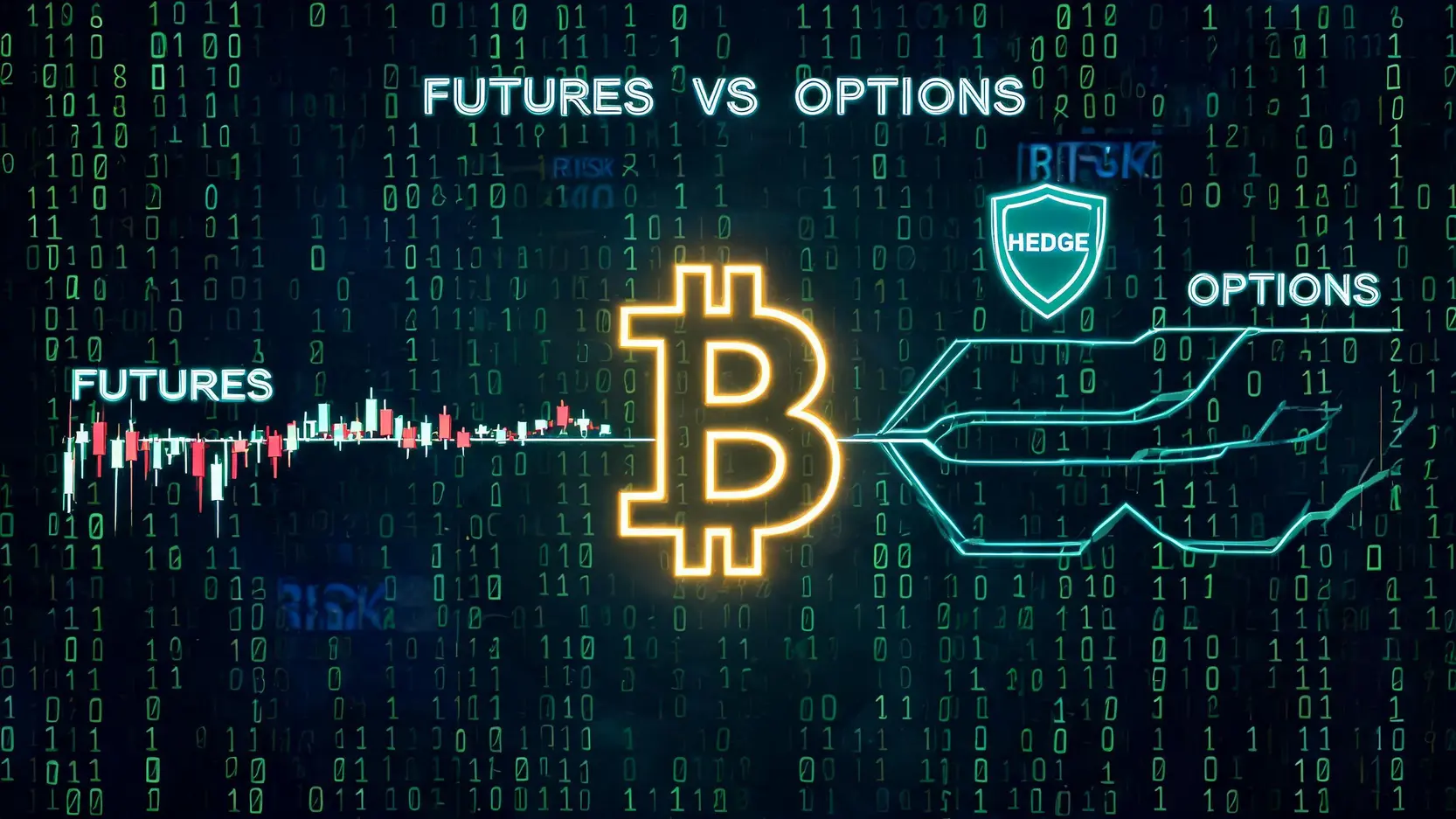
Figure 1: Core Concept Comparison Between Futures (Obligation) and Options (Right)
Further Reading (Highly Recommended)
Key Comparison: 5 Core Differences Between Crypto Futures and Options
Now that we understand the basics, let’s explore the five key differences between cryptocurrency futures and options, which clarify their use cases and risk structures.
Difference 1: Rights vs Obligations (Mandatory Execution vs Optional Execution)
This is the most fundamental difference. Futures contracts are binding obligations for both parties, while options give the buyer the choice to execute or abandon the contract.
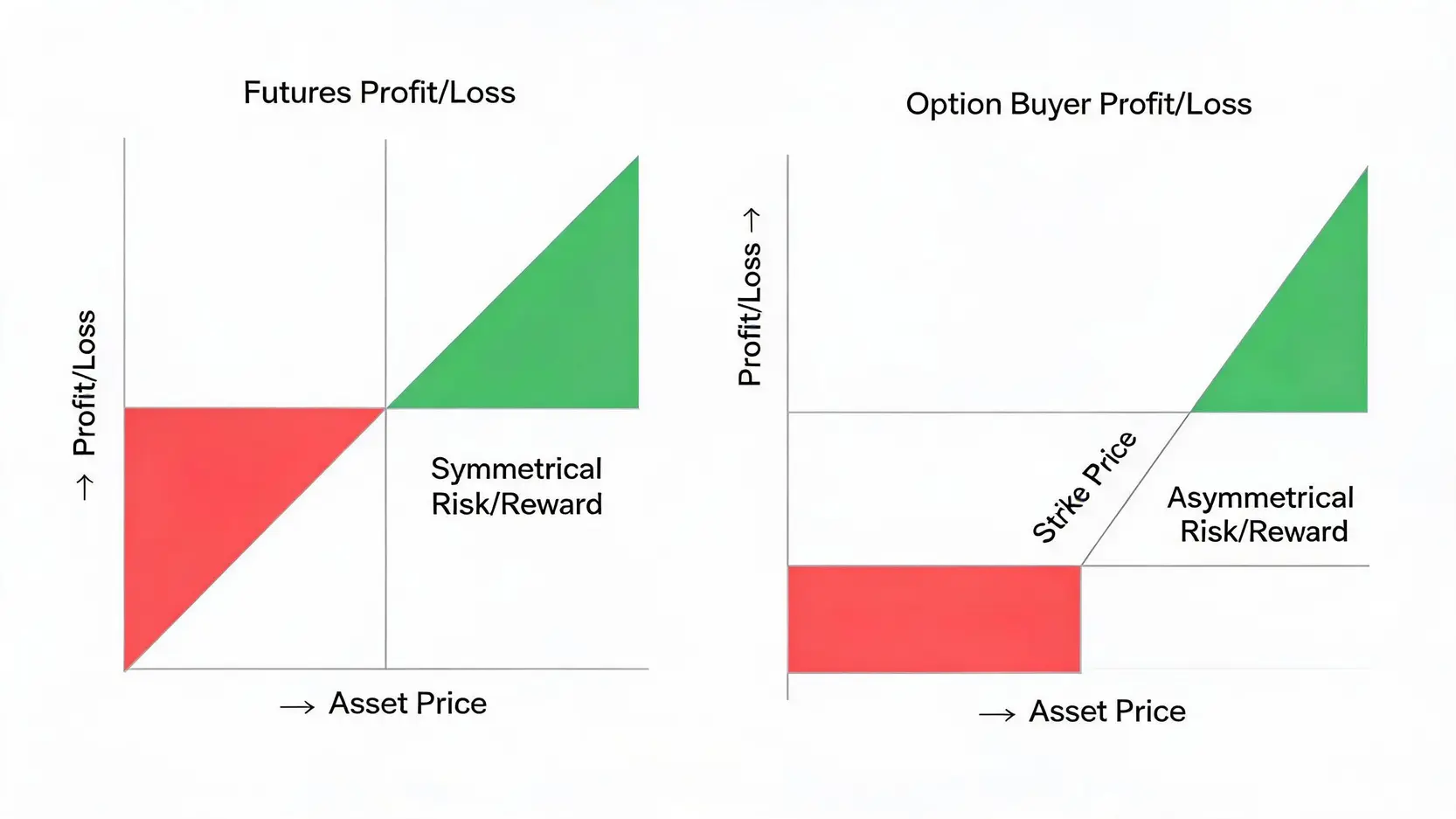
Difference 2: Risk and Return Structure (Symmetrical vs Asymmetrical)
- Futures: Symmetrical and linear risk-reward. Profits and losses can both be theoretically unlimited.
- Options: Asymmetrical risk-reward. For buyers, maximum risk is limited (premium paid), while potential upside is unlimited. For sellers, maximum profit is limited (premium received), while potential risk is theoretically unlimited.

Figure 2: Futures (Symmetrical) vs Options Buyer (Asymmetrical) Risk-Reward Structure
Difference 3: Margin Mechanism (Both Sides vs Seller Only)
To ensure contract performance, trading platforms require traders to deposit margin.
- Futures: Both buyers and sellers are required to post initial margin and maintain a minimum margin level, otherwise they may face forced liquidation.
- Options: Only sellers are required to post margin because they carry the obligation to fulfill the contract. Buyers do not need to post margin because they have already paid the premium, which caps their risk.
Difference 4: Main Use Cases (Price Speculation vs Strategy Diversity)
Although both can be used for speculation and hedging, their focus differs.
- Futures: Due to their linear profit and loss structure, they are more commonly used for directional speculation and simple price hedging.
- Options: Due to their nonlinear characteristics, they offer far greater strategy diversity. Investors can combine different options to build strategies such as spreads and straddles to respond to various market expectations (such as strong upward movement, sharp decline, or consolidation). For more information on options strategies, refer to authoritative academic references.
Difference 5: Complexity Level (Relatively Simple vs Highly Structured Strategies)
From an operational perspective:
- Futures: Relatively straightforward, mainly involving market direction and entry/exit timing decisions.
- Options: More complex, as they involve not only price direction but also volatility and time value (Greeks). Strategy combinations are highly diverse, requiring a higher level of expertise from investors.
Futures vs Options Risk Comparison: Which Is More Suitable for Me?
When choosing between futures and options, conducting a comprehensive futures vs options risk comparison is essential. This is not only about potential returns, but also directly impacts capital safety.
Futures Risk Analysis: Unlimited Loss Potential Under High Leverage
The biggest risk of futures comes from high leverage and a symmetrical loss structure. Leverage amplifies both potential gains and losses. If the market moves against your position, losses can quickly exceed your initial margin and even lead to liquidation, resulting in the loss of your entire capital. Therefore, strict risk management and stop-loss strategies are critical for futures traders.
Options Risk Analysis: Limited Risk for Buyers, Unlimited Risk for Sellers
Options risk depends on whether you are a buyer or a seller.
- Options Buyer: Risk is clearly defined and limited. No matter how volatile the market becomes, the maximum loss is the premium paid for the option. This makes buying options a risk-controlled strategy similar to insurance.
- Options Seller: Risk can be theoretically unlimited. The seller collects a limited premium, but if the market moves extremely (for example, selling a call option while the price rises indefinitely), the seller may face massive losses and may need to continuously add margin.
One-Chart Overview: Futures vs Options Risk-Return Comparison Table
| Derivative Type | Maximum Risk | Maximum Return | Suitable Scenarios |
| Futures Buyer (Long) | Unlimited (possible liquidation) | Unlimited | Strongly bullish market |
| Futures Seller (Short) | Unlimited (possible liquidation) | Limited (price goes to zero) | Strongly bearish market |
| Options Buyer | Limited (premium paid) | Unlimited | High-risk speculation with small capital or hedging |
| Options Seller | Unlimited | Limited (premium received) | Earning time value, range-bound market |
Entry-Level Derivatives Hedging Guide: 3 Ways to Protect Your Crypto Assets
Learning how to use derivatives for risk hedging is a key step from beginner to advanced investor. Below are three basic derivatives hedging strategies to help you protect your spot assets.
Strategy 1: Lock in Profits with a Futures Short to Hedge Spot Downside Risk
Assume you hold 1 Bitcoin in spot, currently priced at $70,000. You are worried about a short-term market pullback but do not want to sell your holdings. In this case, you can sell ( short) an equivalent Bitcoin futures contract.
- If Bitcoin drops to $60,000, your spot position loses $10,000, but your futures short position gains $10,000, perfectly offsetting the loss.
- If the price continues to rise, losses in the futures position are offset by gains in your spot holdings.
This strategy effectively locks in the fiat value of your spot assets and protects against market volatility.
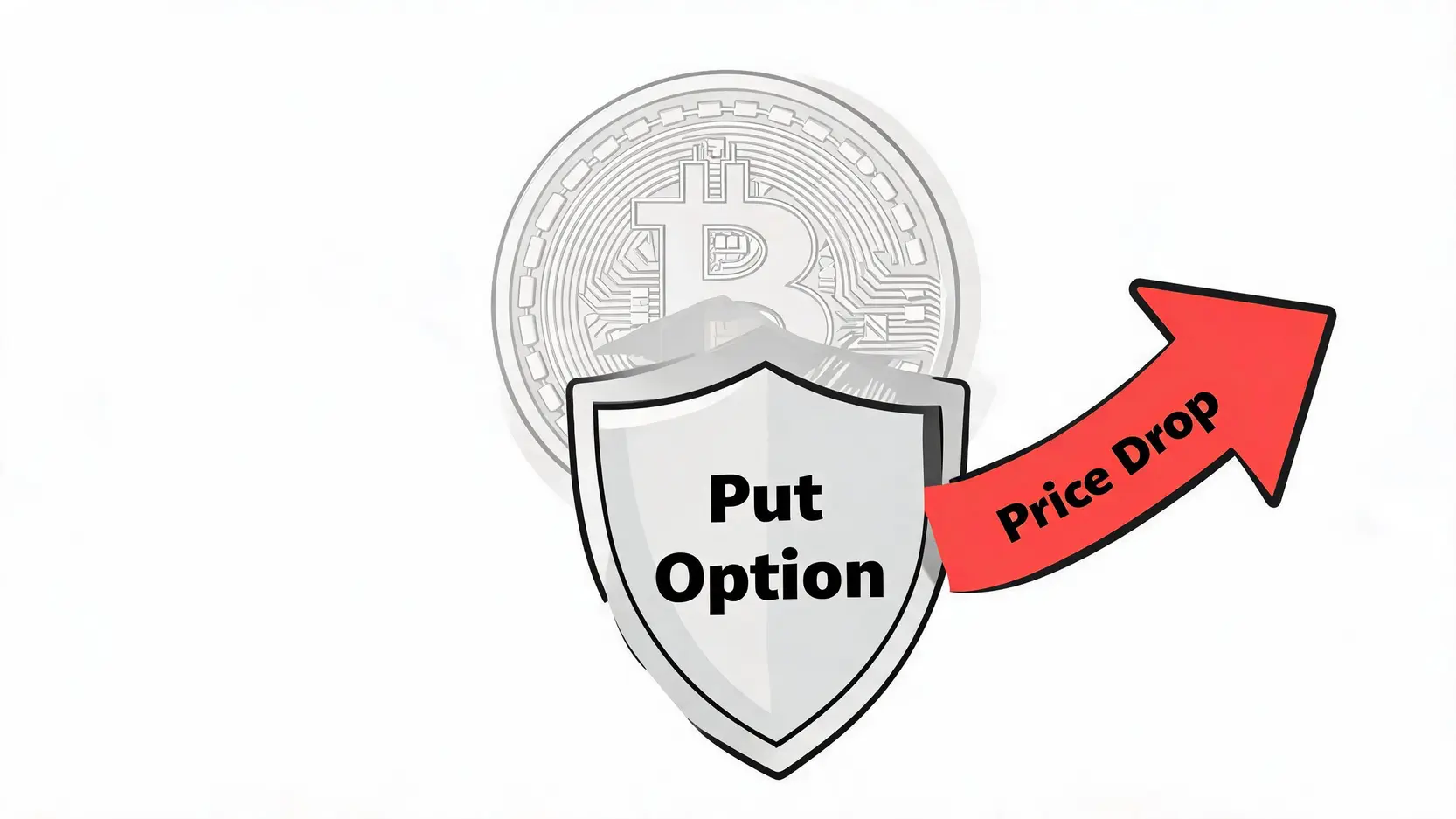
Strategy 2: Buy a Put Option to Insure Your Bitcoin
This is the most classic hedging strategy. Using the same example, you hold 1 Bitcoin and are concerned about downside risk. You can purchase a Bitcoin put option with a strike price of $65,000. This acts like an insurance policy:
- If Bitcoin falls below $65,000, the put option gains value and offsets your spot losses.
- If Bitcoin rises, your maximum loss is limited to the premium paid for the option, while your spot position continues to capture full upside gains.

Figure 3: Using a Put Option as “Insurance” to Hedge Spot Downside Risk
Strategy 3: Use Covered Calls to Generate Additional Cash Flow
If you hold Bitcoin long-term and expect limited short-term upside or sideways movement, you can sell an out-of-the-money call option (strike price above market price). For example, when Bitcoin is at $70,000, you sell a call option with a $80,000 strike price and collect a premium.
- Scenario A: If the price stays below $80,000 at expiration, the option expires worthless and you keep the full premium as extra income.
- Scenario B: If the price exceeds $80,000, your Bitcoin may be sold at $80,000. However, you still earn profit based on your cost basis plus the additional premium received.
This strategy is suitable for investors who want to generate passive income while holding long-term positions. For more advanced hedging and trading techniques, refer to our Cryptocurrency Derivatives Beginner Guide.
Frequently Asked Questions (FAQ)
Q: Should beginners start with futures or options first?
A: Generally, it is recommended that beginners start with “buying options”. This is because, as an options buyer, the maximum risk is controllable (limited to the premium paid), and there is no liquidation risk. This helps beginners become familiar with the derivatives market under limited risk conditions. Futures involve high leverage and potentially unlimited losses, which may be too risky for beginners.
Q: How much margin is required to trade cryptocurrency futures or options?
A: The required margin varies depending on the exchange, leverage level, and contract size. In futures trading, both buyers and sellers must post initial margin. In options trading, only sellers are required to post margin because they carry the obligation to fulfill the contract. Please refer to the specific rules of your trading platform for exact amounts.
Q: What happens when my options contract expires?
A: At expiration, there are two possible outcomes:
1. In-the-money: The option has intrinsic value. Most exchanges will automatically exercise it for you, or you may choose to close the position manually.
2. Out-of-the-money: Exercising the option would result in a loss. The option expires worthless, and you lose the entire premium paid.
Q: What is a strike price?
A: The strike price is a pre-set price in an options contract at which the holder can choose to buy (call option) or sell (put option) the underlying asset at or before expiration. It is the key price that determines whether exercising the option is profitable.
Q: Can options be liquidated like futures?
A: For options “buyers”, there is no liquidation risk, as the maximum loss is limited to the premium paid. However, options “sellers” can face liquidation risk. Since sellers collect a limited premium but take on potentially unlimited risk, their margin may be insufficient during extreme market movements, leading to forced liquidation.
Conclusion
In summary, although cryptocurrency futures and options are both powerful derivative tools, their core differences are significant. Futures represent an “obligation” tied to future price movements, with symmetrical risk and return, making them more suitable for directional trading. Options, on the other hand, represent a “right” rather than an obligation, offering asymmetric risk-reward structures and far greater strategic flexibility. Fully understanding the differences between cryptocurrency futures and options, along with a proper futures vs options risk comparison, is the first step toward effective derivatives hedging. Investors should choose the appropriate tool based on their risk tolerance, capital size, and investment objectives in order to navigate the volatile crypto market more effectively.
Related Articles
-
Practical Applications of Volatility Surfaces: From Options Modeling to Advanced Skew Trading Strategies In options markets, implied volatility is never a flat line. Instead, it forms complex "smile" or "skew" surfaces. For advanced traders, mastering the practical applications of volatility surfaces is equivalent to possessing a lens that reveals market...2026 年 6 月 3 日
-
Building a Foreign Capital Flow Copy Trading Model: A Stock Market Indicator for Accurately Tracking Institutional Positioning In Asia-Pacific stock markets, foreign capital inflows and outflows often determine the direction of the index. However, simply looking at daily net buy and sell data is no longer enough. Only by building...2026 年 6 月 3 日
-
Options Buyer Strategies During Extreme Market Conditions: Black Swan Hedging and Cross-Market Arbitrage During Volatility Surges The most terrifying aspect of financial markets is not a gradual decline, but overnight flash crashes and cross-market capital withdrawals accompanied by volatility surges. In the highly unpredictable global macroeconomic environment of 2026, geopolitical...2026 年 6 月 3 日