Funds vs Stocks: 5 Key Differences for Beginners

Funds vs. Stocks: Which Is Better? 5 Key Differences, Advantages and Disadvantages, a Must-Read Guide for Beginner Investors
Ready to take your first step into investing, but feeling confused by the classic question of “should I buy funds or stocks”? Many people have heard of funds and stocks, yet do not clearly understand the differences between them, let alone the advantages and disadvantages of funds vs. stocks. This is a critical crossroads, and making the wrong choice could make your investment journey far more difficult. This article, from the perspective of an experienced investor, will thoroughly analyze the core differences between these two mainstream investment tools, helping beginner investors make the most informed first decision based on their personal financial goals and risk tolerance.
What Exactly Is the Difference Between Funds and Stocks? Understand the Core Concepts Instantly
Before deciding whether to buy funds or stocks, we must first understand their fundamental nature. Although both are investment tools, their operating logic is vastly different.
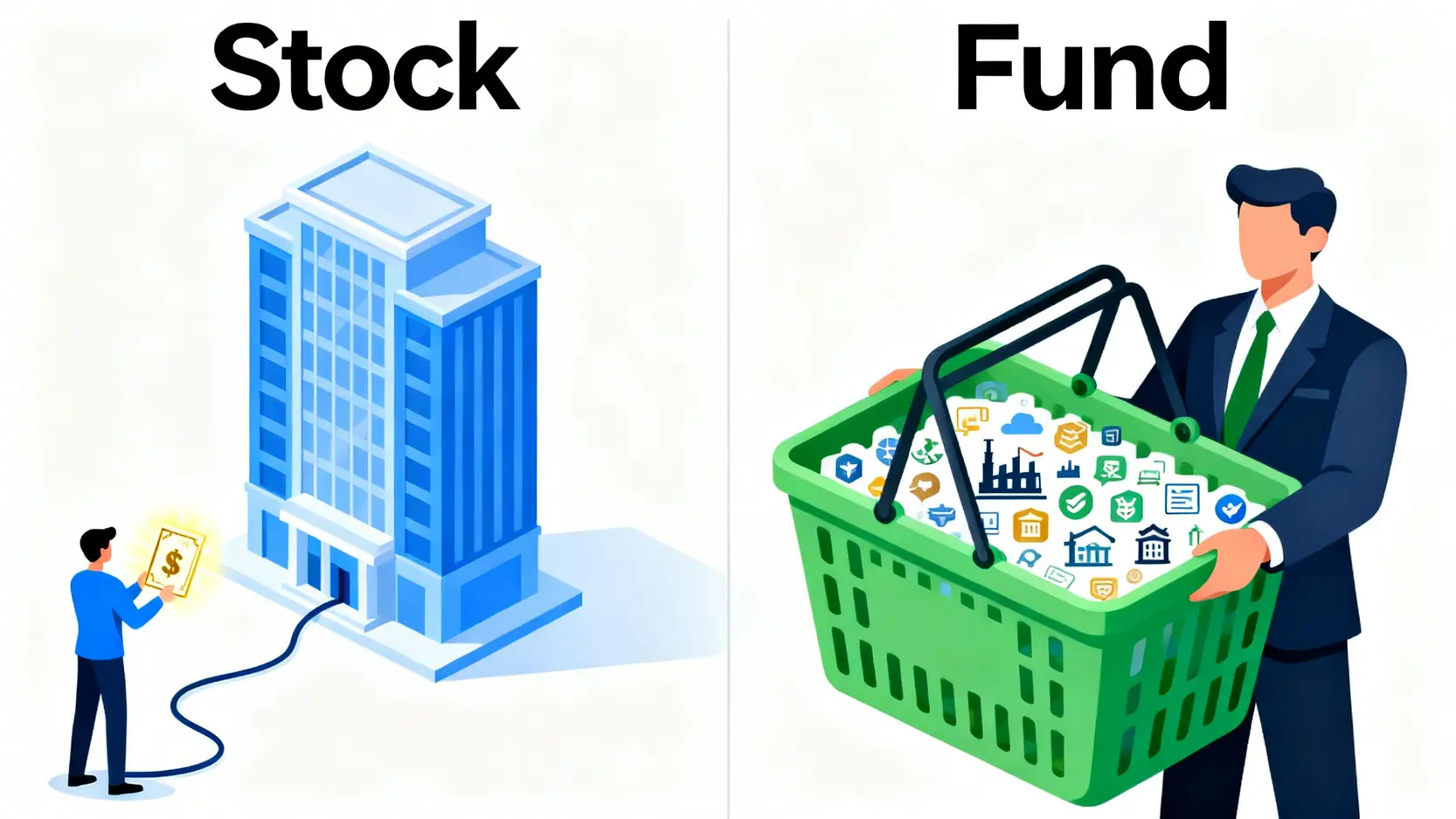
What Is a Stock? Become a Shareholder and Invest Directly in a Business
Imagine you really like a beverage shop and are optimistic about its future. If this shop is a listed company, you can purchase its “stock”. Buying stocks means you proportionally own a part of the company and become a “shareholder”.
- Direct ownership: You directly hold part of the company’s assets. If the company performs well, your stock price may rise, and if it distributes dividends, you also receive a share.
- High risk, high return: If the company performs well, such as launching a popular new product, the stock price may surge, offering significant return potential. Conversely, if the company performs poorly or goes bankrupt, the value of your stock may fall to zero.
- Decision rights: As a shareholder, you have voting rights and can participate in major company decisions (although the influence of small shareholders is minimal).
What Is a Fund? Pooling Resources and Managed by Professionals
If you do not want to invest in just one beverage shop but instead want to invest in dozens or even hundreds of different companies across industries such as food and beverage, technology, and finance, yet lack the time and expertise to research each one, then a “fund” becomes useful.
- Pooled investment: A fund is like a large pool of capital, combining money from thousands of investors.
- Professional management: One or more professional fund managers are responsible for managing this large pool of capital. Based on the fund’s objectives (such as focusing on technology stocks or investing in global bonds), they select a basket of stocks, bonds, or other assets for investment.
- Risk diversification: Buying one unit of a fund means you indirectly hold dozens or even hundreds of different securities, significantly reducing the impact of poor performance from a single company. This reflects the classic principle of “not putting all your eggs in one basket”

Stocks mean directly becoming a shareholder of a company, while funds allow you to invest in multiple assets at once through professional management.
Funds vs. Stocks: A Comprehensive Comparison of Advantages and Disadvantages Across 5 Key Dimensions
After understanding the basic concepts, we will now analyze the advantages and disadvantages of funds vs. stocks across five key dimensions to help you determine which tool better suits your needs.
1. Risk Diversification: Should You Put All Your Eggs in One Basket?
This is one of the most fundamental differences between funds and stocks. The greatest risk in investing is “going all in”.
- Stocks (concentrated risk): Risk is highly concentrated. The performance of the stock of Company A depends entirely on its business performance, industry outlook, and even management decisions. If a “black swan” event occurs, such as a major product defect or financial fraud, the stock price may collapse instantly, resulting in severe losses.
- Funds (diversified risk): Naturally offer diversification. An equity fund typically holds dozens to hundreds of different stocks. Even if one or two companies perform poorly, the overall impact on the fund’s net asset value is limited. This “offsetting effect” helps smooth portfolio volatility. For beginners, this is the simplest and most effective way to manage risk. As emphasized in reports from authoritative institutions, diversification across regions and asset classes is key to controlling investment risk.

Investing in stocks concentrates risk like putting all eggs in one basket, while funds reduce risk through diversified holdings.
2. Investment Threshold and Costs: What Is the Difference Between Entry Costs and Fees?
Investment is not only about returns, cost control is equally important.
- Stocks:
- Threshold: The minimum purchase unit is “one share” (or one lot, depending on the region). For high-priced quality stocks such as NVIDIA or TSMC, buying a single share can already require a substantial amount, creating a higher entry barrier for small investors.
- Costs: Mainly transaction fees, which are charged by brokers for each trade. These fees directly affect your short-term trading profits.
- Funds:
- Threshold: Usually very accessible. Many funds allow small investments (such as a few thousand per month) through regular investment plans, making it easy for small investors to participate in the market.
- Costs: The fee structure is relatively complex, it mainly includes the subscription fee (paid when purchasing), the redemption fee (paid when selling), and the most important “management fee” (charged annually and deducted from the fund’s net asset value). These fees are paid to the fund company and the management team, and over time they will erode a portion of the investment returns.
Further Reading (Highly Recommended)
3. Management Style: Manage It Yourself or Leave It to Experts?
This is the difference that most affects investors’ lifestyles.
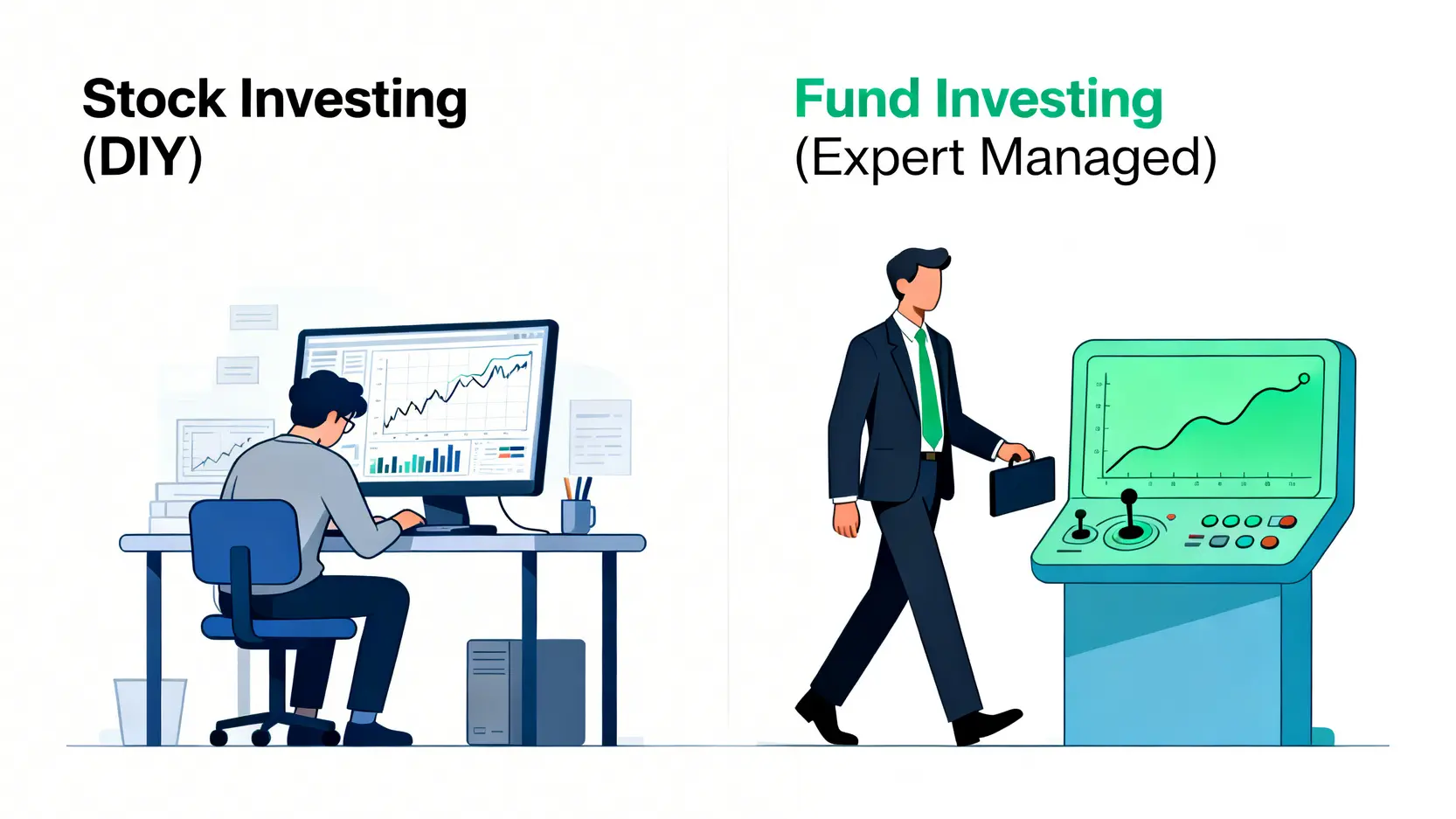
- Stocks (active): Investing in stocks is like cooking yourself. From selecting ingredients (stock picking), studying recipes (analyzing financial statements and market information), to controlling the heat (deciding buy and sell timing), every step requires hands-on involvement. You need to have an in-depth understanding of the companies you invest in and continuously monitor them.
- Funds (passive): Investing in funds is like dining at a reputable restaurant. You only need to choose the cuisine (fund type, such as technology or value), while the selection and preparation are handled by professional chefs (fund managers). You pay a service fee (management fee) in exchange for the expertise and time of professionals.

Investing in stocks requires personal involvement, like being your own captain, while investing in funds is like hiring a professional captain to navigate for you.
4. Time and Effort Required: Passive Investing vs. Active Research
Following the difference in management style, the time commitment also varies greatly.
- Stocks: Require a significant amount of time for both initial research and ongoing monitoring. You need to read financial reports, follow industry news, analyze technical charts, and monitor global economic trends. It is almost like a part-time job, suitable for investors who enjoy research and discovering potential stocks.
- Funds: Relatively time-saving and effortless. Your main task is “selecting the fund”. Once you choose one or several quality funds, you can set up regular investment plans and let professional teams manage them. This is highly attractive for busy individuals or those who “prefer not to spend excessive time on investments”.
5. Potential Returns and Transparency: Return Potential and Price Volatility
Return potential is often directly proportional to risk.
- Stocks:
- Return potential: Higher potential returns. If you identify a promising company early and hold it long term, it is possible to achieve multiple or even exponential returns. Individual stocks have far greater explosive potential than funds.
- Transparency: High price transparency. Stock prices fluctuate in real time during trading hours, allowing you to instantly know the value of your assets.
- Funds:
- Return potential: Returns are relatively stable. The goal of a fund is to achieve market-average returns or outperform the market average (for actively managed funds). Due to diversified holdings, it is difficult to see explosive growth like a single stock, but it also helps avoid catastrophic declines.
- Transparency: Funds have one price per day, known as the “net asset value” (NAV). You cannot trade intraday and must transact at the NAV calculated after market close. Fund companies regularly disclose their holdings, but compared to real-time stock prices, transparency differs.
Conclusion: Should I Buy Funds or Stocks? A Table to Help You Decide
After analyzing the differences between funds and stocks, you likely already have a preliminary answer. To make it even clearer, the following comparison table is provided to help you quickly determine your choice.
| Comparison Dimensions | Stocks (Stock) |
Funds (Fund) |
| Risk Level | High, concentrated in a single company | Low, risk is highly diversified |
| Return Potential | High, potential for multiple-fold growth | Moderate, aims for market-average or stable growth |
| Investment Threshold | Relatively high, influenced by stock price | Low, suitable for small amounts and regular investment |
| Management Style | Self-managed, active trading | Managed by a professional team |
| Time and Effort | Requires significant time investment for research | Time-saving and effortless, suitable for passive investors |
| Suitable For | Investors with high risk tolerance, a passion for research, and a pursuit of high returns | Beginner investors, those seeking stability, and those without time for research |
If you are “this type” of investor, stocks may suit you better
You have in-depth knowledge and strong conviction in a specific industry or company.
You enjoy researching financial statements and analyzing the market on your own.
You have a high risk tolerance and can accept significant stock price fluctuations.
You seek returns that exceed the market average and are willing to take on the associated risks.
You want 100% control over your investment portfolio.
If you match “these” characteristics, starting with funds is more stable
You are a beginner investor who has just entered the market and lacks confidence in stock selection.
You want to effectively diversify risk and avoid losing everything due to negative news from a single company.
You have a busy schedule and no extra time to research individual stocks or monitor the market.
Your investment goal is long-term stable asset growth rather than short-term high profits.
You prefer a “passive investing approach” and want professionals to manage investments for you.
FAQ: Frequently Asked Questions About Funds and Stocks
Q: Is an ETF considered a fund or a stock?
A: An ETF (Exchange-Traded Fund, index equity fund) can be understood as a hybrid. Its nature is a fund, as it pools investors’ money to hold a basket of securities that track a specific index, (such as the S&P 500). However, its trading method is like a stock, as it can be bought and sold in real time on a stock exchange, with prices fluctuating based on market supply and demand. Therefore, ETFs combine the diversification benefits of funds with the trading flexibility of stocks, making them a highly popular investment tool in recent years. For more details, you can refer to this introduction to what an ETF is.
Q: Should beginner investors always start with funds?
A: For the vast majority of beginners, the answer is yes. Funds (especially ETFs that track broad market indices) provide a low-threshold and efficient way to achieve diversification, helping beginners avoid major losses caused by poor stock selection. Starting with funds allows you to become familiar with market trends and volatility while building investment discipline. Once you gain more experience and knowledge, gradually allocating individual stocks is usually a more stable learning path.
Q: What are the typical fees for buying stocks and funds?
A: This depends on your location and the broker or platform you choose. Stock trading fees are usually charged as a fixed percentage of the transaction amount, typically ranging from 0.1% to 0.5%, and may include a minimum fee. In recent years, many online brokers have introduced highly competitive low-fee or even zero-fee options. For funds fee, subscription fees are usually between 1% and 3%, although many platforms offer discounts. The management fee is charged annually and deducted from the fund’s net asset value, with a wide range from around 0.1% for index funds to over 2% for actively managed funds. When choosing an investment tool, these transaction costs must be taken into consideration. You can refer to broker fee comparisons to select the most cost-effective platform.
Q: Can I invest in both funds and stocks at the same time?
A: Yes, and this is a very common and healthy asset allocation strategy. Many experienced investors adopt a “core-satellite” strategy, allocating the majority of their funds (such as 70-80%), into stable index funds or diversified fund portfolios as the “core assets” to achieve long-term stable returns. The remaining portion (such as 20-30%), is used as “satellite assets” to invest in selected individual stocks for higher return potential. This approach ensures overall portfolio stability while allowing room for active stock selection.
Conclusion
In summary, there is no absolute answer to the question of “whether to buy funds or stocks”. It is more like an open-ended question rather than a multiple-choice one. The key lies in thoroughly understanding the differences between funds and stocks, and honestly assessing your investment goals, risk tolerance, available time and effort, and level of knowledge. Stocks offer high return potential and the satisfaction of direct participation, while funds provide stability, diversification, and convenience. It is hoped that this in-depth analysis of the advantages and disadvantages of funds vs. stocks will help you clear the confusion, plan your own investment blueprint, and take the first steady step toward successful financial management.
Related Articles
-
Practical Applications of Volatility Surfaces: From Options Modeling to Advanced Skew Trading Strategies In options markets, implied volatility is never a flat line. Instead, it forms complex "smile" or "skew" surfaces. For advanced traders, mastering the practical applications of volatility surfaces is equivalent to possessing a lens that reveals market...2026 年 6 月 3 日
-
Building a Foreign Capital Flow Copy Trading Model: A Stock Market Indicator for Accurately Tracking Institutional Positioning In Asia-Pacific stock markets, foreign capital inflows and outflows often determine the direction of the index. However, simply looking at daily net buy and sell data is no longer enough. Only by building...2026 年 6 月 3 日
-
Options Buyer Strategies During Extreme Market Conditions: Black Swan Hedging and Cross-Market Arbitrage During Volatility Surges The most terrifying aspect of financial markets is not a gradual decline, but overnight flash crashes and cross-market capital withdrawals accompanied by volatility surges. In the highly unpredictable global macroeconomic environment of 2026, geopolitical...2026 年 6 月 3 日