Fund Expense Ratio: Fees & How They Affect Returns

Updated: 2026/03/24  |  CashbackIsland

fund-expense-ratio-guide

How Does the Fund Expense Ratio Erode Your Returns? Understand Management Fee Calculations and How to Choose Low-Cost Funds

Many investors focus only on historical returns when evaluating a fund, but overlook a hidden cost that quietly erodes long-term profits: the “Total Expense Ratio” (TER). Do you understand how fund management fees are calculated? Under the compounding effect, high fees can significantly reduce your retirement savings. Understanding the impact of the fund expense ratio and learning how to choose low-cost funds is essential for every smart investor. This article provides a comprehensive breakdown of the components of TER, explains how various hidden costs are calculated, and offers practical strategies for selecting low-cost funds to help you protect your capital and make more informed investment decisions. 


Not Just Management Fees! What Is the Total Expense Ratio (TER)?

When discussing fund fees, most people think of the “management fee”. However, this is only the tip of the iceberg. The indicator that truly reflects the total cost of operating a fund is the “Total Expense Ratio” (TER). This is an annual percentage that represents how much of the fund’s “total assets” are used to cover operational and administrative expenses. The higher the ratio, the more your returns are eroded.


Breaking Down the Total Cost: Management Fees, Custodian Fees, Administrative Fees, and Other Expenses

The Total Expense Ratio (TER) is a comprehensive cost indicator calculated by dividing all operating expenses of a fund over a year by its average net asset value. These fees are usually deducted directly from the fund’s assets, so investors do not receive separate bills, making them easy to overlook. The main components include:

  • Management Fee: The largest portion, paid to the fund management company for research, analysis, stock selection, and daily investment decisions. Actively managed funds typically have higher management fees due to their larger research teams.
  • Custodian Fee / Trustee Fee: Fund assets must be held by an independent third-party financial institution (custodian or trustee) to safeguard investors. This fee covers asset protection and independent operation.
  • Administrative Fee: Covers daily operational costs such as calculating net asset value (NAV), processing subscriptions and redemptions, issuing reports, and legal compliance.
  • Performance Fee: Some actively managed funds (especially hedge funds) charge this fee. When the fund outperforms a predefined benchmark (such as a major market index), the fund managers take a certain percentage of the excess return as a performance bonus.
  • Other Expenses: Includes audit fees, legal fees, index licensing fees (for index funds), printing, and marketing costs.

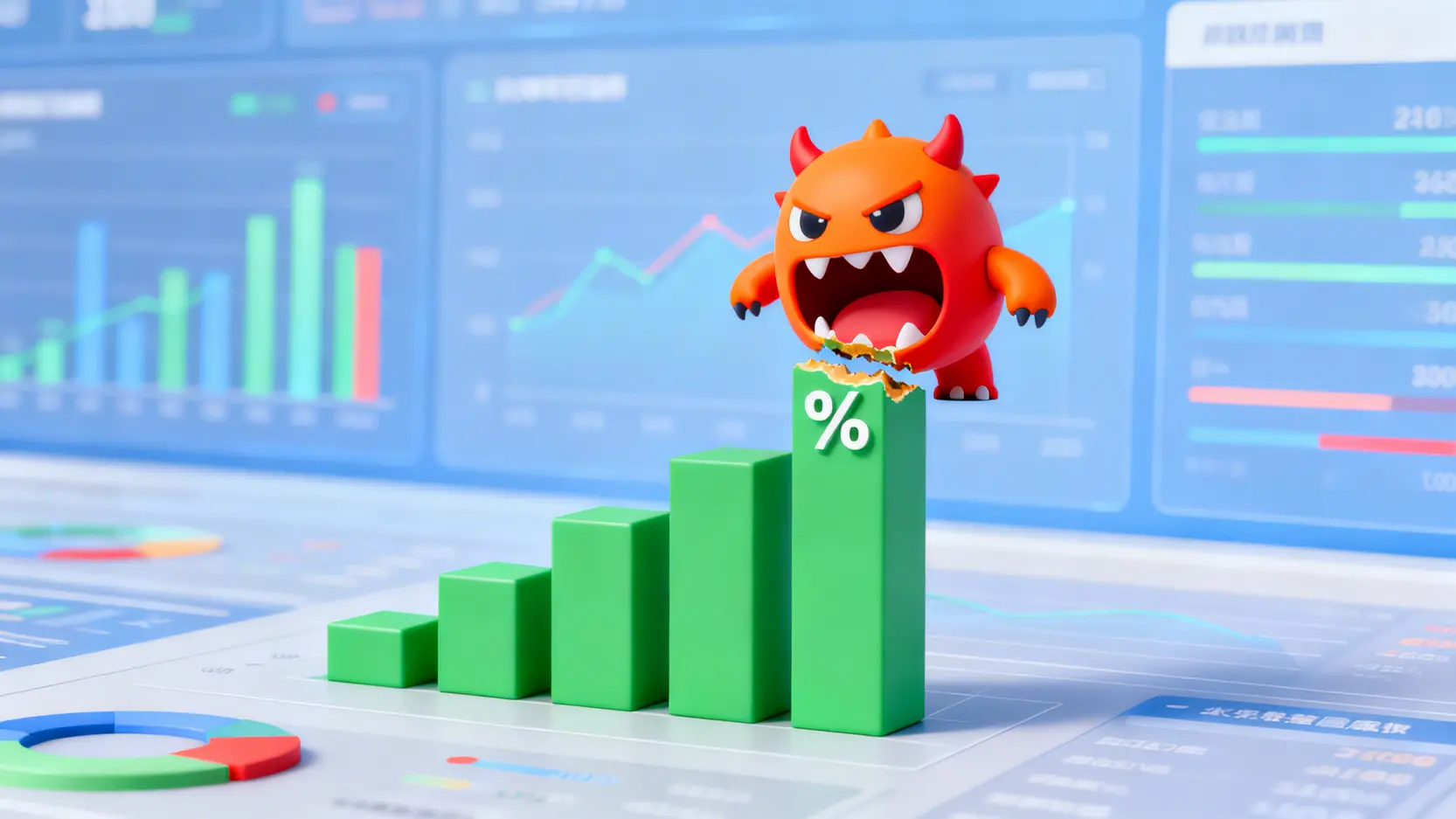
基金總開支比率的冰山示意圖,顯示管理費只是可見的一小部分,而水面下隱藏著託管費和行政費等更多成本。

The Total Expense Ratio (TER) is like an iceberg, with the management fee being only the visible tip.


Why Is TER More Important Than Just Looking at Management Fees?

Focusing only on management fees is like buying a car based solely on its price while ignoring insurance, fuel, and maintenance costs. TER represents the “total cost of ownership”.

Two funds with the same 1% management fee can have very different TERs. Fund A may have a TER of 1.2% due to efficiency and scale, while Fund B may reach 1.8% due to hidden costs or frequent trading. This 0.6% difference can have a devastating impact on long-term returns. Therefore, when comparing fund costs, TER is the most comprehensive and reliable metric.


How Are Fund Management Fees Calculated? Revealing the Hidden Erosion of Returns

After understanding the composition of fund fees, the next key question is: how are these fees actually deducted from our investments? “How fund management fees are calculated” is not as straightforward as a credit card statement; it is an ongoing daily process, making its impact on returns more subtle and far-reaching.


Deducted Daily From NAV: Full Explanation of the Fee Calculation Process

Fund expenses are not deducted once a year; instead, they are accrued daily and gradually taken from the fund’s total assets. Each day after market close, the fund company calculates the fund’s Net Asset Value (NAV), which already reflects the deduction of that day’s operating expenses (calculated by dividing the annual fee rate by 365).

Calculation process:

  1. Daily Rate: Divide the TER by 365. For example, a fund with a TER of 1.5% has a daily rate of approximately 0.0041% (1.5% / 365).
  2. Daily Cost: Multiply the fund’s total assets by the daily rate. If the fund has HKD 100 million in assets, the daily cost is HKD 4,100.
  3. NAV Publication: The published NAV already reflects these deductions.

In other words, the fund price you see daily is already net of fees. This automatic and invisible process causes many investors to underestimate the cost they are paying.


The Power of Compounding: How a 1% Fee Difference Can Cost You Millions?

“Isn’t 1–2% negligible?” This is a common misconception. Under “compounding”, even small fee differences grow exponentially over time. Fees not only reduce your principal returns but also diminish “future gains generated by reinvested returns”.

Let us look at a concrete example to see how significant the impact of the fund expense ratio can be:

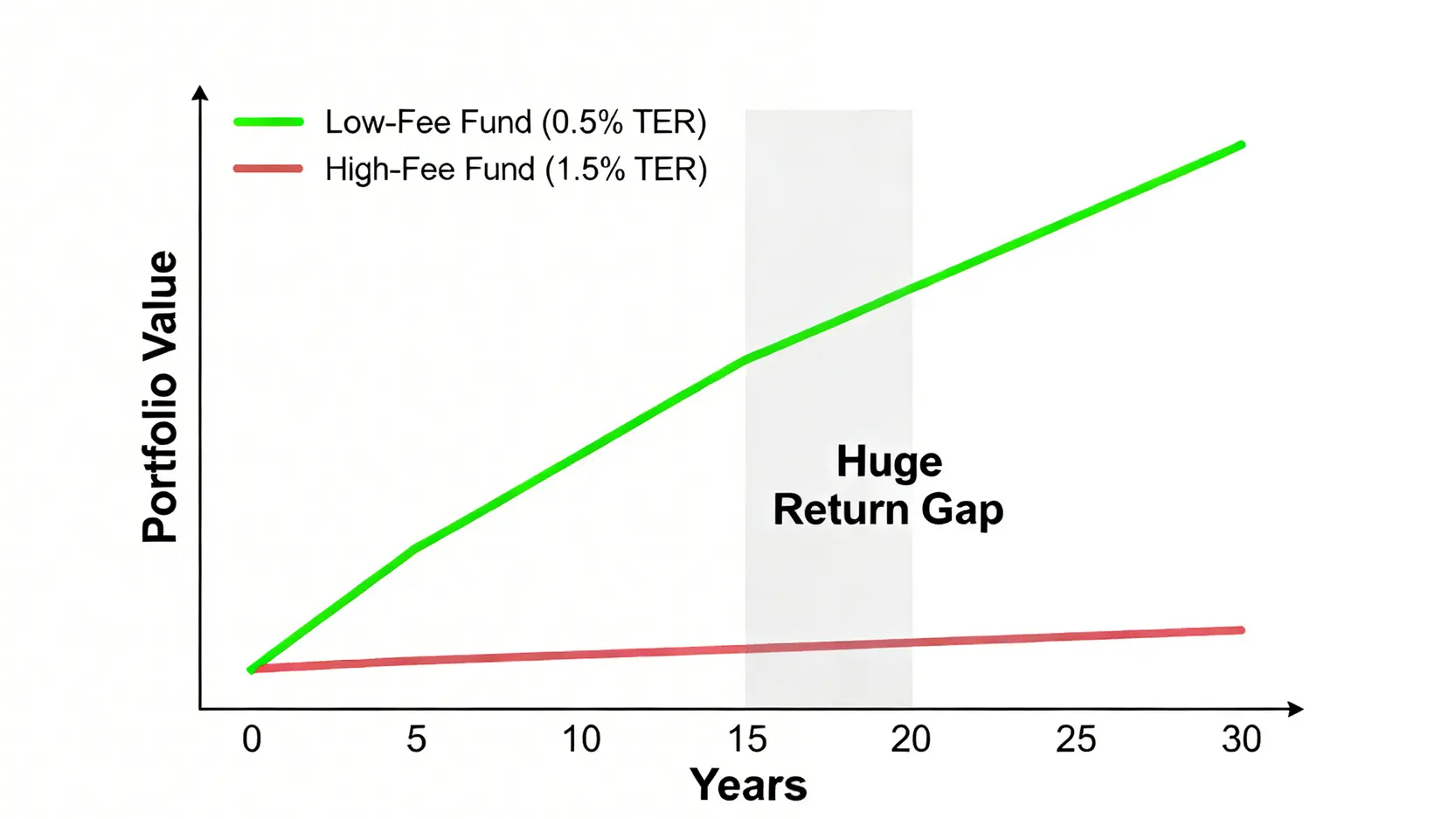
Assume two investors, Xiao Ming and Xiao Hua, each invest HKD 500,000 over a period of 30 years, with an average annual return of 8% (before fees). The only difference is that Xiao Ming chooses a low-cost index fund with a TER of 0.5%, while Xiao Hua selects a more expensive actively managed fund with a TER of 1.5%.

Item Xiao Ming (Low-Cost Fund) Xiao Hua (High-Cost Fund) Difference
Average Annual Gross Return 8% 8%
Total Expense Ratio (TER) 0.5% 1.5% 1.0%
Average Annual Net Return 7.5% 6.5%
Final Asset Value After 30 Years Approximately HKD 4.338 million Approximately HKD 3.312 million Approximately HKD 1.026 million

一張折線圖,比較低收費基金與高收費基金在 30 年內的投資回報增長。圖表顯示,即使只有 1% 的費用差距,最終的資產價值也相差巨大。

A 1% annual fee difference, under the compounding effect over 30 years, is enough to create a return gap of over one million.

With just a 1% difference in annual fees, after 30 years, Xiao Hua’s portfolio ends up with more than HKD 1 million less than Xiao Ming’s. This substantial amount is enough to impact the quality of an entire retirement. This is the most real and harsh effect of costs on long-term investing. Controlling costs directly improves your net returns.


Further Reading (Highly Recommended)

Are Funds Risky? A Complete Guide to Understanding Fund Risk and Return Analysis and RR1–RR5 Ratings


Three Practical Strategies to Easily Identify High-Quality Low-Cost Funds

Now that you understand the importance of controlling fees, the next step is to take action. With a wide array of fund products available in the market, how can you efficiently find low-cost funds that are reasonably priced and high quality? Here are three practical strategies to help you easily complete your selection.

Strategy 1: Actively Managed Funds vs Passive Index Funds (ETFs), Which Is More Cost-Effective?

Fund investments can be broadly divided into two categories: active and passive, with vastly different cost structures.

  • Actively Managed Funds: Managed by fund managers and their teams who actively research and select stocks in an attempt to outperform the market. Due to high research and labor costs, their TER is typically higher, usually ranging from 1.5% to 2.5% or more.
  • Passive Index Funds / ETFs: Instead of trying to beat the market, they aim to replicate the performance of a specific index (such as the Hang Seng Index or the S&P 500). Because the process is relatively simple and follows index components, management costs are very low. Many ETFs have TERs below 0.5%, with some as low as 0.1%.

Extensive academic research and market data show that, over the long term, most actively managed funds fail to consistently outperform their passive counterparts after accounting for higher fees. For most retail investors, choosing low-cost passive index funds or ETFs is the most reliable core strategy for controlling costs and achieving market-average returns. 

Strategy 2: Use the MPFA “Low-Fee Fund List” and Online Comparison Tools

Finding low-cost funds does not have to be difficult. Regulators and financial websites provide useful tools to help investors compare and screen funds.

  • Mandatory Provident Fund Schemes Authority (MPFA): For Hong Kong workers, MPF is a key retirement savings tool. The MPFA website provides a “Low-Fee Fund List” that clearly identifies funds with lower costs across MPF schemes, making it a great starting point to review your portfolio.
  • Fund Comparison Websites: Professional financial platforms (such as Morningstar and Bloomberg) offer powerful screening tools. You can filter by criteria such as “fund category”, “TER below 1%”, or “five-year performance” to quickly narrow down suitable options.


Strategy 3: Learn to Read Fund Factsheets to Identify Key Cost Data

A “fund factsheet”, also called a “fund prospectus” is an official document that every fund must regularly publish. It serves as the fund’s “ID card” and contains all the key information you need to know, especially the details about fees.

When reviewing a factsheet, focus on:

  1. Fees & Charges: Lists all costs, including initial charges, redemption fees, switching fees, and most importantly, the Total Expense Ratio (TER).
  2. Fund Information: Includes inception date and assets under management (AUM). Larger and more established funds often have better efficiency and more competitive costs.
  3. Portfolio: Review the top holdings to understand whether the investment style aligns with your expectations and whether “the fees are justified”.You may refer to how to read fund reports to learn how to analyze fund prospects.

Developing a habit of regularly reviewing fund factsheets ensures you fully understand your cost structure and avoid unknowingly paying excessive “hidden fees”.


Conclusion

In summary, to maximize long-term investment outcomes, controlling investment costs is just as important as pursuing market returns, if not more critical. Gaining a deep understanding of the compounding impact of the fund expense ratio, mastering how fund management fees are calculated, and applying practical strategies for selecting low-cost funds are key steps in transitioning from an average investor to a sophisticated one. Take action now to review your investment portfolio and MPF account, ensuring every dollar is working efficiently for your financial future rather than quietly flowing into fund companies’ pockets. Smart choices can significantly and positively reshape your long-term wealth trajectory. 

FAQ

Q: Does a higher fund expense ratio mean better fund performance?

A: This is a common misconception. A higher expense ratio often indicates an “actively managed fund”, where managers invest more resources in research and analysis to generate excess returns. However, extensive data shows no necessary positive correlation between higher fees and better performance. In many cases, high fees become a drag on long-term returns. When selecting funds, a high TER should not be seen as a sign of quality, but rather as a higher hurdle the fund must overcome.

Q: Besides the expense ratio, what other hidden costs should I watch out for when investing in funds?

A: In addition to operating expenses included in TER, investors may face “transaction costs” that are not reflected in TER. These mainly include:

  • Subscription Fee: A one-time fee paid when purchasing the fund, usually a percentage of the investment amount.
  • Redemption Fee: A fee charged when selling the fund, sometimes applied to discourage short-term withdrawals.
  • Switching Fee: A fee incurred when switching between funds within the same fund company.
  • Bid-Ask Spread: The small difference between buying and selling prices, which can accumulate with frequent trading.

Before investing, always read the fund’s offering documents carefully to understand all potential charges.

Q: How should I compare fund fees across different countries or regions?

A: Fee levels vary across markets due to differences in regulatory environments, competition, and investor behavior. For example, US index funds and ETFs are highly competitive and generally have the lowest fees globally. When comparing, follow the principle of comparing similar categories (such as global large-cap equity funds). Also consider currency and tax differences. Using international fund rating platforms (like Morningstar) allows you to compare funds across regions on a consistent basis.

Q: Can MPF fund fees be negotiated?

A: Individual employees usually cannot negotiate management fees directly with MPF trustees. However, through the “employee choice arrangement” (often referred to as the “MPF semi‑DIY”), you can transfer your own contributions to lower‑fee funds within the same plan or to another plan. Therefore, actively comparing fees and performance across different MPF schemes and making use of your transfer rights is an effective way to indirectly “reduce” costs. Regularly reviewing the list of low‑fee funds published by the MPF Authority is an important step in making informed decisions.

If you liked this article, please share it!

Related Articles

  • Volatility Surface Guide: Skew Trading Strategies
    Practical Applications of Volatility Surfaces: From Options Modeling to Advanced Skew Trading Strategies In options markets, implied volatility is never a flat line. Instead, it forms complex "smile" or "skew" surfaces. For advanced traders, mastering the practical applications of volatility surfaces is equivalent to possessing a lens that reveals market...
    2026 年 6 月 3 日
  • Foreign Capital Flow Model: Track Institutional Money
    Building a Foreign Capital Flow Copy Trading Model: A Stock Market Indicator for Accurately Tracking Institutional Positioning In Asia-Pacific stock markets, foreign capital inflows and outflows often determine the direction of the index. However, simply looking at daily net buy and sell data is no longer enough. Only by building...
    2026 年 6 月 3 日
  • Options Buying Strategies for Extreme Market Risks
    Options Buyer Strategies During Extreme Market Conditions: Black Swan Hedging and Cross-Market Arbitrage During Volatility Surges The most terrifying aspect of financial markets is not a gradual decline, but overnight flash crashes and cross-market capital withdrawals accompanied by volatility surges. In the highly unpredictable global macroeconomic environment of 2026, geopolitical...
    2026 年 6 月 3 日
返回顶部